TL;DR
- A good annual performance review has five sections: a short summary, results against goals, how the work was done, development, and goals and support for the year ahead.
- The three samples here show a complete written review for a strong performer, a solid performer and someone who is struggling. Each uses evidence from across the year and says what happens next.
- The written review records a conversation. It should contain no surprises, rest on examples kept through the year and give as much space to the future as to the past.
Review season arrives, and managers open a blank form for each person in the team. Most know roughly what they want to say. The difficulty is turning a year of impressions into a page that is fair, specific and useful to the person reading it.
This article gives three complete annual performance review samples that you can adapt, for a strong performer, a solid performer and someone who is struggling. It sets out the five sections that every review needs, and shows how to write your own in six steps.
If you want goals, feedback and recognition from the whole year in front of you when you write, see how New Dynamics performance reviews bring that evidence into one place.
About these samples: they were written by the New Dynamics editorial team. The people, the figures and the events are invented. Use them for structure and tone, and write your own content from real evidence.
What an annual performance review is for
Acas describes performance reviews in its guidance on performance management as a chance to discuss what someone is doing well, any areas for improvement, whether they need more support or training, and their career and development objectives. It says that it is a good idea to hold them “at least once a year”, and that it is important “to keep a written record of what is discussed”, shared with the employee afterwards.
The written review is that record. It should summarise conversations that have already happened. If it contains news, something went wrong earlier in the year.
Many organisations now hold lighter reviews through the year as well. The CIPD performance management factsheet describes a shift “away from annual appraisals towards ongoing, flexible review systems”. The annual review still has a job to do: it steps back, looks at the whole year and sets direction for the next.
The five sections of an annual review
- Summary. Three or four sentences that capture the year. Write this last.
- Results against goals. Each goal, what was achieved, and the evidence. Note factors outside the person's control.
- How the work was done. Two or three behaviours that mattered, with examples. Draw on feedback from colleagues where you have it.
- Development. What the person has learned this year, and the one or two areas to work on.
- The year ahead. Draft goals, the support you will provide and any career discussion.
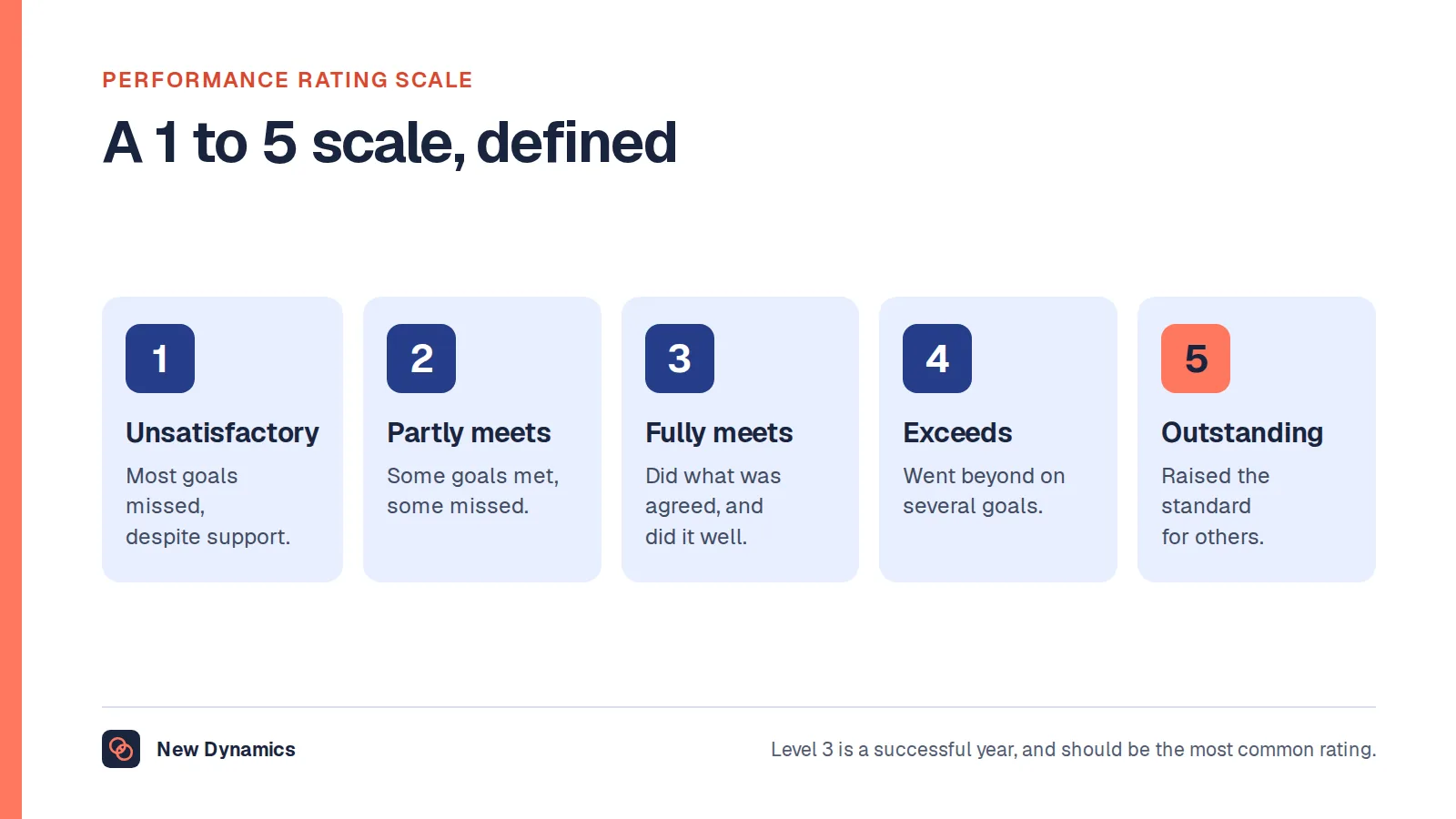
If your organisation uses ratings, add one that follows from the evidence above. Our guide to the performance rating scale gives definitions for each level.

Sample 1: a strong performer
Employee: Asha Patel, Customer Support Team Leader. Review period: January to December. Manager: Tom Reid.
Summary
Asha has had an excellent year. Her team's response times and satisfaction scores both improved markedly, and she did it while developing two people into senior roles. She handled the September outage with a calm that steadied the whole department. Her main opportunity is to take her judgement into wider leadership discussions, where she tends to hold back.
Results against goals
| Goal | Result | Evidence |
|---|---|---|
| Cut median first response from 6 hours to 2 by June | Exceeded: 1.8 hours from May, sustained | Monthly service report |
| Raise customer satisfaction from 4.2 to 4.5 | Met: 4.5 for the final quarter | Survey dashboard |
| Every agent to have a development plan by March | Met: all eight by 28 March | Team records |
| Reduce reopened tickets from 9% to 5% | Partly met: 6.5% | The new knowledge base launched two months late, outside her control |
How the work was done
- Coaching. Asha holds a one-to-one with every agent each month without fail. Two agents told me that her feedback is the most useful they have had. Priya and Dan were both promoted to senior agent this year.
- Calm under pressure. During the outage on 14 September, she set up half-hourly updates for customers and for us, and stayed until the service was restored. Three customers wrote to thank the team.
- Collaboration. Feedback from the product team says that her weekly summary of customer issues is the most useful input they receive.
Development
Asha has grown this year in delegation. In the spring she was still taking the hardest tickets herself, and by autumn she was coaching others through them.
Her development area is influence beyond her team. In leadership meetings she often waits to be asked, and her analysis is usually among the best in the room. I would like her to prepare one contribution for each meeting and make it early.
The year ahead
- Lead the introduction of the new chat channel, with a target of 85% satisfaction in its first quarter.
- Bring reopened tickets down to 5%, now that the knowledge base is live.
- Present the customer insight summary to the leadership team each quarter.
- Support: a place on the leadership programme starting in April, and a mentor from outside the department.
Rating: 4, exceeds expectations.
Employee comments: space for Asha's own view. See our examples of employee comments on a performance review.
Sample 2: a solid, reliable performer
Employee: Ben Carter, Finance Analyst. Review period: January to December. Manager: Fiona Walsh.
Summary
Ben has had a good, steady year. He met his goals, his work is accurate and on time, and colleagues rely on him. He took on the new forecasting tool with little fuss and now supports others with it. To progress, he needs to move from producing the numbers to explaining what they mean.
Results against goals
| Goal | Result | Evidence |
|---|---|---|
| Close the month within 5 working days | Met in 11 of 12 months | Close calendar. March slipped by a day during the system migration |
| Move the team's forecasts onto the new tool by July | Met: completed 30 June | Project log |
| Zero material errors in management accounts | Met | Audit review |
| Present the quarterly variance analysis to budget holders | Partly met: presented twice, with support | My observation |
How the work was done
- Reliability. I cannot recall a deadline that Ben missed without warning me first. When March was at risk, he told me four days ahead.
- Helping others. He wrote the guide to the forecasting tool unprompted, and three colleagues have told me that they use it weekly.
- Communication. His written work is clear. In presentations he reads the figures accurately and is less comfortable saying what they imply or what he recommends.
Development
Ben has become the team's expert on the forecasting tool, which is a real gain since last year.
His development area is commercial interpretation: moving from “costs rose 4%” to “costs rose 4% because of overtime in the warehouse, and I recommend that we review the rota”. This is the main thing between him and a senior analyst role.
The year ahead
- Add a “what this means and what I recommend” section to every monthly report from February.
- Lead the quarterly variance presentation alone from the second quarter.
- Shadow the commercial finance team for two weeks in the spring.
- Support: presentation skills training, and a practice run with me before each of the first two presentations.
Rating: 3, fully meets expectations. This is a successful year, and I want Ben to read it as one.
Sample 3: someone who is struggling
Employee: Chris Doyle, Account Manager. Review period: January to December. Manager: Helen Moss.
Summary
This has been a difficult year for Chris, and this review reflects conversations that we have had since May. Chris's relationships with long-standing clients remain strong, and two renewed early because of them. New business and administration have fallen short of what the role requires, and the improvement plan we agreed in September has produced some progress and not yet enough. I want Chris to succeed, and this review sets out what that will take.
Results against goals
| Goal | Result | Evidence |
|---|---|---|
| Retain 90% of account revenue | Met: 93% | Revenue report |
| Win £200,000 of new business | Not met: £85,000 | Pipeline report. The territory was unchanged from last year |
| Log all client meetings within two days | Not met: about half logged | System audit in June and October |
| Forecast accuracy within 10% | Not met: 25% variance on average | Monthly forecast review |
How the work was done
- Client relationships. Clients like and trust Chris. Hartwell's director told me that Chris is the reason they stayed.
- Follow-through. Proposals have gone out late on at least four occasions that we discussed at the time, in March, June, July and October. Two of those opportunities were lost.
- Response to feedback. Chris has been open in our conversations and has not been defensive. Since September, meeting logs have improved from about 30% to about 70%.
Development
We have discussed whether the balance of the role suits Chris. The relationship side is a clear strength. The prospecting and the administration are not yet at the standard required, and I have not seen the consistent improvement that we agreed in September.
The year ahead
- Continue the improvement plan for a further three months, with fortnightly reviews. The targets are: all meetings logged within two days, proposals sent within five working days and £50,000 of new business in the first quarter.
- Support: weekly pipeline sessions with me, the prospecting course in January and help from the sales coordinator with proposals.
- We will review progress formally at the end of March. If the targets are not met, we will need to consider next steps under the capability procedure. HR has been involved, and Chris has a copy of the procedure.
- We will also discuss whether an account management role focused on existing clients might be a better fit, should one become available.
Rating: 2, partly meets expectations.
A review like this should never be the first time the person hears about the problem. It records a process that began months earlier, names real strengths, is exact about the gaps and is clear about support and consequences. Acas advises employers faced with problems with an employee's performance to “try to understand why”. Our performance improvement guide sets out a fair approach. This is general information, not legal advice.
What the three samples have in common
- Evidence from the whole year, with dates and sources. Notes kept month by month make this possible.
- Results and behaviour, looked at separately.
- Context. Factors outside the person's control are named.
- Strengths in every review, including the hardest one.
- One or two development areas, described as behaviour with an example.
- A future section as full as the past, with support that the manager commits to.
- Plain language. No “synergies”, no “going forward” and no adjectives doing the work of examples.

How to write an annual review in six steps
- Gather the evidence. Goals and results, your notes from the year, feedback from colleagues and customers, and the employee's self-evaluation. Our self-evaluation examples help employees to prepare.
- Go through the goals one by one. Record the result and the evidence before forming an overall view.
- Choose two or three behaviours, with one example for each.
- Write the development and future sections. Be specific about support.
- Write the summary last, and then the rating, if you use one. Check that the rating follows from the evidence.
- Test it. Would the person recognise their year? Is anything a surprise? Would a colleague in a similar position be described in the same way? Our article on unconscious bias examples explains what to look for.
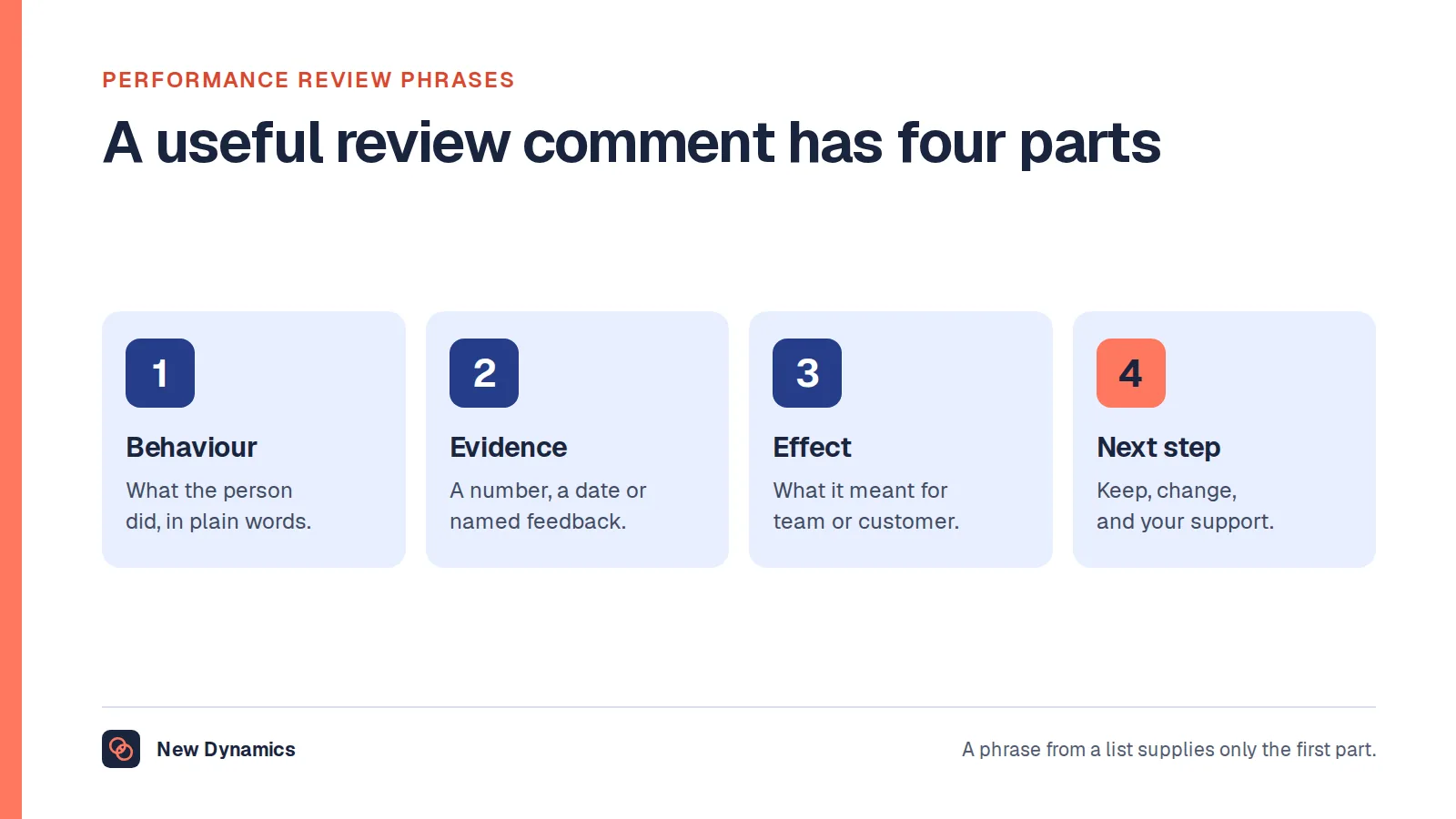
Then hold the conversation, listen, amend the draft if you learn something new and share the final version. Our performance review phrases offer wording for each skill area.

Common mistakes
Recency. Writing about the last six weeks and calling it the year.
Adjectives without examples. “Excellent communicator” tells the person nothing they can repeat.
The surprise. Criticism that appears for the first time in writing.
Copying last year's review. People notice.
Avoiding the hard message. A vague review of a struggling employee is unkind, and it leaves the organisation exposed.
All past and no future. The person reads the review to find out where they stand and what comes next.
Forgetting the employee's voice. Leave space for their comments, and read them.
Frequently asked questions
What should an annual performance review include?
It should include a short summary, results against each goal with evidence, two or three examples of how the work was done, development areas, and goals and support for the year ahead. Add a rating if your organisation uses one, and space for the employee's comments.
How do you write an annual review for an employee?
Gather evidence from the whole year, record the result for each goal, choose two or three behaviours with examples, write the development and future sections, and write the summary last. Check that nothing in it will come as a surprise.
What is an example of a good performance review summary?
“Ben has had a good, steady year. He met his goals, his work is accurate and on time, and colleagues rely on him. To progress, he needs to move from producing the numbers to explaining what they mean.”
How long should an annual performance review be?
One to two pages is usually enough. A short summary, a table of goals and results, a few examples of behaviour and a clear plan for next year are more useful than several pages of general comment.
How do you write a review for an underperforming employee?
Record what has already been discussed, name genuine strengths, state the gaps with dates and evidence, set out the support on offer and explain clearly what happens next. It should never be the first time the person hears about the problem.
Should an annual review include a rating?
That depends on your organisation. A rating can support pay and promotion decisions, but it should follow from the written evidence and be explained. Many organisations define each level in words, and compare ratings between managers before they are final.
Your next step: start next year's notes now
- Create a note for each person you manage.
- Add one dated example this week, good or bad.
- Add to it each month, and after every one-to-one.
- Next year's review will take an hour to write, and it will be fair.
For agendas, questions and a fair process from preparation to follow-up, read and download our performance review guide. The guide is free to read, and the PDF uses our short download form.
Want a year of goals, feedback and recognition ready when you write each review? Book a New Dynamics demo and bring your current form. You can also email contact@new-dynamics.com.