TL;DR
- The charge and the allowance are set in statute. Section 99 of the Finance Act 2016 puts the relevant percentage at 0.5% and the levy allowance at £15,000, which is why the effective threshold is an annual pay bill of £3 million: 0.5% of £3 million is exactly £15,000.
- The money in the apprenticeship service account now has a shorter life. The Apprenticeship technical funding guide from August 2026 states that employers no longer receive the 10% government top-up and that unused funds expire after 12 months rather than 24, with the old 24 month period kept only for funds already in accounts before August 2026.
- The tax is UK wide and the spending service is not. GOV.UK's pay Apprenticeship Levy guidance carries no territorial restriction, while the apprenticeship service pages are marked "Applies to England", and HMRC's Apprenticeship Levy Manual says that "apprenticeships are a devolved policy".
Two questions arrive together in a finance meeting. Are we a levy payer, and if we are, where has the money gone? The first has a clean statutory answer. The second usually does not, because the money is not sitting in a bank account waiting, it is sitting in a government account with an expiry date on it, and that date has recently moved.
This article sets out the apprenticeship levy as the publishers describe it: who pays, what counts as the pay bill, how the 0.5% charge and the £15,000 allowance interact, how groups share one allowance, how you report and pay it, what you can do with the funds, when they disappear, and what happens if you are below the threshold. It is general information about the position in the United Kingdom, not tax or legal advice, and every figure is quoted from the page that publishes it with the date on that page.
The administrative half of this is a training record problem rather than a tax problem. See how New Dynamics onboarding keeps a new starter's checklist, owner and completion dates in one place, which is the same evidence an apprenticeship needs.
What the levy is, in statute
The apprenticeship levy is a tax, not a contribution scheme. Section 98 of the Finance Act 2016 says that "A tax called apprenticeship levy is to be charged in accordance with this Part" and that "The Commissioners are responsible for the collection and management of apprenticeship levy."
Section 99 is the charging provision and it carries both of the numbers everyone argues about. Levy is charged if "a person has a pay bill for a tax year" and "the relevant percentage of that pay bill exceeds the amount of the person's levy allowance (if any) for that tax year". Subsection (5) says "The amount of the levy allowance is £15,000", and subsection (6) says "For the purposes of this section the 'relevant percentage' is 0.5%." The section is marked as extending to the whole of the United Kingdom.
Those two figures have not changed since the levy began. HMRC restates them annually: the guidance on rates and thresholds for employers 2026 to 2027, which says its figures "apply from 6 April 2026 to 5 April 2027", gives the Apprenticeship Levy allowance as £15,000 and the Apprenticeship Levy charge as 0.5%. Because they are set annually in that table, check the table for the year you are in rather than trusting any article, including this one.
For the word itself, and for the completely different American sense of a levy as a seizure, see our post on what a tax levy means.
Who pays, and what counts as the pay bill
GOV.UK's guidance on how to pay Apprenticeship Levy, published 12 December 2016 and last updated 6 April 2026, states that an employer has to pay the levy each month if they "have an annual pay bill of more than £3 million", or "are connected to any companies or charities for Employment Allowance purposes and have a combined annual pay bill of more than £3 million". It adds that "The rules for connected companies are the same for Apprenticeship Levy and Employment Allowance."
The pay bill is a National Insurance concept, not a payroll-cost concept. The same page defines it as "all payments to employees that are subject to employer Class 1 secondary National Insurance contributions such as wages, bonuses and commissions". It must include payments to "all employees earning below the secondary threshold and lower earnings limit", "employees under the age of 21" and "apprentices under the age of 25". It must not include earnings "of employees under the age of 16", "of employees who are not subject to UK National Insurance contributions legislation", or "on which Class 1A National Insurance contributions are payable, such as benefits in kind".
HMRC's Apprenticeship Levy Manual at ALM07000 explains the part that catches people out. Employers pay nothing on the earnings of under 21s and under 25 apprentices up to the relevant upper secondary threshold, because the rate there is 0%, but "Employers remain liable for the payment of Class 1 secondary NICs on those earnings even though the rate at which they would pay is 0%. As a result, these earnings should be included in the pay bill for Apprenticeship Levy purposes." A young workforce reduces your employer National Insurance and does nothing at all to reduce your levy.
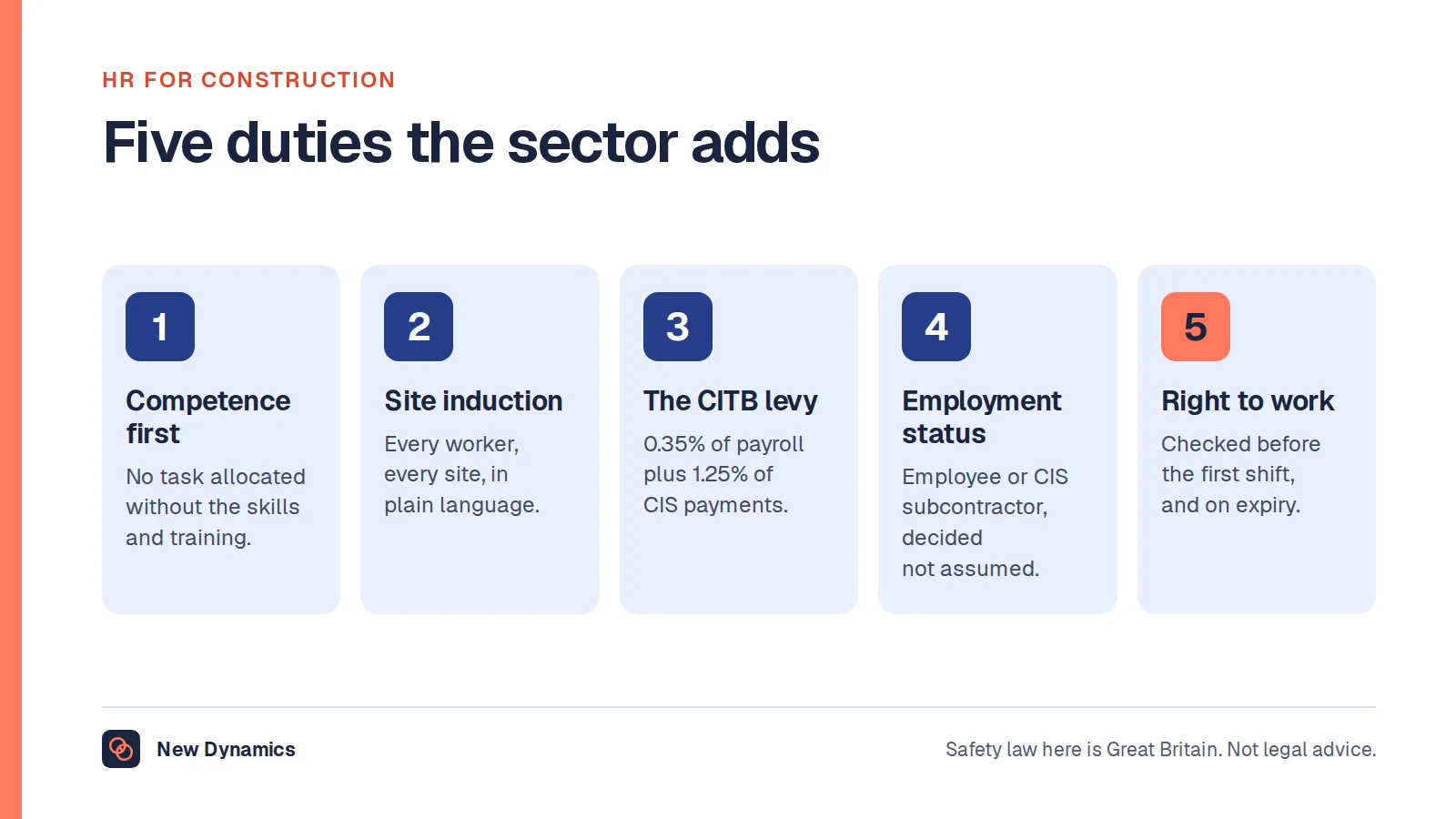
One more trap sits in the same guidance: "You'll still need to pay Apprenticeship Levy even if you already contribute to an industry-wide training levy arrangement (for example the Construction Industry Training Board Levy)." Construction employers pay both. Our post on HR for construction sets out how the CITB levy is assessed under its own Order, which is a separate calculation on a separate base.
Why the threshold is £3 million
Nothing in the legislation says £3 million. The threshold is an arithmetic consequence of the two figures in section 99.
The charge is 0.5% of the pay bill. The allowance reduces what you pay by £15,000 a year. And 0.5% of £3 million is exactly £15,000. So an employer with a pay bill of precisely £3 million has a charge of £15,000 and an allowance of £15,000, and pays nothing. Above that, you pay 0.5% of the excess. A £5 million pay bill produces a charge of £25,000, less the £15,000 allowance, so £10,000 for the year.

The pay Apprenticeship Levy guidance sets out the monthly method. For the first month of the tax year: "Divide your Apprenticeship Levy allowance by 12. Subtract this figure from 0.5% of your monthly pay bill." For later months you work cumulatively: total pay bill for the year to date, total allowance for the year to date, 0.5% of the first less the second, less the levy already paid in the year.
That cumulative shape matters for seasonal businesses. HMRC's manual at ALM08300 says that "Any unused allowance not used in a month will be carried over into the following month", and illustrates it with a seasonal pay bill peaking in months three and four. So allowance does carry forward between months. What it cannot do is cross the year boundary: the guidance is flat that "You cannot carry over any unused allowance into the next tax year."
Connected companies, groups and one allowance between them
A group does not get an allowance each. The guidance states that "Connected companies or charities will only have one £15,000 allowance to share between them", and that the allowance "can be divided between all your PAYE schemes" and "your connected companies or charities".
Section 101 of the Finance Act 2016 sets the mechanics. The members of a company unit "must determine what amount of levy allowance each of them is to be entitled to for the tax year", a member's allowance "may be zero (but not a negative amount)", and the total across the unit "must equal £15,000". Subsection (5) adds that a determination "cannot afterwards be altered by the members concerned". If HMRC sees returns implying a total above £15,000, it can scale each member's figure down itself under subsections (6) to (8).
The practical rules on GOV.UK follow from that. You must report how you divided the allowance the first time you have to pay the levy, and "You cannot change your share of the allowance during the tax year." If you merge, acquire or demerge mid-year, "You must continue to apply the levy allowance that was divided at the beginning of the tax year." Multi-academy trusts get a single £15,000 allowance. Public bodies that are not charities each get a full allowance, because they are not treated as connected, while NHS trusts, Scottish Health Boards, Welsh Local Health Boards and Health and Social Care Trusts in Northern Ireland "are considered to be companies and have to follow the connected companies' rules".
Reporting and paying, and a naming problem worth knowing about
You report the levy through real time information, with everything else. HMRC's manual at ALM09300, citing regulation 147D of the Income Tax (Pay As You Earn) Regulations 2003, says that "Employers must report their levy each month on the Employer Payment Summary (EPS)" and that "Levy payers must send the EPS to HMRC within 14 days after the end of each tax month." Each return carries the tax year, the HMRC office number, the PAYE reference, the accounts office reference, the annual allowance allocated to that PAYE reference, the levy due to date, and the tax month.
Payment rides on the PAYE bill. ALM09400 says employers "must pay the levy each month to HMRC, at the same time as they pay any Income Tax and National Insurance contributions that are due", and should do so "by the 19th (or 22nd if they report electronically) of the following month". Overpayments come back as a PAYE credit, and levy payments "are a deductible expense for Corporation Tax". You must keep the working for at least three years after the tax year it relates to.
Now the naming problem. The pay Apprenticeship Levy page calls the return three different things in one document: "Employment Payment Summary" five times, "Employee Payment Summary" once, and "Employer Payment Summary" once. Only the last is the real name of the RTI submission, and it is the name HMRC's own Apprenticeship Levy Manual uses throughout. If your payroll software offers nothing called an Employment Payment Summary, that is why. Treat the manual as the page that governs here, and tell your software supplier you are looking for the EPS.
Once you start reporting, you keep going. The guidance says that "If you've started paying Apprenticeship Levy, you must continue reporting it until the end of the tax year even if your annual pay bill turns out to be less than £3 million."
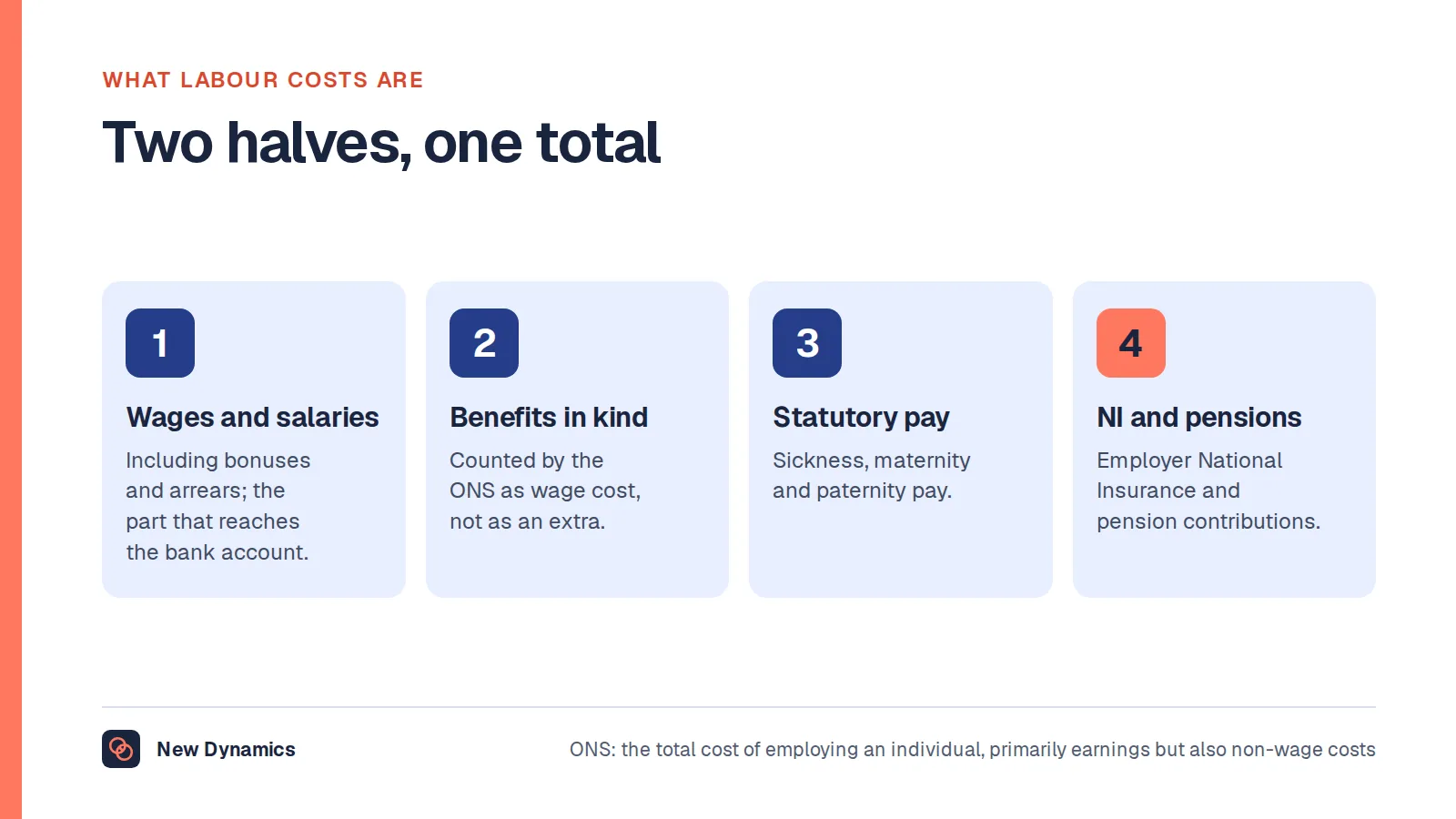
For how this sits beside the rest of the employer's side of payroll, see our post on payroll tax and income tax, and on the wider cost of employing someone, our post on labour costs.
What you get back, and the clock that now runs faster
Paying the levy is one system. Spending it is a different one, run by a different department, and only for England.
GOV.UK's guidance on how to register and use the apprenticeship service as an employer, last updated 1 August 2026 and marked "Applies to England", says the amount entering your account each month is "the levy you declare to HMRC through the PAYE process multiplied by the proportion of your pay bill paid to your workforce who live in England". HMRC calculates that English percentage quarterly from employee home address data on your RTI returns.
Two things changed on 1 August 2026, and both reduce what a levy payer gets. The Apprenticeship technical funding guide from August 2026, updated 29 July 2026, lists among its changes that "employers will no longer receive the 10% government top-up on new funds, and unused funds will expire more quickly, after 12 months instead of 24".

The expiry wording is worth reading closely, because it is the rule employers most often miss and it now bites a year earlier. The same guide says: "After 12 months, any unused funds will be removed from the employer's account (this also applies to any relevant top-ups that were previously added). For example, funds entering an employer's account in September 2026 will become unavailable in September 2027 unless they are spent." It then protects older money: "The 12-month expiry period will only apply to funds entering accounts from August 2026 onwards. Any funds already in employer accounts before that date will continue to follow the 24-month expiry period."
Accounts run first in, first out, "through either payment or expiry", so a payment this month always uses the oldest money. The apprenticeship funding policy paper, updated 29 July 2026, gives the reason without varnish: funds are removed "so levy-paying employers cannot accrue large balances, with the potential to create financial commitments that the government has not planned to meet". It also records that the removal of the 10% top-up and the move to 12 month expiry were announced in the 2025 Autumn Budget.
One naming point. That policy paper says it "only applies to apprenticeships (including foundation apprenticeships) funded by the Growth and Skills Levy", while HMRC's guidance, HMRC's manual and Part 6 of the Finance Act 2016 all still call the tax the Apprenticeship Levy. Same money, two names, depending on whether you are paying it or spending it.
Transfers: up to 50% to another employer
If you cannot use the funds, you can give some of them away rather than let them expire. The guidance on transferring your apprenticeship levy to another business, last updated 1 August 2026, says large employers "can choose to transfer up to 50% of their levy funds each year to other businesses, to pay for their apprenticeship training and assessment", and that "From 22 April 2024, the transfer allowance raised from 25% to 50% of your previous financial year's apprenticeship levy funds".
The allowance is calculated as 50% of the levy declared in the previous tax year with the English percentage applied. Any business can receive a transfer, including other levy payers. Transfers can only fund a new apprenticeship start, and transferred funds can only pay for training and assessment up to the funding band maximum.
Two commitments come with it. A transfer "is not a one-off payment": you are committing to fund that apprenticeship until it completes, and since apprenticeships run for at least 12 months, that usually crosses financial years. And transfer payments leave your account first, "prioritised over payments for your own apprentices".
What the funds can and cannot pay for
Funds pay for training and assessment, and nothing else. The apprenticeship funding rules for 2026 to 2027, which apply to apprenticeships starting between 1 August 2026 and 31 July 2027, require that funds "are only used for the eligible costs listed", up to the funding band maximum. Eligible costs include initial assessment and enrolment, off the job training and tutor costs, learning materials, training for a mandatory qualification, necessary physical materials and consumables, progress reviews, and the administration of arranging the assessment.

The ineligible list is the one to put in front of a budget holder. Paragraph 112 rules out "Apprentice wages (including the costs of backfill), benefits, travel and subsistence costs (including travel to off-the-job training)", "All accommodation costs associated with off-the-job training", "Personal protective clothing / uniforms and safety equipment required by the apprentice to carry out their day-to-day work", recruitment including DBS checks, and "Employer induction activities for the apprentice". Paragraph 119 rules out "Capital purchases including lease agreements". Funding bands themselves "range from £1,500 to £27,000", and any price agreed above the band maximum is paid by the employer in full, directly to the provider.
If you do not pay the levy
Being below £3 million does not shut you out. The apprenticeship service page explains that smaller employers "share the cost of training and assessing their apprentices with the government. This is called 'co-investment'." For apprenticeships starting on or after 1 August 2026, where the apprentice is aged 25 or above, "the government will fund 95% of the training and assessment costs (up to the funding band maximum)" and the employer pays the balance.
Below that age the position is better still. The funding policy paper says that for employers who do not pay the levy, and for levy payers who have exhausted their funds, "government will fund all of the apprenticeship training and assessment costs (up to the funding band maximum)" where the apprentice is aged between 16 and 24 at the start of training. A levy payer who runs out of funds is treated less generously than a non-payer for a 25 year old apprentice: government contributes 75% rather than 95%.
Non-levy employers reserve funds in their apprenticeship service account before an apprentice starts. The reservation period is three months, and since 3 April 2023 small employers "are no longer limited to a maximum of 10 new apprenticeship starts". From 1 October 2026 there is also a hiring payment of up to £2,000, paid in instalments, for a non-levy employer taking on an apprentice aged 16 to 24 who has not been employed by them for more than 90 days before the practical period starts.
Scotland, Wales and Northern Ireland
This is the part that generates the most confused calls, so here is what GOV.UK actually says rather than what people assume.
The tax is UK wide. Section 99 is marked as extending to the United Kingdom, and HMRC's pay Apprenticeship Levy guidance carries no territorial restriction at all. If your pay bill is over £3 million you pay, wherever your employees work.
The spending service is not UK wide. Every apprenticeship service page carries the banner "Applies to England". HMRC's manual at ALM18100 states the position directly: "If the employer is levy-paying, with operations based wholly or partly in Scotland, Wales or Northern Ireland, they will need to engage with the relevant funding authorities for funding apprenticeships located there. As apprenticeships are a devolved policy, authorities in each of the UK nations manage their own apprenticeship programmes, including how funding is spent on apprenticeship training." The funding policy paper puts the same point in one line: "Scotland, Wales and Northern Ireland have their own arrangements for supporting employers to access apprenticeships."
That is why the English percentage exists. Your account is credited with the levy you declared multiplied by the share of your pay bill paid to employees living in England. The rest of your levy is not in an account with your name on it anywhere, and the devolved administrations are where you go for apprenticeship support in the other three nations. GOV.UK does not publish a per nation entitlement for an individual employer, and we will not invent one.
Frequently asked questions
How does the apprenticeship levy work?
It is charged at 0.5% of an employer's annual pay bill, where the pay bill is all payments subject to employer Class 1 secondary National Insurance. Every employer entitled to it has a levy allowance of £15,000 a year, which reduces the amount payable. You report the figure monthly on your Employer Payment Summary and pay it with your PAYE bill. In England, the levy you declare, adjusted for the proportion of your pay bill paid to employees living in England, lands in an apprenticeship service account you spend on apprenticeship training and assessment. General information for the United Kingdom, not tax advice.
What is the apprenticeship levy threshold?
An annual pay bill of more than £3 million, including the combined pay bill of any connected companies or charities. That figure is not in the legislation. It falls out of the arithmetic, because 0.5% of £3 million is exactly the £15,000 levy allowance set by section 99 of the Finance Act 2016, so an employer at precisely £3 million pays nothing.
Do connected companies each get a £15,000 allowance?
No. GOV.UK says connected companies or charities "will only have one £15,000 allowance to share between them", and section 101 of the Finance Act 2016 requires the total across the group to equal £15,000. You decide the split, report it the first time you pay in the tax year, and you cannot change it during that year, even if you merge or demerge.
When do unused apprenticeship levy funds expire?
After 12 months for funds entering an apprenticeship service account from August 2026 onwards. The Apprenticeship technical funding guide from August 2026 gives the example that funds entering in September 2026 "will become unavailable in September 2027 unless they are spent". Funds already in accounts before August 2026 keep the previous 24 month expiry period. Accounts work first in, first out, so each payment uses the oldest money.
Can we use levy funds to pay apprentice wages?
No. The 2026 to 2027 apprenticeship funding rules list apprentice wages, including the cost of backfill, as an ineligible cost, along with benefits, travel and subsistence, accommodation for off the job training, recruitment, employer induction and capital purchases. Funds pay for training and assessment up to the funding band maximum, and the employer pays any agreed price above that band in full.
Do employers in Scotland, Wales and Northern Ireland pay the levy?
Yes. The charge in section 99 of the Finance Act 2016 extends to the United Kingdom and HMRC's guidance sets no territorial limit. What differs is access to the funds. The apprenticeship service pages are marked "Applies to England", and HMRC's Apprenticeship Levy Manual says apprenticeships are a devolved policy, so employers with operations in Scotland, Wales or Northern Ireland deal with the relevant funding authority there.
Your next step: four checks before the next pay run
- Work out the real pay bill. Take earnings subject to employer Class 1 secondary National Insurance across every PAYE scheme and every connected company, including under 21s and under 25 apprentices on whom you pay 0%. Compare the total with £3 million.
- Write down how the £15,000 is split, scheme by scheme and company by company, and check it was reported correctly at the start of the tax year. You cannot change it now, and you want to find a mistake before HMRC does.
- Open the apprenticeship service account and read the expiry dates, not the balance. Money that entered from August 2026 has 12 months. Money that was already there has 24. Spend or transfer in that order.
- If you cannot spend it, pledge it. The transfer allowance is 50% of last year's funds, and a transfer commits you for the whole apprenticeship, so decide early rather than in the month before the money disappears.
For published figures on pay, training and employment across the UK, see the statistics hub. For the argument about whether training is worth doing at all, rather than how it is funded, see our post on why employee training is important.
Treating the levy as a training budget rather than a tax is the practical shift, and our career development guide covers how to decide what to spend it on.
Want apprenticeship milestones, reviews and completion evidence to sit in the same system as everyone else's? Book a New Dynamics demo and bring your current training matrix. You can also email contact@new-dynamics.com.