TL;DR
- Some training is not a business decision at all. Section 2(2)(c) of the Health and Safety at Work etc. Act 1974 puts information, instruction, training and supervision inside the employer's general duty, and regulation 13 of the Management of Health and Safety at Work Regulations 1999 requires adequate health and safety training on recruitment, on exposure to new risks, and during working hours.
- The cost of not training is published and the employer pays a share of it. The Health and Safety Executive puts the total cost to Britain of workplace injury and new cases of work-related ill health at around £22.9 billion for 2023/24, of which £4.3 billion falls on employers.
- No official UK source publishes a retention gain, a productivity gain or a return on training spend. The Employer Skills Survey 2024 measures what employers put in (£53.0 billion, £1,700 per employee, 3.6 days per employee) and what they report as skills gaps, not what training earned back.
Somebody has asked you to justify the training budget, or to explain to a sceptical board why staff should be off the floor for two days. The usual answer is a percentage from a supplier of training, attached to a word like "engagement". It does not survive the first follow-up question, which is always some version of: whose number is that, and would it be true here?
There is a better answer, and it comes in three parts. Part of the question is already settled by law, so it is not a business case at all. Part has a published price, because the state measures what workplace injury and ill health cost and who pays. The rest you argue from your own figures, because no official United Kingdom source publishes a return on training spend.
This article sets out all three, names the publisher and reference period for every figure, and says plainly where the evidence runs out. It is general information about the position in the United Kingdom and not legal advice.
The benefit is only visible if somebody wrote down what should change. See how New Dynamics performance reviews keep the year's goals, feedback and ratings on one record, so "we trained twelve people" can be read next to what those twelve people now do differently.
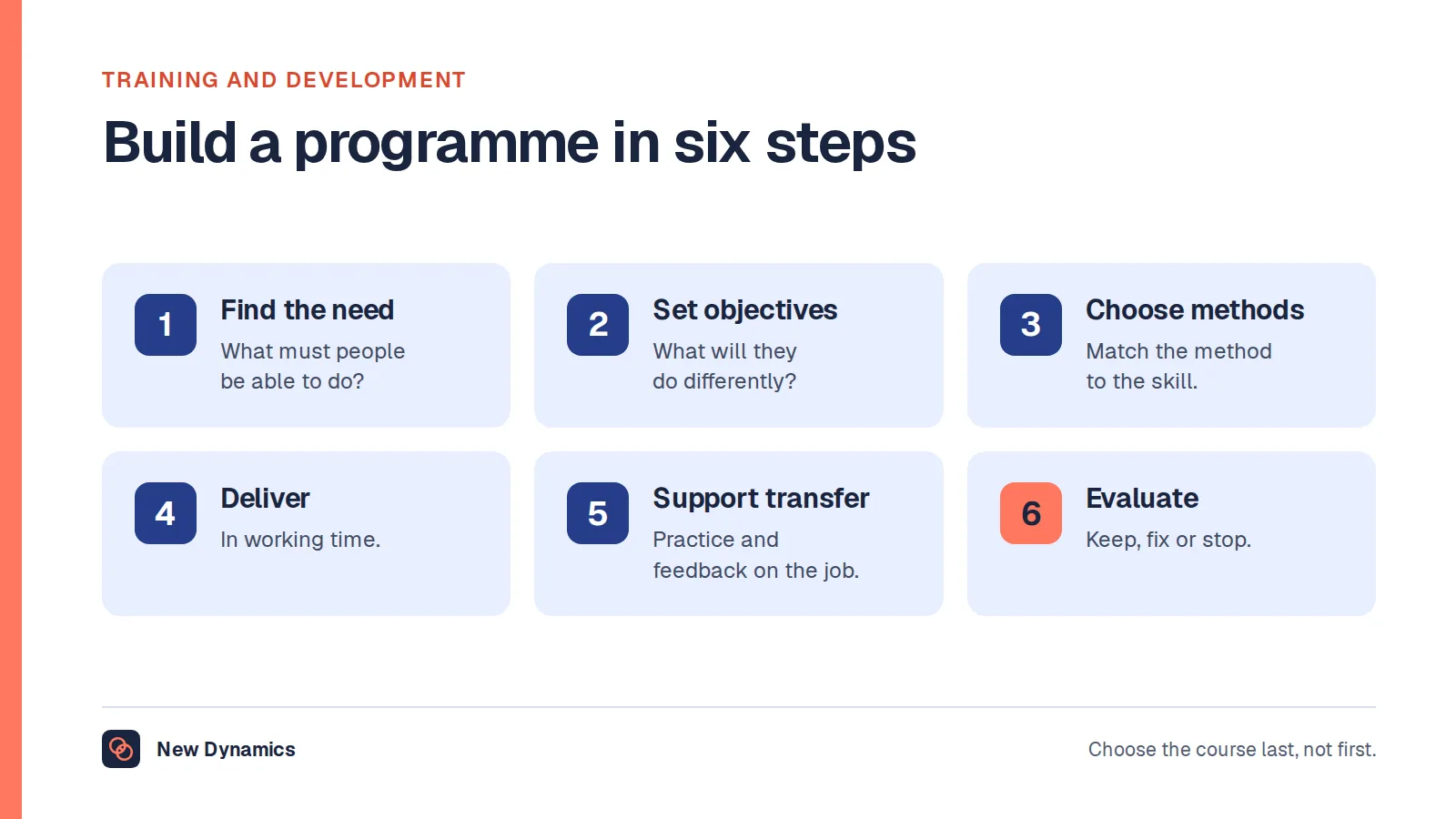
This post answers why training is worth doing. For the programme itself, the ten types and the four levels of evaluation, read employee training and development programs, which covers the how and leaves the why to this one.
The honest short answer
Training matters for three reasons that can be checked, and one that usually cannot.
- Some of it is compulsory. Health and safety training is inside the employer's statutory duty. There is no business case to make, only a register to keep.
- Not training has a published cost. The Health and Safety Executive prices workplace injury and ill health and splits the bill between individuals, employers and government.
- A gap you can count gives you a case. If you can name what people cannot do and what that costs you in rework, escalations or cover, the training argument writes itself.
- The general claim cannot be sourced. Retention, productivity, morale: no official UK statistic attributes a gain in any of them to training. That does not make it false. It makes it yours to demonstrate.

Reason one: part of it is a legal duty, not a benefit
Start by removing the compulsory part from the argument, because arguing a business case for something the law requires wastes everyone's time.
Section 2(2)(c) of the Health and Safety at Work etc. Act 1974 includes within the employer's general duty "the provision of such information, instruction, training and supervision as is necessary to ensure, so far as is reasonably practicable, the health and safety at work of his employees".
Regulation 13(2) of the Management of Health and Safety at Work Regulations 1999 says when: "Every employer shall ensure that his employees are provided with adequate health and safety training" both "on their being recruited into the employer's undertaking" and on exposure to new or increased risks from a change of responsibilities, new or changed work equipment, new technology or a new system of work. Regulation 13(3) adds that the training shall "be repeated periodically where appropriate", shall be adapted to new or changed risks, and shall "take place during working hours".
Two things in that wording are worth reading twice. The triggers are events, not a date in the training calendar: a promotion, a new machine and a new process each start the clock. And "during working hours" settles the argument about whose time it is.
Great Britain is the geography for regulation 13. Northern Ireland has an equivalent general duty in its own 1978 Order. The full register of activity-specific duties, from work equipment to first aid, is set out in our guide to the training plan rather than repeated here.
Reason two: the cost of not training is published
This is the figure most people reaching for a benefits statistic should be using instead, because it is official, dated and split by who pays.
The Health and Safety Executive's page on the costs of workplace injury and ill health states that "The total costs of workplace self-reported injuries and ill health in 2023/24 was £22.9 billion". It splits that total three ways. Individuals bear £13.4 billion, government £5.2 billion, and employers £4.3 billion. Ill health is the larger share of the total at around 72%, or £16.4 billion, against £6.5 billion for injury.
On volumes, the same page says that "an average of 623,000 workers were injured in workplace accidents each year and a further 679,000 workers each year suffered a new case of ill health which they believe to be caused or made worse by their work", based on data from 2022/23 to 2024/25.
Two notes on reference periods, because the page is not consistent with itself. The text dates the injury and ill health counts to 2022/23 to 2024/25, while footnote 1 describes them as an annual average for 2021/22 to 2023/24. The cost total is given as 2023/24 in the text, and footnote 2 describes it as an estimated annual average of 2021/22, 2022/23 and 2023/24 in 2023 prices. Quote whichever you use, and name the period you took with it.
What this does and does not prove is important. It does not prove that training would have prevented a given injury. It does establish that the thing safety training exists to reduce is expensive, that a measurable share of the expense lands on the employer, and that the number comes from the regulator rather than a brochure.
Reason three: your own skills gap is the business case
The Employer Skills Survey is the official picture of what United Kingdom employers train for and how much they spend. The 2024 edition was published on 24 July 2025 by the Department for Education and Skills England, from "a large-scale telephone survey of 22,712 employers across the UK" covering all four nations.
Three findings from it are directly useful in an internal argument.
What employers actually train for. Among employers that trained, the most common type was job specific training (85%), and "Health and safety training was the next most common form of training provided (74%, up from 71% in 2022)". Training in new technology was provided by 50%, up from 46%, and management training by 34%, up from 32%. If someone claims training is a nice-to-have, the published pattern says employers overwhelmingly buy it to let people do the job and to keep them safe.
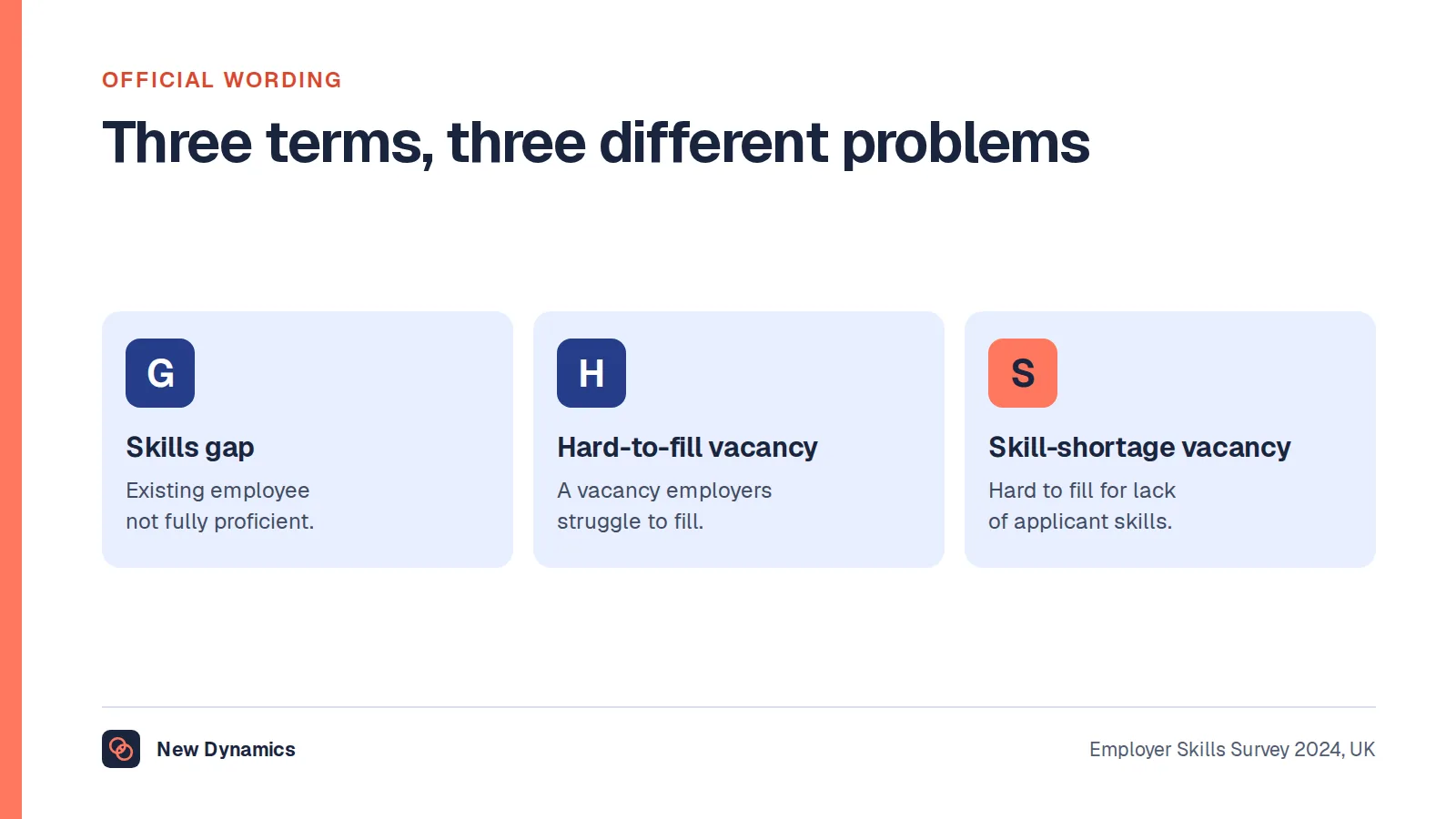
How many employers have a gap they admit to. In 2024, "12% of employers reported skills gaps (at least one member of staff judged to lack full proficiency)", down from 15% in 2022, and 4.0% of the workforce was judged not fully proficient, down from 5.7%. In England alone that was around 1,078,300 employees. The incidence rises steeply with size, "ranging from 4% among the smallest sites with 2 to 4 employees to 38% among those with 100 or more employees".
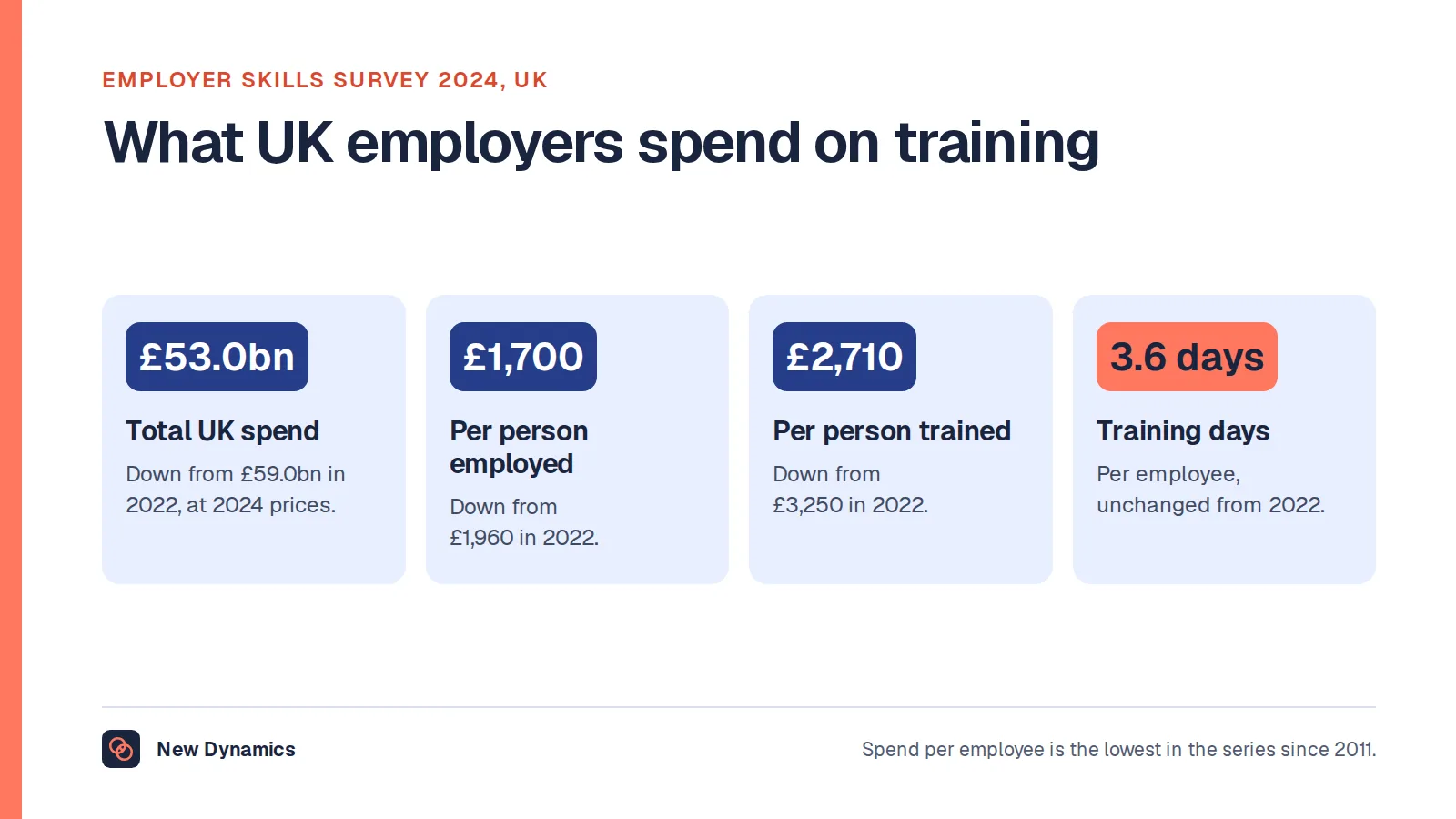
Spend is falling. Total employer expenditure on training over the previous 12 months was £53.0 billion, "equivalent to around £1,700 per person employed, down from around £1,960 in 2022" and a 29.5% decrease since 2011 in real terms. Employers provided 111 million training days, "equivalent to 5.7 days per year per person trained ('per trainee'), and 3.6 days per employee". The proportion of employers that funded or arranged any training was 59%, against 65% to 66% across 2011 to 2019.
For the rest of the series, including the figures by nation, sector and size, see our breakdown of UK learning and development statistics and the wider HR statistics hub.
What the official figures do not say
This is the part that gets skipped, so it is worth being blunt about it.
No official United Kingdom source publishes a retention gain, a productivity gain, an error reduction or any other return attributable to employee training. The Employer Skills Survey is built entirely of inputs and self-reported conditions: vacancies, skills gaps, training incidence, training days and investment. The closest thing to an outcome in the whole release is an employer's own judgement of whether a member of staff is fully proficient, which is an opinion recorded at one site on one day, not a measured return.
So when an article tells you that training raises retention by a specific percentage, the figure is almost always from a vendor survey of self-selected respondents, and it is not a UK official statistic. Capable people do tend to stay where they are learning, and that is a reasonable thing to believe. It is not a thing to cite a number for.
The practical consequence is that the business case has to be local. Pick something you already count: refunds escalated to a duty manager, jobs returned for rework, the same question arriving at the service desk every week, tasks only one person can do. Count it, train, then count it again. One real before-and-after number from your own operation outranks every borrowed statistic, and it is the only kind of evidence a finance director will let you use twice.

What training is worth to the employee, and why that matters to you
Where at least 250 people work, an employee with 26 weeks' service can request time off for training that "must help staff do their job better", under GOV.UK's guide to training and study at work. Time off "is usually unpaid unless the employer agrees to pay it", and the right does not extend to Northern Ireland.
The employer's side of the same guide is the interesting half. It gives the employer 28 days to accept or hold a meeting, and lists the only permitted grounds for turning a request down. The first is that "the training would not benefit their business". The others cover extra cost, meeting customer demands, re-organising work, recruiting cover, damage to quality and business performance, insufficient work at the proposed times, and conflict with planned structural changes.
Read that list as a template. The law already expects an employer to be able to say whether a particular piece of training benefits the business, course by course rather than in general. The same guide confirms the employer "does not have to pay for the training or study" and "can choose to pay all or part of the fees if they think it will benefit the business", which is the decision this article exists to help you make.
You may be paying for training already
If your pay bill is large, some of the training budget is a tax you cannot avoid and can only waste.
GOV.UK's guidance on how to pay Apprenticeship Levy states that the levy "is an amount paid at a rate of 0.5% of an employer's annual pay bill", payable monthly where the employer has "an annual pay bill of more than £3 million", or a combined pay bill above that figure across connected companies or charities. An allowance "reduces the amount of Apprenticeship Levy you have to pay by £15,000 across the year", and the guidance is explicit that "You cannot carry over any unused allowance into the next tax year". Levy payments are a deductible expense for Corporation Tax. A separate GOV.UK page on how to manage apprenticeship funds adds that a levy-paying employer can "transfer a maximum of 50% of your unused annual funds" to other employers.
None of that is an argument for apprenticeships in particular. It is an argument for knowing whether you are a levy payer, because if you are, the question is no longer whether to spend money on training. It is whether the money you are already handing over buys you anything.
Turning a reason into a number
Four steps, none of which need a new system.
- Separate the compulsory from the discretionary. Health and safety and regulated activity go in a register with expiry dates and a named owner. Nothing in that register needs a business case.
- Name one gap in a sentence. Not "improve customer service" but "four of the six evening staff cannot process a refund without the duty manager". Our skills gap analysis guide sets out a method for a whole function.
- Write the benefit as a figure you already collect. Escalations per week, rework rate, time to competence for a new starter, cover shifts bought in. Record today's value before you book anything.
- Check it twice, at six weeks and at six months. The second check is the one that tells you whether the behaviour stuck or the old workaround came back.
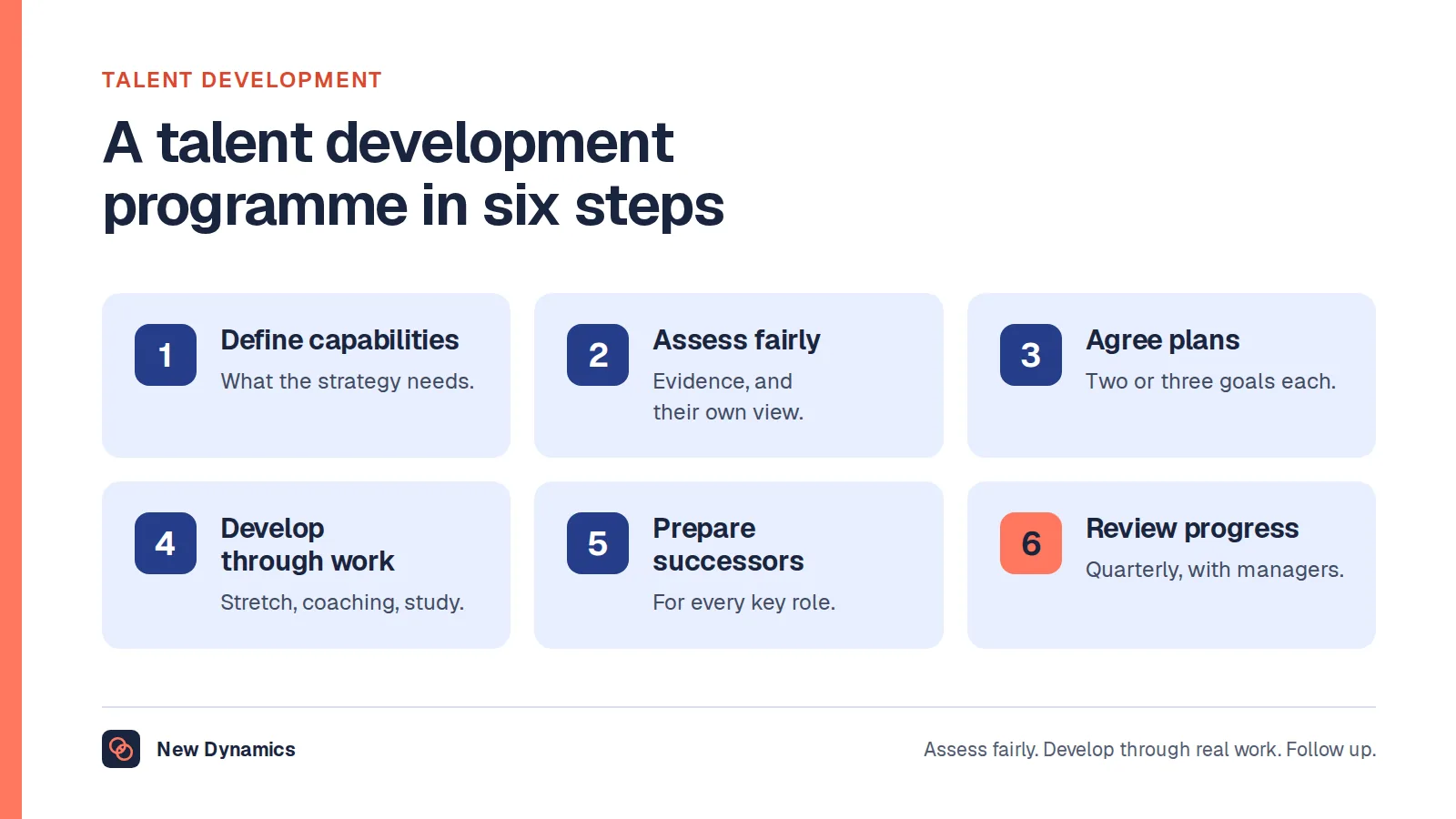
Two posts carry this further. For the mechanics of the document and the statutory register, read our training plan guide. For connecting all of this to careers and succession rather than single courses, see talent development.
Frequently asked questions
Why is employee training important?
For three reasons that can be checked. Some of it is required by law: section 2(2)(c) of the Health and Safety at Work etc. Act 1974 and regulation 13 of the Management of Health and Safety at Work Regulations 1999 put health and safety training inside the employer's duty. The cost of not training is published, with HSE putting the total cost of workplace injury and ill health at around £22.9 billion in 2023/24. And a skills gap you can count gives you a local business case. Claims about retention and productivity are not published by any official UK source.
Is there a legal duty to train staff in the UK?
There is no general duty to train employees in their job skills. The duties attach to health and safety and to particular activities and equipment. Regulation 13 of the Management of Health and Safety at Work Regulations 1999 requires adequate health and safety training on recruitment, on exposure to new or increased risks, repeated periodically where appropriate, and during working hours. Northern Ireland has an equivalent general duty in its own 1978 Order. This is general information, not legal advice.
Does training improve employee retention?
No official United Kingdom statistic attributes a retention gain to training. The Employer Skills Survey measures training incidence, days and spend, not outcomes, so any specific percentage you see quoted comes from a commercial survey rather than an official release. The honest approach is to measure your own leaver rate among trained and untrained groups over a year and quote that instead.
How much do UK employers spend on training?
The Employer Skills Survey 2024, published on 24 July 2025 by the Department for Education and Skills England, puts total employer expenditure over the previous 12 months at £53.0 billion, equivalent to around £1,700 per person employed, down from around £1,960 in 2022. Employers provided 111 million training days, or 3.6 days per employee, and 59% of employers had funded or arranged any training.
What do employers train staff in most often?
Among employers that trained in 2024, job specific training was the most common type at 85%, followed by health and safety training at 74%, up from 71% in 2022. Half provided training in new technology and about a third provided management training. The pattern says most training money goes on letting people do the job and keeping them safe.
Can an employee demand training?
An employee cannot demand it, but in an organisation where at least 250 people work, an employee with at least 26 weeks' service can request time off for training that would help them do their job better. GOV.UK says time off "is usually unpaid unless the employer agrees to pay it", and the employer can refuse only on the listed grounds, the first being that the training would not benefit the business.
Your next step: price one gap
- Pick the single thing your team most often gets wrong or escalates.
- Write today's number for it, from a report you already run.
- Decide what people would have to be able to do for that number to move.
- Train that, then read the number again at six weeks and six months.
For a structured way to connect this to careers rather than courses, read and download our career development guide. The guide is free to read, and the PDF uses our short download form.
Want goals, feedback and review records in one place, so the effect of training shows up next to the work? Book a New Dynamics demo and bring one gap you are trying to close. You can also email contact@new-dynamics.com.