TL;DR
- Construction turns training and competence into law rather than budget. Regulation 15(7) of the Construction (Design and Management) Regulations 2015 says a contractor "must not employ or appoint a person to work on a construction site unless that person has, or is in the process of obtaining, the necessary skills, knowledge, training and experience to carry out the tasks allocated to that person". Section 2(2)(c) of the Health and Safety at Work etc. Act 1974 already requires "the provision of such information, instruction, training and supervision as is necessary".
- The sector has its own training tax. The Industrial Training Levy (Construction Industry Training Board) Order 2026, made on 24 March 2026, assesses the CITB levy as 0.35% of emoluments paid to employees plus 1.25% of the relevant part of contract payments made to subcontractors. An employer is exempt below £150,000 of the two combined, and pays half between £150,000 and £500,000.
- The payroll question is a status question. GOV.UK tells CIS contractors: "You must check if you should employ the person instead of subcontracting the work. You may get a penalty if they should be an employee instead", and on the monthly return "you must declare that the subcontractors listed are not employees", with a penalty of up to £3,000 for giving the wrong employment status. This is general information for the United Kingdom, not legal advice.
Most HR advice assumes a workforce that is employed, on one site, with one email address each. Construction has none of that. A contractor may have two hundred people on its payroll and six hundred on its sites, arriving through three subcontractors and an agency, and the law still attaches duties to the business at the top of the chain. HR for construction is ordinary HR plus a set of statutory obligations that no office employer has to think about.
This article sets out those obligations from the sources that publish them, then what each one changes in HR practice: competence and training duties, the CITB levy, the employee against subcontractor decision, right to work checks through a subcontracted supply chain, inductions for a workforce that changes weekly, records, and travel and accommodation payments. Inductions are the first of those, and the one HR usually controls: see how New Dynamics onboarding gives every new starter the same checklist and shows who has finished it, including the people who never come into an office. This is general information about the position in the United Kingdom, and where safety law is named it is the law of Great Britain. It is not legal advice and no substitute for competent safety advice.
Why construction HR is a different job
Start with the figures, because they explain why the rules exist. HSE's report Construction statistics in Great Britain, 2025, published on 20 November 2025 with data up to March 2025, records that the sector "accounts for 6% of the workforce in Great Britain", citing the Annual Population Survey, 2024.
Against that 6%:
- "There were 35 fatal injuries to workers in 2024/25p", compared with "the annual average number of 40 fatalities for 2020/21-2024/25p". The report says "p is used in this document to indicate provisional figures due to be finalised in 2026".
- "The fatal injury rate in Construction is 1.92 per 100,000 workers", which "is around 4.8 times the all industry rate", averaged over 2020/21 to 2024/25p.
- "There were an estimated 50,000 workers who reported sustaining a workplace non-fatal injury", and "29% of these workplace non-fatal injuries resulted in absence from work of over 7 days", on a Labour Force Survey average estimate over 2022/23 to 2024/25.
- "There were an estimated 79,000 workers suffering from work-related ill health (new or long-standing)" over the same three-year period. Within that, HSE reports "an estimated 41,000 workers suffering from a work-related musculoskeletal disorder (new or long-standing), 53% of all ill health in this sector", and "an estimated 15,000 workers suffering from work-related stress, depression or anxiety (new or long-standing), 19% of all ill health in this sector".
- "In Construction around 2.2 million working days (full-day equivalent) were lost each year", split "Workplace injury (18%)" and "Work-related illness (82%)".
- The economic cost: "The total cost in 2023/24 is estimated at £1.4 billion, (95% confidence interval £1,022M - £1,836M)", which "accounts for 6% of the total cost of all work-related ill health and injury (£22.9 billion)".
These are national survey and reporting estimates with confidence intervals, so they tell you where the sector's risk sits, not what your own site's numbers should be. For the figures we use elsewhere, each with its reference period named, see our HR statistics hub.

Training and competence are legal duties, not a development budget
Regulation 7 of the Management of Health and Safety at Work Regulations 1999 is also what creates the role that usually owns this work. What it covers, and what it cannot take off the employer, is in the HSE manager job description.
In most sectors training sits in an HR plan. In construction it sits in two pieces of legislation, and the wording is about appointment, not development.
The Act. Section 2(1) of the Health and Safety at Work etc. Act 1974 places on "every employer" the duty "to ensure, so far as is reasonably practicable, the health, safety and welfare at work of all his employees". Section 2(2) then lists what that extends to, including at paragraph (c) "the provision of such information, instruction, training and supervision as is necessary to ensure, so far as is reasonably practicable, the health and safety at work of his employees". Section 2(3) adds the written statement: every employer must "prepare and as often as may be appropriate revise a written statement of his general policy with respect to the health and safety at work of his employees", and "bring the statement and any revision of it to the notice of all of his employees". Bringing it to the notice of a workforce spread across sites is an HR distribution problem with a legal deadline attached to it.
The regulations. The Construction (Design and Management) Regulations 2015 go further and put a condition on hiring. Regulation 15(7) reads: "A contractor must not employ or appoint a person to work on a construction site unless that person has, or is in the process of obtaining, the necessary skills, knowledge, training and experience to carry out the tasks allocated to that person in a manner that secures the health and safety of any person working on the construction site." Regulation 15(8) requires the contractor to "provide each worker under their control with appropriate supervision, instructions and information".
Regulation 8(1) applies the same test to the organisations themselves: a designer or contractor "must have the skills, knowledge and experience, and, if they are an organisation, the organisational capability, necessary to fulfil the role that they are appointed to undertake". Regulation 8(2) says they "must not accept an appointment" unless they do, and regulation 8(3) puts a duty on whoever appoints them to "take reasonable steps to satisfy themselves" that they do. Regulation 8(6) is the one HR teams most often miss: "Any person who is required by these Regulations to provide information or instruction must ensure the information or instruction is comprehensible and provided as soon as is practicable."
What that means in practice is that a training matrix is evidence, not administration. If a card, ticket or certificate has expired, the question is not whether someone has missed a development objective, it is whether the person should have been allocated that task at all. The duties that sit above this, on the principal contractor, are set out in our post on the construction site manager role.
The CITB levy, and how it is assessed
Construction pays a sector training levy that no other industry in the same form does, and HR is usually the function that has to explain the bill.
The current instrument is the Industrial Training Levy (Construction Industry Training Board) Order 2026, made on 24 March 2026 and coming into force on 25 March 2026. Article 1(2) says it "extends to England and Wales and Scotland". It gives effect to levy proposals submitted by the Construction Industry Training Board under section 11 of the Industrial Training Act 1982.
Article 7(1) sets the assessment. The amount for each construction establishment is the total of two parts:
- "A is an amount equal to 0.35% of all emoluments which have been paid or are payable by the employer to, or in respect of, persons employed by the employer at or from the construction establishment during the relevant base period"
- "B is an amount equal to 1.25% of the aggregate of the relevant part of all contract payments made by the employer to, or in respect of, sub-contractors of the employer carrying out operations or furnishing labour at or in connection with the construction establishment during the relevant base period"
"Emoluments" is defined in article 2(1) as "salaries, fees and wages excluding fees which are paid to a company director who is remunerated solely by fees", plus "any gratuity or other profit or incidental benefit of any kind obtained by an employee, if it is money or money's worth, other than pension contributions", plus "anything else that constitutes, or is intended to constitute, earnings of the relevant employment". Contract payment and sub-contractor take their meaning from sections 60 and 58 of the Finance Act 2004, which is the Construction Industry Scheme legislation. So the levy is assessed on your payroll and on your CIS payments, at different rates.
Two thresholds follow. Under article 8(2), the total is "reduced by 50%" where the combined emoluments and relevant contract payments are "£150,000 or more and less than £500,000". Under article 9(1), an employer is exempt where that combined figure "is less than £150,000", and article 9(2) exempts "a body of persons or trust established for charitable purposes only".
The base periods are fixed in article 4: twelve months beginning with 6 April 2024 for the first levy period, 6 April 2025 for the second, and 6 April 2026 for the third. Payment is due, under article 14(1), "on the last day of a period of one month beginning with the date of service of the assessment notice", and article 15 gives an employer one month from that service to appeal to an employment tribunal. That appeal route is worth knowing, because the assessment is often built on figures HR and payroll supplied.
Employee or CIS subcontractor: the decision that defines the payroll
This is the question that distinguishes construction payroll from every other kind, and GOV.UK puts the burden squarely on the contractor.
The scheme itself: GOV.UK's page on the Construction Industry Scheme explains that "contractors deduct money from a subcontractor's payments and pass it to HM Revenue and Customs (HMRC)", that "the deductions count as advance payments towards the subcontractor's tax and National Insurance", and that "contractors must register for the scheme". Registration reaches beyond builders: it is required where "your business does not do construction work but you have spent more than £3 million on construction in the 12 months since you made your first payment".
Then the status rule. Among the rules you must follow, GOV.UK's guidance on what you must do as a CIS contractor states: "You must check if you should employ the person instead of subcontracting the work. You may get a penalty if they should be an employee instead." On filing, it says "On your return, you must declare that the subcontractors listed are not employees", and warns: "You could get a penalty of up to £3,000 if you give the wrong employment status for a subcontractor on your monthly return."
The mechanics around that decision:
- Deduction rates are "20% for registered subcontractors", "30% for unregistered subcontractors" and "0% if the subcontractor has 'gross payment' status".
- Before paying a new subcontractor you must "verify" them with HMRC, and "You must also verify subcontractors you've used before if you have not included them on a CIS return in the current or last 2 tax years".
- Where deductions are made, "you must give the subcontractor a payment and deduction statement within 14 days of the end of each tax month", and monthly returns must reach HMRC "by the 19th of every month following the last tax month".
- Records of gross payments and deductions must be kept "for at least 3 years after the end of the tax year they relate to", with a fine of "up to £3,000 if you cannot show your CIS records when asked by HMRC".
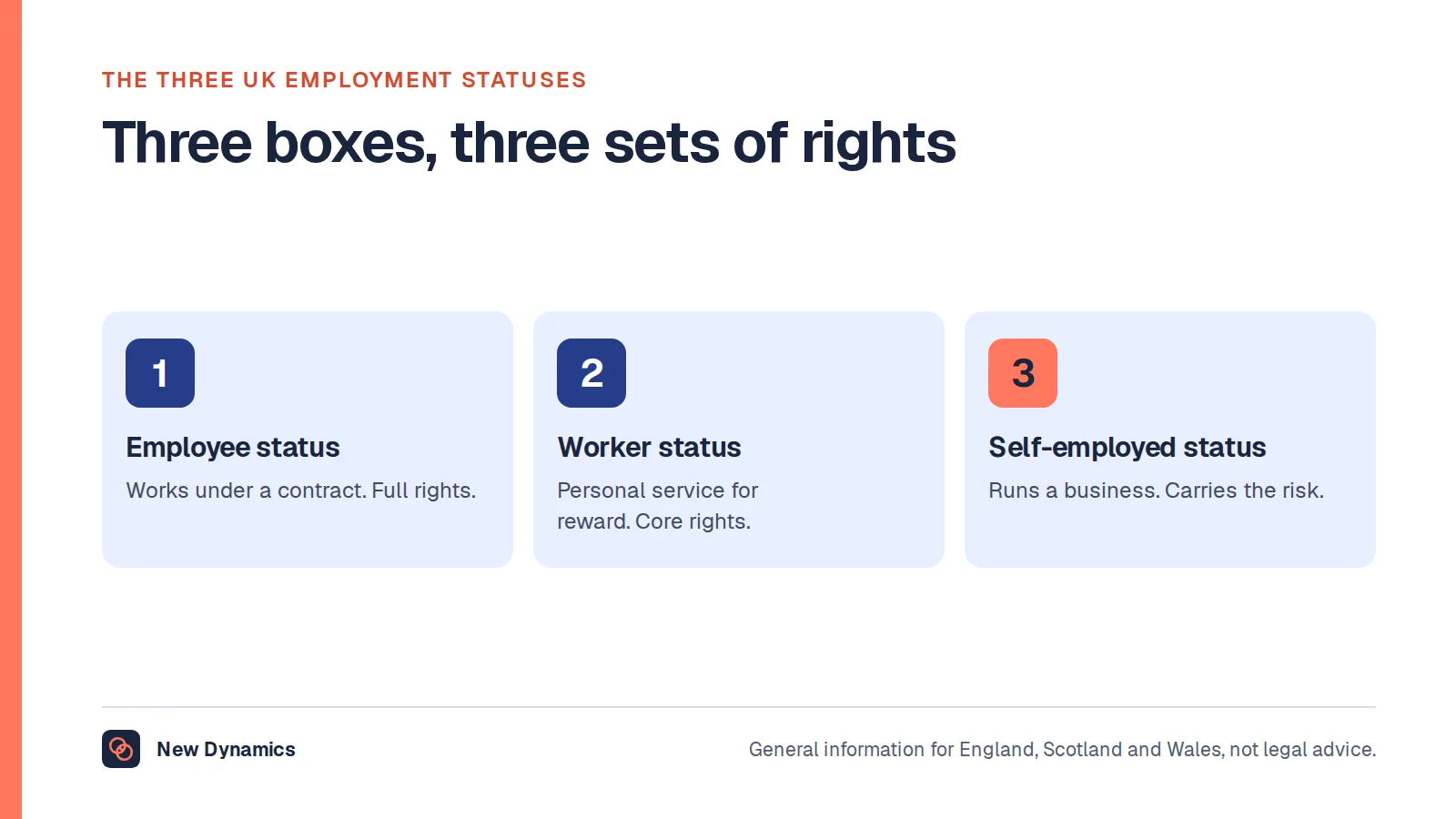
Status is also two questions, not one. GOV.UK's employment status guidance says plainly: "A person may be an employee in employment law but have a different status for tax purposes. Employers must work out each worker's status in both employment law and tax law." On the self-employed page it adds that "Individuals and their employers may have to pay unpaid tax and penalties, or lose entitlement to benefits, if their employment status is wrong", and notes "There are special rules for businesses supplying workers, for example an employment agency". Our post on employment status covers the categories in full.
The practical consequence for HR is that the status decision cannot be left to commercial teams agreeing a day rate. Someone has to hold the evidence of how the engagement actually works, because that is what a later challenge looks at.
Right to work checks when the labour arrives through other people
Construction buys labour through subcontractors, labour-only gangs and agencies, which makes it easy to assume that someone else did the check. The penalty does not move with that assumption.
GOV.UK's guidance on checking a job applicant's right to work states: "You must check that a job applicant is allowed to work for you in the UK before you employ them." The route is an online check with a share code, a check of original documents, or an identity service provider offering Identity Document Validation Technology. The guidance notes that "British and Irish citizens cannot get an online share code to prove their right to work", so their original documents are checked instead, and that "You can no longer accept biometric residence cards or permits". For a document check you must "Check that the documents are valid with the applicant present" and "Make and keep copies of the documents and record the date you made the check". Where a right to work is time-limited, "you'll need to check their documents again when it's due to expire".
The cost of getting it wrong is published. GOV.UK's page on penalties for employing illegal workers says you might "have to pay a civil penalty (fine) of up to £60,000 for each illegal worker", with 28 days to respond to a civil penalty notice, and that your business's details "may be published by Immigration Enforcement". Knowingly employing someone without the right to work carries up to "5 years" in jail and "an unlimited fine". It also states the defence: "You will not have to pay the civil penalty if you can show you made the correct right to work checks."
Two things follow for a construction HR function. First, the check belongs to whoever employs the person, so a subcontractor's workforce is that subcontractor's duty and your assurance question, written into the contract and sampled rather than assumed. Second, expiry dates need to be tracked as diligently as card renewals, because a lapsed permission on a long project is a check that was once correct and no longer is.
Inductions for a site population that changes every week
Site induction is not a cultural nicety in construction; it is a requirement, and it falls due every time the gate population changes.
CDM 2015 requires it twice over. Regulation 15(9) says the information a contractor provides must include "a suitable site induction, where not already provided by the principal contractor", together with "the procedures to be followed in the event of serious and imminent danger to health and safety" and information on risks identified by risk assessment or "arising out of the conduct of another contractor's undertaking". The parallel duty on the principal contractor, under regulation 13(4), is covered in our site manager post.
HSE's guidance on site rules and induction states that "Every site worker must be given a suitable site induction" and that it "should be site specific and highlight any particular risks ... and control measures that those working on the project need to know about". It also says site rules "should be clear and easily understandable", with translation considered where there are non-English speaking workers on site. Regulation 8(6) of CDM 2015 says the same thing in legal terms: information and instruction must be "comprehensible".
Designing that around high turnover means accepting that the induction is run continuously, not in cohorts. Two practical tests: can a supervisor see today, on a phone, which of the people in front of them has been inducted onto this site, and does a worker who moves between three of your sites in a month get three site-specific inductions rather than one generic one. Our employee onboarding checklist covers the general version of the same discipline.

Records, when the workforce moves
A construction HR record set has to answer questions on the day they are asked, usually by someone standing on a site. Who is on this site today, and for whom do they work. Is this person's card, ticket or certificate current. When were they inducted, onto which site, and in which language. Did we check their right to work, when, and where is the copy. Is this person an employee or a CIS subcontractor, and what evidence supports that. What was reported, to whom, and when.
Only some of those have a published retention period. CIS records run for "at least 3 years after the end of the tax year they relate to", as above. We are not aware of an official UK source that publishes an average labour turnover rate for the construction sector, or an average length of time a worker stays on one site, so we do not quote one. If you need those numbers, they have to come from your own access control and payroll data. Our post on employee records retention covers the general rules, and the sector view sits on our construction and property page.
Travel and accommodation payments
Site work means travel, and sometimes nights away, which pulls HR into tax rules that office employers rarely meet.
The 24-month rule. A workplace an employee attends temporarily can be a temporary workplace, which changes how travel to it is treated. HMRC's Employment Income Manual at EIM32080, on sections 339(5) and (6) of the Income Tax (Earnings and Pensions) Act 2003, explains the limit: there is "a further rule that prevents a workplace from being a temporary workplace where an employee attends it in the course of a period of continuous work that lasts, or is likely to last, more than 24 months. Where this further rule applies the workplace will be a permanent workplace." On the proportion, HMRC says "you should treat duties as performed to a significant extent at any workplace if the employee spends 40% or more of his or her working time at that place", and that "The test is whether the employee has spent, or is likely to spend, 40% or more of his or her working time at that particular workplace over a period that lasts, or is likely to last, more than 24 months". It adds that the rule works on expectation: "The effect of the rule is not altered where the expectation does not match the outcome", but "can be altered when there is a change of expectation". On a long project that matters, because the day the programme is extended past two years is a payroll event as well as a commercial one.
Accommodation provided by the employer. Where the business houses workers, the National Minimum Wage rules apply an offset rather than ignoring it. GOV.UK's page on National Minimum Wage and Living Wage: accommodation states that "Accommodation provided by an employer can be taken into account when calculating the National Minimum Wage or National Living Wage" and that "No other kind of company benefit (such as food, a car, childcare vouchers) counts towards the minimum wage". The rates "are set in April each year", and "From April 2026, the rates are: £11.10 (daily rate), £77.70 (weekly rate)". For comparison, the same page lists £10.66 daily and £74.62 weekly for 2025, and £9.99 and £69.93 for 2024.
Those two rules decide whether a travel payment is reimbursement or pay, and whether a bed in a shared house quietly takes someone below the minimum wage. Both are worth settling before a project starts rather than at the first audit.
What this adds up to
The sequence a construction HR function has to be able to evidence is short, and it is the same on every project. Confirm competence before the person is allocated the task. Decide status before the first payment. Check the right to work before the first shift. Induct onto this site, in language the person understands. Keep the record where a supervisor can reach it. Then report what happens honestly, which is the one part no system can do for you: HSE itself notes that non-fatal injuries "are substantially under-reported, especially for the self-employed", and a workforce that is paid by the day has every incentive to stay quiet.
Frequently asked questions
Is HR in construction different from HR in other sectors?
Yes, in the duties attached to it rather than in the discipline itself. Construction adds competence and induction duties under the Construction (Design and Management) Regulations 2015, the training duty in section 2(2)(c) of the Health and Safety at Work etc. Act 1974, the CITB levy, and the employment status decision under the Construction Industry Scheme. The rest of HR, from pay to performance, works as it does elsewhere.
How is the CITB levy calculated?
Under article 7(1) of the Industrial Training Levy (Construction Industry Training Board) Order 2026, the assessment for each construction establishment is 0.35% of emoluments paid to people employed at or from it, plus 1.25% of the relevant part of contract payments made to subcontractors. The total is reduced by 50% where the two combined are £150,000 or more and less than £500,000, and an employer is exempt where the combined figure is less than £150,000. The Order extends to England and Wales and Scotland.
Can a construction worker be self-employed on our site?
They can, but the decision has to be made rather than assumed. GOV.UK tells CIS contractors: "You must check if you should employ the person instead of subcontracting the work. You may get a penalty if they should be an employee instead." It also says a person may be an employee in employment law and have a different status for tax purposes, so employers must work out both. Giving the wrong employment status on a monthly CIS return carries a penalty of up to £3,000.
Who checks the right to work when labour comes through a subcontractor?
The duty sits with whoever employs the person. GOV.UK states that you must check a job applicant is allowed to work for you before you employ them, and that the civil penalty is up to £60,000 for each illegal worker where the correct check was not made. For a subcontractor's own workforce, that is the subcontractor's duty, which leaves you with a contractual and assurance question rather than nothing to do.
Does every worker need a site induction?
HSE's guidance on site rules and induction says that every site worker must be given a suitable site induction, and that it should be site specific and highlight the particular risks and control measures for that project. CDM 2015 requires a contractor to provide one where the principal contractor has not, and requires information and instruction to be comprehensible. On a site with weekly turnover that means running induction continuously rather than in cohorts.
How long do we keep construction HR records?
It depends on the record. CIS records of gross payments and deductions must be kept for at least 3 years after the end of the tax year they relate to, and HMRC can fine up to £3,000 where they cannot be produced. Other records follow the general rules, which our post on employee records retention covers. We are not aware of an official UK source that publishes a retention period specific to site inductions, so firms usually keep them for the life of the project and beyond.
Next steps
Pick the one of these five that you could not evidence this afternoon, and fix that first: competence before appointment, status before payment, right to work before the first shift, induction onto this site, or the record a supervisor can reach. For the hiring process around it, read our recruitment and selection guide, and for the sector view of appraisals across site and office teams, our construction and property page.
If the gap is that site teams never finish the process because it lives on paper, Book a New Dynamics demo and we will show you the same cycle running for people without a desk.