TL;DR
- In the United States, income tax withholding and payroll tax are separate things. Income tax comes out of the worker's pay using their Form W-4. The FICA taxes, Social Security and Medicare, are charged on both sides, and the IRS gives 6.2% and 1.45% for the employer and the same again for the employee.
- In the United Kingdom there is no tax called payroll tax. The same ground is covered by Income Tax collected through PAYE, National Insurance with separate employee and employer contributions, and the Apprenticeship Levy for large pay bills.
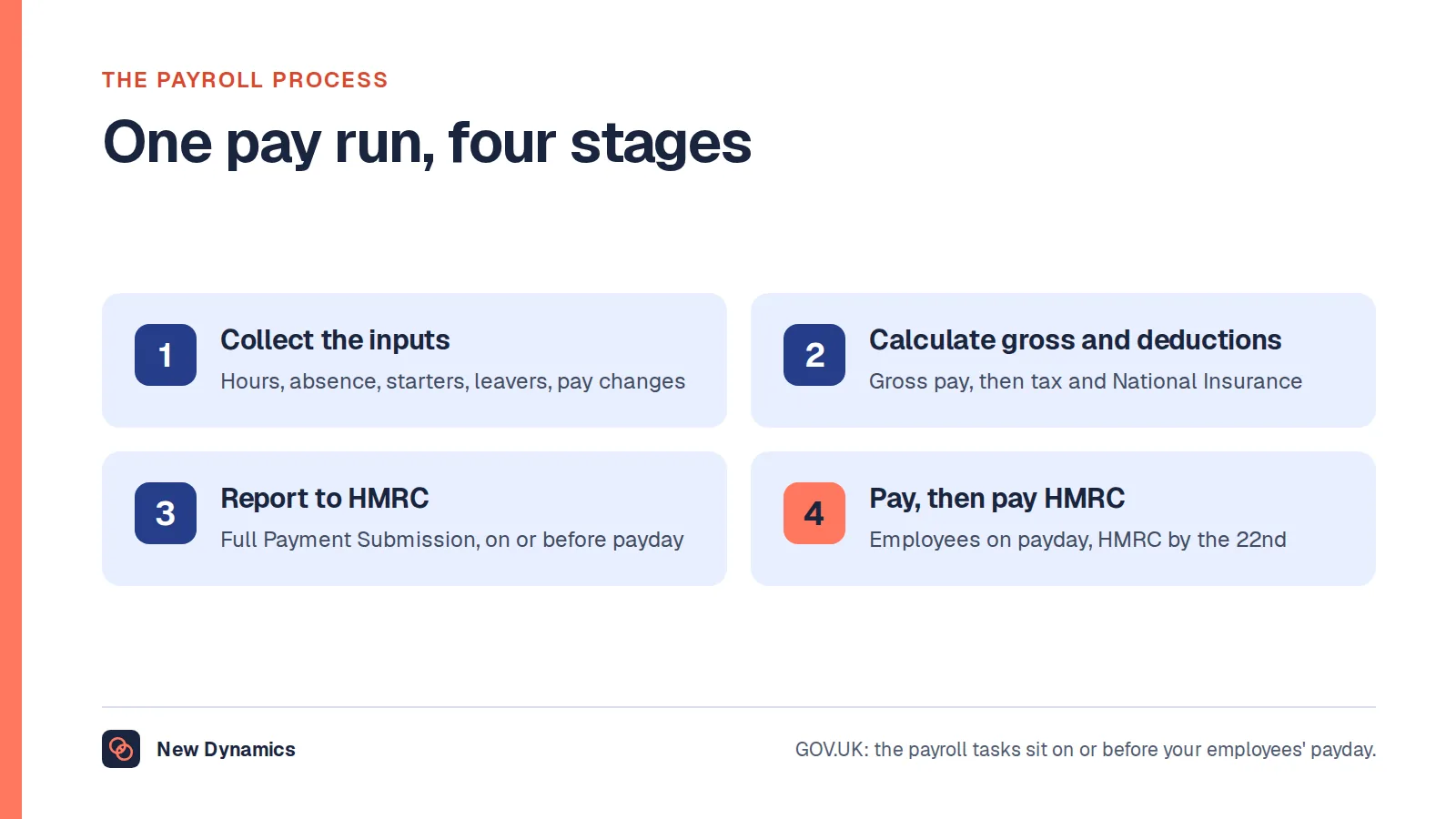
- Whatever the names, the pay run splits two ways: what is withheld from the worker, and what the employer pays on top. The employer remits both, on one deadline, and stays responsible for both.
Someone in a group HR team asks what the payroll tax rate is. If the question comes from Chicago it has a clean answer. If it comes from Manchester, the honest reply is that the country has no tax by that name, and the person asking has to be told what the nearest equivalents are before any figure makes sense.
That gap causes real mistakes: budgets built on the wrong employer cost, offer letters promising a net figure nobody checked, and intercompany reporting that double counts a contribution or misses one.
This article explains what payroll tax means, how payroll tax and income tax actually differ, what each side pays in the United States, what the United Kingdom has instead, and how to compare the two without pretending they map one to one.
Cross-border pay questions go wrong when a step has no owner, not when somebody miscalculates. See how New Dynamics workflows make each step's owner and due date explicit.
New Dynamics does not run payroll and does not give tax advice. Everything below is general information, quoted from the tax authority that publishes it, with the tax year named. Check the rules for the country and the year you are paying in, and take advice on your own position.
For the pay run these taxes sit inside, see our post on the payroll process. For what the word payroll covers, see our payroll definition. For everything that comes out of gross pay, including the parts that are not tax, see our post on payroll deductions.
Why this question is harder than it looks
Jurisdiction: United States and United Kingdom. General information, not legal or tax advice.
Most comparison questions have a single answer. This one has two, because the phrase in the question belongs to one country and the reader may be in another.
"Payroll tax" is American. It is the ordinary working term for the taxes charged on wages as wages, as distinct from the income tax a person pays on their total income for the year. British employers, payroll bureaux and accountants almost never use it. They say PAYE, they say National Insurance, and if they say payroll taxes at all it is usually because they are reading an American document.
So there are two sensible readings of the same question:
- In the United States. The difference between federal income tax withholding and the payroll taxes, meaning Social Security, Medicare and unemployment tax. This is a real distinction in law, with different bases, different rates and a different split between the two sides.
- In the United Kingdom. What the American payroll tax is the equivalent of. The closest answer is Income Tax collected through PAYE plus National Insurance contributions, with the Apprenticeship Levy alongside for larger employers.
The sections below take them in that order, then set them side by side. Every section names the jurisdiction it describes, because a rate quoted without a country is worse than no rate at all.

What payroll tax means in the United States
Jurisdiction: United States, federal.
The IRS does not generally use the phrase "payroll tax" as a legal term. Its own heading is employment taxes. The IRS page on understanding employment taxes, last reviewed on 1 May 2026, opens with the duty rather than the definition: "Employers must deposit and report federal employment taxes." It then sets out four categories.
- Federal income tax. "Employers generally must withhold federal income tax from employees' wages."
- Social Security and Medicare taxes. "Employers generally must withhold Social Security and Medicare taxes from employees' wages and pay the employer share of these taxes." The page notes they have different rates, and that "only the Social Security tax has a wage base limit".
- Additional Medicare tax. Employers must withhold a "0.9% Additional Medicare tax on an employee's wages and compensation that exceeds $200,000 in a calendar year", and the page is explicit that "there is no employer match for the Additional Medicare tax".
- Federal unemployment (FUTA) tax. "You pay FUTA tax only from your own funds. Employees do not pay this tax or have it withheld from their pay."
In everyday American usage, "payroll taxes" normally means the second and fourth of those: the Social Security and Medicare taxes, collected under the Federal Insurance Contributions Act and therefore called the FICA taxes, plus unemployment tax. Income tax withholding is treated as a separate thing even though it travels on the same return and the same deposit.
So payroll tax, in American usage, is a tax on the wage itself, charged at a flat rate, shared between worker and employer and earmarked for specific social insurance programmes. Income tax is a tax on a person's income for the year, charged at rising rates, assessed on the individual and settled on their annual return.

Income tax withholding in the United States
Jurisdiction: United States, federal. States and cities add their own income taxes and rules, which this article does not cover.
Federal income tax withholding is often abbreviated FIT on an American payslip, and yes, FIT is federal income tax. It is the employer taking an estimate of the employee's eventual federal income tax bill out of each payment of wages. The estimate comes from the employee's own Form W-4, which is why two people on identical salaries at the same employer can have different amounts withheld.
Three features matter for the comparison.
It is progressive. The IRS page on federal income tax rates and brackets, last reviewed on 27 July 2026, describes the mechanism plainly: "You pay tax as a percentage of your income in layers called tax brackets. As your income goes up, the tax rate on the next layer of income is higher." The page lists rates of 10%, 12%, 22%, 24%, 32%, 35% and 37%, and covers income earned in 2025 and 2026. A higher earner does not pay the top rate on everything, only on the layer above the threshold.
It is personal. Filing status, dependants, other income, deductions and credits all change the final figure. Withholding is a running estimate of something only settled when the individual files.
The employer pays none of it. Every dollar of income tax withholding comes out of the employee's gross pay. The employer's role is to calculate it, hold it and hand it over.
That last point is the most useful thing to hold on to. Income tax withholding reduces the worker's net pay and does not change the employer's cost of employing them. Some of the payroll taxes do both.
FICA in the United States: Social Security and Medicare
Jurisdiction: United States, federal.
This is where the employer starts paying. IRS Topic no. 751, Social Security and Medicare withholding rates, last updated on 24 September 2026, gives the figures as a split:
- Social Security: "6.2% for the employer and 6.2% for the employee, or 12.4% total".
- Medicare: "1.45% for the employer and 1.45% for the employee, or 2.9% total".
So a flat 7.65% comes out of the employee's wages, and the employer pays a further 7.65% from its own funds. On a $60,000 salary that is $4,590 withheld from the worker and $4,590 added to the employer's cost, before any benefit, insurance or state tax.
Two limits change the arithmetic at the top end.
Social Security has a cap. Topic no. 751 states that for 2026 earnings "this base limit is $184,500". Above that figure, no further Social Security tax is due from either side for the year. The IRS page on self-employment tax, last reviewed on 30 October 2026, names the same number: "For 2026, the first $184,500 of your combined wages, tips, and net earnings is subject to any combination of the social security part of self-employment tax."
Medicare does not. Topic no. 751 is explicit: "There's no wage base limit for Medicare tax." It keeps applying at 1.45% each side on every dollar of wages.
And there is a surcharge on the employee only. The 0.9% Additional Medicare tax applies to "wages paid in excess of $200,000 in a calendar year", and Topic no. 751 repeats that "there's no employer match for Additional Medicare tax". So between $200,000 and the Social Security cap the two sides are no longer symmetrical: the employee is paying more than the employer on that slice of pay.
Self-employment shows that FICA is really one tax with two halves. The IRS puts the self-employment tax rate at 15.3%, consisting of "12.4% for social security" and "2.9% for Medicare", which is both sides of FICA added together, and says it "is similar to the Social Security and Medicare taxes withheld from the pay of most wage earners".
FUTA and state unemployment: the employer's own taxes in the United States
Jurisdiction: United States, federal, with a state element.
FUTA is the cleanest example of a payroll tax that an employee never sees. IRS Topic no. 759, on FUTA tax, last updated on 24 September 2026, states that "the FUTA tax rate is 6.0%" and that "the tax applies to the first $7,000 you paid to each employee as wages during the year". The page names 2024 and 2025. It also sets out the credit that makes the headline rate misleading in practice: "if you paid into state unemployment funds, you may receive a credit of up to 5.4% of FUTA taxable wages when you file your Form 940."
Most employers therefore pay a much smaller net federal rate and a separate state unemployment tax on top, at a rate set by the state and often varied by the employer's own claims history. State rates are not published centrally and are not quoted here. Check them with the state workforce agency for the state and year you are paying in.
The point for the comparison is structural. FUTA never reduces anyone's net pay. It is purely a cost of having employees, which is exactly how employer National Insurance behaves in the United Kingdom.
Depositing and reporting in the United States
Jurisdiction: United States, federal.
Whatever the split between the two sides, the employer sends the money. The IRS page on depositing and reporting employment taxes, last reviewed on 29 June 2026, states that "federal tax deposits must be made by electronic funds transfers (EFT)" and that "there are two deposit schedules, monthly and semi-weekly", which the employer "must determine" before each calendar year begins.
Reporting runs on separate tracks:
- Income tax withholding and FICA go on the same quarterly return. Employers file "Form 941, Employer's Quarterly Federal Tax Return, each quarter". Form 943 covers agricultural employees and Form 944 is for employers notified to use it.
- FUTA is annual. The IRS says to "report your FUTA taxes by filing Form 940, Employer's Annual Federal Unemployment (FUTA) Tax Return", and that deposits "are required for the quarter within which the tax due exceeds $500".
- The employee's annual statement is Form W-2, filed with Form W-3. The page notes that "at the end of the year, the employer must complete Form W-2, Wage and Tax Statement", and that "Forms W-2 are required to be furnished to employees and filed with SSA by January 31". That filing goes to the Social Security Administration rather than to the IRS.
So income tax withholding and the FICA taxes are legally distinct but operationally joined. They are calculated differently and they fall on different parties, yet they reach the government through the same deposit and the same quarterly form.
The United Kingdom does not have a payroll tax
Jurisdiction: United Kingdom.
If you look for a British payroll tax you will not find one. There is no HMRC page defining it, no rate, no return. What exists is a bundle of three things that together do the job the American phrase describes.
Income Tax, collected through PAYE. GOV.UK's guide to PAYE and payroll for employers puts it in one line: "PAYE is HM Revenue and Customs' (HMRC) system to collect Income Tax and National Insurance from employment." PAYE is not a tax. It is the collection mechanism, and it carries both the income tax and the National Insurance.
The rates come from GOV.UK's page on Income Tax rates and Personal Allowances, which states that "the current tax year is from 6 April 2026 to 5 April 2027" and that "the standard Personal Allowance is £12,570, which is the amount of income you do not have to pay tax on". For England, Wales and Northern Ireland it gives the basic rate as 20% on taxable income of "£12,571 to £50,270", the higher rate as 40% on "£50,271 to £125,140" and the additional rate as 45% "over £125,140".
Scotland is different, and only for income tax. The same page warns that "income tax bands are different if you live in Scotland". GOV.UK's page on Income Tax in Scotland gives seven bands for the 2026 to 2027 tax year: the Personal Allowance "up to £12,570" at 0%, a starter rate of 19% on "£12,571 to £16,537", a basic rate of 20% on "£16,538 to £29,526", an intermediate rate of 21% on "£29,527 to £43,662", a higher rate of 42% on "£43,663 to £75,000", an advanced rate of 45% on "£75,001 to £125,140" and a top rate of 48% "over £125,140". National Insurance is not devolved, so a Scottish taxpayer's National Insurance is the same as anyone else's in the United Kingdom.
National Insurance. The employee and employer contributions, covered in the next section, and the part that behaves most like an American payroll tax.
The Apprenticeship Levy. A charge on large pay bills, covered below.

For the wider employer cost this sits inside, see our guide to labour costs, and the statistics hub for published figures on pay and employment.
National Insurance in the United Kingdom: employee and employer
Jurisdiction: United Kingdom.
National Insurance is the closest British relative of the American FICA taxes. It is charged on earnings rather than on total income, it has its own thresholds that are not the income tax thresholds, and it falls on both sides of the employment relationship in different amounts.
GOV.UK's page on National Insurance rates and categories sets out the structure first: an employee's Class 1 National Insurance "is made up of contributions" that are "deducted from their pay (employee's National Insurance)" and "paid by their employer (employer's National Insurance)". How much of each depends on "the employee's National Insurance category letter" and "how much of the employee's earnings falls within each band".
The employee side. For the tax year 6 April 2026 to 5 April 2027, the page shows category A employees paying 0% on earnings from £129 to £242 a week, 8% between £242.01 and £967 a week, and 2% over £967 a week. Its own worked example shows the banding clearly. For someone in category A earning £1,000 in a week: "nothing on the first £242", "8% (£58) on your earnings between £242.01 and £967" and "2% (£0.66) on the remaining earnings above £967", so "your National Insurance payment will be £58.66 for the week".
That 2% top band is the important contrast with the United States. Where American Social Security stops entirely above the wage base limit, British employee National Insurance does not stop, it steps down.
The employer side. For the same tax year, the page shows category A employers paying 15% across every band above the threshold, and HMRC's guidance on rates and thresholds for employers 2026 to 2027 gives the same 15% employer rate for category A. Other category letters carry 0% in the lower bands, which is how reliefs for younger workers, veterans and investment zones are delivered.
Class 1A and 1B. The rates page adds that employers "pay Class 1A and 1B National Insurance on expenses and benefits they give to their employees", and that "the rate from 6 April 2026 to 5 April 2027 on expenses and benefits is 15%", with Class 1A also due "on some other lump sum payments, for example redundancy payments". There is no American equivalent as a separate class.
Employment Allowance. GOV.UK's page on claiming Employment Allowance states that it "allows eligible employers to reduce their annual National Insurance liability by up to £10,500". That page does not name a tax year beside the figure, so confirm the amount and the eligibility conditions for your year before relying on it.
For 2026 to 2027 the employee National Insurance threshold and the Personal Allowance coincide at £242 a week and £12,570 a year, which makes the two look like one tax. They are not. They have separate legislation, separate bands at the top, and a separate employer charge that income tax does not have.
Where GOV.UK contradicts itself on the employer threshold
Jurisdiction: United Kingdom. Flagged rather than resolved.
While checking the employer figure for this article, two GOV.UK pages gave two different weekly thresholds for employer National Insurance for the same tax year. Both are live official pages. This article does not pick between them.
- GOV.UK's guide to running payroll, in its list of what to do on or before payday, says: "Calculate the employer's National Insurance contribution that you'll need to pay on their earnings above £242 a week."
- GOV.UK's guide to PAYE and payroll for employers says: "Your payroll software will work out how much tax and National Insurance you owe, including an employer's National Insurance contribution on each employee's earnings above £96 a week." The same page gives £96 as the registration trigger, saying you must register for PAYE if "they're paid £96 or more a week".
For reference, HMRC's detailed guidance on rates and thresholds for employers 2026 to 2027 gives the secondary threshold, which is the employer threshold, as "£96 per week / £417 per month / £5,000 per year", and the primary threshold, which is the employee threshold, as "£242 per week / £1,048 per month / £12,570 per year". The National Insurance rates and categories page shows the employer table starting at "£96 to £481" a week and the employee table starting at "£129 to £242" a week.
Three official pages, and one of them does not agree with the other two. Of the three, the rates and thresholds guidance is the page HMRC publishes specifically to carry the year's figures, which is worth knowing when you decide what to rely on and record. For budgeting, the difference between £96 and £242 a week is roughly £1,100 of employer cost a year for a single employee at the 15% rate, so it is not a rounding question. Raise it with HMRC or your adviser rather than choosing the figure that suits the budget, and note which page you relied on and when you read it.
The Apprenticeship Levy in the United Kingdom
Jurisdiction: United Kingdom.
The Apprenticeship Levy has no American counterpart, and it is the item most often missed when an American parent company models the cost of a British subsidiary.
GOV.UK's guidance on paying the Apprenticeship Levy states that as an employer "you have to pay Apprenticeship Levy each month if you: have an annual pay bill of more than £3 million", and that the levy "is an amount paid at a rate of 0.5% of an employer's annual pay bill". An annual allowance applies, which "reduces the amount of Apprenticeship Levy you have to pay by £15,000 across the year". Employers "must report and pay Apprenticeship Levy monthly through your Employee Payment Summary", and "you pay Apprenticeship Levy every month as part of your PAYE bill". The guidance was last updated on 6 April 2026 and refers to the year 2026 to 2027.
It is an employer charge, so it never appears on a payslip and never reduces anyone's net pay. It sits firmly on the employer's side, alongside employer National Insurance.
The comparison, plainly
Jurisdiction: both, compared. General information, not legal or tax advice.
What is withheld from the worker.
- United States: federal income tax, calculated from the employee's Form W-4; Social Security at 6.2% up to the 2026 wage base limit of $184,500; Medicare at 1.45% with no limit; and the 0.9% Additional Medicare tax above $200,000 of wages.
- United Kingdom: Income Tax under PAYE at 20%, 40% and 45% for England, Wales and Northern Ireland, or the seven Scottish bands; and employee National Insurance at 8% between £242.01 and £967 a week and 2% above that for category A.
What the employer pays on top.
- United States: Social Security at 6.2% and Medicare at 1.45%, matching the employee up to the respective limits; no match on the Additional Medicare tax; FUTA at 6.0% on the first $7,000 of each employee's wages, with a credit of up to 5.4% for state unemployment contributions; and state unemployment tax at the state's own rate.
- United Kingdom: employer National Insurance at 15% above the secondary threshold for category A, Class 1A and 1B at 15% on expenses and benefits, and the Apprenticeship Levy at 0.5% where the pay bill exceeds £3 million. Employment Allowance may reduce the National Insurance liability for eligible employers.
Who remits it.
The employer, in both countries, and for both sides.
- United States: electronic deposits on a monthly or semi-weekly schedule, Form 941 quarterly for income tax withholding and FICA, Form 940 annually for FUTA, and Form W-2 with Form W-3 to the Social Security Administration by 31 January.
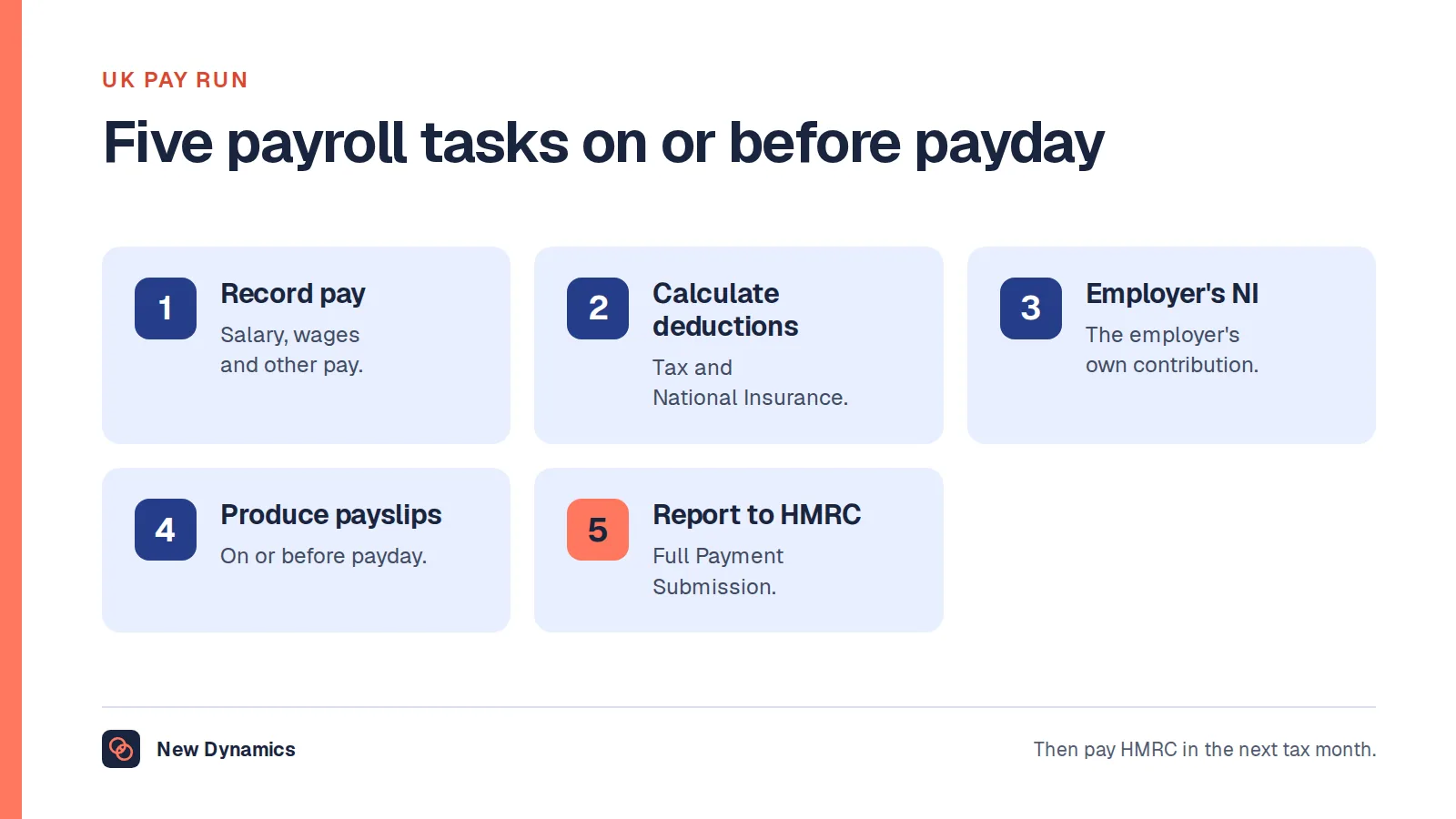
- United Kingdom: a Full Payment Submission to HMRC on or before each payday, and payment of the PAYE bill by, as GOV.UK's page on paying your PAYE bill puts it, "the 22nd of the next tax month if you pay monthly" or "the 22nd after the end of the quarter if you pay quarterly". That one bill bundles "employee Income Tax deductions", "Class 1 and 1B National Insurance", student loan repayments, Construction Industry Scheme deductions and "Apprenticeship Levy payments".
Three differences that matter most.
- A cap, against a step down. American Social Security stops above the wage base limit. British employee National Insurance never stops, it drops to 2%. A senior hire costs an American employer less in Social Security above the cap and costs a British employer the same 15% all the way up.
- One levy with no counterpart. The Apprenticeship Levy exists only in the United Kingdom, and only above a £3 million pay bill.
- Where the complexity sits. In the United States it is the state and local layer on top of the federal rules. In the United Kingdom there is no state layer, and the hard part is the category letters, the benefit classes and the devolved income tax bands.
Three mistakes this confusion causes
Jurisdiction: both. General information, not tax or legal advice.
Budgeting a British hire at the American employer rate, or the reverse. 7.65% plus unemployment tax is not 15% above a threshold, and neither includes pension contributions. Build the cost from the country's own published rates.
Treating PAYE as a tax. It is a collection system carrying two different taxes. "How much is PAYE?" has no answer until you say whether you mean the income tax, the National Insurance or the whole bill.
Assuming the thresholds line up. In the United States, the Social Security cap, the Additional Medicare threshold and the income tax brackets are three unrelated numbers. In the United Kingdom the National Insurance primary threshold and the Personal Allowance happen to match for 2026 to 2027, and the secondary threshold matches neither. Coincidence is not a rule, and it changes between tax years.
Frequently asked questions
What is the difference between income tax and payroll tax?
Income tax is charged on a person's income for the year at rising rates, is assessed on the individual and is settled on their annual return. Payroll tax, in American usage, is charged on wages as wages at a flat rate, is shared between the employee and the employer, and funds specific programmes. The IRS treats federal income tax withholding and the Social Security and Medicare taxes as separate categories of employment tax.
What is payroll tax, and what are the current rates?
In the United States it usually means the Social Security and Medicare taxes plus unemployment tax. IRS Topic no. 751 gives Social Security as "6.2% for the employer and 6.2% for the employee, or 12.4% total" and Medicare as "1.45% for the employer and 1.45% for the employee, or 2.9% total", with the 2026 Social Security wage base limit at $184,500 and no limit for Medicare. FUTA is 6.0% on the first $7,000 of wages, with a credit of up to 5.4% for state unemployment contributions.
Is there a payroll tax in the United Kingdom?
No tax carries that name. The equivalent bundle is Income Tax collected through PAYE, National Insurance contributions with separate employee and employer amounts, and the Apprenticeship Levy for employers with an annual pay bill over £3 million. GOV.UK describes PAYE as HMRC's system "to collect Income Tax and National Insurance from employment".
Which payroll taxes does the employer pay rather than deduct?
In the United States, the employer share of Social Security and Medicare, plus FUTA and state unemployment tax. The IRS says of FUTA: "You pay FUTA tax only from your own funds. Employees do not pay this tax or have it withheld from their pay." There is no employer match on the 0.9% Additional Medicare tax. In the United Kingdom, employer National Insurance, Class 1A and 1B on expenses and benefits, and the Apprenticeship Levy.
Does FIT on a payslip mean federal income tax?
Yes. FIT is the usual American payslip abbreviation for federal income tax withholding, the amount the employer takes from wages towards the employee's eventual federal income tax bill, calculated from their Form W-4. It is separate from the FICA lines for Social Security and Medicare, which are charged on both sides.
Who sends the money to the government?
The employer, in both countries, for the withheld amounts and its own contributions alike. In the United States that means electronic deposits monthly or semi-weekly, with Form 941 each quarter and Form 940 each year. In the United Kingdom it means a Full Payment Submission on or before payday and payment of the PAYE bill by the 22nd of the following tax month.
Your next step: write the employer cost down per country
Jurisdiction: any. General information, not legal or tax advice.
- For each country you employ in, list the employer charges separately from the employee deductions. Do not net them.
- Name the published page and the tax year behind every rate, and the date you read it.
- Flag any figure where two official pages disagree, as the employer National Insurance threshold does above, and get it confirmed rather than choosing one.
- Check the thresholds again at the start of each tax year. They move, and they do not move together.
For setting pay in a way you can explain to the people it applies to, read and download our compensation policy guide. The guide is free to read, and the PDF uses our short download form.
Want pay and reward steps to have an owner and a date rather than a good intention? Book a New Dynamics demo and bring your current process. You can also email contact@new-dynamics.com.