TL;DR
- Beverage manager, food and beverage manager and food and beverage director are three sizes of the same job, not three names for one. A beverage manager owns drink: range, price, stock, gross profit and the bar teams who pour it. A food and beverage director owns every outlet that sells either, plus the budget and the capital plan. The American occupational database O*NET lists "F and B Manager (Food and Beverage Manager)" among the reported job titles for food service managers, whose tasks include "Review menus and analyze recipes to determine labor and overhead costs, and assign prices to menu items".
- The commercial core is drink margin: what the venue buys, on what terms, how much reaches a glass, and what it sells for. No official United Kingdom source publishes a typical pour cost or a benchmark gross profit for drink, so this article does not borrow one. Nor is there a National Careers Service profile for beverage manager or food and beverage director, so there is no official pay figure for either title.
- Licensing is what separates this role from every other management job. In England and Wales the Licensing Act 2003 makes it a mandatory condition that no alcohol is supplied when there is no designated premises supervisor, and that "every supply of alcohol under the premises licence must be made or authorised by a person who holds a personal licence". Scotland runs under the Licensing (Scotland) Act 2005, where one person cannot be premises manager of more than one licensed premises. Northern Ireland runs under the Licensing (Northern Ireland) Order 1996. General information, not legal advice.
Drink is where a hospitality business makes its margin, and the person who owns that margin is usually described in an advert that says almost nothing about it. Most beverage manager adverts list "manage the bar team", "maintain stock levels" and "ensure compliance with licensing laws", then stop. A candidate cannot tell from that whether they will run one cellar or eleven, whether they will be named on a premises licence, or which numbers they own.
This is a hiring and management document rather than careers advice. It covers the role by setting, the ladder from bar manager to food and beverage director, the commercial core, the UK licensing duties, the people part and a template to paste.
A beverage manager in a group or a hotel is a textbook dual-reporting job: the general manager owns the site, the food and beverage director owns the drink. See how New Dynamics multi-manager reviews let two managers contribute to one appraisal instead of one of them quietly dropping out of the process.
People often search for a particular hotel group's or brewery's internal job description. We do not publish any named employer's internal job description, and we do not name, rank or price suppliers. What follows is the generic role, from official sources.
What a beverage manager actually is
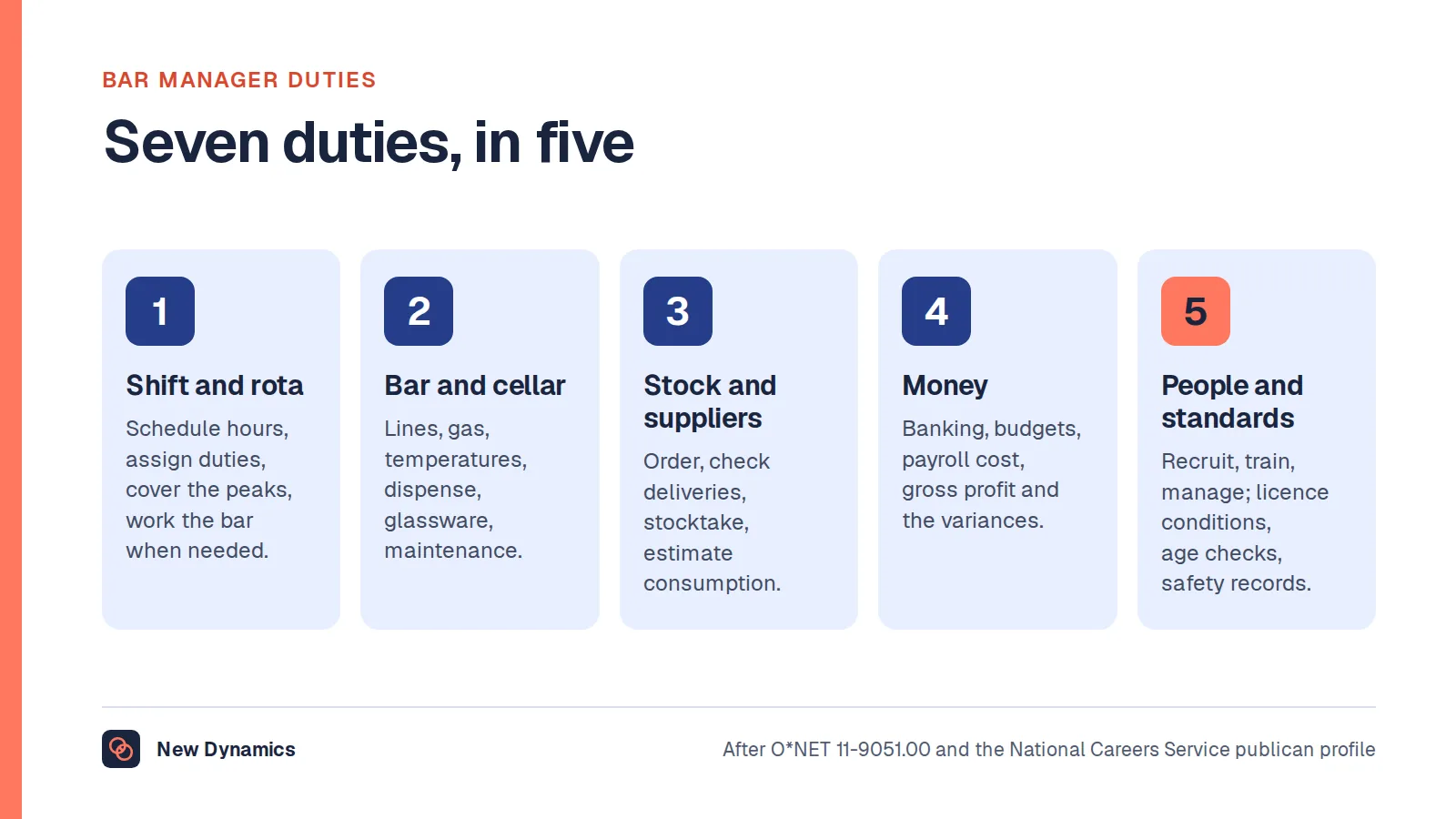
There are two jobs on the drinks side of hospitality. The first is running a bar: a room, a rota, a cellar and a till. That is the bar manager's job, and our bar manager job description covers it in detail.
The second is owning drink as a category across whatever the business operates. That is the beverage manager. The postholder decides what is listed, at what price, bought on what terms, poured to what spec and trained to what standard. They may never run a shift. They are measured on gross profit, stock accuracy, range performance and the competence of the bar teams, not on whether Friday went smoothly.
The United States Department of Labor's occupational database, O*NET, carries no separate entry for beverage manager. It folds the work into food service managers, code 11-9051.00, defined as "Plan, direct, or coordinate activities of an organization or department that serves food and beverages", and lists "F and B Manager (Food and Beverage Manager)" among the sample of reported job titles. That classification is American, and its tasks read like the commercial half of the job:
- "Estimate food, liquor, wine, and other beverage consumption to anticipate amounts to be purchased or requisitioned."
- "Review menus and analyze recipes to determine labor and overhead costs, and assign prices to menu items."
- "Monitor employee and patron activities to ensure liquor regulations are obeyed."
Forecasting, costing, pricing, range performance and legal compliance. Not cocktails.
How the job changes by setting
One title covers four very different operations. Hire for the wrong one and the appointment fails in a quarter.
A single bar or pub. Here the beverage manager and the bar manager are the same person, and the National Careers Service's publican profile is the closest official description. Its alternative titles are "Pub landlord, bar manager, licensed premises manager", and its tasks include "order stock and take deliveries", "maintain the premises, bar equipment and cellar" and "handle wages, bookkeeping and accounts". The same person cleans the lines, writes the rota and is usually the one named on the licence.
A restaurant group. Across sites the role becomes a category job sitting above them: the list, the terms, the specs, the training and the margin audit. Site managers own service, and the restaurant manager profile describes that half: "plan menus with your chefs", "manage stock control and budgets" and "make sure the restaurant follows licensing, food hygiene, and health and safety rules". The hard part is influence without line authority: accountability for a number other people produce.
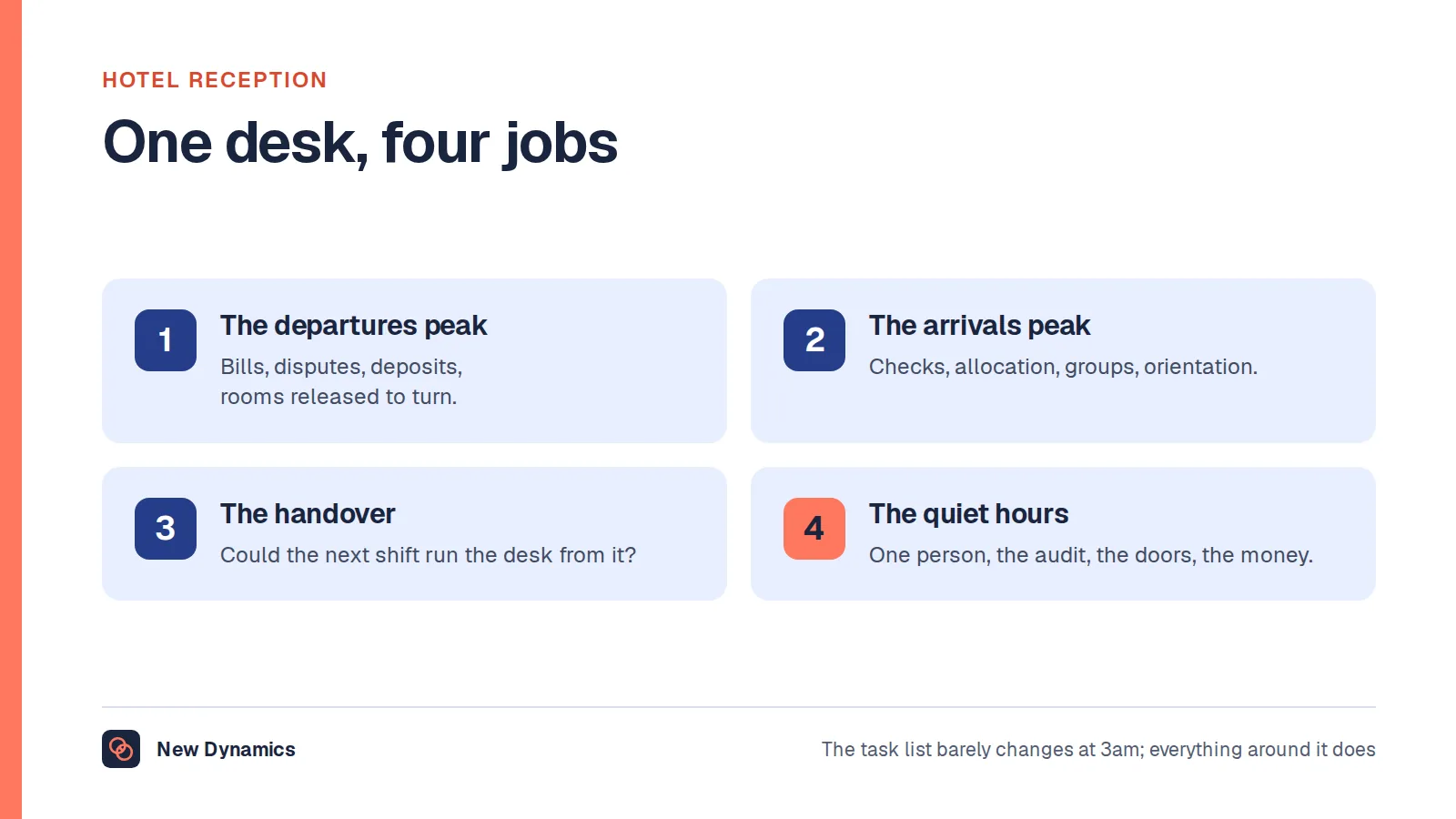
A hotel with several outlets. The most complex version, because drink is sold in several places at once on different margins: a lobby bar, a restaurant, room service, breakfast, banqueting and conferencing. The hotel manager profile describes the general manager above all of it as "responsible for running operations like guest services, housekeeping, bar and restaurant facilities, and conferencing and events". Banqueting is the complication: one event can move more stock than a month of lobby trade, at a price agreed months earlier by somebody in sales. Our hotel reception article covers the desk beside it.
A stadium, arena or event venue. A different trade wearing the same title. Volume arrives in bursts, the workforce is casual, and stock moves in pallets. Forecasting is the whole job: get it wrong and you either run dry in front of 20,000 people or write off a lorry of unsold product.

The ladder: bar manager to food and beverage director
What changes at each rung is not drinks knowledge. It is the size of the budget, the number of licensed outlets and the distance from the shift.
Bar supervisor. Runs a shift: the next four hours, the float, the standards and the people on with them.
Bar manager. Runs a bar as a business: rota, cellar, stock, cash, gross profit and the licence conditions on that premises. The first step at which the postholder can be the named designated premises supervisor.
Beverage manager. Owns drink as a category: range, price, specs, suppliers, stock policy, training and margin, usually across more than one outlet. The first step at which the job is mostly analysis, negotiation and influence rather than service.
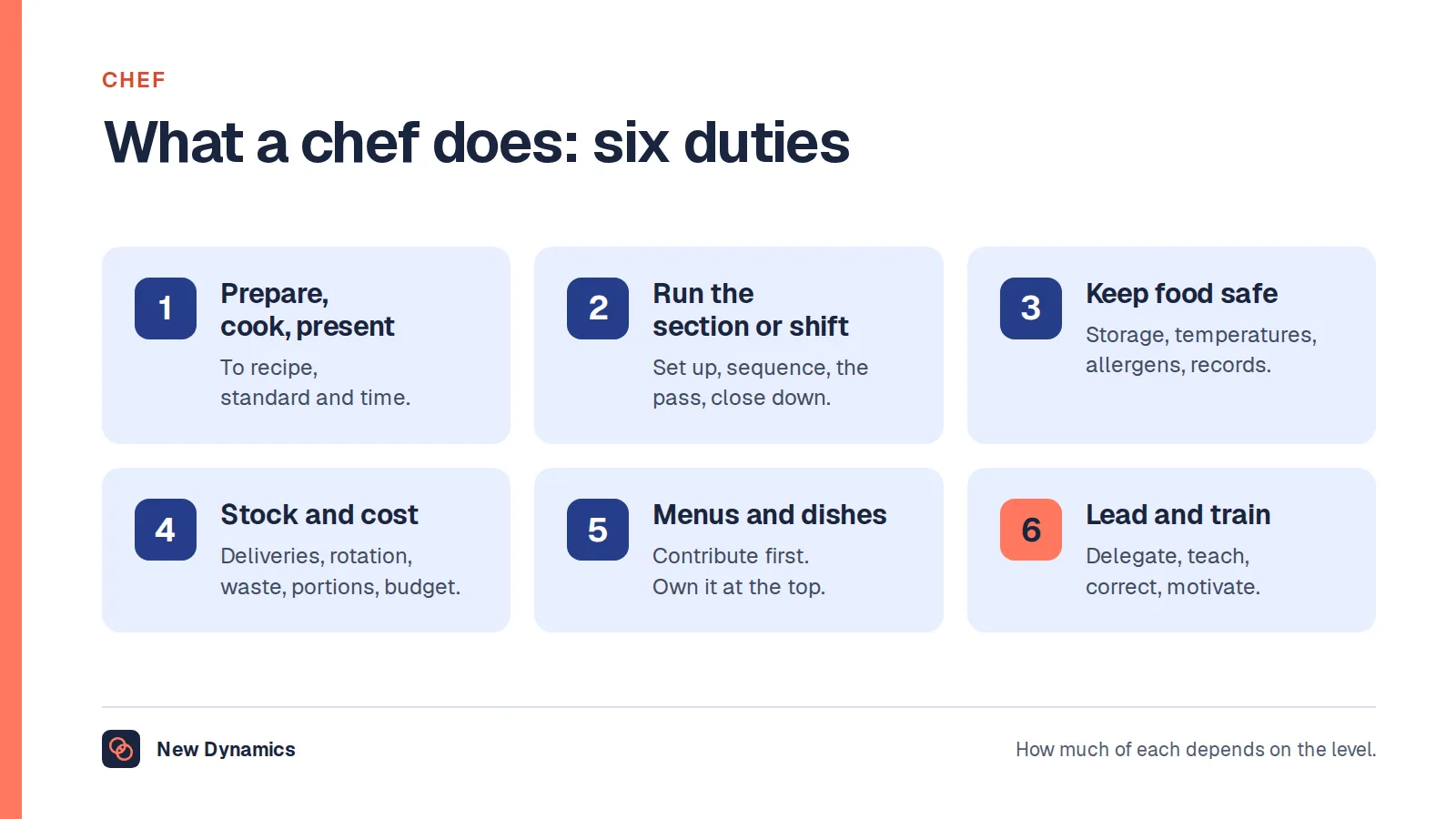
Food and beverage manager. Owns food and drink in one operation, which means working with the kitchen as well as the bar. Our chef job description covers that other half. Food wastage behaves nothing like drink wastage, and labour is a far larger share of the plate than of the glass.
Food and beverage director. Owns every outlet that sells food or drink, plus the departmental budget, the capital plan, the supplier contracts and the heads of department. The question stops being "is the margin right" and becomes "is this the right outlet in this space".

So the test is not the title. It is three questions: how many licensed outlets, whose budget, who reports in.
The commercial core: gross profit, stock, suppliers and menu engineering
This is the half of the job that adverts leave out and interviews fail to test.
Gross profit on drink. The gap between what a drink costs to buy and what it sells for, after tax. Every other number here explains why that gap is smaller than it should be. A beverage manager who can take a margin report apart by category, site and product is doing the job. One who can only report takings is not.
Pour cost. The cost of the liquid sold as a share of its selling price, the trade's working measure of whether a bar is pouring to spec. We will not quote a target: no official United Kingdom source publishes a typical or benchmark pour cost, and a figure borrowed from a supplier's marketing page is worse than none. Set the target from the venue's own costed specs and stock results.
Stock variance and wastage. The gap between what the stock figures say should have been sold and what the till says was sold. Most of it is dull: over-pouring, spillage, unrecorded staff drinks, measurement error and deliveries signed for without being counted. Investigating it in that order, before reaching for dishonesty, marks a competent appointment. Wastage splits into ullage, out-of-date stock, line losses after cleaning and prep that did not sell, and one "wastage" line hides all four.
Supplier terms and goods inwards. What the business buys, from how many suppliers, on what terms. A signature on an uncounted delivery note is a margin loss nobody will trace. One statutory duty belongs here: GOV.UK's alcohol licensing guidance states that businesses selling alcohol to the public "will need to ensure that the UK wholesalers they buy alcohol from have been approved by HMRC under the Alcohol Wholesaler Registration Scheme (AWRS)", and will "need to check the wholesaler's Unique Registration Number (URN) against the HMRC online database".
Menu engineering. What goes on the list, where it sits, what it costs and what it is priced at, then reading what sold. O*NET's task is to "Record the number, type, and cost of items sold to determine which items may be unpopular or less profitable". Popularity and margin are two axes, not one. The product everyone orders at a thin margin and the one nobody orders at a fat margin are both problems, and they need opposite fixes.
Licensing: what makes this role legally distinct in the United Kingdom
This is the part most adverts handle badly, and the reason the job is not interchangeable with any other management role in the building. State the jurisdiction every time, because the United Kingdom does not have one alcohol licensing regime. It has three. What follows is general information and not legal advice.
GOV.UK's alcohol licensing guidance, last updated 8 August 2025, states that "Businesses, organisations and individuals who want to sell or supply alcohol in England and Wales must have a licence or other authorisation from a licensing authority - usually a local council". It defines the three authorisations: "any business or other organisation that sells or supplies alcohol on a permanent basis needs to apply for a premises licence"; "anyone who plans to sell or supply alcohol or authorise the sale or supply of alcohol must apply for a personal licence"; and qualifying members' clubs "need to apply for a club premises certificate if they plan to sell or supply alcohol".
Section 4 of the Licensing Act 2003, extent E+W, says the licensing objectives are "(a) the prevention of crime and disorder; (b) public safety; (c) the prevention of public nuisance; and (d) the protection of children from harm".
The premises licence
The premises licence attaches to the place, not the person. GOV.UK describes it as authorising "the use of any premises ... for licensable activities", and those activities include not only alcohol sales but regulated entertainment and late night refreshment, "the sale of hot food or drink to the public ... between 11pm and 5am".
Trading outside it is an offence. Section 136 says a person commits an offence if he carries on a licensable activity "otherwise than under and in accordance with an authorisation, or ... he knowingly allows a licensable activity to be so carried on", with liability "on summary conviction to imprisonment for a term not exceeding six months or to a fine, or to both". That second limb matters here: knowingly allowing it is the offence too.
The designated premises supervisor
GOV.UK defines the designated premises supervisor as "the person who has day-to-day responsibility for the running of the business", and says all businesses selling or supplying alcohol must have one, except members' clubs and certain community premises. The supervisor "will act as primary contact for local government and the police", and "while they need not be on site at all times, they are expected to be involved enough with the business to be able to act as its representative, and they must be contactable at all times". Crucially, "each business may have only one supervisor selected for this role, but the same person may act as the designated supervisor at more than one business".
Read that last clause again if you are hiring for several sites in England or Wales. One person can hold the role across more than one business there, which is not true everywhere in the United Kingdom. Whoever takes it "must be named in the operating schedule" on the licence application, must hold a personal licence and must be nominated by the licence holder.
The personal licence
The personal licence attaches to the person and travels with them. GOV.UK says it plainly: "You are not required to have a personal licence to be employed in a pub or other business that sells alcohol. Premises licensed to sell alcohol must have a designated premises supervisor, who holds a personal licence." It compares the licence to a driving licence, which "permits the driving of any car".
To apply, GOV.UK says "you must be aged 18 years or over, and (in almost all cases) hold a relevant licensing qualification", and that your local council "will want to know of any relevant criminal convictions, and these may impact on whether or not you're found to be suitable as a licensee". So the honest line for a job description is one of three: the postholder already holds a personal licence, the employer will fund the qualification, or the role does not need one.
Authorisation of alcohol sales, and the mandatory conditions
Here licensing stops being paperwork and becomes a daily operating rule. Section 19 of the Act says that where a premises licence authorises the supply of alcohol, the licence "must include the following conditions":
"(2) The first condition is that no supply of alcohol may be made under the premises licence - (a) at a time when there is no designated premises supervisor in respect of the premises licence, or (b) at a time when the designated premises supervisor does not hold a personal licence or his personal licence is suspended.
(3) The second condition is that every supply of alcohol under the premises licence must be made or authorised by a person who holds a personal licence."
GOV.UK states the staffing consequence: "Anyone who does not hold a personal licence must be authorised to sell alcohol by a personal licence holder. There is no such requirement for the supply of alcohol in a members' club." In practice that is an authorisation chain the beverage manager maintains: who is authorised, by whom, recorded how, refreshed as people join and leave. In a venue with hundreds of casual staff, that chain is the control.
Section 19(4) brings in the conditions set by order. GOV.UK lists them: "The Licensing Act 2003 (Mandatory Conditions) order 2014 banned the sale of alcohol below the cost of duty plus VAT", and the remaining mandatory conditions are "a ban on irresponsible promotions", "mandatory provision of free potable (drinking) water", "adoption of an age verification policy" and "the mandatory provision of smaller measures".
Those four are operational, not abstract. The promotions ban constrains what a beverage manager may run commercially, and the water, the age verification policy and the smaller measures have to be visible, trained and in place on every shift. They are what a beverage manager owns and a general manager assumes is being done.

Scotland has a separate regime
Scotland runs under the Licensing (Scotland) Act 2005, administered by licensing boards. Section 1 says "Alcohol is not to be sold on any premises except under and in accordance with ... a premises licence, or ... an occasional licence", with a person guilty of selling in breach "liable on summary conviction to ... a fine not exceeding £20,000". The term is not designated premises supervisor. Section 19 defines the "premises manager" as "the individual for the time being specified as such in the premises licence", then adds the restriction that changes multi-site hiring:
"(2) An individual may not, at any one time, be the premises manager of more than one licensed premises; and, accordingly, if an individual who is the premises manager of licensed premises is subsequently specified in the premises licence of other licensed premises as the premises manager of those other premises, the subsequent specification is of no effect."
One premises manager per licensed premises. A beverage manager covering six Scottish bars cannot be named on all six, so the advert has to say who is.
Northern Ireland has a separate regime again
Northern Ireland runs under the Licensing (Northern Ireland) Order 1996, and even the vocabulary differs: the statute regulates "intoxicating liquor". Article 3 makes it "unlawful for any person to sell intoxicating liquor by retail unless he holds a licence authorising him to do so in the course of a business carried on in premises specified in the licence", with an offence carrying "a fine not exceeding level 5 on the standard scale" or up to six months' imprisonment.
Article 5 then limits licences to listed kinds of premises, including "an hotel", "a restaurant", "an indoor arena" and "an outdoor stadium". For most of those it imposes a test with no equivalent in England and Wales: the licence does not authorise sales unless "there is being carried on in those premises a business of the type normally carried on in premises of that kind; and the sale of intoxicating liquor is ancillary to that business".
In Northern Ireland that ancillary test is a commercial constraint, not a technicality.
The people part: bar teams, training and the rota
The commercial half of this job is delivered entirely by other people, most of them young, part-time and able to leave on a week's notice.
Recruiting into a tight market. The Office for National Statistics reported in "Vacancies and jobs in the UK: October 2026", released on 20 October 2026, that "early estimates for July to September 2026" suggest "a decrease of 21,000 (2.9%) vacancies to 691,000", and that "There were 2.4 unemployed people per vacancy in June to August 2026, down from 2.5 in March to May 2026". That is the whole economy, not hospitality alone, but it is the published backdrop. See our HR statistics hub for the wider picture.
Training to a spec. A costed drink spec is also a training document. If the house pour is 50ml, the margin assumes 50ml, and somebody has to teach, check and re-teach it. This is where the people half and the commercial half of the job become the same work.
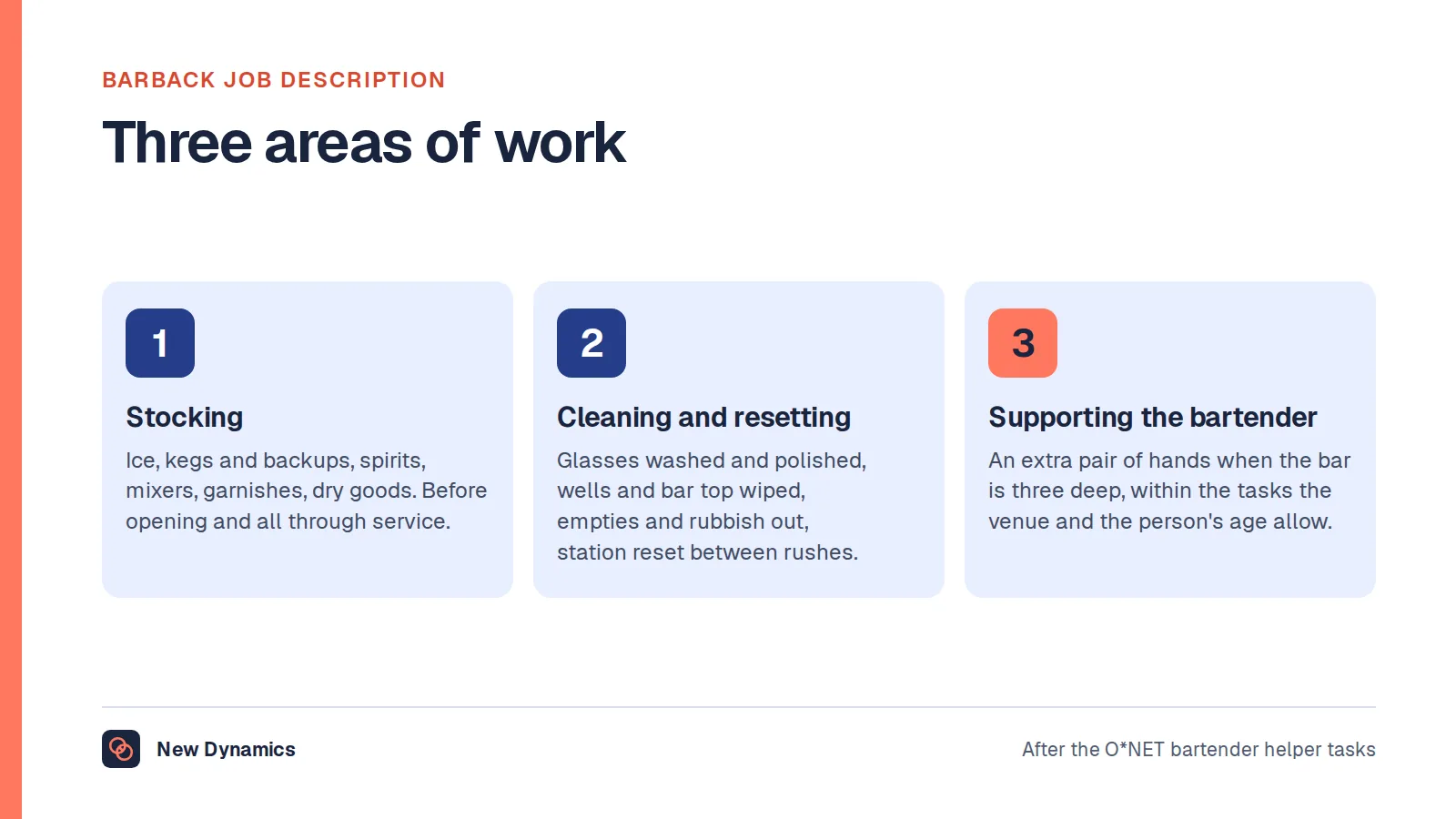
Authorisation as an induction step. In England and Wales an unauthorised person may not make a supply of alcohol, so the induction has to include the authorisation, with a record, before the first shift. Our barback job description covers the entry role most bar teams are built from.
Rotas across late nights. This is what people actually leave over: late finishes, split shifts, the gap between closing and the last train, and how far ahead the rota appears. The National Careers Service publishes typical hours a week for the nearest profiles: publican "45 to 50", variable; hotel manager "40 to 45"; restaurant manager "42 to 44", with "split shifts" named; catering manager "37 to 42". All four note evenings and weekends.
Safety is a named duty. The Health and Safety Executive's guidance on slips and trips in catering and hospitality says "Slips and trips remain the single most common cause of major injury in UK workplaces", with "the occupations most affected" being "kitchen assistants, chefs and waiting staff". Put the risk assessment in the responsibilities.
Appraisals for people with no desk. Bar teams have no company email address, no office and little overlap with the manager meant to appraise them. See how New Dynamics onboarding turns an induction into a dated set of tasks, early goals and check-ins that works for somebody whose first shift starts at six in the evening.
Pay and hours: what official sources publish, and what they do not
There is no National Careers Service profile for "beverage manager", "food and beverage manager" or "food and beverage director". Those URLs return a 404, so no official United Kingdom pay figure exists for the job by those names, and this article will not borrow one from a job board.
The National Careers Service does publish an average salary band and typical hours for the four nearest profiles, as a year, starter to experienced:
| Profile | Published salary band | Typical hours a week |
|---|---|---|
| Catering manager (alternative title "Food service manager") | £24,000 to £34,000 | 37 to 42 |
| Restaurant manager | £26,000 to £40,000 | 42 to 44 |
| Publican (alternative titles "Pub landlord, bar manager, licensed premises manager") | £27,000 to £50,000 | 45 to 50, variable |
| Hotel manager (alternative titles "Guest house manager, hotel general manager") | £30,000 to £60,000 | 40 to 45 |
Use those as the shape of the market, not the rate for your role. A beverage manager in one bar and a food and beverage director over nine outlets are not in the same band.
Beverage manager job description template
Adapt this, and resist the temptation to leave the licensing lines vague.
Job title: Beverage Manager (or Food and Beverage Manager, Beverage Director, Director of Food and Beverage, depending on scope)
Reports to: General Manager, Operations Director or Food and Beverage Director. If the role reports to two people, say so, and say who owns the appraisal.
Scope: The number and type of licensed outlets, the drink revenue band, the size of the bar team including casual staff, whether events are included, who holds the premises licence, and which nation's regime applies.
Purpose: Own drink as a commercial category: the range, the price, the terms, the stock, the margin and the competence of the teams who serve it, within the licence conditions.
Responsibilities:
- Set and maintain the drink range, specs and pricing within the group's commercial framework, and review performance by product, category and outlet.
- Own gross profit on drink, stock accuracy and wastage; investigate variance and act on it.
- Forecast consumption, plan purchasing, manage supplier terms, and verify deliveries for quality and quantity, checking wholesalers are approved under the Alcohol Wholesaler Registration Scheme.
- Maintain cellars, dispense and bar equipment, including line cleaning, temperatures and gas, to a documented schedule.
- Uphold licence conditions on every shift: the age verification policy, free drinking water, smaller measures, the ban on irresponsible promotions and permitted hours.
- Maintain alcohol sale authorisation records for every member of staff who serves, and refresh them as people join and leave.
- Recruit, induct, train and develop bar teams; run the rota; hold one-to-ones and appraisals that happen on a shift pattern.
- Carry out and review risk assessments for the bar environment, including slips, trips and glass.
Requirements:
- Experience owning drink margin, stock and range at comparable scale, not only running a bar.
- Personal licence held, or willingness to obtain one with employer support. In Scotland, the equivalent position under the Licensing (Scotland) Act 2005; in Northern Ireland, under the Licensing (Northern Ireland) Order 1996.
- Over 18, and able to pass the background checks the employer and the licensing authority require.
- Numerate: comfortable with gross profit, costed specs, stock results and supplier terms.
- Able to influence site managers who do not report to them.
Working pattern: The shift pattern, late finishes, split shifts, weekends and bank holidays, how far ahead the rota is published, and how travel between sites works.
Progression: The next step, and what support is offered towards licensing qualifications.
A hotel or resort often pairs this role with a spa, which carries its own licensing and water safety duties. Our post on the spa manager role covers those, including the Legionella risk that closes a spa.
Frequently asked questions
What does a beverage manager do?
Owns drink as a commercial category: the range and the pricing, supplier terms and purchasing, stock, wastage and gross profit, the costed specs and the training behind them, and the licensing conditions on selling alcohol. In a single bar the same person runs the shift and the cellar. In a group, a hotel or a venue the role is mostly forecasting, costing, auditing and training.
What is the difference between a beverage manager and a food and beverage director?
Scope and budget. A beverage manager owns drink. A food and beverage director owns every outlet that sells food or drink, plus the departmental budget, the capital plan, the supplier contracts and the heads of department. What changes at each step is the budget and the number of licensed outlets, not the drinks knowledge.
Does a beverage manager need a personal licence in the UK?
It depends on the premises and the role, and the answer differs by nation, so this is general information rather than legal advice. In England and Wales, GOV.UK says you are not required to hold a personal licence simply to be employed in a business that sells alcohol, but licensed premises must have a designated premises supervisor who holds one, and anyone without a personal licence must be authorised to sell alcohol by a personal licence holder. Scotland and Northern Ireland have separate regimes, and the licensing authority for the premises is the place to confirm.
Can one person be the designated premises supervisor for several sites?
In England and Wales, yes in principle. GOV.UK states that each business may have only one supervisor selected for the role, but the same person may act as the designated supervisor at more than one business. Scotland is different: section 19 of the Licensing (Scotland) Act 2005 says an individual may not at any one time be the premises manager of more than one licensed premises. Northern Ireland operates under the Licensing (Northern Ireland) Order 1996. General information, not legal advice.
What is a typical pour cost or drink gross profit target?
No official United Kingdom source publishes one, so we do not quote a figure. Set the target from your own costed specs, purchase prices and stock results, then hold the manager to movement against that baseline rather than to a supplier's marketing number.
What does a food and beverage director earn in the UK?
There is no National Careers Service profile for food and beverage director, beverage manager or food and beverage manager, so no official figure exists for those titles. The nearest published bands, as a year from starter to experienced, are catering manager at £24,000 to £34,000, restaurant manager at £26,000 to £40,000, publican at £27,000 to £50,000 and hotel manager at £30,000 to £60,000. Treat those as the market's shape, not the rate for a multi-outlet director role.
Your next step: write the four things the advert is missing
- Scale. How many licensed outlets, what the drink revenue is, how many people, and whether events are in scope.
- The numbers owned. Which figures the postholder is accountable for, and which they can change. If pricing is set centrally, say so.
- The licence position. Nation, personal licence required or funded, named supervisor or manager or not, and the conditions that bite.
- The rota reality. Shifts, late finishes, travel between sites, and how far ahead the rota is published.
A candidate can read that in ninety seconds and know whether to apply.
Bar teams turn over faster than any other part of a hospitality business, and the beverage manager carries the cost. For a plan to keep the people you train, read and download our employee retention guide. The guide is free to read, and the PDF uses our short download form.
Want appraisals, objectives and check-ins recorded for teams across several licensed outlets, on late shifts, with two managers contributing to one review? Book a New Dynamics demo and bring the rota and the review form you use today. You can also email contact@new-dynamics.com.