TL;DR
- Hotel reception is one post covering a 24 hour operation, so the job description has to describe four different jobs: the arrivals and departures peak, the handover between shifts, the quiet hours when the desk is also the night audit and the security presence, and the early morning. The same tasks at three in the morning carry authority and risk they do not carry at three in the afternoon.
- Write the role as outcomes rather than a task list: every guest in the right room and billed correctly, an accurate record of who is in the building, money that reconciles each shift, problems closed or handed over with a name and a time, and a following shift that starts informed. In larger hotels guest relations sits beside the desk and front of house management sits above both.
- The parts most hotel reception job descriptions leave out are employment realities and law. Staff who regularly work at least three hours between 11pm and 6am are night workers under the Working Time Regulations, with an eight hour average limit and a free health assessment, and HSE requires employers to manage the risk before anyone works alone. Reception teams also usually have no company email or desk, which changes how you run reviews, recognition and communication.
Most hotel reception job descriptions read as though the desk closes at six. They list check-in, check-out, answering the telephone and taking reservations, and they leave out the three things that actually make the role hard to fill and harder to keep: the shift pattern, the hours after midnight when one person holds the building, and the fact that the person doing the job has no desk of their own and usually no company email address.
This is a hiring and management document rather than careers advice. It covers what hotel reception does across a full 24 hour operation, a hotel receptionist job description you can adapt, guest relations and front of house management above it, the employment and health and safety realities you have to plan for, and what to measure once someone is in post.
A receptionist's first fortnight is where most of the risk sits, because the role is customer facing and cash handling from day one. See how New Dynamics onboarding turns an induction into a dated path of tasks, early goals and manager check-ins that works for someone who starts on a late shift.
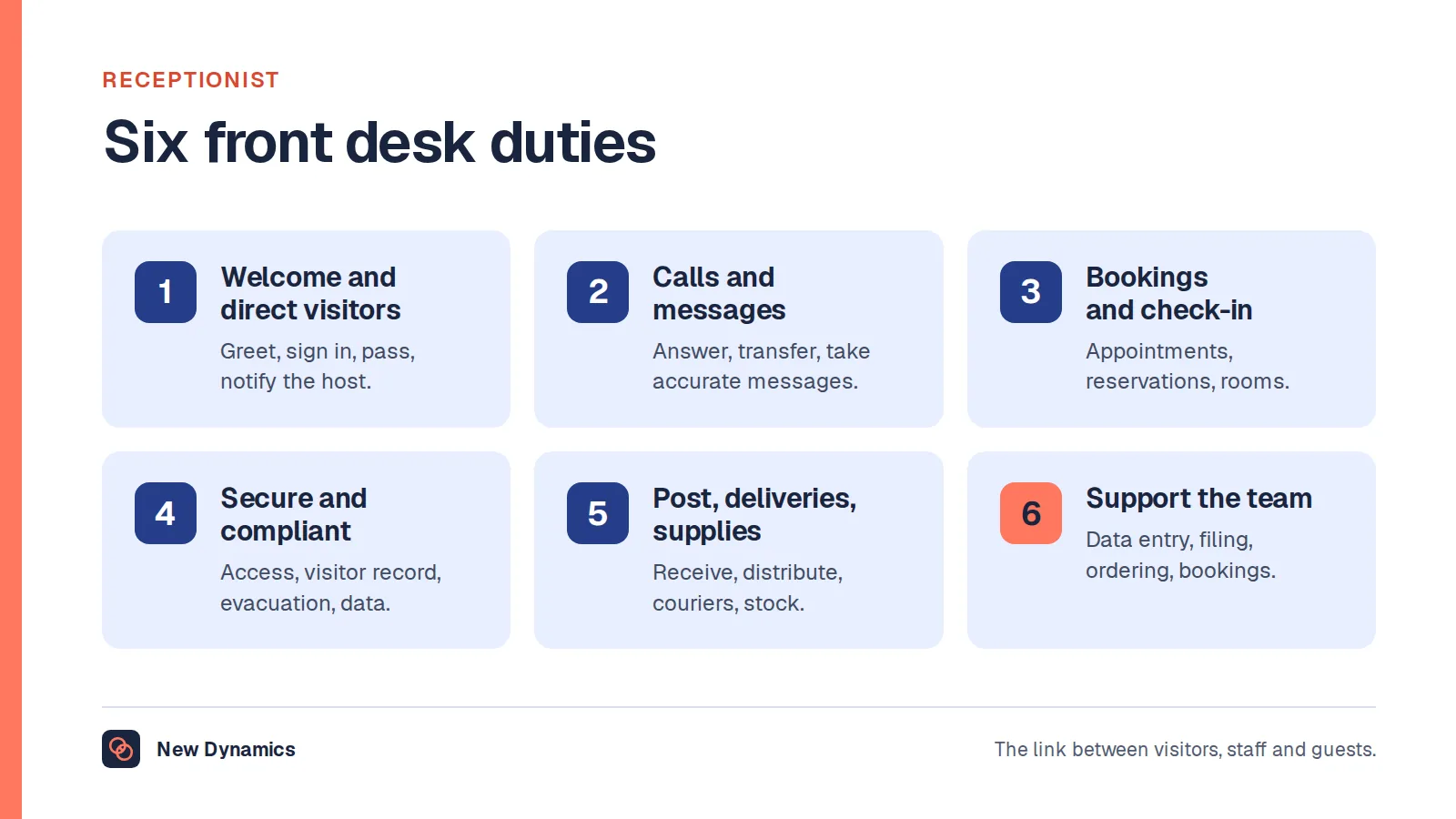
For the general version of the role across offices, surgeries and hotels, see our receptionist job description. This article is about the hotel desk specifically, which is a different job.
What hotel reception does across a 24 hour operation
The desk is a single post covering a service that never stops. That gives you one job title and at least four distinct jobs.
The departures and arrivals peaks
The morning peak is an accounting exercise under time pressure. Bills are presented, disputes are settled, extras are added, deposits are released, late check-outs are priced and the housekeeping board is updated so rooms can be turned in order. The afternoon peak is the opposite: identity and payment checks, room allocation against requests and accessibility needs, group arrivals, and the orientation that stops a guest from ringing down three times in an hour.
Both peaks are measured in minutes per guest, and both are the point at which the hotel's commercial decisions become visible. Rate disputes, overbooking, upselling and walking a guest to another property all land on the desk, usually in front of a queue.
The handover between shifts
The handover is the part of the role most job descriptions ignore entirely, and it is the part that fails most often. Reception runs on knowledge that is true for a few hours: the room that smells of smoke, the guest who has complained twice, the card that declined, the contractor due at seven, the key that was never returned. If that knowledge lives only in one person's head, the next shift starts blind and the guest tells the story again.
So the handover belongs in the accountabilities as an outcome, not as a task. The test is simple: could the next person run the desk from what you wrote down?
The quiet hours
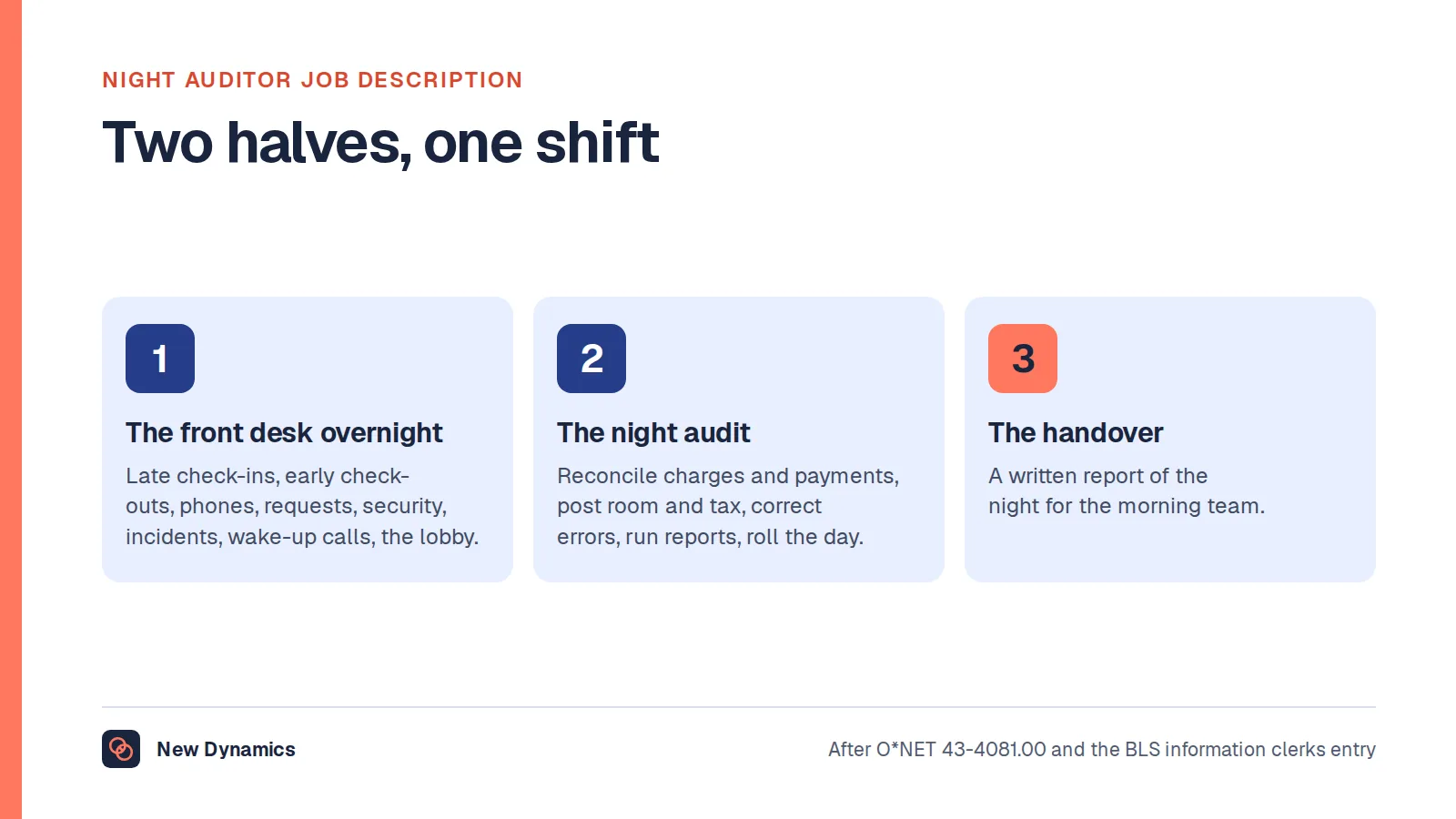
After the last arrival, the job changes character. One person is typically holding reception, the switchboard, the doors, the fire panel, the money and whatever the night brings. In most hotels that same person also closes the day's accounts; see the night auditor job description for the audit itself, step by step.

Why the job is different at 3am from 3pm
The task list barely changes. Everything around it does.
- Nobody to ask. At three in the afternoon a duty manager is twenty feet away. At three in the morning the receptionist decides whether to call the police, wake a manager, refuse a walk-in, or let a distressed guest into a room that is not theirs.
- Fewer people, higher consequence. A fire alarm at 3pm has a lobby full of alert adults. At 3am it has a building full of sleeping strangers and one trained person to start the evacuation.
- The money is unsupervised. Cash, card terminals, safe deposits and the audit all sit with one person, with no second pair of eyes until the morning.
- The body is working against the shift. HSE's guidance on fatigue describes it as “a decline in mental and/or physical performance that results from prolonged exertion, sleep loss and/or disruption of the internal clock”, resulting in “slower reactions, reduced ability to process information, memory lapses, absent-mindedness, decreased awareness, lack of attention, underestimation of risk, reduced coordination”, and adds that “night workers are particularly at risk of fatigue because their day sleep is often lighter, shorter and more easily disturbed”.
If your job description describes one job, it is describing the 3pm version and hiring for it.
A hotel receptionist job description you can use
Adapt the hours, the systems and the property. Keep the structure: purpose, accountabilities as outcomes, person specification, and what good looks like after six months.
Job title: Hotel receptionist (front desk)
Reports to: Front office manager or front of house manager
Hours: Shift rota covering [07:00 to 15:00, 15:00 to 23:00 and 23:00 to 07:00], including weekends and bank holidays. [Night shifts are part of the rota / nights are covered by a separate night team.]
Purpose: To hold the front desk of a 24 hour operation so that every guest is checked in correctly, informed, charged accurately and dealt with promptly, the hotel always knows who is in the building, and each shift hands over a desk the next person can run.
Accountabilities, as outcomes:
- Arriving guests are in a room that matches what they booked and what they need, with payment secured and the hotel explained, without having to ask twice.
- The record of who is in the building is accurate at any moment, including at four in the morning for a fire roll call.
- Money taken on the shift reconciles: deposits, pre-authorisations, city or tourist charges, no-shows and refunds are posted before the shift ends.
- Problems raised at the desk are either closed before the guest leaves the lobby or handed to a named person with an agreed time, and the guest is told which.
- The following shift starts informed, because the handover record is written, specific and current.
- The building is secure out of hours and the lone working, fire and incident procedures are followed as written.
- Reservations, rates and guest records in the property management system are correct and data is handled in line with our privacy rules.
Person specification, essential:
- Calm and courteous with people who are tired, late, unwell or angry, in person and on the telephone.
- Accurate with money and records under time pressure, and willing to flag an error rather than absorb it.
- Able to work the rota as advertised, including nights and weekends.
- Sound judgement when working alone, including knowing when to escalate rather than improvise.
- Right to work in the UK and willing to complete our security and data protection training.
Person specification, desirable:
- Experience of a property management system, and of a hotel of comparable size or standard.
- A second language relevant to our guest mix.
What good looks like after six months:
- Runs a full arrivals or departures peak unsupervised, including a group and at least one rate dispute.
- Closes a shift with a reconciliation that needs no correction by the morning team.
- Writes handovers that colleagues say they can work from.
- Has resolved guest problems within an agreed authority without escalating everything, and escalated the ones that needed it.
- Has completed fire, lone working and first aid familiarisation and can start an evacuation.
- Knows the property, the neighbourhood and the regular guests well enough to answer without checking.
We provide: Paid shadow shifts on each shift type including a night, a named person to call out of hours, the training above, and a route to senior receptionist, guest relations, night manager or front office supervisor.

Guest relations and front of house management
In a small hotel, reception is all of this. As a property grows, two roles separate out of it, and your job descriptions should show the ladder because that is a large part of why people stay.
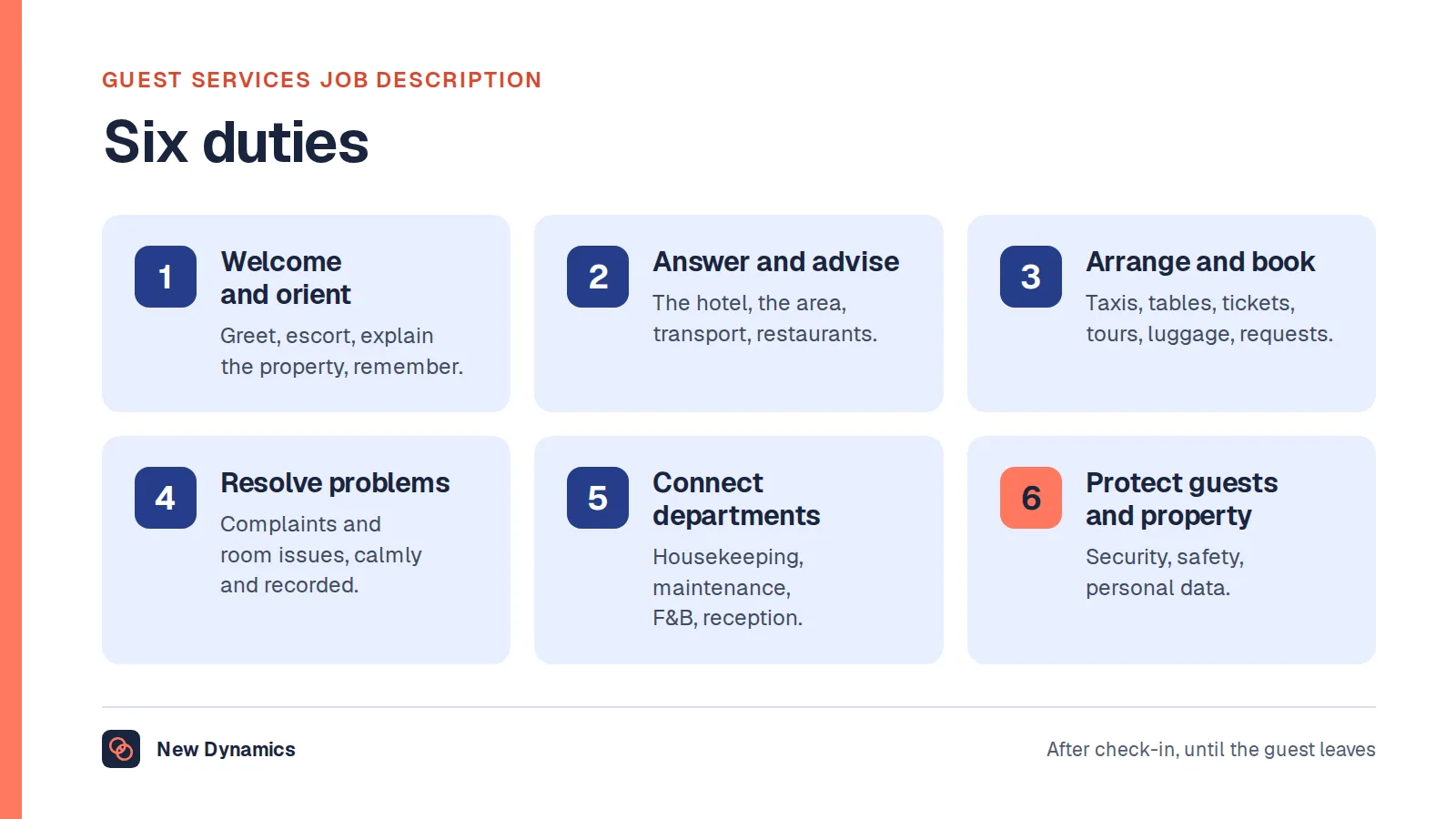
Guest relations takes the stay rather than the transaction. The desk owns arrival, departure and the money. Guest relations owns the guest between those points: recognising returning and VIP guests, preparing rooms for occasions, meeting and greeting arrivals the desk is too busy to walk through, chasing complaints to a conclusion rather than a resolution code, collecting and acting on feedback during the stay, and acting as the link between guests and housekeeping, maintenance, food and beverage and the duty manager. The common job titles are guest relations agent, guest services agent and guest service representative, and the senior version is the concierge; our guest services job description covers that role in full. Guest relations responsibilities overlap with reception on purpose, so define the handover point in both documents or each will assume the other is dealing with it.
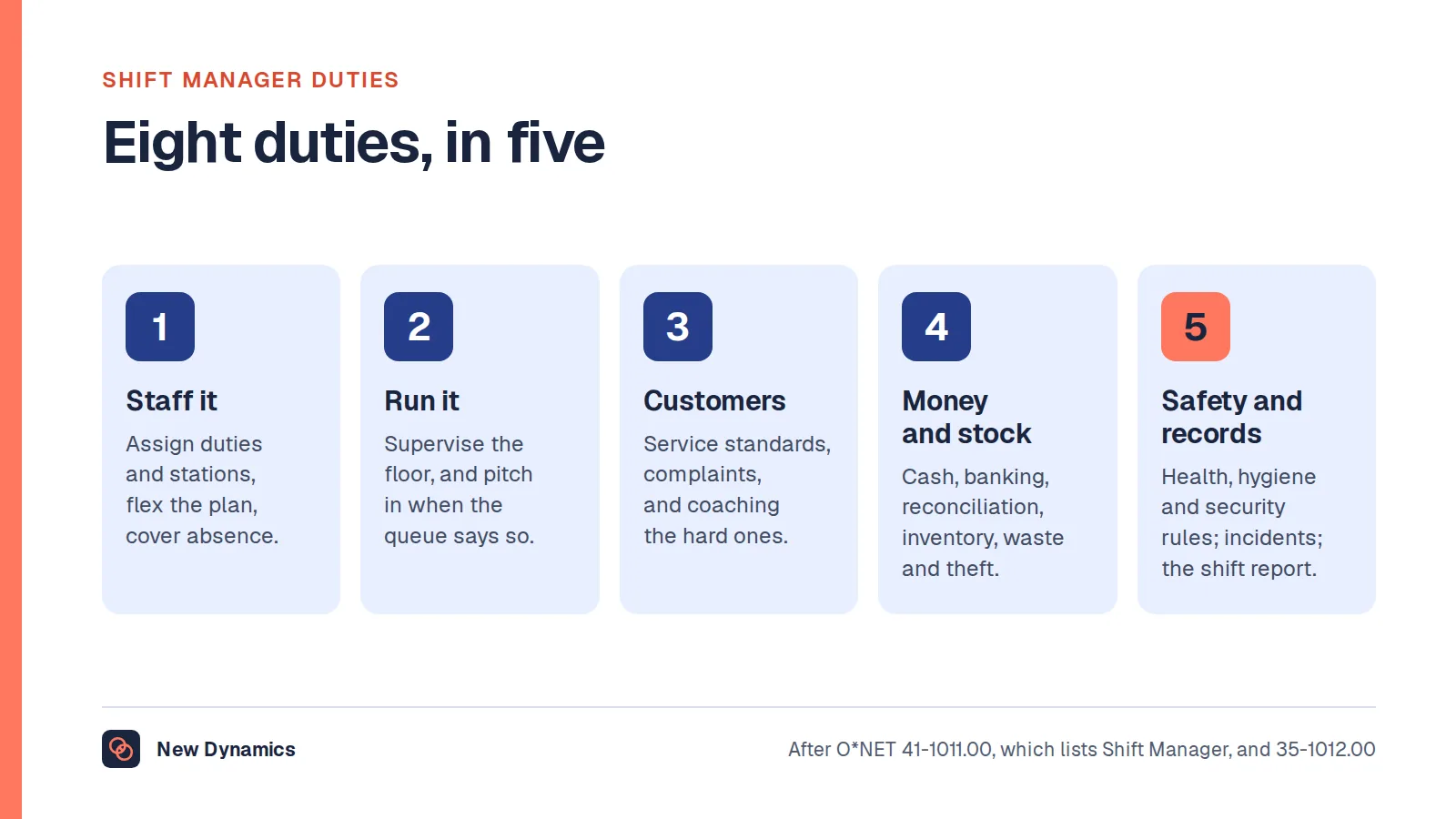
Front of house management sits above both. The front of house manager owns everything the guest sees: reception, guest relations, concierge, porters and the lobby itself. The accountabilities are the rota and its cost, standards and training, service recovery above the desk's authority, the relationship with housekeeping and revenue, and the shift that no manager is on site to watch. It is a people management job built on a rota, which is why the capability set resembles our shift manager job description more than it resembles reception.

Why this role is hard to staff and keep
Three employment realities drive turnover at the desk, and all three are manageable if you plan for them.
The shift pattern is the job. Nights, weekends, bank holidays and split cover are not an inconvenience attached to the role, they are its shape. The practical levers are notice of the rota, stable patterns rather than random ones, a fair distribution of unpopular shifts and a workable system for swaps and cover. Our guide to employee scheduling software sets out what a rota system has to handle, including rest rules and short notice changes.
Nights mean working alone. That is a health and safety duty, covered in the next section, and it is also a retention issue. People leave night reception because they feel unsupported, not only because they are tired.
The workforce is deskless. A hotel receptionist usually has no company email address, no personal computer and no quiet half hour in a working day. Every HR process that assumes a laptop fails here. Reviews get skipped because the manager and the employee are never rostered together; our guidance on performance reviews for part-time and shift workers covers who writes a review when nobody sees the whole person, and when to hold the meeting for someone on nights. Recognition stops at the people who are visible, which is why employee recognition ideas that work on a rota are deliberately small and frequent. And announcements posted by email never reach the night team, so choose internal communication tools that reach people without a work email.
Health and safety duties for lone and night workers
This section is general information about the law in Great Britain, not legal advice. Northern Ireland has its own health and safety regulator and its own working time rules, and nothing here replaces advice on your own property and rota.
The Health and Safety Executive defines lone workers as “those who work by themselves without close or direct supervision”, and states the duty plainly: employers must “manage any health and safety risks before people can work alone”, and “this applies to anyone contracted to work for you, including self-employed people”. HSE notes that lone workers face “greater risks ... without direct supervision or anyone to help them if things go wrong”.
On the arrangements that follow, HSE's guidance on training, supervision and monitoring says “it's harder for lone workers to get help, so they may need extra training”, that you should “base your levels of supervision on your risk assessment, the higher the risk, the more supervision they will need”, and that “it's a good idea for a new worker to be supervised at first if they're being trained” or “doing a job with specific risks”. It is also explicit about contact: “you must monitor your lone workers and keep in touch with them”, through “knowing where lone workers are, with pre-agreed intervals of regular contact, using phones, radios, email etc” and “other devices for raising the alarm, operated manually or automatically”.
For hotel reception that translates into a short list you can write into the role and the rota: a risk assessment that names violence and aggression at the desk, an agreed contact pattern through the night with someone who will act if contact stops, a panic alarm that someone answers, a rule on when the receptionist does not leave the desk or enter a room alone, supervised first nights rather than a solo start, and a named person on call. On the general duties behind all of this, see our summary of workplace safety. HSE is also clear that compliance with working time limits is not fatigue management on its own: “the legal duty is on employers to manage risks from fatigue, irrespective of any individual's willingness to work extra hours or preference for certain shift patterns”.
Working time: night workers and the limits that apply
This is the part most hotel reception job description pages omit entirely, and it is the part that decides whether your rota is lawful.
GOV.UK's guidance on night working hours sets the definitions. “Staff who regularly work at least 3 hours during the ‘night period’ are night workers.” The night period itself is defined: “the night period is 11pm to 6am, unless the worker and employer agree a different night period.” On a standard 23:00 to 07:00 hotel shift, the night receptionist is a night worker, and so is anyone whose late shift regularly runs past 2am.
The limit follows: “night workers must not work more than an average of 8 hours in a 24-hour period”, normally averaged over 17 weeks. Where the work involves “special hazards” or “mental or physical strain”, GOV.UK states that those night workers “cannot work longer than 8 hours in any 24-hour period”, with no averaging. There is also a health duty: “employers must offer workers a free health assessment before they become a night worker”, how often it is repeated “depends on the results of the assessment for each worker”, and “if a health professional confirms that night working has affected a worker's health, the employer must find them other suitable work, where possible”. Under 18s are a separate case: staff aged 16 or 17 “cannot work between midnight and 4am”, subject to narrow exceptions that include hotels.
Two further limits shape a reception rota. On maximum weekly working hours, “you cannot work more than 48 hours a week on average”, “normally averaged over 17 weeks”, and an adult worker may choose to opt out in writing, although a night worker's 8 hour average limit cannot be opted out of. On rest breaks, “workers have the right to one uninterrupted 20 minute rest break during their working day, if they work more than 6 hours a day”, “workers have the right to 11 hours rest between working days”, and weekly rest is “an uninterrupted 24 hours without any work each week” or “an uninterrupted 48 hours without any work each fortnight”.
The word that causes most trouble at a hotel desk is “uninterrupted”. A break taken at reception, within earshot of the telephone and expected to answer the bell, is not a rest break. Either someone covers the desk or the hotel owes compensatory rest. Decide which before you write the rota, not after a complaint.
Measuring performance at the desk
Reception generates more numbers than almost any other hourly role, and most of them are poor individual measures.
Guest satisfaction scores are the obvious trap. A review score reflects the room, the bed, the breakfast, the noise, the price, the booking channel and the weather, and only partly the ninety seconds the guest spent at the desk. Samples per person are tiny, respondents are self-selected and skewed towards complaints, and a guest who names a receptionist usually does so because something went wrong or very right. Ranking a reception team on review scores measures which shifts drew the easier guests.
Measure what the person controls:
- Accuracy. Shifts that reconcile without correction, and billing disputes caused at the desk rather than passed to it.
- The handover. Whether the next shift could work from it, judged by the people who receive it.
- Problem closure. Issues resolved within the receptionist's authority, and escalations that were right to escalate.
- Compliance habits. Identity and payment checks, the in-house list kept current, contact calls made on a night shift.
- Peak competence. Running an arrivals peak, a group, a walk or a system outage unsupervised.
- Qualitative evidence. Specific notes from managers and colleagues, including guest comments that name a behaviour rather than a score.
Acas's guidance on performance management is the right frame for how often this happens. It says employers “should conduct regular performance reviews for anyone with the legal status of employee”, that “it's a good idea to do them at least once a year”, and that “alongside more formal performance reviews, managers should still talk to employees informally about their performance on a regular basis. For example, through: sharing regular feedback, coaching, regular check-ins, sometimes known as one-to-ones.” Acas adds that objectives “should be fair and reflect the employee's usual tasks and workload”.
On a 24 hour rota, the regular part is the hard part. Decide who writes the review when three managers see fragments of the person, put the conversation inside a rostered shift rather than on a day off, and capture a note after a notable handover or incident while it is still specific.
Frequently asked questions
What does a hotel receptionist do?
A hotel receptionist runs the front desk of a 24 hour operation: checking guests in and out, taking and amending reservations, allocating rooms, handling payments, deposits and billing disputes, answering the telephone and guest requests, keeping an accurate record of who is in the building, maintaining security out of hours, and handing over to the next shift. On nights the same person is usually the security presence and often completes the night audit.
What is the difference between hotel reception and guest relations?
Reception owns the transaction and the record: arrival, departure, rooms, payments and the handover. Guest relations owns the stay between those points: recognising returning and VIP guests, meeting and greeting, following complaints through to a conclusion, gathering feedback during the stay and linking guests to housekeeping, maintenance and food and beverage. Small hotels combine the two. Larger ones should define the handover point in both job descriptions.
What are the duties of a front of house manager?
Front of house management covers everything the guest sees: reception, guest relations, concierge, porters and the lobby. The accountabilities are the rota and its labour cost, service standards and training, recovery above the desk's authority, the relationship with housekeeping and revenue, and performance on shifts no manager attends. It is a people management role built on a rota rather than a senior version of reception.
Who counts as a night worker on a hotel reception rota?
GOV.UK states that staff who regularly work at least 3 hours during the night period are night workers, and that the night period is 11pm to 6am unless the worker and employer agree a different one. A standard 23:00 to 07:00 hotel shift makes the receptionist a night worker, as does a late shift that regularly runs past 2am. Night workers must not work more than an average of 8 hours in a 24-hour period.
What must an employer do before a receptionist works alone at night?
HSE requires employers to manage any health and safety risks before people work alone, which means a risk assessment covering violence and aggression at the desk, training beyond what a supervised worker needs, supervision set by the level of risk, supervised first nights, an agreed pattern of contact through the shift with someone who will act if contact stops, and a way to raise the alarm. A free health assessment must be offered before someone becomes a night worker.
How should you measure a hotel receptionist's performance?
Measure what the individual controls: shifts that reconcile, disputes caused rather than inherited, handovers colleagues can work from, problems closed within their authority, compliance habits such as identity checks and night contact calls, and competence at peak. Treat guest satisfaction scores as team and property level evidence, because an individual's sample is small, self-selected and heavily influenced by the room, the price and the booking channel.
Your next step: describe all four shifts, then staff them
- Write the role as outcomes, and state the rota, the night arrangements and the lone working measures in the advert rather than at offer stage.
- Check the rota against the night worker definition, the 8 hour average, the 48 hour average, the 20 minute uninterrupted break and 11 hours daily rest.
- Decide who covers the desk during breaks, and record the lone working risk assessment and contact pattern.
- Define the handover point between reception, guest relations and front of house management.
- Decide who writes the review, and schedule it inside a shift.
A new receptionist's first shifts decide whether they stay, and almost all of it happens away from a computer. Read and download our employee onboarding guide for the structure. The guide is free to read, and the PDF uses our short download form.
Want reviews, goals, feedback and recognition to reach a team with no desk and no company email? Book a New Dynamics demo and bring your current rota. You can also email contact@new-dynamics.com.