TL;DR
- A finance administrator runs the purchase and sales ledger, expenses, bank reconciliation, payroll input and the monthly reporting pack. In a small organisation this is one person who touches everything financial, which is exactly why the job description has to be specific about systems, approval limits and who signs what.
- The thing almost no template gets right is segregation of duties. One person should not both raise and approve a payment. Where the team is too small to split every task, write compensating controls into the document: a named second approver, an independent bank reconciliation and a manager who samples the audit trail. This is general financial control good practice rather than a quoted legal rule.
- Payroll input makes this a data protection role as well as a finance one. The ICO says you "must apply at least one lawful basis whenever you are keeping records of your workers' personal information", and that where special category information is involved you "must identify a special category condition (under Article 9 of the UK GDPR)". This article is general information about the United Kingdom, not legal, accounting or tax advice.
In a thirty-person organisation there is usually one person who knows where every pound went. They raise the purchase orders, chase the sales invoices, check the expense claims, reconcile the bank, send the hours to payroll and assemble whatever the board sees each month. Their title is finance administrator, or financial administrator, or in about half of advertised roles something broader like finance and administration officer.
The finance administrator job description that goes out to advertise that post is almost always a list of duties lifted from a job board. That document has two failings. It cannot tell anybody whether the job is being done well, because duties are activities rather than outcomes. And it says nothing about approval limits or who signs what, which is the single most consequential thing about a role with access to the payment system.
This role runs on a timetable and a set of handoffs, so it belongs in a system rather than in one person's memory. See how New Dynamics configurable people workflows keep approvals, owners and due dates in one place, so the month-end close and the starter and leaver handoffs do not depend on somebody remembering to send an email.
This article sets out what the role genuinely covers, why the combined finance and administration version needs boundaries, a job description written as outcomes, the segregation of duties question, where payroll input turns into a data protection obligation, the records the organisation must keep, how to measure the role and how to hire for it.
Where sources are quoted they describe the United Kingdom. This is general information rather than legal, accounting or tax advice, and the control practices described here are good practice rather than statutory requirements. Take advice from your accountant or auditor on your own arrangements.
What does a finance administrator do?
Strip away the local variations and the role covers four areas.
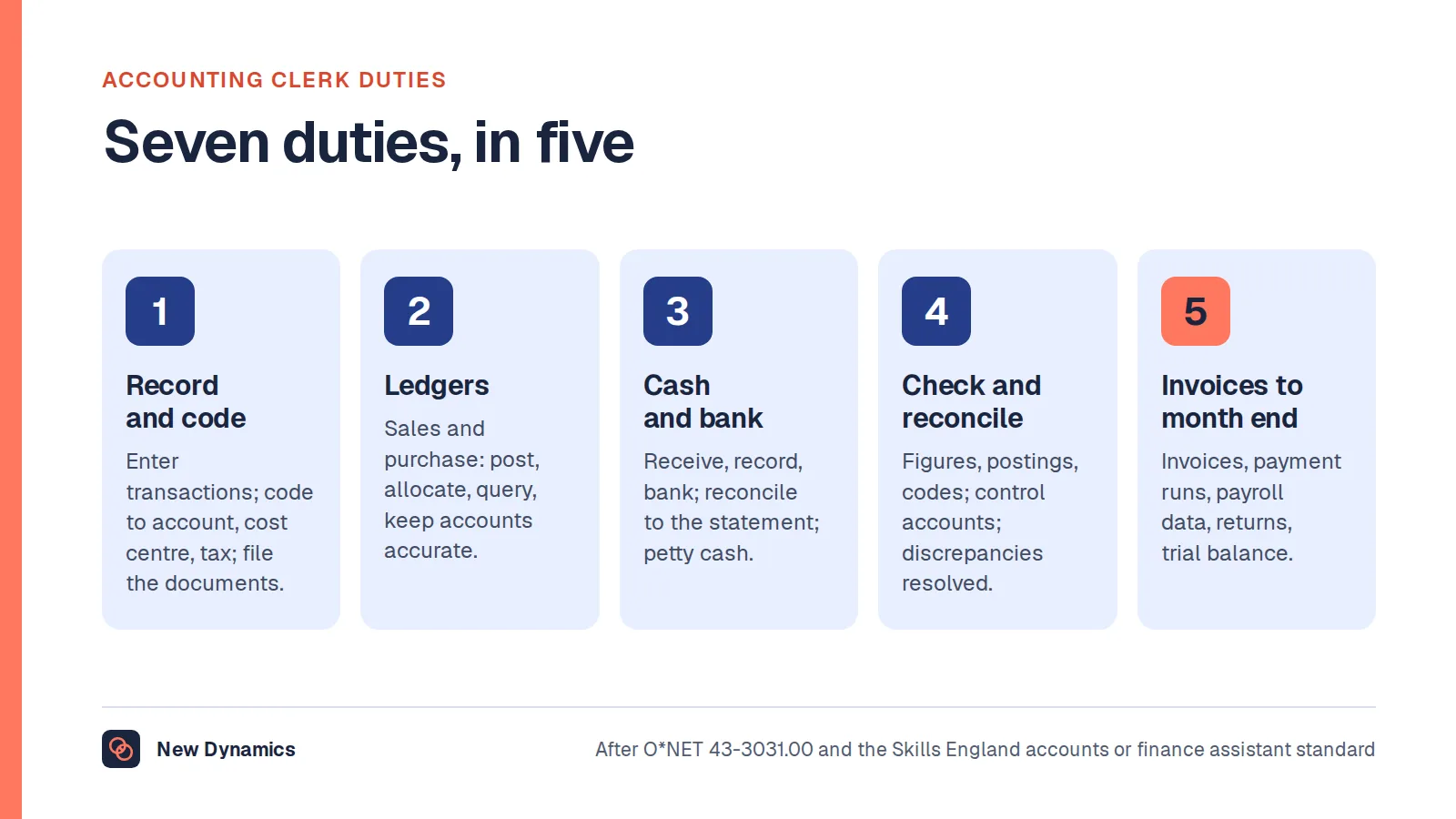
The ledgers. The purchase ledger means supplier invoices: matching them to orders and delivery notes, coding them to the right account and cost centre, resolving the queries and keeping supplier accounts accurate. The sales ledger is the mirror image: raising invoices, allocating receipts, running the aged debt report and chasing what is overdue. In a small organisation the same person does both, which is itself a control issue worth noting.
Money in and out. Expense claims checked against the policy, receipts matched, mileage recalculated. Payment runs prepared for approval. Bank reconciliation, which means agreeing the accounting system to the bank statement and explaining every difference. Petty cash and company card statements, if those still exist.
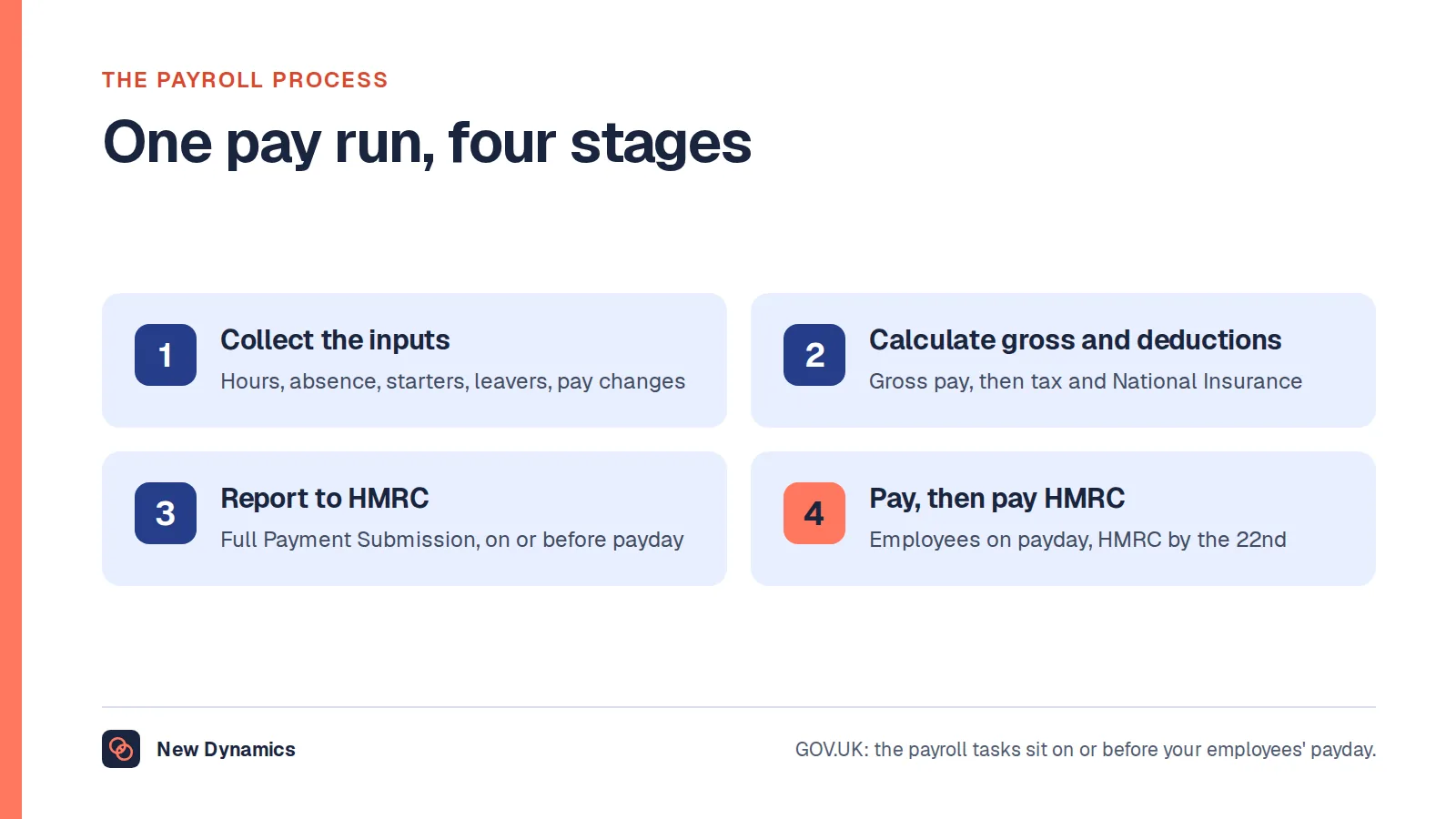
Payroll input. Not usually the payroll calculation itself, which is often outsourced or run by a payroll specialist, but the data that feeds it: hours, overtime, starters, leavers, changes to pay and bank details, salary sacrifice elections, absence that affects pay. Our post on the payroll process sets out the full cycle this input sits at the front of.
Reporting and records. The month-end pack, whatever that means in your organisation: a profit and loss against budget, a cash position, a debtors list, a few schedules. Plus filing, the audit trail and the retention of everything.

The honest summary for a small employer is this. In a finance team of twelve, the finance administrator owns a slice. In a team of one, they touch everything financial, and the job description needs to say so plainly rather than implying a narrow remit the post holder will immediately outgrow.
If the role you are describing is more purely transactional, sitting under an accountant in a larger finance function, our accounting clerk job description covers that version in more detail.
The combined finance and administration role
Search for this role and you will find "finance and admin job description" almost as often as the finance-only version. That hybrid is real and common. In charities, schools, small professional practices and owner-managed businesses, one person reasonably handles the ledgers and the office: the insurance renewal, the supplier contracts, the health and safety file, the holiday calendar, the printer.
There is nothing wrong with the combination. The risk is specific and predictable: the post becomes the place where every task nobody else owns goes to live. Someone leaves, their residue lands here. A new system arrives, the administration of it lands here. Over eighteen months the person hired to close the books accurately is spending a third of their week on facilities and the close slips.
Three things prevent that.
- Split the document. Write the finance accountabilities and the administration accountabilities as separate blocks with a rough weighting, for example seventy per cent finance and thirty per cent administration. The weighting is a statement of intent you can hold a conversation against.
- Name what is excluded. A short "not in this role" line is unusual in a job description and unusually useful. It is the only part anybody quotes back to you later.
- Review the weighting, not just the performance. Once a year, ask whether the split still matches reality. If it does not, either change the document or give the work back.
On turning duties into accountabilities generally, our guide to how to write a job description works through the method.
A finance administrator job description you can use
Adapt the wording. Replace every bracketed prompt with your own facts.
Job title: Finance Administrator (or Finance and Administration Officer)
Reports to: Finance Manager, Financial Controller, or in a small organisation the Chief Executive or a trustee treasurer.
Scope: State the accounting system, the approximate number of supplier and customer invoices a month, the bank accounts covered, whether payroll is in-house or outsourced, the month-end timetable and whether the role includes office administration.
Purpose: Keep the organisation's financial records accurate, complete and on time, so that payments are made correctly and under proper authority, income is collected, the bank agrees to the ledger every month and management has reliable numbers to decide on.
Accountabilities. Written as outcomes, because those can be assessed.
- Supplier invoices are recorded, coded and approved to procedure, and suppliers are paid to terms with no duplicate or unauthorised payments.
- Sales invoices go out within the agreed period of the work being done, and aged debt over the agreed age is escalated with a written chase history.
- Expense claims are checked against policy before approval, with queries raised rather than absorbed.
- All bank accounts are reconciled monthly within the close timetable, with every difference explained and cleared.
- Payroll input is accurate, complete and submitted by the cut-off, with changes evidenced and authorised.
- The month-end pack is delivered by the agreed date, with the schedules behind each figure available.
- Financial records are filed and retained so that any transaction can be traced to its supporting document.
- Financial controls are applied as written, and control weaknesses are reported rather than worked around.
Person specification. Separate what the job needs from what templates habitually demand.
Genuinely matters: demonstrable accuracy under deadline; confidence with a ledger system and a spreadsheet, named explicitly; understanding of double entry well enough to know why a reconciliation does not balance; the judgement to question an invoice or an instruction that looks wrong; discretion with pay and personal data.
Usually inflated: a degree, for a role that is transactional and procedural. A full professional qualification (ACA, ACCA, CIMA) for a post that will never prepare statutory accounts. A named software package when any comparable system plus a fortnight of training would do. "Five years' experience" when two years in a comparable volume is the actual requirement. Each unjustified requirement shrinks your field and removes good candidates who took a vocational route.
A reasonable middle: an AAT level 2 or level 3 qualification, or progress towards one, or equivalent experience. Say which, and say what study support you offer.
What good looks like after six months. Put this in the document, not just in your head. Month end closed on time for three consecutive months without escalation. Bank and control accounts reconciled with no unexplained items carried forward. Supplier and customer queries answered without the manager being copied in. One process documented well enough that somebody else could cover it. No payment made outside the approval route.

Segregation of duties: the part templates leave out
This is the section that makes a finance administrator job description worth more than the template you downloaded, and it is almost always missing.
The principle is simple. The person who raises a payment should not be the person who approves it. The person who sets up a new supplier should not be the only person who can pay that supplier. The person who records the cash should not be the only person who reconciles the bank. Splitting those tasks is what segregation of duties means, and it protects the post holder as much as the organisation: it is what allows them to demonstrate that a mistake was a mistake.
To be clear about status, this is general financial control good practice as auditors and funders commonly expect it, not a statutory rule we are quoting at you. Your auditor, funder or governing document may impose something stricter.
In a team of two or three you cannot split everything. That is what compensating controls are for, and they belong in the job description because they define the boundaries of the post.
- A named second approver who is not the administrator, with a written limit above which a second or more senior approval is required.
- Bank payments released by someone other than the person who prepared the run, using a separate login.
- New supplier and bank detail changes verified independently, by telephoning a number held on file rather than one supplied in the email requesting the change.
- The bank reconciliation reviewed and signed by someone else, even if the administrator prepares it.
- A manager or trustee who samples the audit trail periodically: new suppliers added, standing data changed, journals posted, credit notes raised.
- System access that matches the role, reviewed when the role changes.

Write these into the accountabilities and the document starts doing real work. It tells the candidate the organisation is competently run, it tells the post holder what they may and may not do alone, and it gives the manager something concrete to review.
Payroll input is a data protection matter
Payroll is where this role stops being only about money. Payroll input involves names, addresses, dates of birth, bank details and salaries, and often absence information that reveals health. Health data is special category data, which carries extra obligations.
The ICO's guidance on collecting and keeping employment records lists "payroll information; pension information; interview notes; emails; references; and equality and diversity information" among the records employers hold, and states that "You must apply at least one lawful basis whenever you are keeping records of your workers' personal information." Where the records include sensitive information it says you "must identify a special category condition (under Article 9 of the UK GDPR)" as well as a lawful basis. On access it describes "ensuring that access to employment records systems is limited to HR staff only, and that managers only have access to the information they need to meet their obligations", and on keeping records only as long as needed it says "You should set up a retention policy or schedule that lists: the types of record or information you hold; what you use it for; and how long you intend to keep it." Those quotations come from the ICO's employment practices and data protection guidance and its employment guidance hub, which also offers "Answers to key questions on the right of access for employers".
For the job description, three practical consequences.
- Say in the document that the role has access to personal and sometimes special category data, and that handling it to policy is an accountability rather than an afterthought.
- Grant access at the level the role needs and no further. A finance administrator who submits payroll input rarely needs to read the whole HR file.
- Expect the role to execute the retention schedule rather than invent it. Our post on employee records retention covers how to build that schedule.
The record keeping the organisation must do
This role usually executes obligations that sit with the organisation, so the job description should name them.
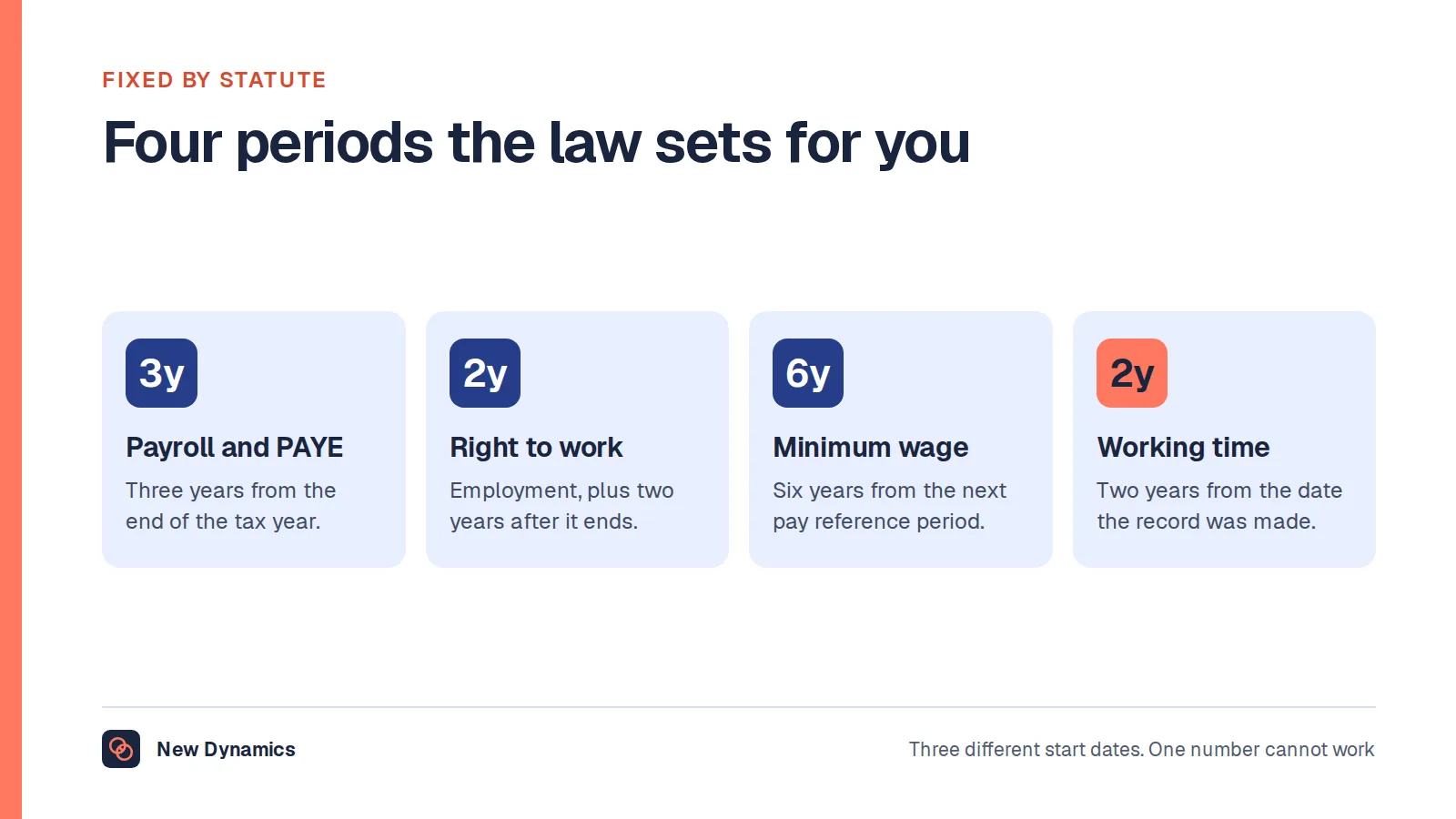
On PAYE, gov.uk's guidance on PAYE record keeping says employers "must collect and keep records of: what you pay your employees and the deductions you make, reports you make to HM Revenue and Customs (HMRC), payments you make to HMRC, employee leave and sickness absences, tax code notices, taxable expenses or benefits, Payroll Giving Scheme documents, including the agency contract and employee authorisation forms". On how long, it says "you need to keep them for 3 years from the end of the tax year they relate to", and warns that "If you do not keep full records, HMRC may estimate what you have to pay and charge you a penalty of up to £3,000."
On the wider business position, gov.uk's guidance on company and accounting records covers "all money received and spent by the company" along with assets, debts, stock and the supporting receipts and bank statements, and states "You must keep records for 6 years from the end of the last company financial year they relate to, or longer if" the records cover a transaction spanning more than one accounting period, relate to an asset expected to last beyond six years, the return was filed late, or a compliance check has been opened. It adds that "You can be fined £3,000 by HMRC or disqualified as a company director if you do not keep accounting records." Both figures and periods are as published on gov.uk at the time of writing; check the current pages before relying on them. For wider HR and workforce figures, see our HR statistics hub.
Two numbers worth putting in the document, then, with the caveat that your legal form changes which apply: three years for PAYE records, six for company accounting records.
Measuring the role
The temptation is to measure volume, because volume is easy to count. Invoices processed, payments made, claims checked. Volume measures how busy the organisation made the post holder, not how well they did the job, and it rewards the wrong instinct in a role where speed without care is the main hazard.
Measure accuracy and timeliness instead, on the month-end rhythm the role naturally has.
- Accuracy. Postings corrected after review, as a proportion of postings made. Payments made in error or outside the approval route, which should be zero. Reconciling items carried forward unexplained.
- Timeliness. Bank reconciliation, ledger close and the month-end pack delivered by the agreed dates. Payroll input submitted by the cut-off.
- Control. Exceptions raised by the post holder rather than found later. A control weakness reported is good performance, not bad news.
- Service. Supplier and customer queries resolved within the agreed period.
The close gives you a cadence. Review the same four things each month, and the appraisal becomes a summary of twelve conversations that already happened rather than an annual archaeology exercise.
Hiring for the role
Test the work, not the vocabulary. A short practical exercise, forty-five minutes at most and paid if you can, tells you more than any competency question. Give the candidate a small bank statement, a ledger extract and three or four supporting documents, and ask them to reconcile and list what does not agree and what they would do about each item. Include one planted problem: a duplicate invoice, an expense claim outside policy, or an email asking for a supplier's bank details to be changed urgently. What you are assessing is whether they notice, and whether they raise it rather than quietly fixing it.
Ask about judgement. "Tell me about a time you were asked to process something you were not comfortable with" is the single most useful question for this post. Listen for whether they escalated, and how.
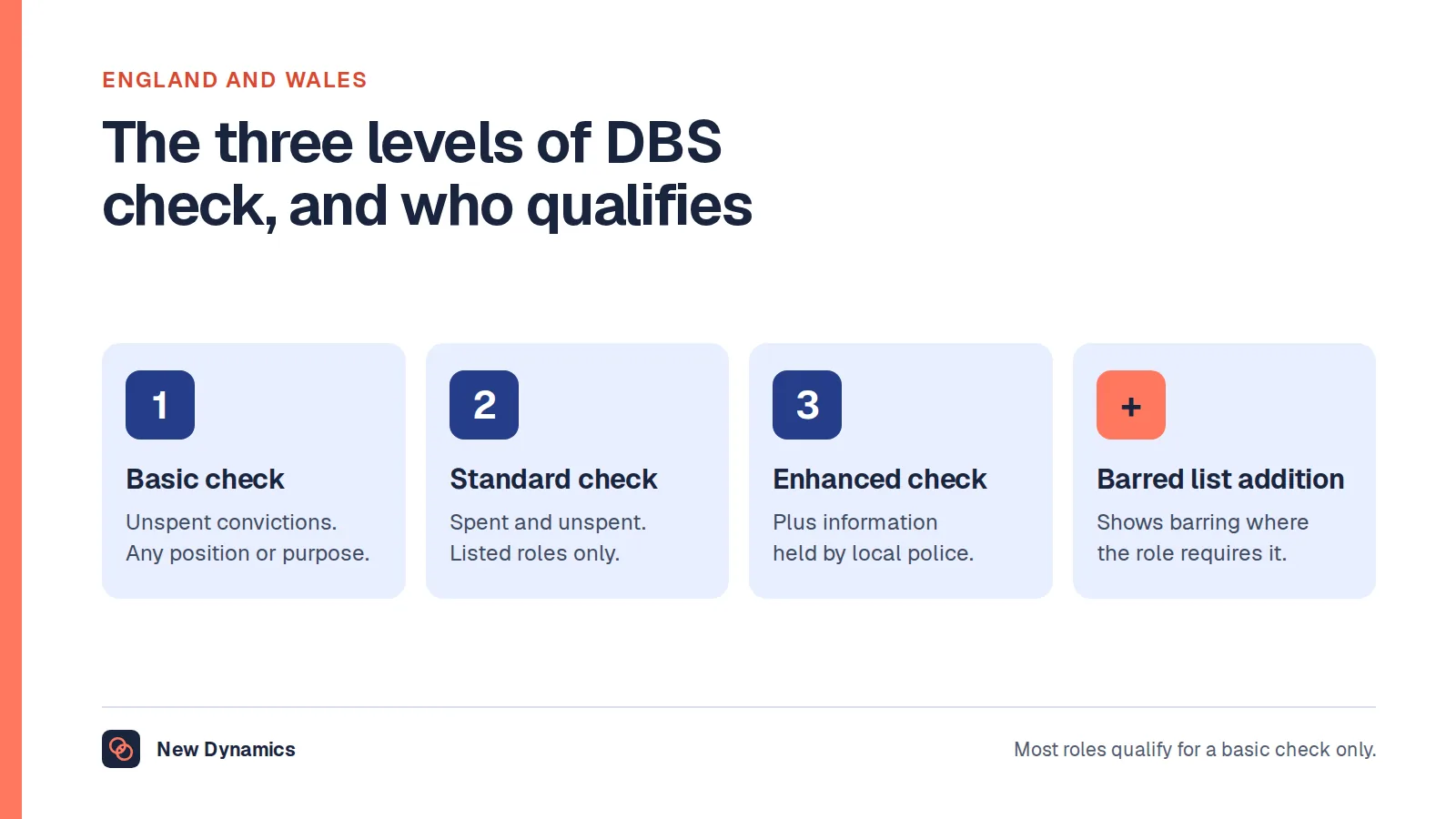
Check the references properly. For a role with payment access, take up references that confirm the actual duties and dates, speak to a named person rather than accepting a template letter, and ask the direct question about whether there were ever concerns about financial propriety. Think about proportionate pre-employment checks for a post with access to funds, and apply the same standard to every candidate for that post. Our post on background checks covers what is proportionate, what consent and transparency require, and where checks overreach.
Be honest in the advert. Say if the role is the whole finance function. Say what the month-end timetable demands. The candidate who takes the job knowing that is the candidate who stays.
Frequently asked questions
What is a finance administrator?
A finance administrator keeps an organisation's financial records accurate and on time. The work typically covers the purchase and sales ledgers, expense claims, payment runs, bank reconciliation, payroll input and a monthly reporting pack. In a small organisation it is often one person who handles every financial transaction, which makes approval limits and controls part of the job rather than an extra.
What are the main duties and responsibilities of a finance administrator?
Four groups. The ledgers, meaning supplier and customer invoices, coding, allocations and queries. Money in and out, meaning expenses, payment runs, bank reconciliation and petty cash. Payroll input, meaning hours, starters, leavers and pay changes passed to payroll by the cut-off. Reporting and records, meaning the month-end pack, filing, the audit trail and retention.
Is finance and administration a sensible combined role?
Yes, and it is common in charities, schools and owner-managed businesses. The risk is that the post becomes a dumping ground for every task nobody else owns. Write the finance and administration accountabilities as separate blocks with a rough weighting, name what is excluded, and review the split each year so the finance work is not quietly squeezed out.
What qualifications does a finance administrator need?
An AAT level 2 or level 3 qualification, or progress towards one, or comparable experience, is a reasonable requirement for most of these posts. A degree and a full chartered qualification are usually inflated requirements for transactional finance work, and naming a single software package rules out good candidates who would learn yours in a fortnight. State what you will actually accept, and what study support you offer.
Why does segregation of duties matter in this role?
Because one person should not both raise and approve a payment, and in a small team the finance administrator is close to every stage of the money. Where you cannot split every task, use compensating controls: a named second approver, bank payments released by someone else, supplier bank detail changes verified by telephone, an independently reviewed reconciliation and periodic sampling of the audit trail. This is general financial control good practice rather than a legal rule we are quoting.
How should I measure a finance administrator's performance?
On accuracy and timeliness rather than volume, using the month-end close as the rhythm. Track postings corrected after review, payments made outside the approval route, unexplained reconciling items carried forward, and whether the reconciliation, the close and the payroll input landed by their agreed dates. Treat a control weakness that the post holder reports as good performance.
Your next step: write the controls into the document
- Name the accounting system, the volumes, the bank accounts and the month-end timetable.
- Rewrite the duty list as the eight or so outcomes the role is accountable for.
- Decide the approval limits and the compensating controls, and put them in the document.
- Strip out the requirements you cannot justify, and say what you will accept instead.
- Set the practical exercise and the reference questions before you advertise.
For a structured way to run the whole vacancy, from the person specification to the selection decision, read and download our recruitment and selection guide. The guide is free to read, and the PDF uses our short download form.
Want approvals, month-end handoffs and objectives for a finance team in one place, with an audit trail you can show an auditor? Book a New Dynamics demo and bring your current job description. You can also email contact@new-dynamics.com.