TL;DR
- The formula is S squared times D, where S is the number of separate spells of absence in the period and D is the total number of days lost. The squaring is the whole point: it weights frequency far above duration.
- Ten days taken as one spell scores 10. The same ten days taken as ten single days scores 1,000. That is a hundredfold difference in the score from identical time lost.
- Acas says an employer should not use review points to trigger automatic disciplinary action, and that absence related to disability or pregnancy can be excluded from them. This article describes the United Kingdom position and is general information, not legal advice.
An employee takes ten days of sickness absence in a year. Whether that produces a score of 10 or a score of 1,000 depends entirely on how the ten days were arranged. That is the Bradford Factor working as designed, and it is also the reason it has to be handled carefully.
This article gives the formula, three worked examples, how trigger bands are usually set, and what Acas says about using review points at all. It describes the United Kingdom position and is general information rather than legal advice.
A pattern of short absences is usually a signal about the work or the person's health, and it is better discussed than scored. See how New Dynamics continuous feedback keeps those conversations on the record.
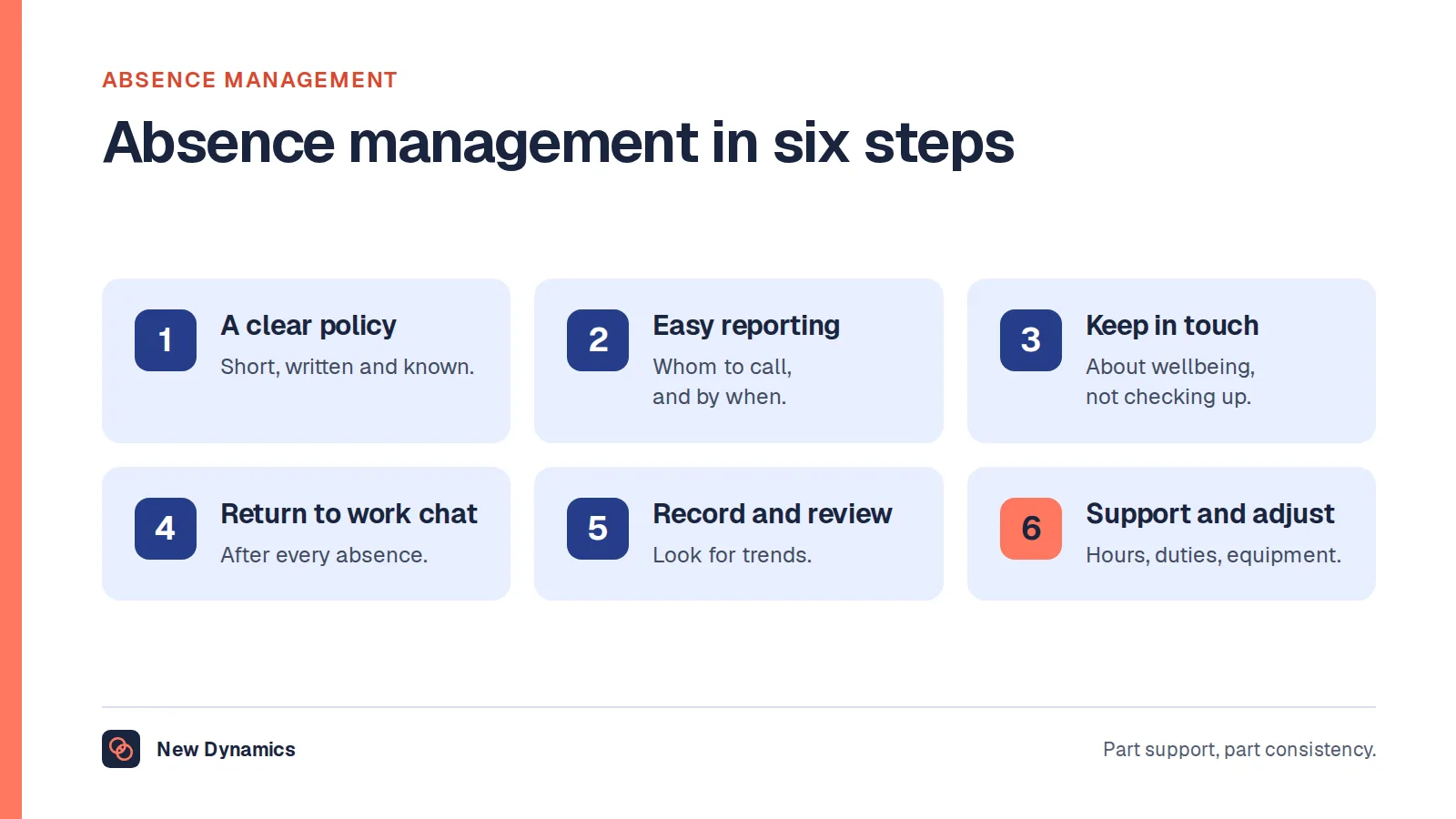
For the policy, the return to work conversation and the wider measures, our post on absence management covers the process this score sits inside.
The formula

Bradford Factor = S² × D
S is the number of separate spells of absence in the period. D is the total number of days lost across all of them. The period is usually a rolling twelve months, though some employers use six.
A spell is one continuous absence, however long. Three consecutive days off is one spell of three days, not three spells.
Squaring the spell count is the entire mechanism. It means the score rises with the square of how often somebody is away and only linearly with how long. An employer using it is stating, in arithmetic, that frequent short absence concerns them more than one long one.
Three worked examples
The same ten days lost, arranged three ways.
| Pattern | Spells (S) | Days (D) | Calculation | Score |
|---|---|---|---|---|
| One absence of ten days | 1 | 10 | 1 × 1 × 10 | 10 |
| Four absences, ten days total | 4 | 10 | 16 × 10 | 160 |
| Ten single days | 10 | 10 | 100 × 10 | 1,000 |
Three people have lost their employer exactly the same amount of working time. The scores differ by a factor of a hundred.
Two more, to show the other direction:
| Pattern | Spells (S) | Days (D) | Calculation | Score |
|---|---|---|---|---|
| One absence of sixty days | 1 | 60 | 1 × 60 | 60 |
| Three absences, six days total | 3 | 6 | 9 × 6 | 54 |
Two months away after an operation scores barely more than three short colds. If that ordering looks wrong to you, the Bradford Factor is the wrong measure for your organisation, and saying so is a legitimate answer.
How trigger bands are usually set
There is no national standard for Bradford Factor bands. Each employer sets its own, and they vary widely. A common shape looks like this.

- Up to 50. No action. Normal variation.
- 51 to 200. An informal conversation and a note of it.
- 201 to 500. A formal absence review.
- Over 500. A review under the absence procedure, with the outcome depending on the cause.
Those numbers are an example of a typical structure, not a rule. Whatever you choose, two things matter more than the thresholds: the bands have to be written in the policy before anyone is measured against them, and reaching one has to start a conversation rather than produce an outcome.
What Acas says about review points
Acas is clear that a trigger is a prompt, not a decision. Its guidance describes them plainly: "Some organisations have absence policies that set automatic triggers to review absence. They're sometimes called 'trigger points' or 'review points'."
On how they are used, the guidance states that "An employer should not use review points to automatically trigger disciplinary action for absence", and that employers "should set this out clearly in an absence policy".
On fairness, the same guidance says that "Being flexible with review points can help employers avoid discrimination", for example by adjusting them or by deciding "that absence related to disability or pregnancy will not count towards review points".
Acas guidance on supporting disabled people at work puts the same point as an adjustment: "Some adjustments might be around trigger points for absence, if the organisation uses a trigger point system", and gives two examples, "not counting some or all sickness absence related to a disability towards any trigger points" and "increasing the number of absences that will trigger a review".

The risk with a squared score is specific. A condition that produces regular short absences, such as a treatment cycle or a fluctuating condition, generates a high score quickly. An employer that acts on the score without asking why it is high is acting on the symptom of a disability.
Where the score is useful, and where it is not
It is useful as a way of noticing frequency, which a simple days-lost figure hides. One person losing ten days in ten separate absences genuinely needs a different conversation from one person losing ten days after surgery.
It is not useful as an outcome, a league table, a figure in a performance review, or a number shown to anyone who does not need it. It is also poor at part-time patterns, because a day is a day whether it is a three-hour shift or a ten-hour one.
It is not a diagnosis. A high score tells you to ask a question. The answers are usually a health condition, a caring responsibility, a commute, a workload, a shift pattern or a manager.
What to measure alongside it
- The absence rate. Working time lost as a share of time available, which our post on absence management sets out with a worked example.
- Frequency on its own, unsquared, which is easier to explain to a manager than a score.
- The reasons recorded, which is the only measure that tells you what to change.
- Patterns by team and manager, because absence that clusters in one team is rarely about the people in it.
- Return to work conversations held, which is the single most useful absence process an employer runs.
What usually goes wrong
- Using the score as the decision rather than as a prompt to talk.
- No written policy, so the first time an employee hears about a score is when it is used against them.
- Disability-related absence counted in, without considering an adjustment.
- Pregnancy-related absence counted in, which is a separate and serious problem.
- Applying one threshold to everyone, including part-time staff and people on shift patterns the measure was never designed for.
- Letting the score replace the manager. The score cannot ask how somebody is.
Frequently asked questions
What is the Bradford Factor formula?
The score is S² × D, where S is the number of separate spells of absence in the period and D is the total days lost. A spell is one continuous absence of any length, and the period is usually a rolling twelve months.
How do you calculate a Bradford Factor score?
Count the separate spells of absence in the period, square that number, then multiply by the total days lost. Four separate absences totalling ten days gives 4 × 4 × 10, which is 160.
Why does the Bradford Factor square the number of absences?
To weight frequency above duration. The design assumes short, frequent and unplanned absence disrupts an employer more than one long absence. Whether that assumption fits your organisation is a decision to make deliberately, not to inherit from a formula.
What is a high Bradford Factor score?
There is no national standard. Employers set their own bands, and a structure running from no action below 50 to a formal review above 500 is common. What matters is that the bands are published in the absence policy before anyone is measured against them.
Is the Bradford Factor legal in the UK?
Using a trigger system is not unlawful in itself. Applying it mechanically can be. Acas says review points should not automatically trigger disciplinary action, and that absence related to disability or pregnancy can be excluded from them. Seek advice on your own policy, because this article is general information rather than legal advice.
Should disability-related absence count towards a Bradford Factor score?
Acas gives not counting some or all disability-related sickness absence towards trigger points as an example of a reasonable adjustment, alongside increasing the number of absences that trigger a review. Decide the approach in the policy, record the adjustment, and apply it consistently.
Your next step: test your own policy
- Calculate the score for your three highest absence records from last year.
- For each, write down what the score would have caused to happen under your current policy.
- Check whether any of the three involves a condition that might be a disability, and whether an adjustment was considered.
- If the policy would have produced an outcome without a conversation, change the policy.
For the wider absence process this sits inside, read our post on absence management, or read and download our employee engagement guide for the conversations that prevent most of it. The guide is free to read, and the PDF uses our short download form.
Want the pattern visible to a manager before it becomes a score? Book a New Dynamics demo and bring your absence policy. You can also email contact@new-dynamics.com.