TL;DR
- A review answers whether someone did this job well. A promotion asks whether they can do the next one. The two questions use different evidence, and treating the first as an answer to the second is how organisations lose a strong specialist and gain a struggling manager.
- Readiness has four tests: evidence of next-level work already done, the scope and ambiguity they can hold, the behaviours the next level needs, and whether a role actually exists. Three of the four can be evidenced before anyone is promoted.
- Promotion decisions carry fairness obligations. Acas lists excluding someone from opportunities among the things that can disadvantage a person, says unintended discrimination still counts, and expects employees who are off work to be told about promotion opportunities.
The review says "exceeds expectations". The panel says no. Both can be right, and because nobody explains the difference, the employee concludes that the review was meaningless and the manager concludes that the panel is political.
This article covers why a strong review is not a promotion case, four tests for readiness with the evidence each needs, the fairness rules that promotion decisions attract, and how to run the conversation in each of the three possible outcomes. It describes the position in Great Britain and is general information, not legal advice.
Evidence of next-level work is easier to produce when it has been recorded all year. See how New Dynamics performance reviews keep goals and feedback together across cycles.
Performance and readiness are different questions

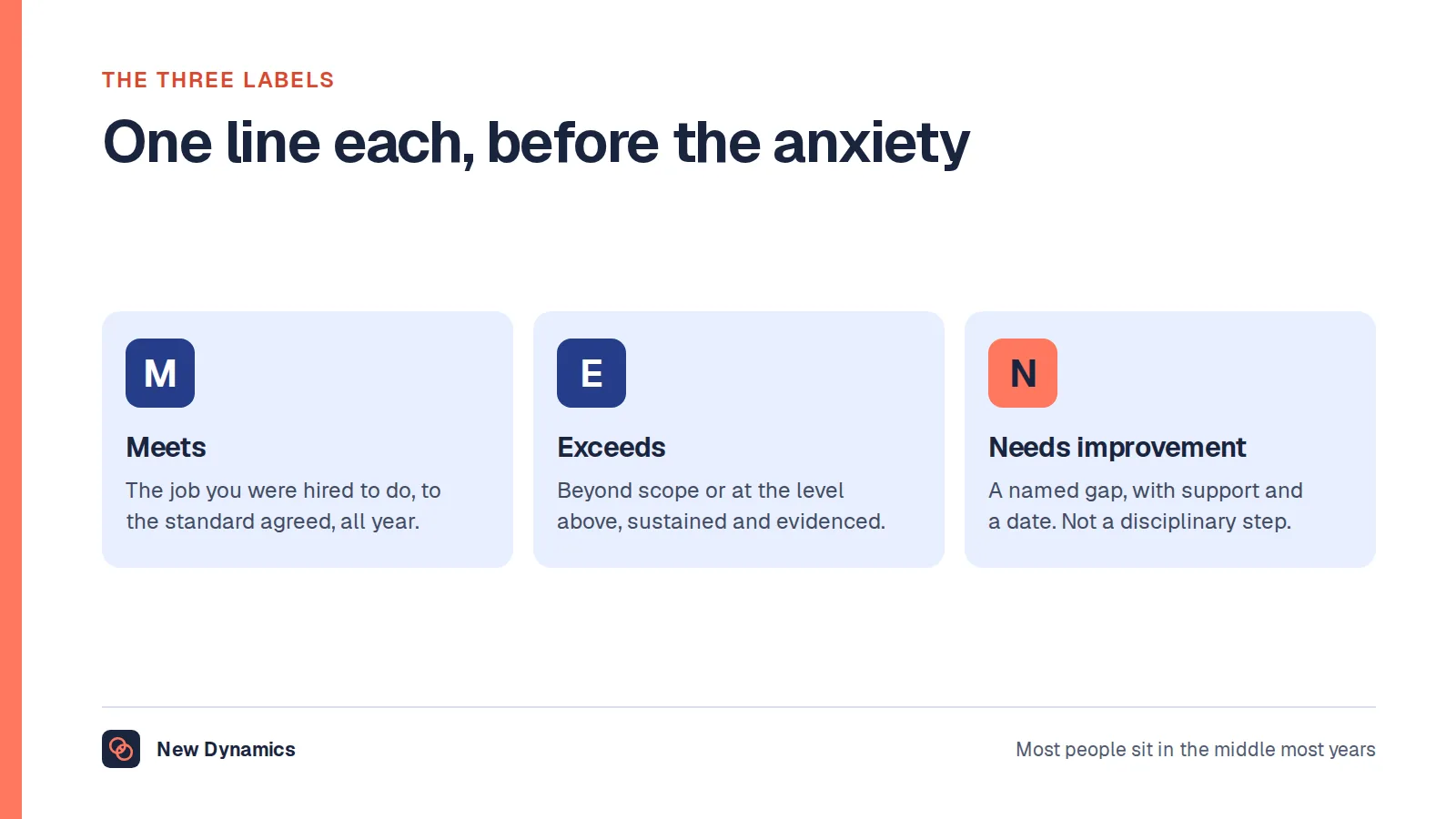
A review looks backwards at one role: were the objectives met, were the behaviours right, what support is needed. Our post on what meets expectations means covers how those labels are supposed to work.
A promotion looks forward at a different role. The question is not "was this year good" but "can this person do the job above, and is there one". Someone can be the strongest performer in a team and not ready, and someone rated solidly in the middle can be ready, because they have been doing parts of the next job all year without anyone noticing.
The classic failure is promoting the best individual contributor into a management job that needs different behaviours entirely. Our post on a first performance review as a new manager covers what that job actually involves.
Four tests for readiness

1. Evidence of next-level work already done. Not potential, not promise. Three concrete examples of work that belongs at the level above, with dates and outcomes. If none exist, the answer is "not yet" and the plan is to create the opportunities.
2. Scope and ambiguity. The next level usually means more stakeholders, less instruction and more decisions made without a clear answer. Ask what they did when the brief was unclear, and whether they escalated at the right moment rather than too early or too late.
3. The behaviours the level needs. Written down in advance, not improvised in the room. Our posts on core competencies and competency feedback examples cover describing them observably.
4. Whether a role exists. The least discussed and most common blocker. Promotion into a job that is not needed creates an unhappy person and a confused team, and the honest version of the conversation says so.
Three of the four are assessable from evidence before anyone commits to anything. Only the fourth is a business decision, and separating them keeps the conversation fair.
Make the assessment something other than a feeling
- Define the levels in writing, including two worked examples of the difference between adjacent ones.
- Use more than one assessor. Acas, writing about countering unconscious bias, recommends "at each stage, having more than one person sifting job applications, interviewing the applicants and deciding who gets the job", and the same logic applies internally.
- Allow time. Acas also lists "allowing time to make decisions, for example on recruitment, promotions or grievance and disciplinary outcomes" among the ways to avoid bias. Promotion rounds squeezed into a week produce decisions made on familiarity.
- Record the reason. Acas recommends "keeping a written record of why decisions were made", which is also the only way to give useful feedback afterwards.
- Use readiness language rather than scores. "Ready now", "ready in six to twelve months with specific experience", "not on this path, and here is why" are clearer than a rating, and harder to fudge.
What not to use: length of service on its own, visibility to senior people, how strongly a manager advocates, or the phrase "ready for a challenge", which means nothing and is usually said about someone the speaker likes.
The fairness part
Promotion is an opportunity, and opportunities are where discrimination law bites. Acas says less favourable treatment "might include: excluding someone from opportunities or benefits" and that "it can still be discrimination even if the less favourable treatment was not intended".
Three practical consequences:
- Part-time employees have the same rights here. Acas says part-time employees and workers should not be any worse off than a full-time comparator for "promotions, career breaks and job transfers", or for training and career development. A promotion process that quietly requires full-time hours needs examining.
- People who are away must be told. Acas says employers should update employees who are off work "about: promotion or other job opportunities", and warns that someone missing something important while off could in some circumstances be discrimination. That includes family leave and long-term sickness.
- Check the pattern, not just the case. Look at who has been promoted over three years by working pattern, location and, in aggregate with HR, by protected characteristic. A process that is fair in every individual decision can still produce a pattern worth understanding.
The three conversations
Ready now. Say it plainly, say what happens next and when, and do not let the process drift. An agreed promotion with no date is a resignation letter being drafted.
Not yet. The most common outcome and the most badly handled. It needs four things, and vague encouragement is not one of them.

- The specific gaps, named, with what good would look like.
- The work that closes them, which is the manager's job to find rather than the employee's to invent.
- A sponsor and a date. Who is making the opportunities happen, and when this is looked at again.
- Honesty about the role. If the blocker is that no position exists, say that rather than implying a development gap. People find out, and they forgive the facts faster than the fiction.
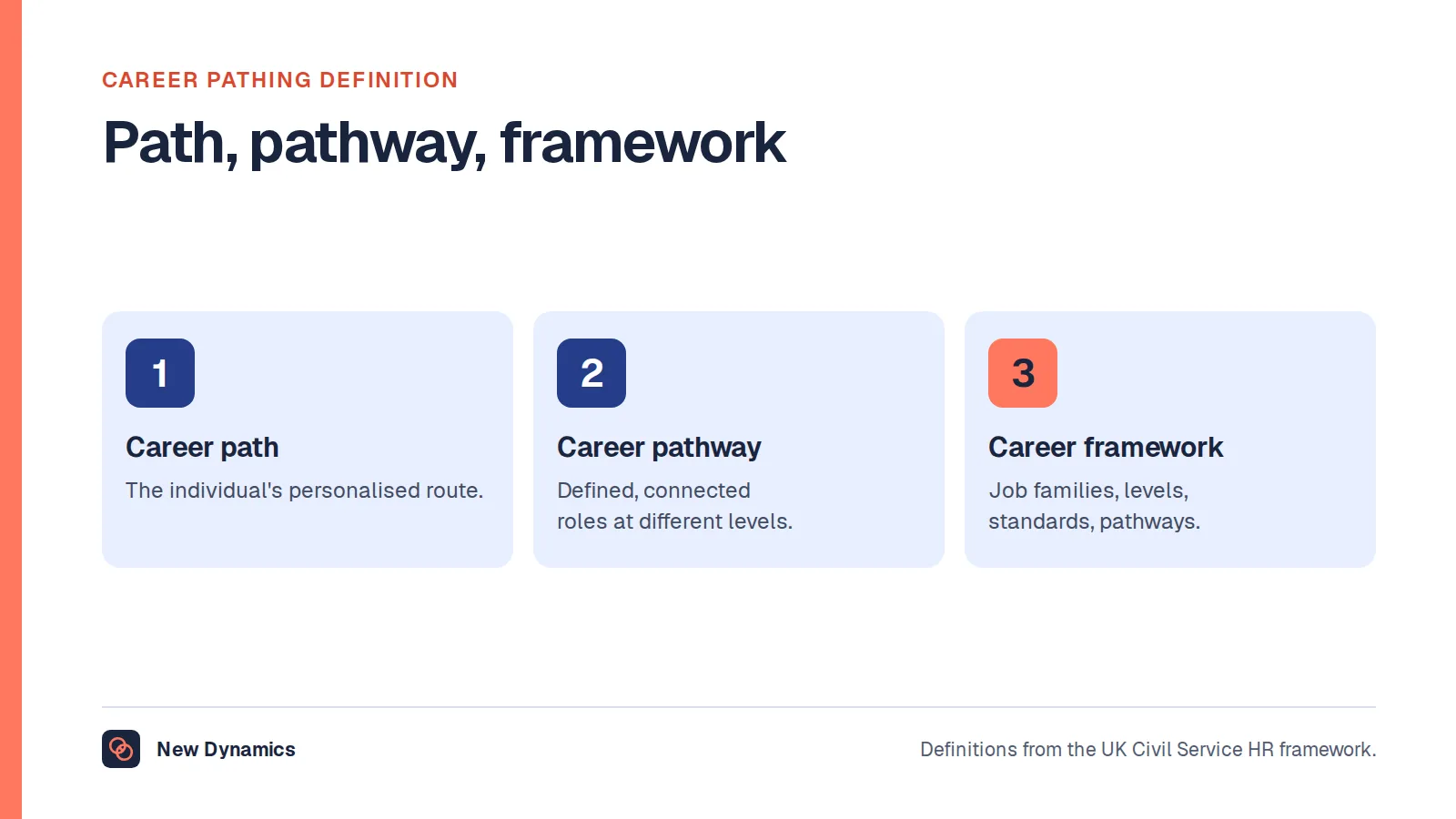
Not on this path. Rare and worth doing properly when it is true. Someone may be excellent in their current role and genuinely unsuited to the next one, or want a direction the organisation cannot offer. Say it kindly, early and once, and talk about the alternatives: a lateral move, depth rather than breadth, or an honest conversation about going elsewhere. Our post on career pathing covers the routes that are not upwards.
What HR should publish
The criteria for each level, who decides, how often promotion is considered, what evidence is expected, and what happens after a "not yet". Most of the suspicion around promotion is produced by the absence of those five facts rather than by the decisions themselves.
Frequently asked questions
Does a good performance review mean a promotion?
No. A review assesses how someone did in their current role; a promotion asks whether they can do a different one and whether that role exists. Strong performance is necessary and not sufficient, which is why promotion decisions need their own evidence: examples of next-level work, the scope the person can hold and the behaviours the level requires.
How do you assess promotion readiness?
Use four tests: evidence of work already done at the next level, how the person handles scope and ambiguity, the behaviours written down for that level, and whether a role exists. Assess the first three from evidence with more than one assessor, and treat the fourth as the business decision it is.
What should you say when someone is not ready for promotion?
Name the specific gaps, describe what closing them looks like, agree the work that will create the evidence, and set a date to look again with a named sponsor. If the real blocker is that no role exists, say so rather than implying a development gap.
Can part-time employees be passed over for promotion?
Not for being part-time. Acas says part-time employees and workers should not be any worse off than a full-time comparator for promotions, job transfers, or training and career development. A process that effectively requires full-time hours is worth examining with HR. This is general information, not legal advice.
Should someone on maternity or sick leave be considered for promotion?
They should be told about the opportunity and considered on the same evidence as anyone else. Acas says employers should update employees who are off work about promotion or other job opportunities, and warns that missing something important while off could in some circumstances be discrimination.
How do you avoid bias in promotion decisions?
Write the criteria down, use more than one assessor at each stage, allow enough time, and record the reason for every decision. Acas recommends all four as ways to counter unconscious bias, and the written record is also what makes useful feedback possible afterwards.
Your next step: separate the two questions
- Write the criteria for the level above one role in your team, with two worked examples.
- For anyone you would put forward, list three pieces of next-level work with dates. If you cannot, that is the answer for now.
- Check who has been promoted in the last three years by working pattern and location.
- Make sure anyone currently on leave knows about any open opportunity.
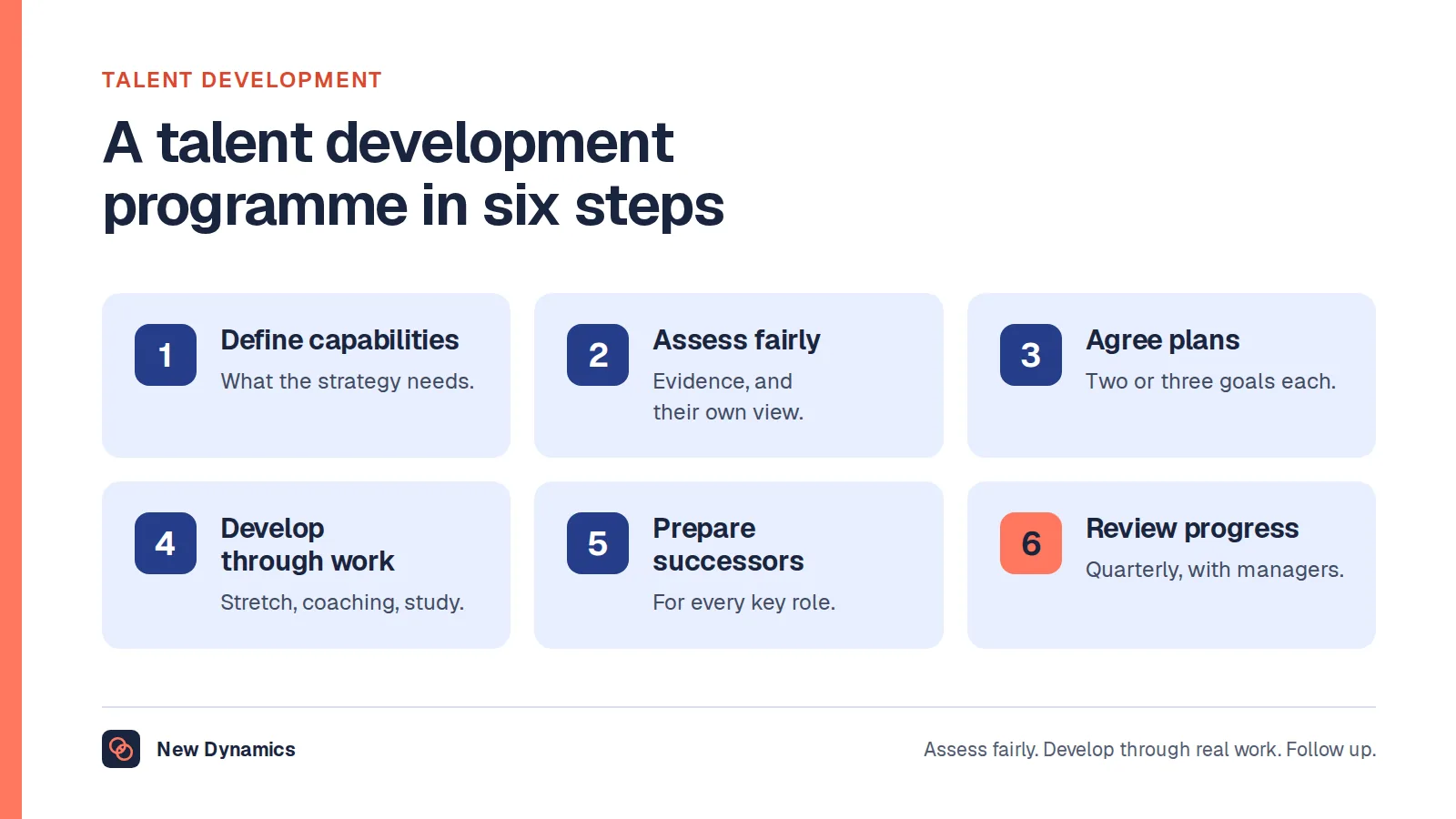
For the development side of this, read and download our career development guide. The guide is free to read, and the PDF uses our short download form.
Want evidence of next-level work gathered before the promotion round, not after? Book a New Dynamics demo and bring your level definitions. You can also email contact@new-dynamics.com.