TL;DR
- The Carer's Leave Regulations 2024 came into force on 6 April 2024 and give an employee one week of unpaid leave in any rolling 12 months to provide or arrange care for a dependant with a long-term care need. The minimum is half a working day, and regulation 5(4) says the leave need not be taken on consecutive days.
- An employer has no power to refuse. Regulation 8 allows postponement only, where the business "would be unduly disrupted", and only if the same amount of leave starts no later than one month after the earliest day requested, confirmed in writing.
- The notice test in regulation 7(3) is the longer of three days and twice the number of days or part days requested. Regulation 7(4) stops an employer asking for evidence of the dependant's care needs before granting the leave.
Someone in your team needs three afternoons over the next fortnight to move a parent with dementia into a care home. Nobody is ill that day. Nothing has gone wrong. There is no emergency to point at. Until April 2024 there was no statutory route for that absence in Great Britain, so it came out of annual leave, out of goodwill, or out of nowhere.
There is a route now, and it is narrower and more procedural than most handbooks suggest. This article sets out what the Carer's Leave Regulations 2024 say about the entitlement, who counts as a dependant, how the leave may be taken, the notice an employee has to give, and the single thing an employer may do with a valid request, which is move it. It covers Great Britain, and it is general information rather than legal advice.
Requests like this fail at the handover, not the decision. See how New Dynamics workflows let you shape the stages, forms and approvals around your own process, so a notice does not sit unread in a manager's inbox for a week.
Where carers leave comes from, and the date that matters
There are two dates, and mixing them up is the most common error in a policy document.
The Carer's Leave Act 2023 (c. 18) received Royal Assent on 24 May 2023. Its long title answers the pay question immediately: "An Act to make provision about unpaid leave for employees with caring responsibilities." The Act creates no entitlement by itself. It inserts sections 80J to 80N into the Employment Rights Act 1996 and requires the Secretary of State to make regulations. Those inserted provisions came into force on 4 December 2023, under the Carer's Leave Act 2023 (Commencement) Regulations 2023.
The right an employee can use arrived later. The Carer's Leave Regulations 2024 (SI 2024/251) were made on 28 February 2024, and regulation 1(2) states that "The Regulations come into force on 6th April 2024." Regulation 2(1) adds that they apply to employees "who give notice of an intention to take carer's leave on or after 6th April 2024". So 6 April 2024 is the date to cite.
Read regulation 1(3) before you publish anything company-wide: "The Regulations extend to England and Wales and Scotland." This is a Great Britain entitlement. If you employ people in Northern Ireland, check that position separately.
How much carers leave entitlement an employee gets
Regulation 5(1) is the core sentence. An employee who satisfies the conditions in regulation 4 "is entitled one week of carer's leave during the relevant period", as the published instrument words it. Regulation 3 defines "relevant period" as "a period of 12 months which ends on the last day of the carer's leave the employee has requested". That is a rolling look-back, not a leave year and not a tax year.
A week means the employee's own week, not five days. Regulation 6(1) sets it as the period the employee "is normally expected or required to work in a week at the time of making the request". GOV.UK puts it plainly: "if someone usually works 3 days a week, they can take 3 days of carer's leave."
Caring for two people does not double it. GOV.UK: "If an employee needs to care for more than one person, they cannot take a week of carer's leave for each dependant. They can only take one week every 12 months. They can use the week of leave on more than one dependant."
There is no qualifying period either. The conditions in regulation 4(2) concern the dependant, the purpose and the unused entitlement. Service does not appear. GOV.UK: "Employees are entitled to carer's leave from their first day of work for their employer."

Irregular hours and part-year workers
Where contractual hours vary week to week, or the employee works some weeks and not others, regulation 6(3) gives a week's leave as the total periods normally required in the relevant period "divided by 52". For someone employed at least one week but fewer than 52, regulation 6(4) divides by the weeks employed instead. Acas works it through: an employee who worked 780 hours in the previous 12 months divides by 52 and can take up to 15 hours of carer's leave.
Who counts as a dependant with a long-term care need
This is set by statute. Section 80J(2) of the Employment Rights Act 1996 says a person is a dependant of an employee if they:
- "are a spouse, civil partner, child or parent of the employee",
- "live in the same household as the employee, otherwise than by reason of being the employee's boarder, employee, lodger or tenant", or
- "reasonably rely on the employee to provide or arrange care".
The third limb is where a neighbour, a sibling or a friend fits. Note "reasonably rely". GOV.UK compresses this to "It can be anyone who relies on them for care", which is a fair summary but drops the reasonableness test in the statute.
A dependant has a long-term care need under section 80J(2)(b) if they have "an illness or injury (whether physical or mental) that requires, or is likely to require, care for more than three months", "a disability for the purposes of the Equality Act 2010", or they "require care for a reason connected with their old age". The disability limb carries no three month condition, so a disabled dependant qualifies on that ground alone.
How the leave can be taken
Three sentences in regulation 5 settle the shape of it. Regulation 5(2): "The minimum period of carer's leave an employee may take is half a working day." Regulation 5(3): "The maximum period of carer's leave an employee may take is one continuous week." Regulation 5(4): "Where an employee chooses to take carer's leave it need not be taken on consecutive days."
A working day, under regulation 5(5), is "the period in which an employee is normally expected or required to work on the day the leave is to be taken". A half day for a part time employee is half of that person's shift, not half of a notional 7.5 hours.
Carers leave notice: the test that applies
Regulation 7(2) says what a notice must do: state that the employee is entitled to the leave, specify the days and flag any part day, and be given "before the relevant date". Regulation 7(3) defines that date as "whichever is the earlier of" twice as many days in advance as the number of days or part days the notice relates to, or three days in advance. Earlier in the calendar means longer notice, so in practice the employee gives the longer of three days and double the leave requested. GOV.UK adds the detail that catches people out: "The notice period needs to be in full days, even if the request includes half day amounts."
Acas publishes the resulting table, in which a half day counts as a whole unit when you double it:
| Leave requested | Minimum notice |
|---|---|
| Half a day to 1 day | 3 days |
| 1.5 to 2 days | 4 days |
| 2.5 to 3 days | 6 days |
| 3.5 to 4 days | 8 days |
| 4.5 to 5 days | 10 days |
Two points matter more than the arithmetic. The request does not have to be in writing. And regulation 7(4) is blunt: "An employer cannot require an employee to supply evidence in relation to a request for carer's leave before granting the leave." No doctor's letter, no care plan, no proof of the relationship.
Short notice is not fatal. Regulation 7(5) lets the employer waive the timing requirement, and if the rest of regulation 7(2) is met the employee "is to be treated as having given notice in accordance with this regulation". A policy that reflexively rejects late notices throws away a power the Regulations gave the employer on purpose.

Postponement, not refusal
GOV.UK states the position in one sentence: "Employers cannot refuse a carer's leave request but can ask the employee to take it at a different time."
Regulation 8 is the only lever, and all five of its conditions have to be met. Notice must have been given under regulation 7. The employer must "reasonably consider that the operation of their business would be unduly disrupted" during the period in the notice. It must permit leave "of the same duration as the period identified in the employee's notice", starting on a date it sets "after consulting with the employee, which is no later than one month after the earliest day or part day" requested. It must give written notice stating the reason and the agreed dates. And that notice must go out "as soon as reasonably practicable but not later than the earlier of" seven days after the employee's notice or before the earliest day requested.
Here the official wording diverges, and the difference is not trivial. GOV.UK and Acas both describe the test as absence that "would cause serious disruption to the organisation". Regulation 8(b) says "unduly disrupted". The Regulations are the law and the guidance is guidance, so decide on "unduly disrupted" and treat the guidance phrasing as a plain English gloss.
Pay, the right to return, and protection
Carer's leave is unpaid. Section 80K(3)(b) of the 1996 Act excludes "terms and conditions about remuneration" from the terms preserved during leave, and regulation 9(2) repeats it. Regulation 9(3) narrows remuneration usefully: "only sums payable to an employee by way of wages or salary are to be treated as remuneration." Everything else continues, because regulation 9(1)(a) entitles the employee to "the benefit of all the terms and conditions of employment which would have applied if the employee had not been absent". Holiday accrues, pension and benefits run on.
Nothing stops you paying it. Regulation 14 handles the overlap with a contractual right: the employee cannot exercise both separately, but may "take advantage of whichever right is, in any particular respect, the more favourable".
Regulation 10(1) gives an employee returning from "an isolated period of carer's leave" the right to return to the same job, with seniority and pension rights as if they had not been absent. Regulation 11 entitles them not to be subjected to any detriment because they "took, sought to take, or made use of the benefits of, carer's leave", or because "the employer believed the employee was likely to take carer's leave". Belief alone triggers it. Regulation 12 makes a dismissal for those reasons automatically unfair under section 99, and regulation 12(2) extends the same protection to redundancy selection. Note what is missing from regulation 12: any service requirement.
Carers leave and time off for dependants are different rights
Do not merge these in a handbook. A reader who conflates them takes the wrong one.
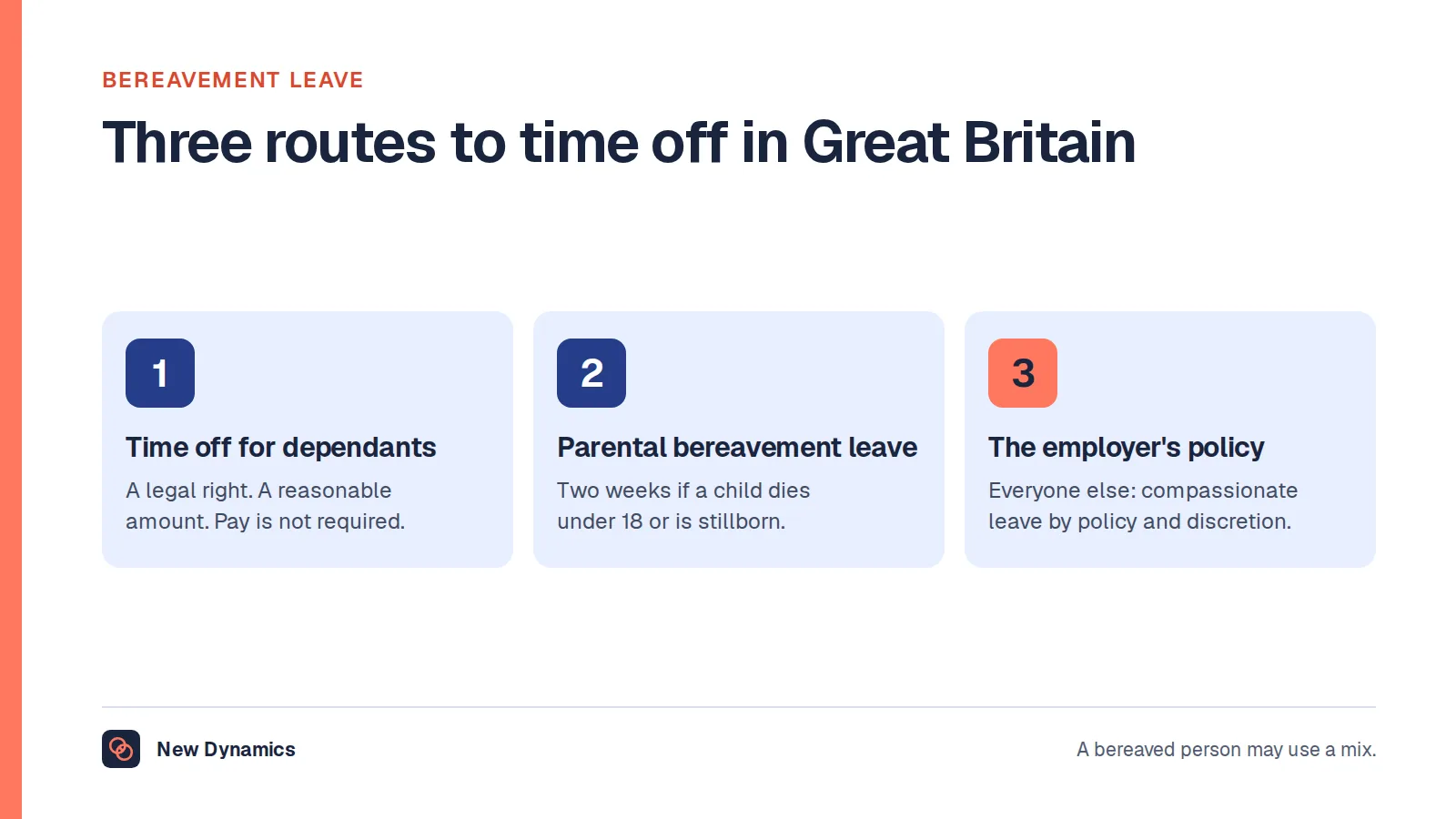
Time off for dependants is the emergency right. GOV.UK describes it as time off "to deal with an emergency involving a dependant", with "a reasonable amount of time off to deal with the emergency, but there's no set amount of time as it depends on the situation". There is no notice period and no cap: "There are no limits on how many times you can take time off for dependants." It is also expressly unavailable for the foreseeable: "You cannot have time off if you knew about a situation beforehand." That is the gap carer's leave now fills.

The scale is published even though take-up is not. In its bulletin Unpaid care, England and Wales: Census 2021, released on 19 January 2023, the Office for National Statistics reported that "In England and Wales an estimated 5.0 million usual residents aged 5 years and over provided unpaid care in 2021, this is an ASP of 9.0%". ASP means age-standardised proportion. No official source publishes how many employees have taken carer's leave since 6 April 2024, so this article does not give a take-up figure. For the figures we do hold, see our HR statistics hub.
What to put in your own policy
- The date and the instrument. Name the Carer's Leave Regulations 2024 and 6 April 2024, so nobody argues from an older handbook.
- Your own week. State how a week converts for each working pattern you employ, including variable hours and term time staff.
- The notice table, and the waiver. Reproduce it, then say that you may waive late notice under regulation 7(5), and who decides.
- No evidence. Write down that managers must not ask for proof. This is the rule most often broken in good faith.
- Postponement, with a named approver. Record the "unduly disrupted" test, the one month limit and the seven day written notice. Give it to one role, not every line manager.
- Whether you pay it. Silence reads as unpaid.
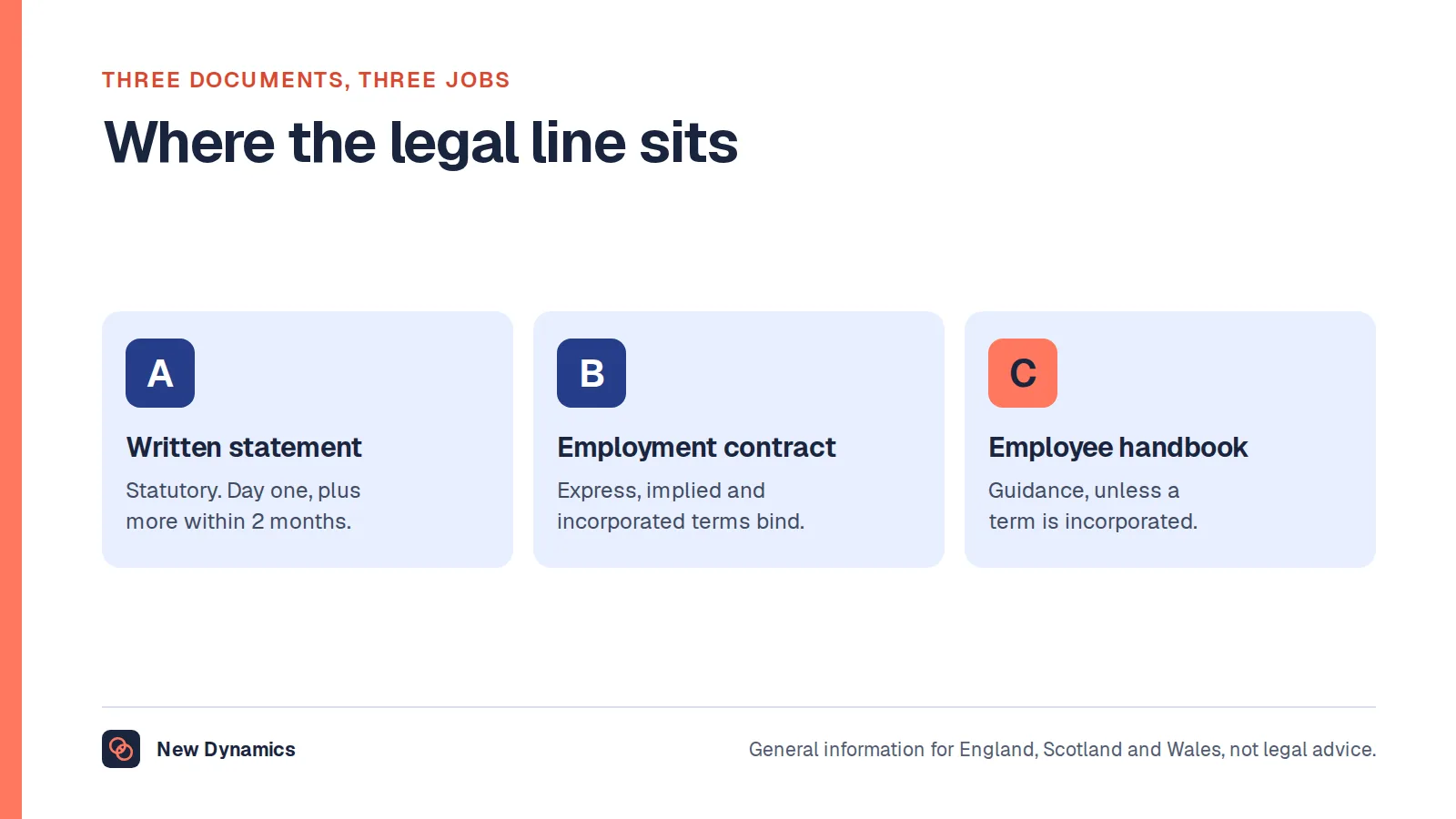
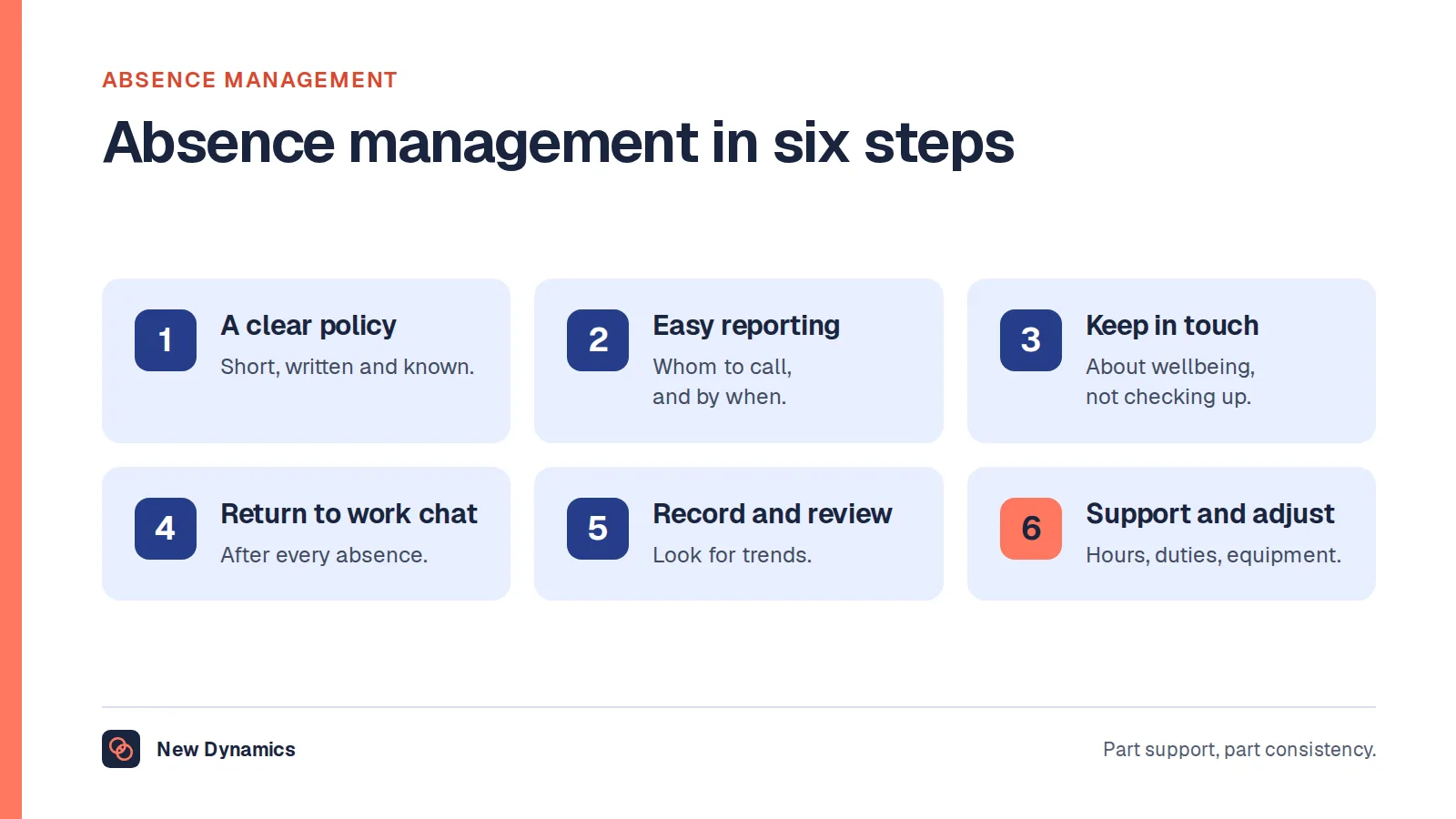
Treat it as one chapter of a leave policy, not a standalone document. Our posts on absence management and a leave of absence cover the surrounding process, and the employee handbook is where this belongs.
Frequently asked questions
Is carers leave paid?
No. The Carer's Leave Act 2023 is described in its own long title as an Act about unpaid leave, and section 80K(3)(b) of the Employment Rights Act 1996 excludes terms about remuneration from those preserved during the leave. An employer may choose to pay it, and regulation 14 lets an employee rely on whichever right is more favourable in any particular respect.
How much carers leave can an employee take?
One week in any rolling 12 months, under regulation 5(1) of the Carer's Leave Regulations 2024. A week means the time the employee normally works over seven days, so three days for someone who works three days a week. Caring for more than one dependant does not increase it.
Is carers leave a day one right?
Yes. The entitlement conditions in regulation 4(2) say nothing about length of service, and GOV.UK states that employees are entitled to carer's leave from their first day of work for their employer.
What notice does an employee have to give for carers leave?
The longer of three days and twice the number of days or part days requested, counted in whole days, under regulation 7(3). Three days for a half day or a single day, four days for two days, six days for three days. The request does not have to be in writing.
Can an employer refuse carers leave?
No. GOV.UK says employers cannot refuse a request but can ask the employee to take it at a different time. Regulation 8 allows postponement only, where the employer reasonably considers the business would be unduly disrupted, and only if it offers the same amount of leave starting within one month of the earliest day requested and confirms the reason and new dates in writing.
Can an employer ask for proof of the dependant's care needs?
No. Regulation 7(4) states that an employer cannot require an employee to supply evidence in relation to a request for carer's leave before granting the leave.
What is the difference between carers leave and time off for dependants?
Carer's leave is planned leave for a dependant with a long-term care need, needs notice, and is capped at one week per rolling 12 months. Time off for dependants is for an emergency, needs no notice period, has no cap, and is not available where the employee knew about the situation in advance.
Does carers leave apply across the United Kingdom?
Regulation 1(3) states that the Regulations extend to England and Wales and Scotland. Employers with staff in Northern Ireland should check that position separately.
Your next step: three checks on your current policy
- Search your handbook for "carer". If the only hit is emergency time off for dependants, you are missing a right that has existed since 6 April 2024.
- Work out a week of carer's leave for your three most awkward working patterns, and write the answers down before someone asks.
- Name the single role that can postpone a request, and give that person the five conditions in regulation 8 on one page.
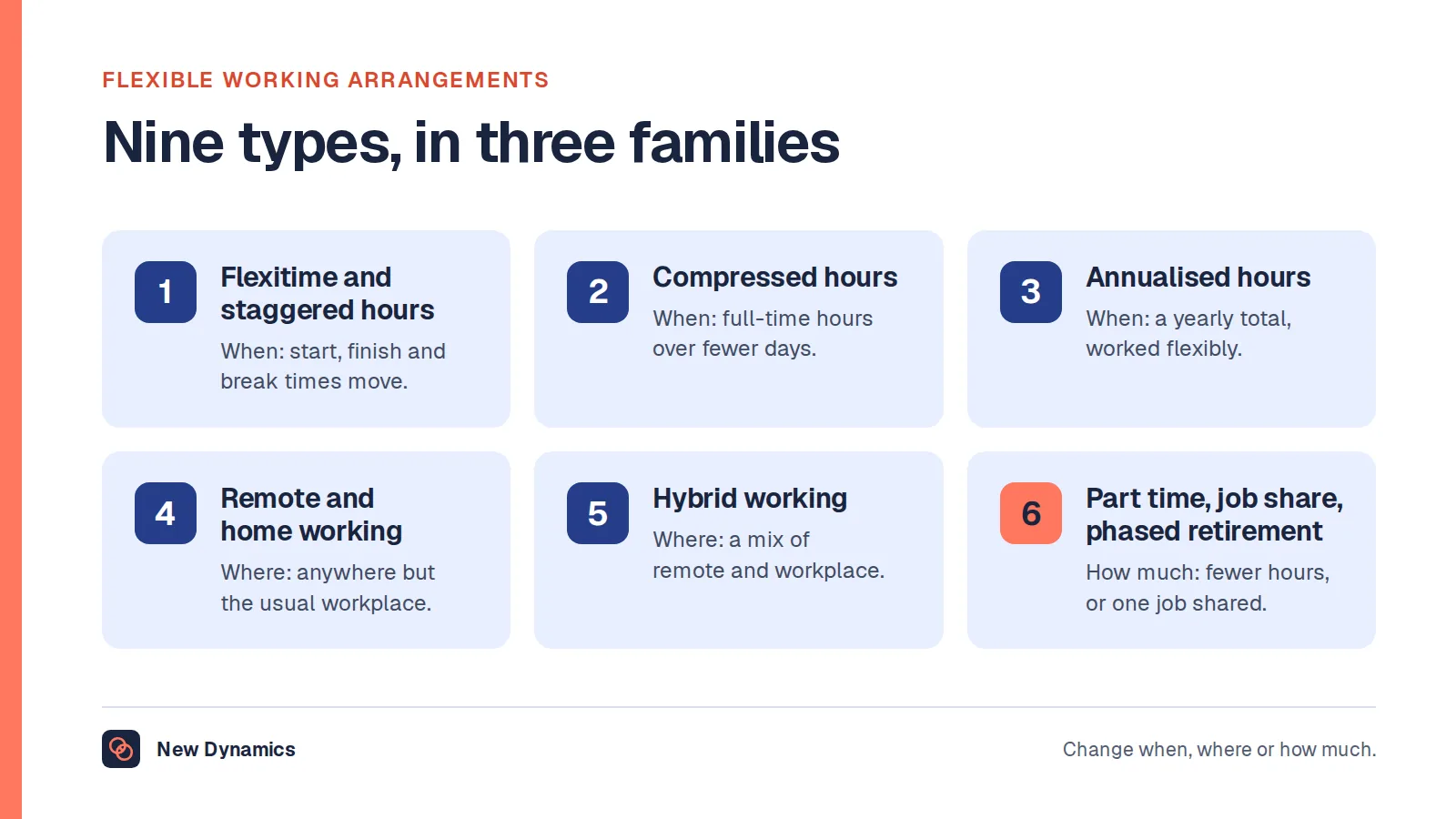
Policies only work when a manager can find them. Read and download our employee handbook guide for the structure that keeps rules like this findable, and see flexible working arrangements for the longer term option many carers actually need.
Want the notice, the approval and the record to live in one place instead of three inboxes? Book a New Dynamics demo and bring your current leave policy. You can also email contact@new-dynamics.com.