TL;DR
- A clinic coordinator is an administrative role that makes a clinic run: building the lists, moving patients along a pathway, keeping records straight, ordering stock and holding the rota. NHS Health Careers describes the family plainly: NHS administrative staff “provide business support to clinical and non-clinical staff”.
- A clinical coordinator is a different job. NHS Health Careers says of clinical management that “You’ll already be a trained healthcare professional, such as a nurse or allied health professional”, and puts that career typically at Agenda for Change band 6 or 7. A clinic coordinator needs no clinical registration.
- No official source publishes a salary for the title “clinic coordinator”, because it is an employer title and not an NHS role profile. Where the post is NHS banded, the Agenda for Change rates published from April 2026 give band 4 as £28,392 under three years' experience and £31,157 at three years or more.
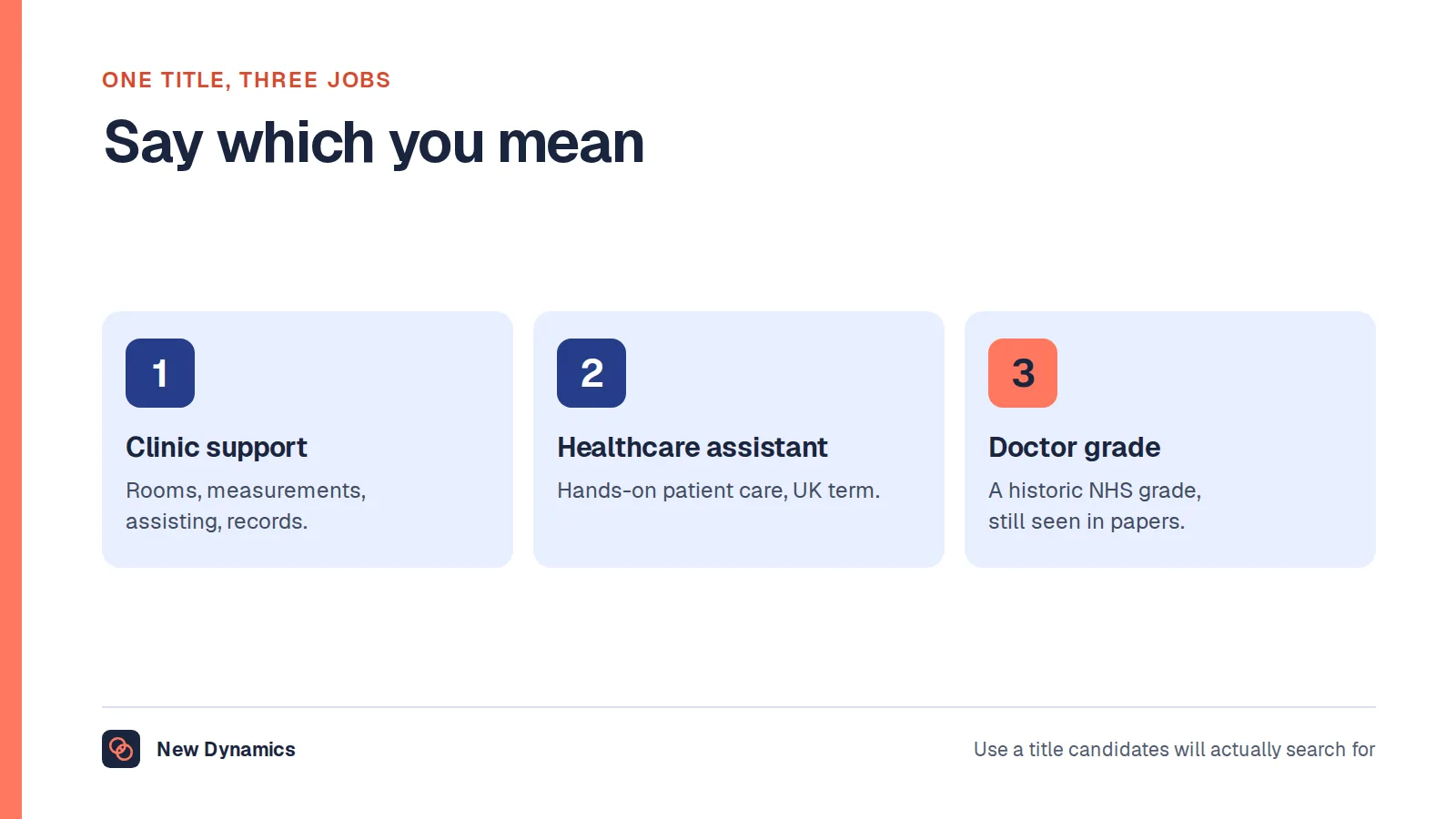
Four job titles arrive on the same desk and get treated as one. Clinic coordinator, clinical coordinator, practice manager, medical secretary. In a regulated setting the difference between two of them is a professional registration.
This article explains what a clinic coordinator is in the United Kingdom: the duties, how the role differs from those three titles, the entry routes, the reporting line, and what is and is not published about pay. It describes roles, and it is not legal or clinical advice.
Reporting lines are where this role goes wrong most often, because a coordinator sits between an administrative manager and a clinical lead. See how New Dynamics org charts keep the line manager and the professional lead on one record rather than inferred from a rota.
What a clinic coordinator actually does
A clinic coordinator is an administrative post. The job is to make a clinic session happen: the right patients, in the right order, in a room that is ready, with the notes present, the kit stocked and enough staff on shift.
NHS Health Careers sets out the family it belongs to on its administration roles page: "NHS administrative staff provide business support to clinical and non-clinical staff." That page lists the family as clerk, health records staff, receptionist, secretary/typist, medical secretary or personal assistant, and telephonist.
Notice what is missing. "Clinic coordinator" is not on the list. It is an employer title, built locally, usually for a senior administrator running the operational side of one clinic or specialty. That is why there is no official profile or salary to look up, and why the job description has to do the work an official profile would otherwise do.
Clinic coordinator or clinical coordinator?

Get this right before you advertise. It changes the person specification completely.
A clinical coordinator coordinates clinical practice. The role sits in clinical management, and NHS Health Careers is blunt about the starting point on its clinical manager page: "You'll already be a trained healthcare professional, such as a nurse or allied health professional." It says that in the NHS "your career in clinical management would typically start at Agenda for Change band 6 or 7, with some positions at band 5".
A clinic coordinator coordinates the clinic. No registration, no clinical decisions, no delegated clinical tasks. The test: if the work described would need a professional register, the post is clinical. If it is scheduling, records, stock, rotas and pathway administration, it is not.
Against a practice manager
A practice manager runs a business. NHS Health Careers describes the role on its practice manager page: "You'll manage the business and operational aspects of the surgery, making sure that patients are at the centre." The duty list includes "business planning", "handling financial systems for the practice, including payroll" and "selecting, training and supervising non-clinical staff".
The overlap is appointment systems, which that page also names. The difference is scope: a practice manager owns the budget, the contracts and the employment of non-clinical staff. A coordinator owns the sessions.
Against a medical secretary
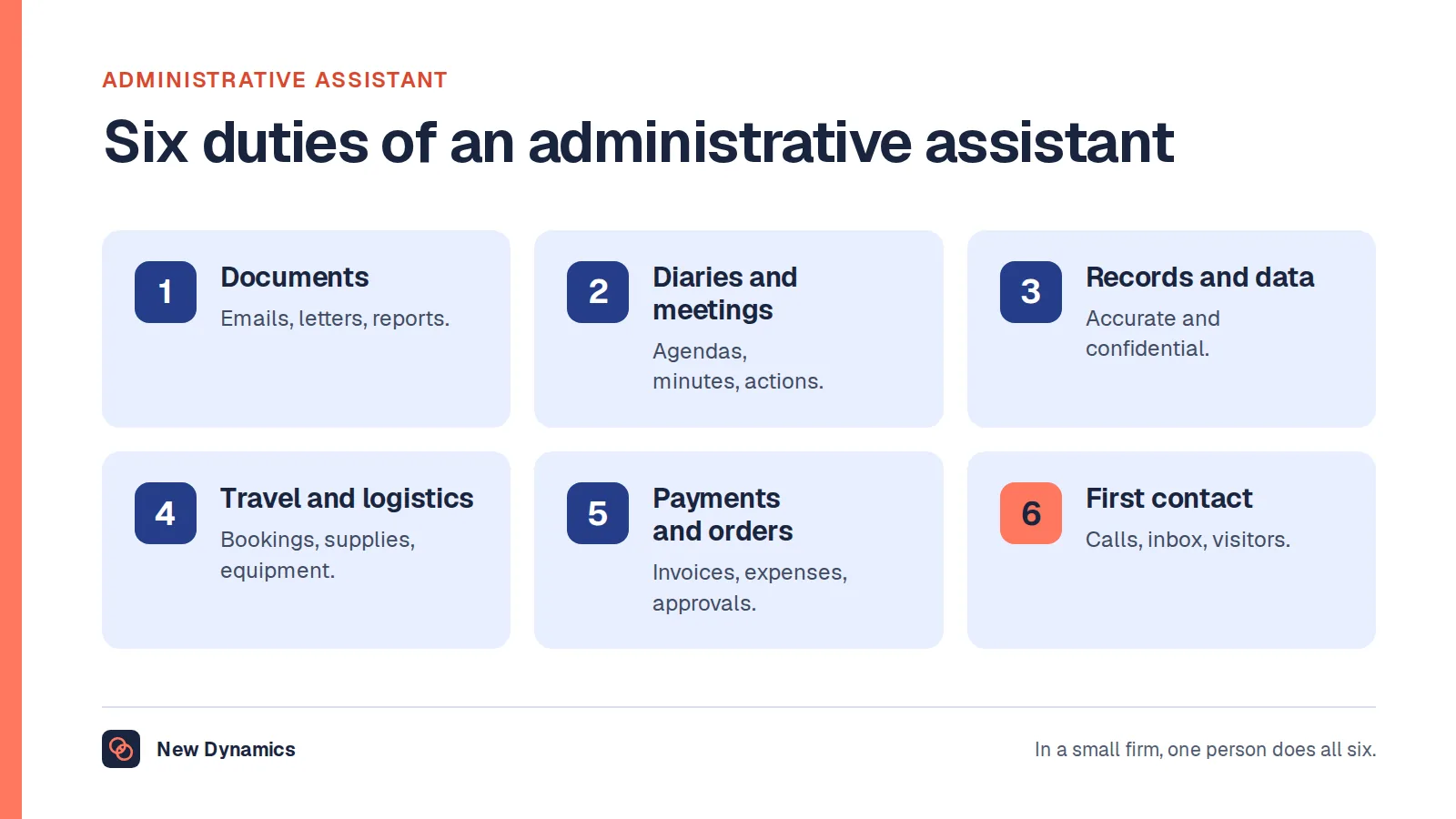
A medical secretary supports clinicians. The National Careers Service medical secretary profile lists tasks including "organise a doctor's diary, book consulting rooms and meetings", "manage a waiting list of patients" and "update patient records and deal with confidential information".
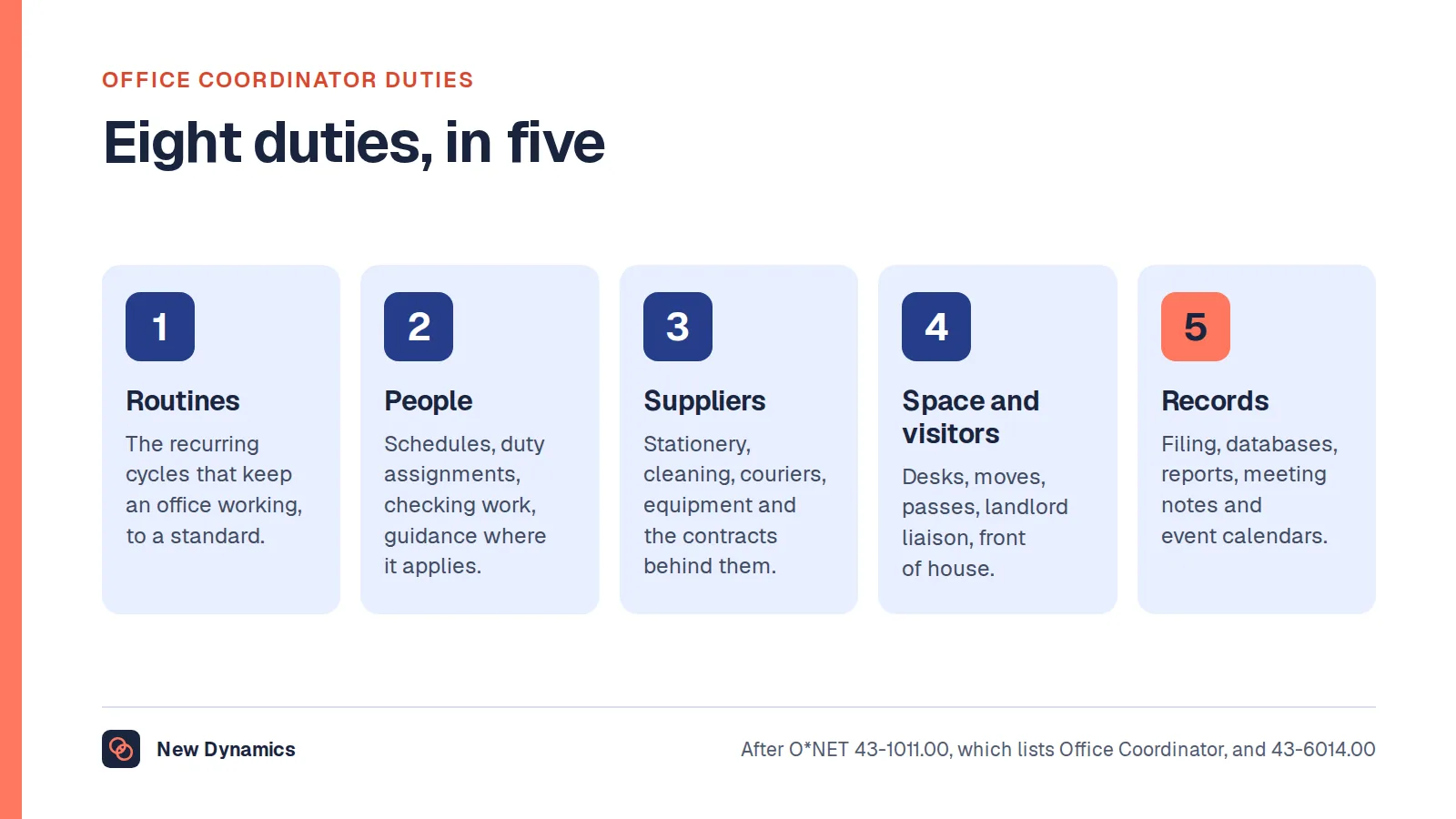
The overlap on diaries, waiting lists and records is real. The difference is the unit of work. A secretary's work follows a consultant or team. A coordinator's work follows a clinic session: all its clinicians, rooms, equipment and staffing. Our posts on the office coordinator role and the administration manager role cover the general versions of the same split.
The duties, in five groups

- Scheduling clinics and lists. Build session templates, set appointment lengths by type, load the lists, hold urgent capacity, manage cancellations and fill same-day gaps.
- Patient pathway administration. Track patients from referral through triage, appointment, investigation, review and discharge. Chase the step that has not happened and say when someone is stuck.
- Records and information governance. Keep notes, results and letters complete and attached to the right patient, with access limited. NHS Health Careers puts it neatly for health records staff: clerks "use systems and follow procedures to make sure that information about a patient is only seen by those who need to see it."
- Stock, equipment and the environment. Order consumables, check expiry dates, log faults, book maintenance and calibration, and confirm a room is usable before a session starts.
- Staff rotas. Build and publish the rota, arrange cover, confirm the skill mix and escalate when it is short. For how absence feeds a rota, see our post on absence management.
Group five is where authority must be written down. Someone who can build a rota but cannot book bank cover is not coordinating anything.
Where the published rules attach
The coordinator is rarely the duty holder. The employer is. But a coordinator's day is made of the tasks that keep the employer compliant.
Health data is special category data. The ICO's guidance on what is special category data states that "The UK GDPR singles out some types of personal data as likely to be more sensitive", and the list given extra protection includes "data concerning health". Need-to-know access is not a habit in this role, it is the role.
Records and staffing are regulated where the service is registered. Care Quality Commission Regulation 17: Good governance requires that "providers must securely maintain accurate, complete and detailed records in respect of each person using the service and records relating to the employment of staff and the overall management of the regulated activity". Regulation 18: Staffing says "Sufficient numbers of suitably qualified, competent, skilled and experienced persons must be deployed in order to meet the requirements of this Part". Whoever builds the rota works at the sharp end of that.
A registered service has a named registered manager. Regulation 7, as the CQC guidance stood at its last update on 16 May 2025, states that "A person (M) shall not manage the carrying on of a regulated activity as a registered manager unless M is fit to do so", with "the necessary qualifications, competence, skills and experience to manage the carrying on of the regulated activity". A clinic coordinator is not normally that person. Say so, and name who is.
Safety duties sit with the employer. HSE guidance on managing risks and risk assessment at work, last updated 24 March 2025, states: "As an employer, you're required by law to protect your employees, and others, from harm." The minimum under the Management of Health and Safety at Work Regulations 1999 is to identify hazards, judge the risk, and "take action to eliminate the hazard, or if this isn't possible, control the risk". In a clinic the coordinator often sees the hazard first, so write their reporting duty down.
Qualifications and entry routes

There is no licence and no mandatory qualification. NHS Health Careers sets the baseline for the administration family: "For any admin role you need a good standard of literacy and numeracy. Employers usually ask for GCSEs (or equivalent) in English and maths", adding that IT skills matter "as so many NHS systems are IT-based now".
Four routes get people in: direct application with administration experience; an apprenticeship, which the National Careers Service names for the nearest profile as an "Administration Assistant Level 2 Intermediate Apprenticeship, or Business Administrator Level 3 Advanced Apprenticeship", taking "between 1 and 2 years"; a college course in medical administration or the T Level in Management and Administration; and internal promotion from reception or health records, which is how most coordinators arrive.
Progression is published too. NHS Health Careers says of administration: "You could stay in administration, perhaps by becoming a team leader or supervisor. You could go on to become an administration manager." Ask for two things that are not qualifications: medical terminology, and competence on the patient administration system you actually run.
Reporting lines
Write two lines, not one. A document with only one of them creates the standing argument about whose priority wins.
- Line manager: sets objectives, approves leave, handles conduct and appraisal. Usually an administration, service or practice manager.
- Clinical lead: whose judgement sets the session rules, including appointment lengths, urgent slots and what may be moved.
- Who the coordinator supervises: receptionists, clerks or bank administrators, named by role.
- Escalation route: for short staffing, stuck patients, equipment failure and missing records, plus the deputy for when that person is away.
- The registered manager, where the service is registered.
The test: on a day when the clinical lead wants a patient added and the line manager has capped the list, does the coordinator know what to do?
What is published about pay, and what is not
No official source publishes a salary for the title "clinic coordinator". There is no NHS role profile and no national benchmark, because the title is set by individual employers. Any figure quoted for it comes from an advert or an aggregator, not from a publisher of pay data.
Where the post is NHS banded, Agenda for Change applies. NHS Health Careers publishes Agenda for Change pay rates and calls them "a guide only to NHS Terms and Conditions of Service (Agenda for Change) pay rates from April 2026", covering "all staff except doctors, dentists and very senior managers". On those rates, band 3 is £25,760 under two years' experience and £27,476 at two years or more; band 4 is £28,392 under three years' experience and £31,157 at three years or more. The same page gives high cost area supplements effective 1 April 2026, with Inner London at "20% of basic salary, subject to a minimum payment of £5,794 and a maximum payment of £8,746". Coordinator posts commonly sit at band 3 or 4, but the band follows job evaluation of the actual post, so read the advert. For more published workforce figures, see our HR statistics.
Outside the NHS, Agenda for Change does not apply. In private hospitals, independent clinics and dental practices, pay is whatever the employer sets, and no official source publishes a figure. Even general practice is mixed: NHS Health Careers notes of practice managers that "Most are employed directly by the partners of the practice but some practices run on Agenda for Change (AfC) terms and conditions." Benchmark against the administrative grades you already pay.
A clinic coordinator job description template
Job title: Clinic coordinator, [specialty or service]
Reports to: [administration or service manager]
Works to the clinical direction of: [clinical lead]
Supervises: [receptionists, clerks, bank administrators]
Purpose: Plan and run the clinic's sessions so patients are seen in the right order, in a prepared room, with complete records and adequate staffing.
Responsibilities
- Build and maintain clinic templates, appointment types and session lists.
- Load lists, hold urgent capacity, manage cancellations and fill short-notice gaps.
- Track patients between pathway steps and escalate anyone who is stuck.
- Keep records, results and correspondence complete and accessible only to those who need them.
- Order and check stock, and log faults, maintenance and calibration.
- Prepare rooms and equipment and confirm readiness before sessions.
- Build and publish the rota, arrange cover and escalate shortfalls.
- Report hazards, incidents and near misses through [route].
Decision rights: may [approve bank cover up to X shifts, move a non-urgent appointment] without prior approval. Must refer [overbooking a capped list, changing an appointment length, releasing information] to [role].
Checks and training: [background check level], information governance training before system access.
Essential: administration experience, GCSE English and maths or equivalent, competence on [patient administration system].
Fill the brackets in before you advertise. An unfilled bracket is the part a new starter guesses at.
How the role is measured
- Capacity used: sessions run against sessions planned, slots used against slots available.
- Short-notice fill rate: how often a cancellation was reused the same day.
- Pathway breaches and stuck patients, counted and explained.
- Records completeness at the start of a session, sampled.
- Rota notice, in days published in advance.
Avoid making patients seen per session a coordinator's personal target. The clinical team controls how long a patient takes, and squeezing the parts a coordinator does control is how the safety margin goes.
Frequently asked questions
What is a clinic coordinator?
An administrative role responsible for making a clinic's sessions happen: building and loading the lists, moving patients along their pathway, keeping records complete and correctly restricted, ordering stock, preparing rooms and building the staff rota. It involves no clinical treatment and no clinical decisions.
What is the difference between a clinic coordinator and a clinical coordinator?
Registration. A clinical coordinator works in clinical management, and NHS Health Careers says of that career that you will already be a trained healthcare professional, such as a nurse or an allied health professional. A clinic coordinator is an administrator and needs no registration, so an advert asking for a nurse is describing a clinical post.
Is a clinic coordinator the same as a practice manager?
No. NHS Health Careers describes a practice manager as managing the business and operational aspects of the surgery, including business planning, financial systems and payroll, and supervising non-clinical staff. A coordinator runs the sessions. Small practices often combine the two, but the scopes differ.
How does a clinic coordinator differ from a medical secretary?
By unit of work. A medical secretary supports a clinician or team, and the National Careers Service lists tasks such as organising a doctor's diary, booking consulting rooms and managing a waiting list. A coordinator's work follows a clinic session: all its clinicians, rooms, equipment and staffing. The diary, waiting list and records duties do overlap.
What qualifications do you need to be a clinic coordinator?
None are mandatory. NHS Health Careers says that for any administration role you need a good standard of literacy and numeracy, and that employers usually ask for GCSEs or equivalent in English and maths. Routes in include direct application, an Administration Assistant Level 2 or Business Administrator Level 3 apprenticeship, a T Level in Management and Administration, and promotion from reception or health records.
What does a clinic coordinator earn in the UK?
No official source publishes a salary for this job title, because it is an employer title rather than a published NHS role profile. Where the post is NHS banded, Agenda for Change applies: the rates published from April 2026 give band 3 as £25,760 under two years' experience and £27,476 at two years or more, and band 4 as £28,392 under three years' experience and £31,157 at three years or more. Outside the NHS, Agenda for Change does not apply and no official source publishes a figure.
Who does a clinic coordinator report to?
Usually two people: an administrative line manager who sets objectives and does the appraisal, and a clinical lead whose judgement sets the session rules. Name both, along with the escalation route for staffing shortfalls, stuck patients, equipment failures and missing records, and who the registered manager is.
Your next step: write the two reporting lines first
- Name the line manager and the clinical lead separately, and say which one decides what.
- Write the decision rights: what the coordinator may do without asking, and what must be referred.
- Fill in the five duty groups with local detail, including the patient administration system by name.
- State the band and the pay scale if the post is banded, or say plainly that pay is set locally.
- Write the escalation route, including the deputy.
Because this role handles health data every day, set the access and training expectations from a written position rather than from habit. Read and download our employee data protection guide for the structure. The guide is free to read, and the PDF uses our short download form.
Want reporting lines, training records and appraisals in one record rather than four spreadsheets? Book a New Dynamics demo and bring your current clinic coordinator job description. You can also email contact@new-dynamics.com.