TL;DR
- Competency boxes defeat managers because the heading is an abstraction. Start by writing what good looks like here in observable terms, then the examples write themselves.
- Every comment needs a source. Communication lives in writing people kept or forwarded, teamwork in what colleagues say and in who gets asked for help, and attention to detail in rework, corrections and the checks that caught something.
- Where a competency is genuinely weak, the follow-up is an objective rather than an adjective. Acas sets the test: specific, measurable, achievable, relevant and time-bound, with any training the person needs.
A review form with three competency headings and a blank box under each is where good managers run out of words. The work was fine. The heading says "Communication". What is there to write that is not "a good communicator"?
This article gives wording for the three competencies people get most stuck on, with strengths and development versions of each, the evidence behind them, and a way to turn a vague line into one that survives being read by someone who was not there.
Competency comments are easier to write when the behaviours are recorded through the year. See how New Dynamics performance reviews pull goals, feedback and notes into one conversation.
First, say what good looks like here

A competency heading is an abstraction, and abstractions produce adjectives. One sentence fixes it, written before you fill anything in:
- Communication: the audience could act on it without a second exchange.
- Teamwork: the people around them finished faster because of them.
- Attention to detail: what reached the customer was right the first time.
Those are observable, which means they can be evidenced, discussed and improved. Write the equivalent sentence for your own organisation, because the right answer differs between a design studio and a payroll team.
Communication
Strengths
- Rewrote the release note so support could answer customer questions without escalating; escalations during releases dropped from routine to rare.
- Flagged the supplier delay on the day it was known, with the two options and a recommendation, which left the team a week to choose.
- Runs the Monday call in fifteen minutes with a written summary afterwards, which is why people who miss it are not lost.
- Changed the way the handover is written after the night team said they were reading the same background three times.
- Can explain the pricing model to a customer and to an engineer in the same week, differently, and both leave with the same answer.
- Asked for the problem to be restated at the start of a difficult meeting, which stopped two people arguing about different things.
Development
- Status updates describe what was done rather than whether the date still holds, so the reader has to ask the question that matters.
- The specification was accurate and eleven pages long; the team acted on the first two. Lead with the decision needed.
- When the deadline moved, three of the five affected people heard it secondhand. Decide who needs telling before you decide what to say.
- In meetings, the first version of an idea is the one that gets defended. Leaving space for a second one would make the discussions shorter.
- Written replies to customers are correct and terse enough that several ask a follow-up to check nothing is wrong.
- Hard news is softened until the point is hard to find. The sentence "the migration will slip to the fifteenth" can come first.
Where the evidence is. Things people forwarded or kept, the questions that came back, handover notes, meeting outcomes, and whether anybody had to ask a second time.
Teamwork
Strengths
- Covered two weeks of a colleague's work during a family emergency and wrote down what they learned about the process, which the team still uses.
- Is the person three others ask when they are stuck, and answers without making it a transaction.
- Raised a disagreement with a peer directly and early, in a way that left the working relationship intact.
- Volunteered to pair with a new starter for the first fortnight, which halved the time before their first solo release.
- Brings the quiet person into the discussion by asking them a direct question rather than waiting for a gap.
- Took the unglamorous half of the project so the deadline would hold, and said so to nobody.
Development
- Finishes their own work and stops, while two colleagues finish late each week. Ask what else is outstanding before you close the laptop.
- Took over a colleague's task to speed it up, which was faster once and left them further behind.
- Information from client calls stays in their notes. The team needs a short written version within a day.
- Disagreements surface in retrospectives rather than at the time, by which point everyone has rebuilt the story.
- Works well with the two people they like and visibly less with the third. The work does not get to choose the pairing.
- Delegates the task but keeps the decision, so the other person stops at every fork.
Where the evidence is. What colleagues say when asked something better than "are they a team player", who gets asked for help, how handovers read, and what happened the last time something went wrong at short notice. If a team is pulling against itself, check structure before character: HSE names Relationships, "promoting positive working to avoid conflict and dealing with unacceptable behaviour", and Role, "whether people understand their role within the organisation and whether the organisation ensures that they do not have conflicting roles", among the six areas of work design that managers control.
Attention to detail
Strengths
- Caught the duplicated client record before the invoice run, which would have been a credit note and an apology.
- Numbers in the monthly pack have matched source data for six months, including through the system change in the spring.
- Added the checking step to the process after one near miss, and wrote it down so it survived them being on leave.
- Reads the brief twice and asks the one question that saves the rework, usually before anyone has started.
- Their documents arrive without the small errors that make a client wonder about the big ones.
- Spotted that two reports counted the same adjustment differently, which had been true for a year.
Development
- Three of the last five packs needed a figure corrected after sending. A check against the source before it goes would catch it.
- The work is right and the formatting is inconsistent, which makes the reader slow down and look for other problems.
- Copy-and-paste left last quarter's date in two places in the board paper. Build a final read into the routine.
- Accuracy drops in the last hour before a deadline, which suggests the schedule rather than the care. Start the final check earlier.
- The analysis was correct and the assumptions were not written down, so nobody else could check it.
- Edge cases are discovered by customers rather than in testing. Agree what gets tested before the work starts.
Where the evidence is. Rework, corrections after sending, customer-reported errors, the checks that caught something, and how often work comes back.
One caution: where detail errors cluster under time pressure, the problem may be the schedule rather than the person, and where they are constant, the person may need training. Acas is clear that employers "must provide 'adequate resources' to enable an employee to do their job", including training.
Turning a vague line into one that holds up

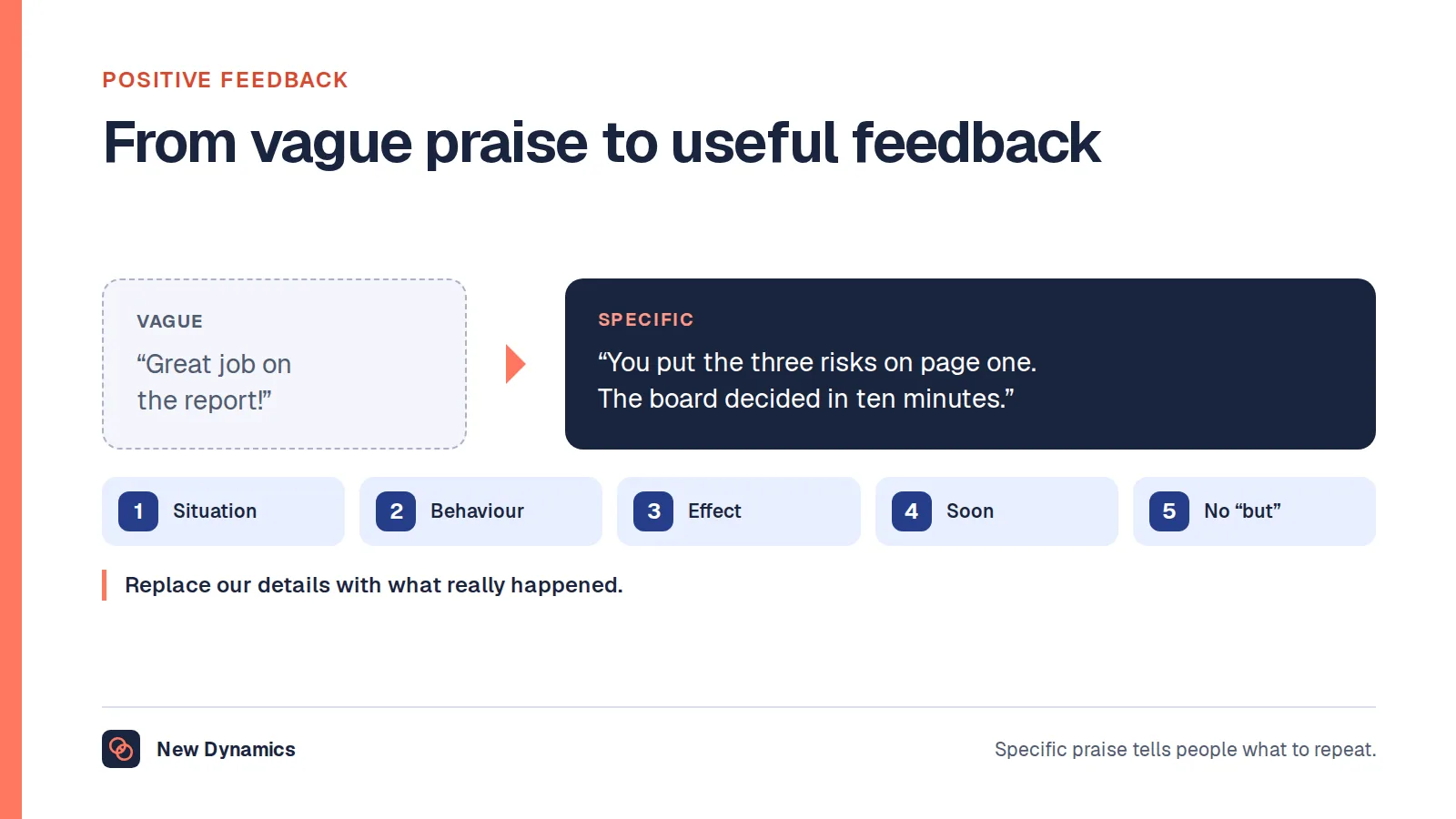
- "Needs to improve communication" becomes "status updates say what was done but not whether the date holds; include the date position in every update from now on."
- "Great team player" becomes "covered two weeks of a colleague's work in March and documented the process afterwards, which the team still uses."
- "Must pay more attention to detail" becomes "three of five packs needed a figure corrected after sending; add a check against source before the pack goes out."
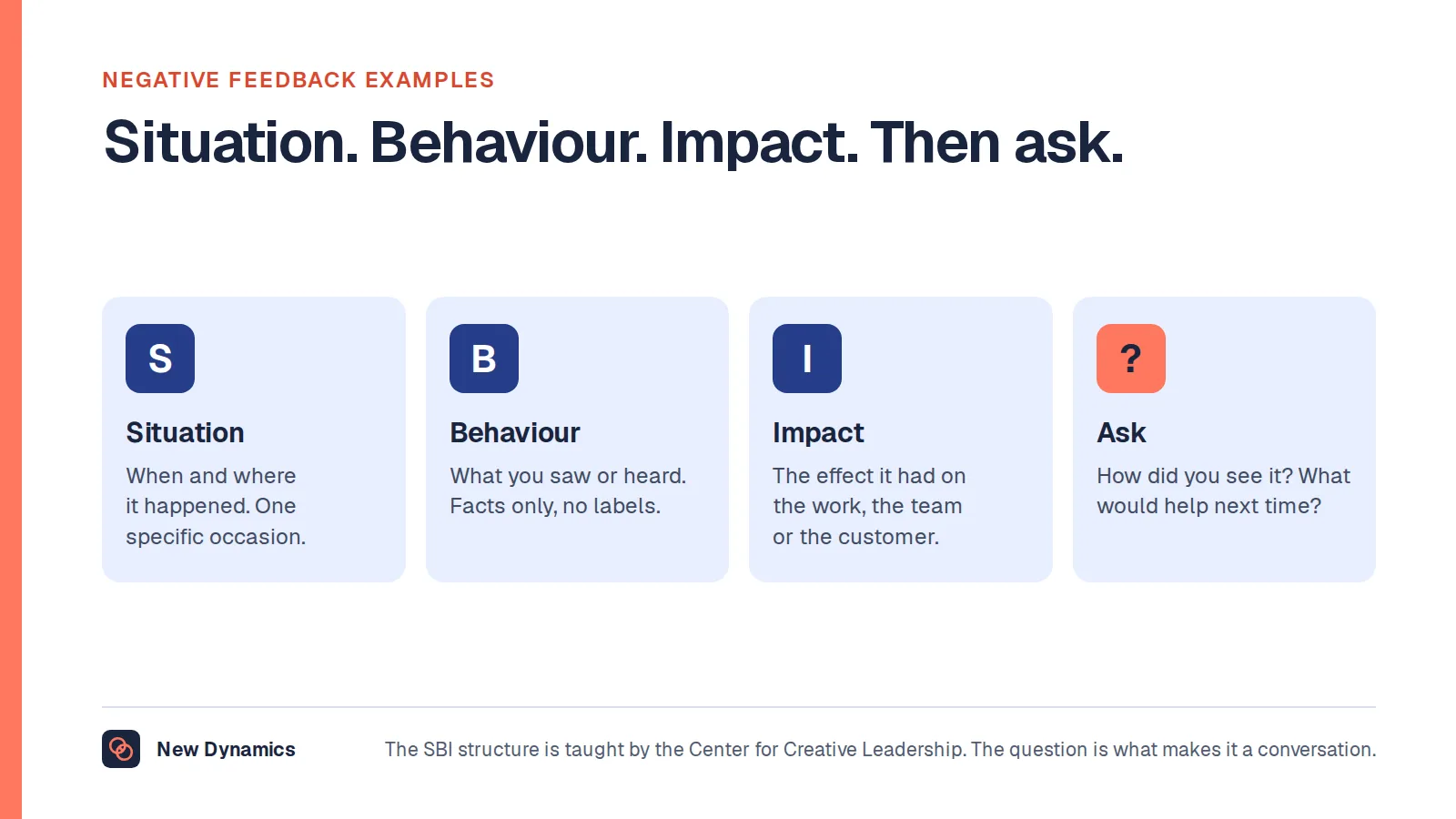
The pattern in all three: a moment, a consequence, and a next action. Our negative feedback examples and positive feedback examples posts have more wording for conversations rather than forms.
Where the evidence lives

Most competency comments fail because nobody looked anywhere before writing them. Fifteen minutes in the right places produces better material than an hour of thinking:
- What people kept, forwarded or quoted tells you about communication.
- Who gets asked, and what colleagues say to a specific question, tells you about teamwork.
- Rework, corrections and near misses tell you about attention to detail.
- Your own one-to-one notes tell you about all three, which is why fifteen minutes of writing after each conversation is the highest-value habit a manager has.
Then set the objective, not the adjective
Where a competency is genuinely weak, finish with something checkable. Acas says objectives should be specific, measurable, achievable, relevant and "time-bound - with a reasonable time-frame for achieving them", and that a review is also the place to discuss "whether they need more support or training". "Improve communication by the next review" is neither. "Every status update states whether the date still holds, from Monday, reviewed at the end of the quarter" is both.
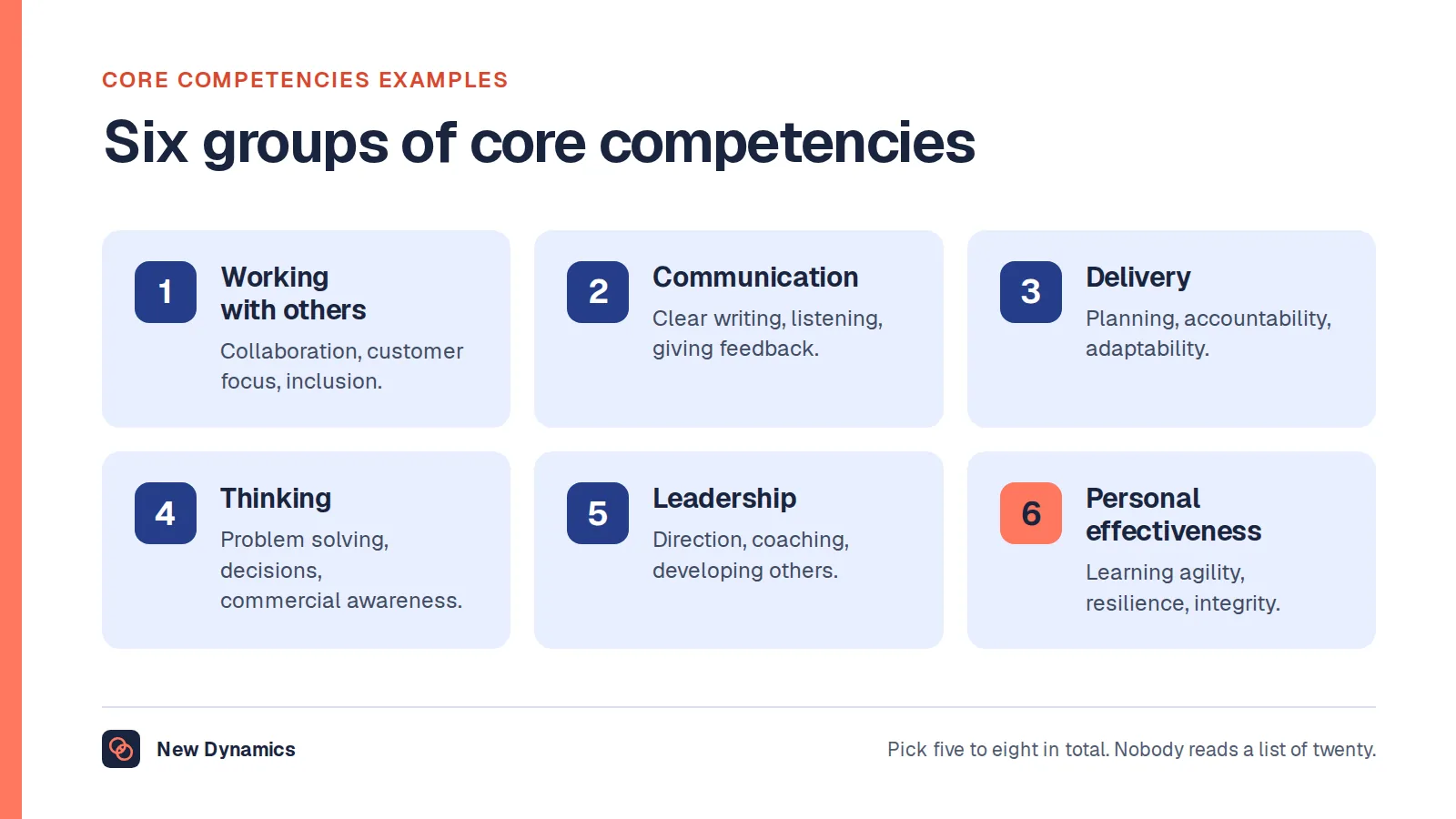
For defining the competencies themselves, rather than writing about them, see our post on core competencies.
Frequently asked questions
What are good examples of feedback on communication skills?
Specific ones tied to an audience and an outcome: "rewrote the release note so support could answer customer questions without escalating" as a strength, or "status updates say what was done but not whether the date still holds" as a development point. Avoid "good communicator", which tells the reader nothing and the person even less.
How do you write feedback about teamwork?
Describe what the people around them experienced. Who asked them for help, what happened when a colleague was stuck or absent, and whether disagreements were raised at the time or saved for the retrospective. If a whole team is struggling, check role clarity and conflicting priorities before writing about individuals.
How do you give feedback on attention to detail?
Use the record rather than the impression: corrections after sending, rework, customer-reported errors and near misses caught. Say what to change, such as a check against source before a pack goes out. If errors cluster under time pressure, the schedule may be the cause rather than the person.
Where do you find evidence for competency feedback?
Four places. What people kept or forwarded, for communication. Who gets asked for help and what colleagues say to a specific question, for teamwork. Rework and corrections, for attention to detail. Your own one-to-one notes, for all of it, which is why writing notes after each conversation matters so much.
What should you not write in a competency review?
Adjectives with no moment attached, comparisons to named colleagues, judgements about personality, and instructions nobody can act on such as "be more proactive". If a line could be written about half the team without checking anything, it is not feedback.
How do you turn competency feedback into an objective?
Make it checkable. Acas says objectives should be specific, measurable, achievable, relevant and time-bound, and that reviews should cover whether someone needs support or training. "Every status update states whether the date still holds, from Monday, reviewed at the end of the quarter" is an objective; "improve communication" is a wish.
Your next step: fill the boxes with evidence
- Write one sentence under each competency heading on your own form saying what good looks like here.
- Spend fifteen minutes in the four evidence places before you write anything.
- Draft each comment as a moment, a consequence and a next action.
- Read your drafts and delete every line that could be about anyone.
For a worksheet that turns behaviours into feedback and development actions, read and download our competency-based feedback guide. The guide is free to read, and the PDF uses our short download form.
Want behaviours captured through the year so the competency boxes write themselves? Book a New Dynamics demo and bring your current form. You can also email contact@new-dynamics.com.