TL;DR
- A transcriptionist turns recorded speech into an accurate written record. The work splits into five fields that share a craft and almost nothing else: medical, legal, media and subtitling, research interviews and general business. Say which one your vacancy is, because the formats, the terminology and the accuracy standard differ in each.
- The role is measurable, which is unusual for administrative work. Accuracy as errors per thousand words on a sampled check, turnaround from file received to transcript returned, working minutes per audio minute, and compliance with the house format give you four standards you can agree in writing before the first file arrives.
- Transcription means handling recordings that contain personal data, and in the medical case special category data. The ICO says you "must apply at least one lawful basis whenever you are keeping records of your workers' personal information", and that special category information needs you to "identify a special category condition (under Article 9 of the UK GDPR)" as well. This article is general information about the United Kingdom and not legal advice.
A recording is not a record. It is forty minutes of overlapping speech, a cough on the key sentence, two people called Sarah and a drug name that sounds like three other drug names. Somebody has to turn that into a document a clinician, a court, a researcher or a board can rely on, and be accountable for the result.
That person is a transcriptionist. This article covers the definition, the job day to day, the five specialisms, the measurable skills, the equipment and working pattern including self employment, how the pay is structured, a job description template, what automatic speech recognition changed, the confidentiality duties most adverts leave out, and how to write a transcriptionist bio.
Accuracy and turnaround are the two things this role is judged on, and both are countable. See how New Dynamics goals and OKRs hold a measurable standard and its check-in dates in one place, so a transcription target is a shared agreement rather than a line in somebody's inbox.
Where law and official figures are quoted they describe the United Kingdom unless stated otherwise. This is general information, not legal advice.
What is a transcriptionist? The meaning, defined
A transcriptionist listens to recorded speech and produces an accurate written version of it, formatted to an agreed standard and delivered by an agreed time. That is the whole definition.
To define transcriptionist against the titles it is confused with:
- A transcriptionist works from a recording, after the event, and can rewind.
- An audio typist or copy typist is often the same job inside an office. The National Careers Service publishes no transcriptionist profile, but its medical secretary profile says you will "find it useful to have a qualification or experience in audio typing along with excellent IT skills".
- A stenographer or palantypist writes in real time, live in the room, on a shorthand machine. Different skill, different training, different equipment.
- A note taker summarises. A transcriptionist does not summarise unless asked to, and in most fields is told not to.
- A captioner produces text timed to a picture, which is transcription plus timing and line splitting.
One further distinction matters more to an employer than any of those: verbatim or clean read. Verbatim keeps the false starts, repetitions, hesitations and crosstalk, because in a legal or research context how somebody said it is evidence. Clean read, sometimes called intelligent verbatim, removes the stumbles and leaves the meaning, which is what a clinic letter usually wants. An advert that does not say which it means has not described the job.
What is the job of a transcriptionist, day to day?
Strip away the specialism and a working day has five parts.
- Take the file in. Receive the audio, check it plays, check the length against what was booked, and check you have the reference material: speaker list, spelling list, template.
- Produce the draft. Either by typing it, or increasingly by correcting a machine-generated draft against the audio, with a foot pedal controlling playback so both hands stay on the keyboard.
- Resolve the unclear. Research a name, a place, a statute, a drug. Where it cannot be resolved, mark it to the house convention with a timecode, so the reader knows which second is in doubt rather than reading a buried guess.
- Proofread against the audio, not against the text. Reading the transcript back while listening is the step that catches the confident error, and the step that gets dropped when the turnaround is unrealistic.
- Format, deliver and dispose. Apply the template, speaker labels and headers, deliver through the agreed route, then delete the local copy of the audio and the draft on the agreed schedule.
The American occupational database O*NET, which files the title under medical transcriptionists, describes the same shape from the clinical side: "review and edit transcribed reports for spelling, grammar, clarity, consistency, and proper medical terminology", "identify mistakes in reports and check with doctors to obtain correct information" and "decide which information should be included or excluded in reports". That is an American occupation, but most of those tasks are judgement rather than typing, and the last explains why the job did not disappear when the software arrived.
The five transcription specialisms

Medical transcription. Dictated clinic letters, discharge summaries, radiology reports, operation notes. The transcriptionist needs anatomy, pharmacology and the local abbreviations, and has to separate drug names that differ by two letters and one order of magnitude. Output goes into a patient record, so an error is a clinical risk rather than a typographical one, and the data is special category data.
Legal transcription. Hearings, tribunals, police interviews, client meetings. Usually strict verbatim, usually multi-speaker, often poor room audio with people talking across each other. The transcriptionist needs the client's format, the conventions for inaudible speech and crosstalk, and the discipline never to tidy a sentence a lawyer may later rely on word for word. Court-ordered transcription in the United Kingdom runs under contract to the courts, with its own specification to read.
Media, subtitling and captioning. Documentary rushes, podcasts, broadcast interviews, corporate video. Transcription here feeds something else: a paper edit, a subtitle file, a caption track, so the work adds timecoding, line splitting at grammatical breaks, reading-speed limits and sound descriptions for deaf and hard of hearing viewers.
Research interviews and focus groups. One-to-one interviews are the easiest audio in transcription; focus groups are among the hardest, because six voices around one recorder produce overlap the recording never resolves. Research transcription also carries an anonymisation duty: the participant was promised their name would not appear, and the transcript is where that promise is kept.
General business and administrative transcription. Board minutes, grievance hearings, investigation interviews, dictated correspondence. Inside an organisation this often sits with an administrator rather than a specialist, and our data entry clerk job description covers the neighbouring role that handles the keying rather than the listening. An investigation recording needs tighter handling than a podcast: allegations about named people, often health information, sometimes a person speaking while distressed.
Transcriptionist skills, and the four you can measure
The skills in most transcription adverts are a list of adjectives. These are the ones that separate a usable transcript from an unusable one.
- Listening, not hearing. Resolving an unfamiliar accent, a quiet speaker and a ventilation hum at once, for hours.
- Language. Grammar, punctuation and spelling to a standard where punctuation changes meaning, because here it does.
- Subject vocabulary. Held well enough to know when a machine draft has produced a plausible wrong word.
- Research habit. Checking a name or a citation rather than typing what it sounded like.
- Honesty about uncertainty. Marking a passage inaudible is a professional act. Guessing is the worst habit in the field.
- Accurate typing at speed. Accuracy at speed is what is being bought.
- Self-management and discretion. Most transcription is unsupervised, deadline-driven and often done at home, on recordings of identifiable people.

Four of these turn into numbers, and agreeing the numbers in advance avoids almost every argument transcription work produces.
Accuracy. Errors per thousand words on a sampled check against the audio, with the error types defined. A missed "not" is not the same as a missing comma, and a transposed dose is not the same as either.
Turnaround. From file received to transcript returned, in working hours, with the clock defined. Standard, next day and same day are three different products, and the same-day price pays for the overtime it forces.
Working minutes per audio minute. The most useful planning number in transcription and the one most rarely stated. Clear single-speaker audio takes a modest multiple of its own length; a six-person focus group recorded on a phone takes much longer; correcting a decent machine draft takes less. Measure it on your own material, because the ratio belongs to the audio rather than to the typist.
Format compliance. Template applied, speakers labelled consistently, timecodes at the agreed interval, inaudible markers in the house convention. For wider workforce numbers, see our HR statistics hub.
There is no mandatory qualification in the United Kingdom. For an in-house post the sensible requirement is audio typing experience, a terminology test and a practical exercise on your own audio.
Equipment, working pattern and how the pay is structured
The kit is short and it matters: closed-back over-ear headphones with a flat response rather than noise-cancelling music headphones, which smooth away the detail you are listening for; a foot pedal, the single biggest productivity difference in the job; transcription software with variable-speed playback and keyboard control; and secure storage and transfer, meaning an encrypted disk, encrypted transfer and a device nobody else in the household uses.
Transcription comes in three shapes: in house, usually combined with other duties; employed by a transcription provider, working a queue of client files to a house style; and self employed, working directly for clients or subcontracting from providers.
The self-employed version matters to an employer, because it is who you contract with. Work arrives as files, pay is by output rather than by hour, and the transcriptionist carries their own equipment, software, insurance and tax affairs. Employment status follows the real relationship rather than the label on the contract. Our post on the independent contractor relationship sets out what distinguishes genuine self employment, and our remote working practice post covers output-based work done away from an office.
How transcription pay is structured
No official United Kingdom source publishes a going rate for transcription. There is no National Careers Service transcriptionist profile to quote, so we are not going to invent a per-minute figure or repeat one from an agency. What can be said accurately is how the pay is built.
- Per audio minute or per audio hour. The dominant structure in freelance and provider work. You are paid for the length of the recording, not the time you spend on it, which makes the ratio above your real hourly rate. Difficult audio at a flat per-minute rate is a pay cut.
- Per line or per thousand characters. Still used in medical transcription, where output volume is predictable.
- Per project. Common in subtitling and research, where a file is quoted whole.
- Hourly or salaried. The in-house versions, where the employer absorbs the variation in audio difficulty.
- Uplifts. Multiple speakers, poor audio, strict verbatim, specialist terminology, timecoding and same-day turnaround are normally charged above the base rate.
For the nearest official United Kingdom figure to an in-house role that includes this work, the National Careers Service medical secretary profile gives, under the heading "Average salary (a year)", "£23,000 Starter" and "£30,000 Experienced", as published when we checked the page on 5 November 2026. That is a medical secretary rather than a transcriptionist, and the profile covers a far wider job, so treat it as a reference point and not a transcription rate.
For the American picture, the O*NET medical transcriptionists page reports median wages of "$19.43 hourly, $40,410 annual" for 2025, employment of 42,000 in 2025, and projected growth for 2025 to 2035 of "Decline (-1% or lower)" with 6,200 projected openings, from Bureau of Labor Statistics wage data for 2025 and the 2025 to 2035 projections. Those are American figures for an American occupation, quoted because the direction is what the next section is about.
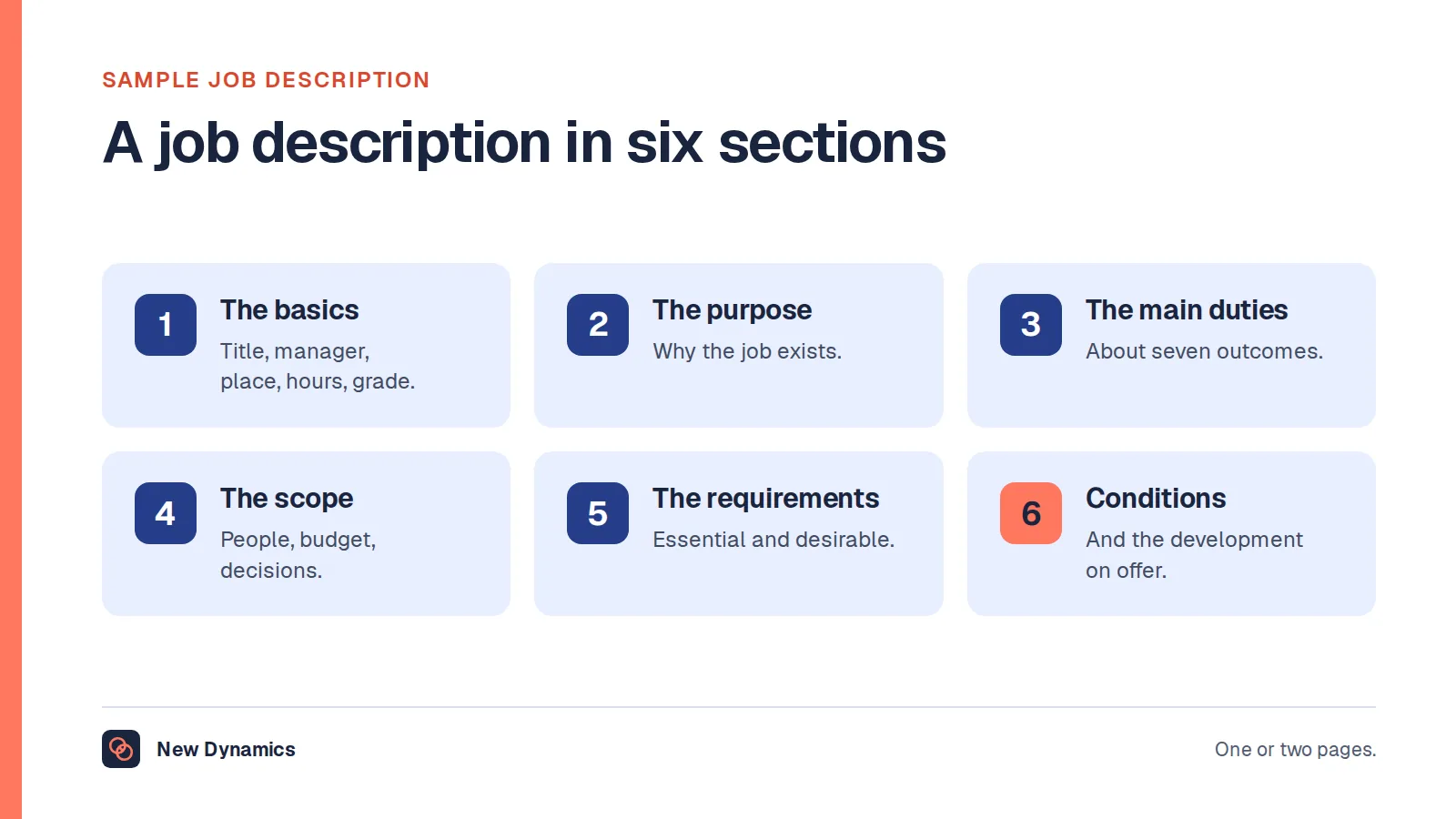
A transcriptionist job description template
Replace every bracketed prompt with your own facts. For the layout of the whole document see our job description template, and for turning duties into accountabilities our guide to how to write a job description.
Job title: Transcriptionist ([medical, legal, research, media] transcription)
Reports to and basis: [Practice, office, research or production manager]. [Employed] or [self employed, contracted by the file]. [On site, hybrid or home based.]
Purpose of the role: To produce accurate, correctly formatted written records of recorded speech, delivered within the agreed turnaround, and to handle the recordings and transcripts in line with our data protection and confidentiality requirements.
The material: [Dictated clinic letters] / [recorded hearings] / [research interviews and focus groups] / [video for subtitling]. Typical recording length [x] minutes, typical weekly volume [x] minutes. Audio quality ranges from [good single-speaker dictation] to [multi-speaker recordings made in a room].
Transcription standard: [Strict verbatim, including false starts, repetitions and overlapping speech] or [clean read, removing stumbles and retaining meaning]. Speaker labels [named or numbered]. Timecodes [every x minutes, at speaker changes, or not required]. Unclear passages marked as [convention] with a timecode. House template and style guide provided.
Accountabilities:
- Transcripts meet the agreed accuracy standard, verified on a sampled check against the audio
- Files are returned within the agreed turnaround, and any file at risk is flagged before the deadline
- Unclear passages are marked and timecoded rather than guessed
- Names, terminology and references are verified against the supplied material
- The house template, speaker convention and formatting are applied consistently
- Recordings and transcripts are stored, transferred, accessed and deleted in line with the retention schedule
- Queries about content, scope or audio quality are raised with [named contact] rather than assumed
Skills and experience:
- Demonstrable accuracy at speed, evidenced in a practical exercise on our own audio
- [Medical, legal, technical] terminology, or a demonstrated ability to learn it
- Confident with transcription software, variable-speed playback and a foot pedal
- Excellent written English, with punctuation that carries meaning correctly
- Understanding of confidentiality duties when handling recordings
Equipment: We provide [software, foot pedal, headphones, secure transfer and storage]. [Or: you provide your own equipment and encrypted storage, and must meet our security requirements.]
What good looks like after three months: The accuracy standard met on every sampled check, turnaround met without escalation, a terminology list maintained, and no audio held outside approved storage.
Two prompts do most of the work: the transcription standard, which prevents rejected work, and the audio quality, which prevents a disputed rate.
How automatic speech recognition changed the job
Automatic speech recognition now produces a usable first draft of clean, single-speaker audio in a fraction of real time. That has not removed the need for a transcriptionist. It has moved the work, and that belongs in the job description rather than in a conversation six months after somebody starts.

What the machine is good at: clear audio, common vocabulary, one speaker at a time, speed. What it remains unreliable at: overlapping speech, strong accents, poor room recordings, specialist terminology, names, numbers, and knowing when it is wrong. That last failure is the important one, because a speech recognition system does not hesitate. It produces a fluent, plausible sentence with the wrong drug in it, and nothing marks the difference.
So the role shifts in four ways.
- From typing to editing and verification. The core activity becomes listening to the audio while reading the draft, correcting against what was said, and taking responsibility for the difference. Typing speed matters less, attention and subject knowledge more.
- The hard files stay human from the start. Focus groups, hearings and accented multi-speaker recordings are often faster to transcribe from scratch than to repair, and somebody has to triage which is which.
- Accountability becomes the deliverable. What an organisation buys is no longer a typed document, because it can get one in minutes. It is a named person who has checked the document against the recording and will say so.
- The data question gets harder. Sending a recording to an automatic transcription service means sending personal data to a third party that processes it, which is a processor relationship with contractual requirements.
So hire for verification and terminology rather than words per minute alone, and say in the advert that machine drafts are part of the workflow. Candidates already know. When machine transcription enters a process that runs on people, the handoffs are what break: see how New Dynamics configurable workflows keep owners, steps and due dates in one place so a check does not quietly stop happening.
Confidentiality and data protection: the part most adverts forget
Transcription adverts list accuracy, speed, terminology and software. They rarely carry the sentence that matters most: this role handles recordings of identifiable people talking about themselves, their health, their colleagues and their disputes.
A recording of a consultation, a grievance interview or a research interview is personal data. In the medical case, and wherever somebody discusses their health, it is special category data. The ICO's guidance on what is special category data includes "data concerning health" in that list, and defines health data as "personal data related to the physical or mental health of a natural person, including the provision of health care services, which reveal information about his or her health status". This section describes the United Kingdom and is general information rather than legal advice.
A lawful basis, and a condition on top of it
Two separate questions, and transcription adverts collapse them. On the employment side, the ICO's guidance on collecting and keeping employment records states that "You must apply at least one lawful basis whenever you are keeping records of your workers' personal information", and that where the records include sensitive information you must "identify a special category condition (under Article 9 of the UK GDPR)".
For special category material generally, the ICO's guidance on the conditions for processing is that you need a valid lawful basis and, separately, one of the ten Article 9(2) conditions. The ones most likely to apply here are (a) explicit consent, (b) employment, social security and social protection law, (f) legal claims and judicial acts, (h) health or social care, and (j) archiving, research and statistics. The ICO notes that (b) and (g) require an appropriate policy document under the Data Protection Act 2018, while (h) and (j) do not. Identify yours before the recording is made, not after a transcript has been questioned.
Who should have access, and for how long
Access to a recording belongs to the people who need it for the purpose it was made for. The ICO's employment records guidance puts the principle plainly: records "can only be accessed, altered, disclosed or deleted by those who are authorised to do so". In practice: name who may listen, so a grievance recording does not reach the general administrative queue; give one transcriptionist one matter rather than standing access to a folder; separate the audio from the finished transcript; and review access when the role changes, including the freelancer whose contract ended last quarter.
Retention is where most organisations fail, because they schedule documents and forget the recording still exists, on the dictation device, in the transcription software, in the email it arrived in, in a freelancer's download folder and in an automatic transcription service's account. The same ICO guidance says you should "set up a retention policy or schedule that lists: the types of record or information you hold; what you use it for; and how long you intend to keep it", and that retention periods follow from your purposes rather than one uniform rule. So give the schedule a line each for the original recording, any copy held by the transcriptionist, the working draft, any machine-generated draft, the final transcript and the covering correspondence. Usually the audio can go sooner than the transcript, because once the record is verified the recording's purpose is complete. Our post on employee records retention covers building the schedule.
What belongs in a contract with a freelance transcriptionist
If you send recordings to a self-employed transcriptionist or a transcription provider, they process personal data on your behalf. The ICO's guidance on when a contract is needed says "every time a controller uses a processor to process personal data, there must be a written contract that binds the processor to the controller in respect of its processing activities".
The ICO's guidance on what needs to be included in the contract says it must cover the subject matter and duration of the processing, the nature and purpose of the processing, the type of personal data and categories of data subject, and the controller's obligations and rights. It then lists the minimum Article 28(3) terms: "Processing only on the documented instructions of the controller", "Duty of confidence", "Appropriate security measures", "Using sub-processors", "Data subjects' rights", "Assisting the controller", "End-of-contract provisions" and "Audits and inspections". The ICO notes that this guidance is under review following amendments made by the Data (Use and Access) Act, so check the live page before you draft.
For a transcription engagement that means your documented instructions and the scope; a commitment of confidence from the transcriptionist and anyone they let near the files; encrypted storage, encrypted transfer and a named transfer route; whether work may be passed to anyone else, including an automatic transcription service, and your written authorisation before it is; help if the person recorded asks for a copy of their data; deletion or return of every copy at the end, working drafts included; and your right to ask how files are held.
Add two clauses the list does not mention: notify you if a file goes astray, and raise rather than resolve anything in the audio that suggests a risk to a person, because a transcriptionist is sometimes the only person who hears a disclosure in full.
How to write a transcriptionist bio
A transcriptionist bio is a short professional profile: the paragraph on a freelance profile, a proposal, a professional network summary or an internal team page. It answers three questions quickly. What can you handle? How accurate and how fast? Can I trust you with this recording?
Five rules. Lead with the specialism and the material, because "medical transcriptionist" says more in two words than three sentences about being detail-oriented. Name the standard rather than the adjective: verbatim or clean read, the formats, the turnarounds. Give only claims you can evidence on request. Include one sentence on confidentiality, which here is reassurance rather than boilerplate. And match the length to the place.
The two profiles below are examples we wrote to show the shape. They are not real people, and the numbers in them are invented.
Example bio: a freelance transcriptionist
Medical and clinical transcriptionist with eight years' experience of dictated correspondence, radiology and histopathology reports for private clinics and NHS departments. I work to clean read or strict verbatim, to your template, with standard turnaround of two working days and next day available. I keep a terminology list for every client and mark anything unclear with a timecode rather than guessing. All audio is held on encrypted storage, transferred through your approved route and deleted on your schedule, with confirmation. Typing at 85 words per minute, and happy to complete a paid test piece on your own audio before you commit.
Each sentence is doing a job: the specialism and material, the standard and turnaround, the honesty convention, the security sentence, one number, and an offer that removes the client's risk.
Example bio: an in-house transcription and administration role
Rachel has worked in the practice administration team for six years and handles clinical correspondence, consultant dictation and the typing of investigation and grievance records for HR. She holds the practice's terminology and template library, checks every machine-generated draft against the audio before it goes out, and maintains the retention schedule for recordings as well as documents. She is the person colleagues ask when a name, an abbreviation or a format is not obvious.
The in-house version has a different reader. Nobody is buying. A colleague is deciding whether to trust this person with a sensitive recording. So it names the material, the ownership of the terminology and retention work and the verification step, and leaves out the speed claims.
Frequently asked questions
What is a transcriptionist?
A transcriptionist listens to recorded speech and produces an accurate written version of it, formatted to an agreed standard and delivered within an agreed time. The work covers medical, legal, media and subtitling, research and general business material, and involves researching names and terminology, marking unclear passages rather than guessing, proofreading against the audio and handling the recording securely.
What is the difference between a transcriptionist and a stenographer?
A transcriptionist works from a recording after the event and can rewind, replay and research. A stenographer or palantypist writes in real time, live in the room, on a shorthand machine. They are different skills with different training and equipment.
What is a transcription job, and how is it paid?
Freelance and provider work is usually priced per audio minute or per audio hour, so you are paid for the length of the recording rather than the time you spend on it. Medical work sometimes uses a per line rate, subtitling and research are quoted per project, and in-house posts are hourly or salaried. No official United Kingdom source publishes a going rate, so we do not quote one. Uplifts for multiple speakers, poor audio and fast turnaround are normal.
What skills does a transcriptionist need?
Careful listening, excellent written English with punctuation that carries meaning, the subject vocabulary for the field, a research habit for names and terms, honesty about what is unclear, accurate typing at speed and real discretion with confidential recordings. Four can be measured: accuracy, turnaround, working minutes per audio minute and compliance with the house format.
Is transcription still a job now that software can transcribe audio?
Yes, but the content has moved. Automatic speech recognition produces a usable first draft of clean single-speaker audio, so the human work shifts towards editing, verification and accountability. The software remains unreliable on overlapping speech, strong accents, poor recordings, terminology, names and numbers, and gives no signal when it is wrong.
How do I write a transcriptionist bio?
Open with your specialism and the material you handle, state the transcription standard and turnarounds you work to, give one or two numbers you can evidence on request, include a sentence on how you store, transfer and delete recordings, and keep it to two to four sentences. Avoid adjectives that cannot be checked, and never publish a figure you could not demonstrate on a test piece.
Your next step: describe the standard, not just the typing
- Say which specialism the role covers, and whether it is verbatim or clean read.
- Describe the audio honestly: speakers, length, quality, volume.
- Agree the four measurable standards in writing: accuracy, turnaround, working minutes per audio minute and format.
- Say that machine drafts are part of the workflow and that verification is the deliverable.
- Write the confidentiality duties into the accountabilities, add a retention line for the audio as well as the transcript, and get the processor contract terms in place before the first file moves.
Handling recordings of identifiable people is a data protection obligation before it is an administrative one. Read and download our employee data protection guide for the lawful basis, access and retention decisions in one place. The guide is free to read, and the PDF uses our short download form.
Want accuracy standards, turnaround targets and the check-ins that keep them honest in one place? Book a New Dynamics demo and bring the standard you work to today. You can also email contact@new-dynamics.com.