TL;DR
- The Ministry of Justice reports that in Q1 2026, the Employment Tribunal received 14,000 single claim receipts, disposed of 6,100 single claim cases, and held 70,000 single claim cases in the open caseload at the end of June. Receipts rose 28%, disposals fell 6% and the open caseload rose 51%.
- Most disputes never reach a hearing. Acas dealt with over 150,000 notifications for early conciliation in the year to 31 March 2026, a 27% increase in volume, and reports that 68% of early conciliation notifications did not progress to employment tribunal between October and December 2025.
- Nobody publishes how many grievances or disciplinaries employers run internally. No official body collects it, so the only reliable figures are the ones you produce from your own case records.
Somebody asks how many grievances a company of your size should expect, or how bad the tribunal backlog really is. Half of that question has excellent official data behind it. The other half has none at all, and knowing which half is which saves you from quoting a number that cannot be checked.
This article sets out the published UK employee relations statistics, quoted as the publisher words them, with the reference period named each time. It also says plainly where no official figure exists. It is general information rather than legal advice.
Most employee relations work starts long before a formal process does. See how New Dynamics continuous feedback keeps concerns visible while they are still small.
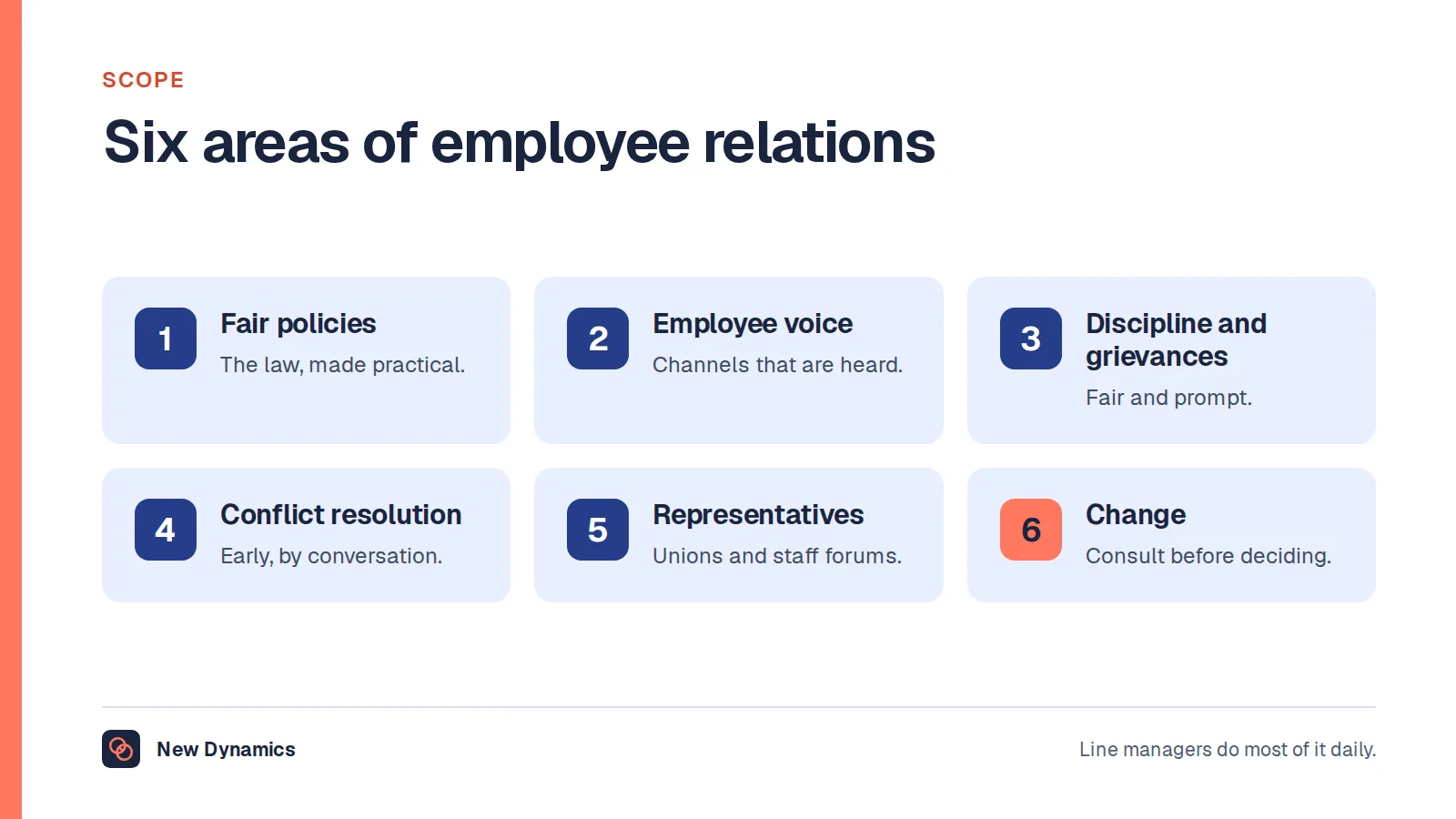
For the ground the figures cover, our post on employee relations explains the discipline itself.
What has official data and what does not
Four parts of this subject are measured by official bodies. Employment tribunal volumes come from the Ministry of Justice. Early conciliation comes from Acas. Redundancy levels come from the Office for National Statistics. The legal framework, including the unfair dismissal qualifying period, comes from the Department for Business and Trade and from the legislation itself.
Two parts are not measured at all. No official body counts how many grievances employers receive, and none counts how many disciplinary cases they run. That is covered further down.
Employment tribunal statistics: the backlog is the story
The Ministry of Justice publishes Tribunal Statistics Quarterly. Its edition for April to June 2026 reports that "In Q1 2026, the Employment Tribunal received 14,000 single claim receipts", a 28% increase on the same quarter a year earlier. Over the same quarter the tribunal "disposed of 6,100 single claim cases", a 6% decrease, and there were "70,000 single claim cases in the open caseload" at the end of June, a 51% increase.

Read those three together rather than separately. More cases arrived, fewer were closed, so the queue grew by half in a year. The publisher says the same thing about the longer run: "receipts have exceeded disposals for the last few years".
For the full financial year, the January to March 2026 edition reports "50,000 single claim receipts" in 2025/26, up 39% on 2024/25, with 26,000 single claim cases disposed of, down 12%, and a single claim open caseload of 64,000 at the end of March 2026, up 55%.
Three definitions from the Ministry of Justice guide to the series are worth having in front of you, because they are narrower than they sound. A single claim is "made by a sole employee/worker, relating to alleged breaches of employment rights". A receipt is a "Volumetric term covering the acceptance of a case by a HMCTS Tribunal". A disposal is the "closure of a case when work has ceased to be done. This can be through a claim being withdrawn, settled, dismissed or being decided at a hearing".
That last one matters a great deal. A disposal is not a judgment. Most disposals are withdrawals and settlements, which is why the next section is the more useful one for an employer.
Multiple claims are counted separately
A multiple claim is one "where two or more people bring proceedings arising out of the same facts, usually against a common employer". These are reported as lead cases and as the individual claims behind them, so the two sets of numbers are not comparable with the single claim ones.
In the April to June 2026 quarter there were "500 lead multiple cases received, and 380 cases disposed of in Q1 2026/27", with 7,600 open lead cases at the end of June. Those lead cases cover 11,000 multiple claim receipts, 4,100 disposals and an open caseload of 467,000 multiple claims. Multiple claim receipts fell 19%.
If you quote one headline number for tribunal volumes, say which of these two counts you are using. Mixing them produces figures that look alarming and mean nothing.
Acas early conciliation statistics
Before most tribunal claims can proceed, the claimant has to notify Acas. That makes Acas the better source for the shape of UK employee relations, because it sees disputes that never become claims.

The Acas annual report for the year 1 April 2025 to 31 March 2026, announced on 3 July 2026, reports that its individual dispute resolution service "dealt with over 150,000 notifications for early conciliation" with a "27% increase in volume". It also reports that "Over 9 out of 10 cases handled by Acas were resolved", that it "answered 584,000 calls from employers and workers", and that it was "involved in over 400 collective disputes" with a "settlement rate of 93%".
The quarterly service statistics for England, Scotland and Wales add the outcome split. For the January to March 2026 quarter, Acas records 39,822 worker-led individual cases, 480 worker-led group cases and 1,273 employer-led cases, and states that "Around 97% of all early conciliation notifications came from workers in January to March 2026".
Two outcome figures from the same release are the ones to remember. Acas reports that "68% of early conciliation notifications did not progress to employment tribunal between October and December 2025", which is reported a quarter behind because of administrative lag. It also reports that "80% of all employment tribunal cases that had an outcome in January to March 2026 did not progress to a hearing".
So the realistic path of a UK employment dispute is: notification to Acas, then settlement or withdrawal. A hearing is the exception, not the destination.
Unfair dismissal statistics and the qualifying period
The headline change here is legislative rather than statistical. Section 25 of the Employment Rights Act 2025 is described in the Department for Business and Trade factsheet as follows: it "will reduce the qualifying period for protection against 'ordinary' unfair dismissal from two years to six months and will remove the power to vary the qualifying period further without primary legislation". The same factsheet states that "The Government intends to commence the package of changes relating to unfair dismissal on 1 January 2027", and that the change strengthens rights for employees in England, Scotland and Wales.
Three figures in its key statistics section tell you the scale.
- "Around 6.3 million employees (22% of all employed 16+) have been working with their current employer for between six months and two years, so have only very limited protection against unfair dismissal." The source is given as Department for Business and Trade analysis of the Labour Force Survey, based on the Q1 2022 to Q4 2024 release.
- "Many businesses (around 40%) operate discretionary probationary periods, and the vast majority are six months or less." The source is given as the ONS Business insights and impact on the UK economy, Wave 133.
- "In 2023/24, there were 646 awards for unfair dismissal in employment tribunals reported, and the median award was £6,746." The source is given as Ministry of Justice Employment Tribunal Data 2023-24.
That third figure is the one most often misquoted. The factsheet also notes that the cap on compensatory awards, "which as of 6 April 2026 is the lower of either £123,543 or 52 weeks' gross pay", is being removed. The cap is the number that gets quoted in headlines. The median award is the number that describes what actually happens.
Redundancy statistics
Redundancy is the one part of this subject with a regular national series. The ONS publishes both a level and a rate from the Labour Force Survey. For June to August 2026, released on 20 October 2026, the "LFS: ILO redundancy level (thousands): UK: All: SA" series stood at 113,000, and the "LFS: ILO redundancy rate: UK: All: SA" series at 3.8 per 1,000 employees.
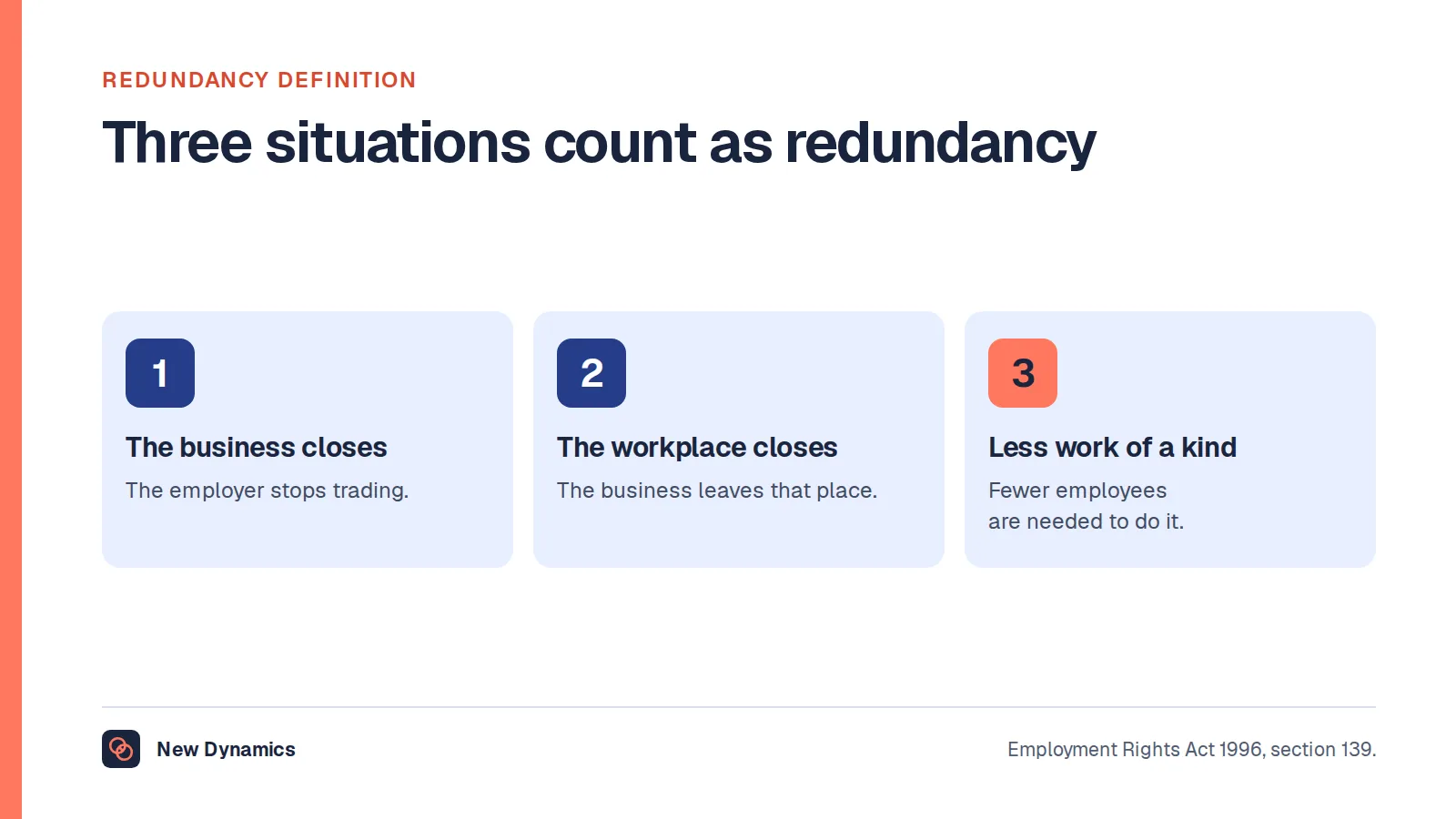
Use the rate, not the level, when you compare periods, because the level moves with the size of the workforce. For a sector or regional split, the ONS RED02 dataset gives redundancies by age, industry and region. The wider HR statistics hub sets the labour market context around it, and our post on the definition of redundancy covers what legally counts as one.
Nobody publishes grievance or disciplinary statistics
This is the honest answer to two of the most searched questions in this cluster. There is no official UK statistic for how many grievances employers receive, and none for how many disciplinary cases they run. No government department, statistics agency or tribunal collects it, because internal procedures are private to the employer and nothing requires them to be reported.
Percentages in circulation come from membership and vendor surveys of self-selecting respondents. They describe the panel that answered, not the economy, and where the sample is not published they cannot be checked at all.
The nearest official signal of internal demand is the Acas helpline figure above, 584,000 calls from employers and workers in the year to 31 March 2026. That counts calls, not cases.

So produce your own figures. Four are worth keeping from your case records.
- Cases raised per 100 employees, each quarter. A rate, not a count, so growth in headcount does not look like growth in conflict.
- Days from case raised to written outcome. Measure the median and the slowest case, because the slowest one is the one that becomes a claim.
- Stage reached. Informal resolution, formal hearing, appeal, Acas notification, tribunal claim. The ratio between the first and the last is your real quality measure.
- Where cases cluster. By team, by manager and by issue type. One manager generating a quarter of your cases is a training problem, not a legal one.
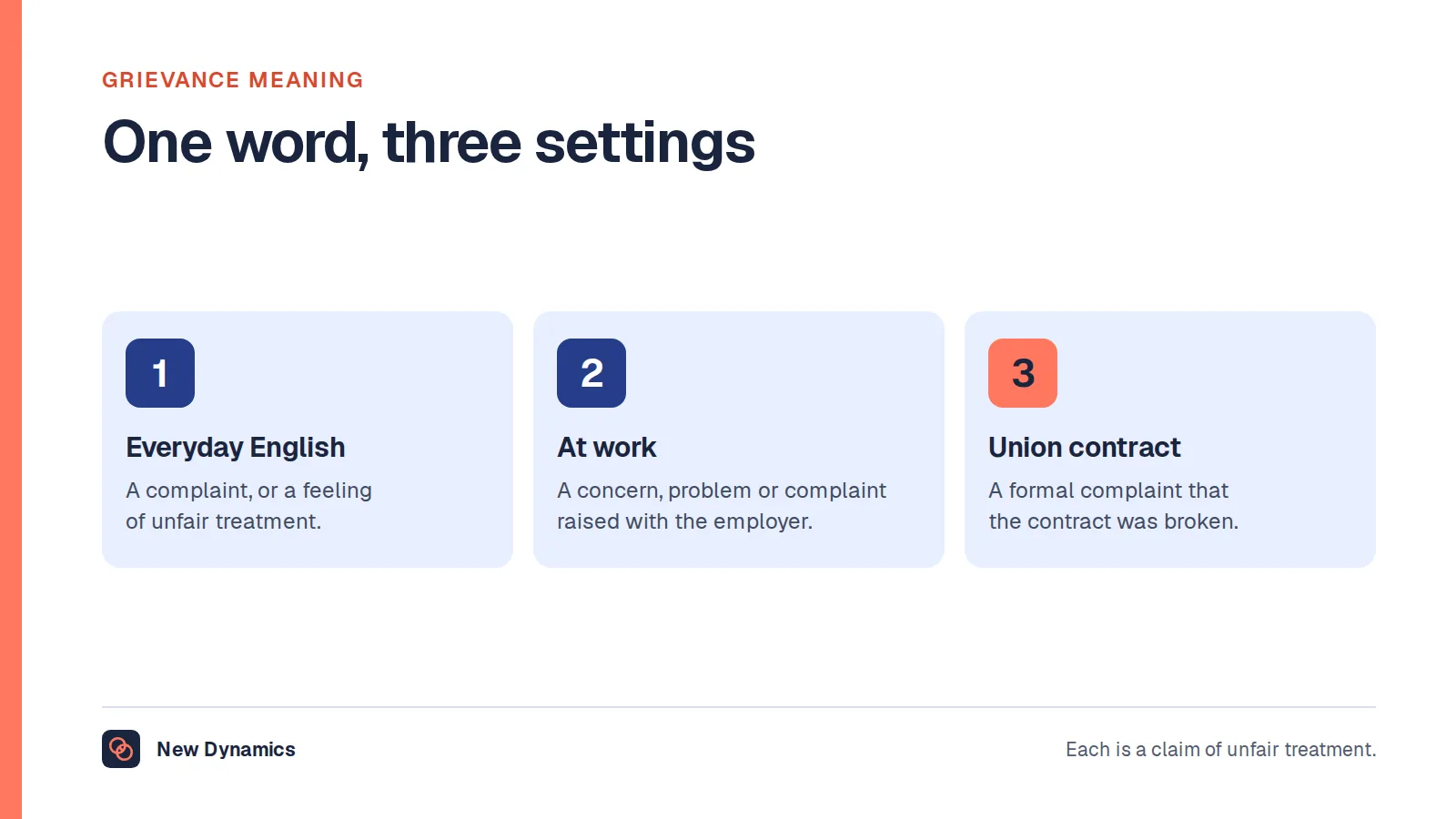
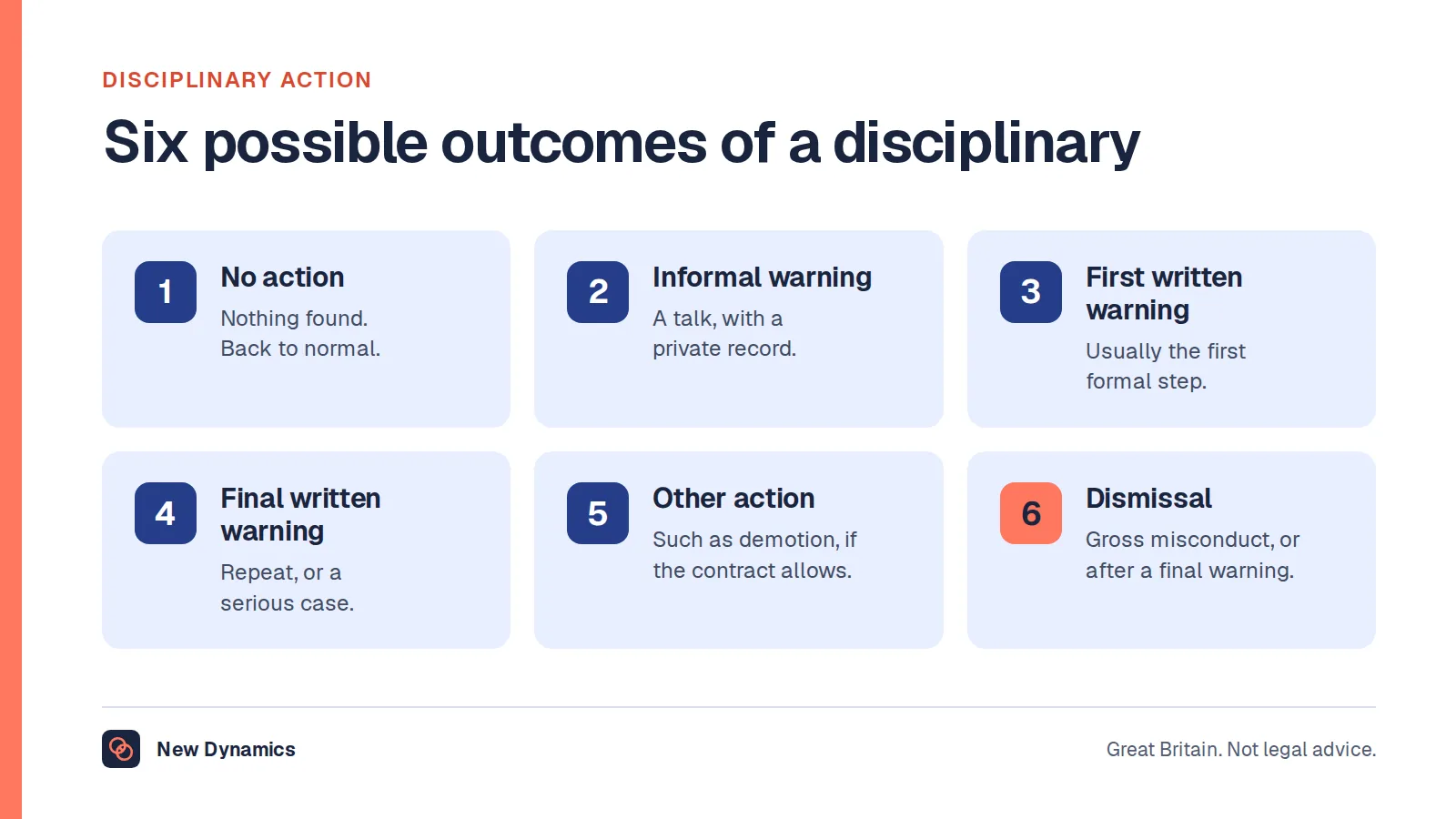
Count the same way each quarter and write the definition down first, including what you do with concerns resolved informally and cases withdrawn. For the process these numbers describe, our posts on grievances and disciplinary action set out the steps.
What usually goes wrong when these figures are quoted
- Mixing single and multiple claims to produce a tribunal total that no publisher would recognise.
- Treating a disposal as a judgment. It includes withdrawals and settlements, so it tells you a case closed, not who won.
- Quoting the compensation cap as a typical award, when the published median award for unfair dismissal is a very different number.
- Quoting a survey percentage for grievance volumes as though it were an official statistic.
- Comparing redundancy levels across periods instead of the rate.
- Assuming national coverage. The Acas service statistics and the unfair dismissal factsheet both name England, Scotland and Wales, so Northern Ireland sits outside them.
Frequently asked questions
How many employment tribunal claims are there in the UK?
The Ministry of Justice reports that the Employment Tribunal received 14,000 single claim receipts in Q1 2026, up 28% on the same quarter a year earlier, and 50,000 single claim receipts across 2025/26, up 39% on 2024/25. Multiple claims are counted separately, with 11,000 multiple claim receipts in Q1 2026/27.
Is the employment tribunal backlog getting worse?
Yes, on the published figures. There were 70,000 single claim cases in the open caseload at the end of June 2026, a 51% increase, after disposals fell 6% in the same quarter. The Ministry of Justice says receipts have exceeded disposals for the last few years.
How many early conciliation notifications does Acas receive?
Acas dealt with over 150,000 notifications for early conciliation in the year to 31 March 2026, a 27% increase in volume on the previous year. Around 97% of all early conciliation notifications came from workers in January to March 2026.
Do most employment disputes reach a hearing?
No. Acas reports that 68% of early conciliation notifications did not progress to employment tribunal between October and December 2025, and that 80% of all employment tribunal cases that had an outcome in January to March 2026 did not progress to a hearing.
What are the UK grievance and disciplinary statistics?
There are none. No official body collects how many grievances or disciplinary cases employers handle internally, because the procedures are private to the employer and nothing requires reporting. Any percentage you find comes from a self-selecting survey panel, so measure your own case records instead.
How many employees are affected by the unfair dismissal qualifying period change?
The Department for Business and Trade factsheet states that around 6.3 million employees, 22% of all employed 16+, have been working with their current employer for between six months and two years, so have only very limited protection against unfair dismissal. Section 25 of the Employment Rights Act 2025 reduces that qualifying period from two years to six months.
Your next step: build the figures you are missing
- Export your last four quarters of grievance and disciplinary cases and count them per 100 employees, on one written definition.
- Add the median days from case raised to written outcome, and flag the slowest case in each quarter.
- Record the stage each case reached, from informal resolution through to Acas notification, so you can see where cases escalate.
- Split the cases by team, manager and issue type, and treat any cluster as a management development question first.
- Keep the external figures separate. Quote the Ministry of Justice, Acas and ONS releases with their reference periods when you need context, and never as a benchmark for your own volumes.
For the planning side of workforce change, read and download our redundancy and workforce change guide. The guide is free to read, and the PDF uses our short download form.
Want concerns surfacing in a one to one rather than in a tribunal bundle? Book a New Dynamics demo and bring last year's case log. You can also email contact@new-dynamics.com.