TL;DR
- Employee relations is the relationship between an employer and its employees, both individually and collectively, and the HR work of keeping that relationship fair, lawful and constructive.
- It covers six areas: fair policies, employee voice, discipline and grievances, conflict resolution, relations with unions and other representatives, and consultation during change.
- Industrial relations and employment relations are closely related terms. A career in employee relations needs employment law, investigation, consultation, conflict resolution and impartial judgement.
Most of the time, nobody notices employee relations. People are paid, managed and listened to, problems are settled early and change is explained before it happens. It becomes visible when it fails: a grievance that drags on for months, a restructure announced by email, a dispute that reaches a tribunal or a picket line.
This article gives a plain definition of employee relations, explains how the term differs from industrial relations and employment relations, sets out the six areas that it covers, describes a career in the field and lists the common mistakes.
Good employee relations begin with listening. See how New Dynamics continuous feedback gives every employee a regular voice.
What is employee relations?
The Cambridge Business English Dictionary defines employee relations as “the relationship between employees and managers in a company, especially whether the employees feel happy with their working conditions and involved in making decisions”.
The CIPD, the UK's professional body for HR, adds the second dimension in its factsheet on employee relations: “‘Employee relations’ describes the relationship between employers and employees - both individually and collectively.”
The phrase is used in two ways.
- The relationship itself. How much trust there is between an employer and its workforce, and how they deal with each other.
- The HR specialism. The people and processes that look after that relationship: policy, consultation, casework and dispute resolution. The CIPD's Profession Map describes this specialism as “creating and maintaining a positive working relationship between an organisation and its people”.
Do not confuse it with relationships between colleagues, which our guide to workplace relationships covers. Employee relations concerns the relationship between the employer and the people whom it employs.
Individual and collective
The CIPD's summary says that employee relations “focuses on both individual and collective relationships in the workplace”. The distinction is worth understanding.
- Individual relations. The dealings between the employer and one person: the contract, one-to-ones, performance, a flexible working request, a grievance, a disciplinary case.
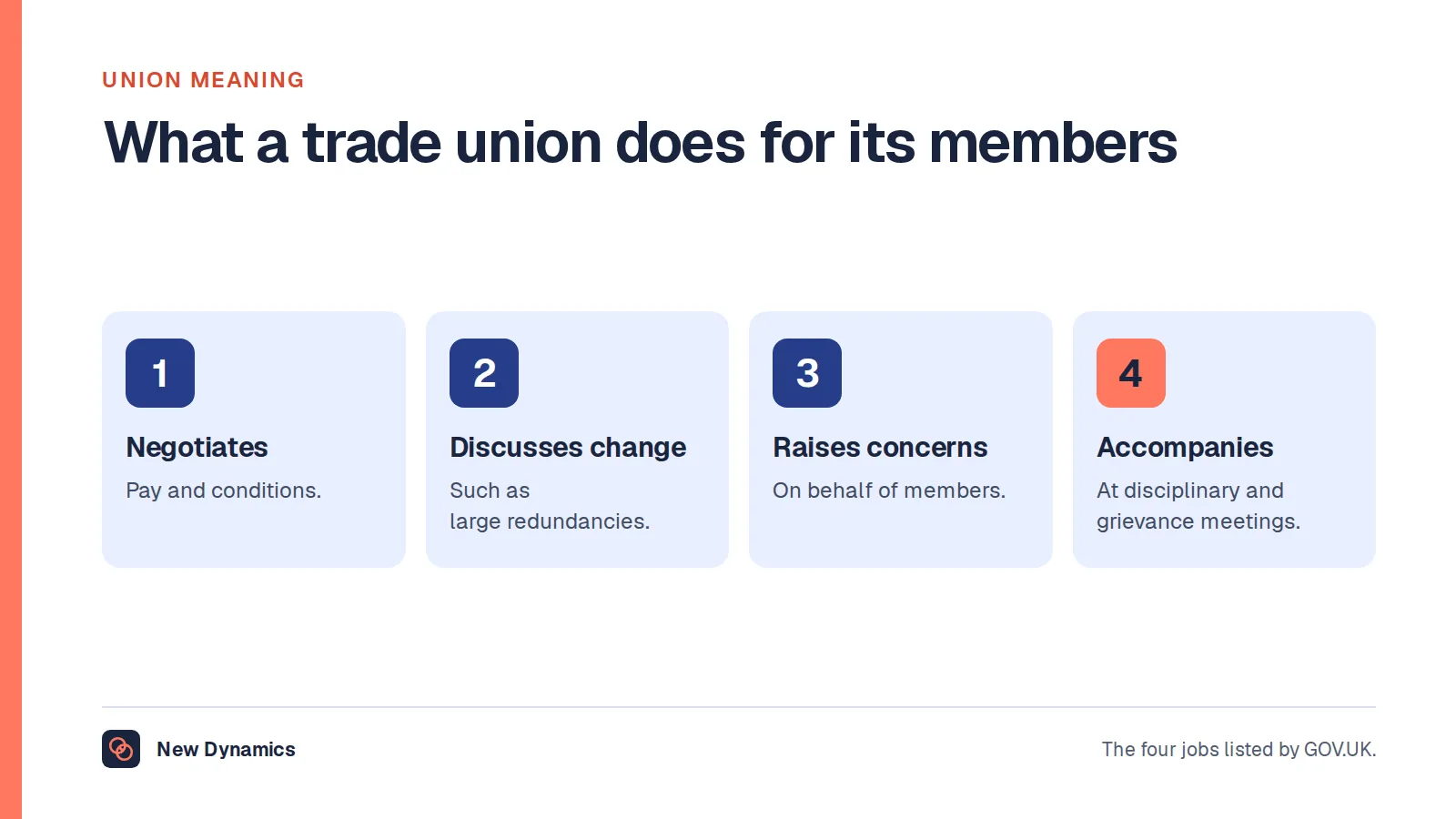
- Collective relations. The dealings between the employer and employees as a group, through a trade union, a staff forum or elected representatives: pay negotiations, consultation on redundancies, changes to terms.
The CIPD notes that individual voice channels are very important, and that collective channels “give employees a collective voice that can complement individual channels”. An organisation needs both. One-to-ones cannot settle a pay structure, and a staff forum cannot settle one person's complaint.

Employee relations, industrial relations and employment relations
| Term | Usual meaning |
|---|---|
| Industrial relations | The older term. The Cambridge Dictionary defines it as “the relationships between companies and their workers”. In practice it suggests unions, collective bargaining and disputes |
| Employee relations | The common HR term today. Individual and collective relationships, with or without a union |
| Employment relations | A neutral term for the same field |
| Labor relations | The usual American term for dealings between management and unions |
The shift in words reflects a shift in work. Where unions are recognised, collective bargaining remains central, and our guides to the meaning of a trade union and collective bargaining explain it. In workplaces without a recognised union, most employee relations work concerns individuals.
In the UK, the public body in this field is Acas. It describes itself as independent and impartial experts who help employers and workers to prevent problems, manage issues and resolve disputes. Its reason applies everywhere: “Healthy relationships at work encourage productive organisations and make work better for everyone.”
What employee relations covers: six areas
- Fair policies. Turning employment law into clear, practical rules. The CIPD's Profession Map speaks of “policies and processes which apply the law in a practical, fair and transparent way”.
- Employee voice. Channels through which people can raise ideas and concerns and be heard: surveys, forums, one-to-ones and a genuine open door policy. The CIPD calls informing and consulting the workforce “a core people management principle”.
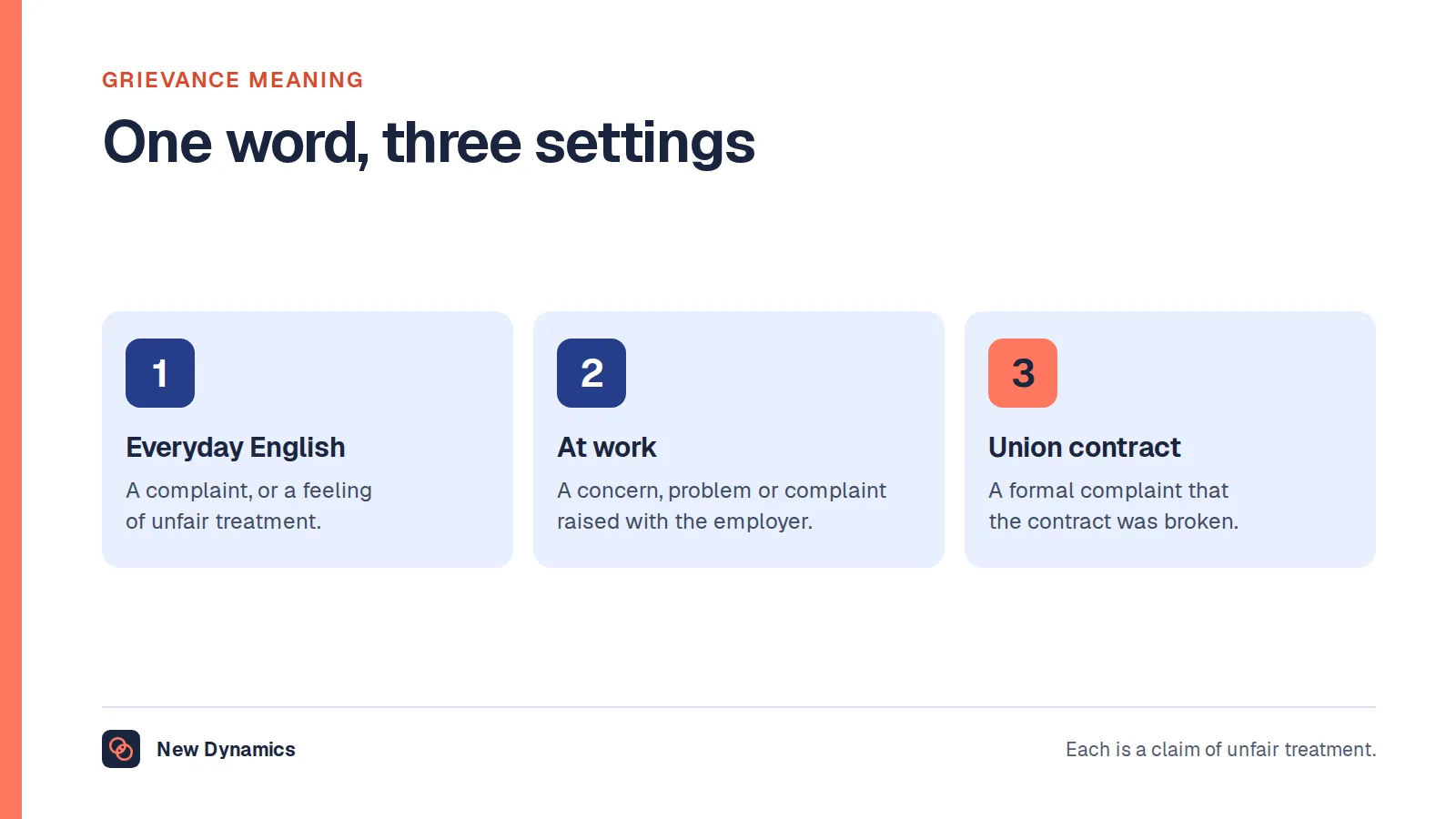
- Discipline and grievances. Fair, prompt handling of complaints and misconduct. See our guides to the meaning of grievance and to disciplinary action.
- Conflict resolution. Settling disagreements early through conversation and mediation, before they become formal cases.
- Unions and representatives. Working with recognised unions, staff forums and elected representatives.
- Consultation during change. Restructures, redundancies, transfers and changes to terms, where the law often requires consultation. Our plain guide to the definition of redundancy explains one of these.
Protection for people who raise serious concerns belongs here too. See our guide to the meaning of whistleblower.

Why employee relations matters
The CIPD states the case in one sentence: “A positive climate of employee relations - with high levels of employee involvement, commitment and engagement - can improve business outcomes and contribute to employees' wellbeing.”
In practice, good employee relations shows in four ways.
- Problems surface early. People who trust the process raise concerns while they are small.
- Change goes more smoothly. Employees who were consulted understand the reasons, even when they dislike the result.
- Less time goes on disputes. Formal cases consume management time and damage teams.
- Decisions are fairer. Consistent procedures reduce the part played by favouritism and bias.
Who is responsible?
- Line managers do most of the daily work of employee relations, often without using the name. How a manager handles a late arrival, a complaint or a request decides whether it ends there.
- HR writes the policies, trains and advises managers, handles complex cases and leads consultation.
- Senior leaders set the tone, and decide whether employees are told the truth about the business.
- Employee representatives carry the collective voice, in unionised and non-unionised organisations alike.
An employee relations career
Larger employers have specialist employee relations teams, with job titles such as employee relations adviser, case manager, ER partner and head of employee relations. The work is a mixture of advice, casework and negotiation.
The CIPD's Profession Map treats employee relations as an area of specialist knowledge. Drawing on its description, five skills stand out.
- Employment law. The Map says that specialists “need a deep understanding of employment / labour law”, and must keep up to date in order to advise the business and line managers.
- Investigation. Gathering facts fairly, interviewing witnesses and writing clear reports.
- Consultation and negotiation. The Map refers to resolving conflict “through consultation and negotiation with individuals and representative bodies”.
- Conflict resolution. Knowing how to deal with disputes internally, including mediation, as well as through the legal system when needed.
- Impartial judgement. Both sides must be able to trust the process. The Map adds that specialists increasingly use “employee voice insights from working groups and staff forums” to change how things work.
Most people reach the specialism from a general HR role, by taking on casework. Professional qualifications help. Our comparison of HR certifications covers the main routes, and our guide to HR management shows where the specialism sits.

How to measure employee relations
- Casework: the number of grievances and disciplinary cases, how long they take and how many are settled informally.
- Voice: survey answers to questions such as “I can raise a concern without fear” and “My views are listened to”.
- Turnover and absence, by team, as signals of local problems. See our guide to the turnover rate.
- Disputes: claims, conciliation cases and their outcomes.
- Consultation: whether it took place before decisions, and what changed as a result.
Read the numbers with care. A rise in grievances after you improve the procedure can mean that people now trust it.
Common mistakes
Policy without practice. A fine handbook means little if managers ignore it.
Leaving managers untrained. Most cases are made better or worse in the first conversation.
Consulting after the decision. People can tell when a consultation is theatre.
Letting cases drift. Delay harms the person who complained, the person accused and the team around them.
Treating every disagreement as formal. Many disputes can be settled by a facilitated conversation.
Seeing unions or forums as the enemy. Representatives often know about problems before managers do.
Frequently asked questions
What is employee relations in simple terms?
Employee relations is the relationship between an employer and its employees, individually and collectively, and the HR work of keeping that relationship fair, lawful and constructive through policy, voice, consultation and the handling of disputes.
What is the difference between employee relations and industrial relations?
Industrial relations is the older term, and suggests unions, collective bargaining and disputes. Employee relations is the common term today and covers individual as well as collective relationships, in workplaces with or without a union.
What does employment relations mean?
Employment relations is a neutral name for the same field: the relationship between employers and the people who work for them, and the rules, institutions and practices that govern it.
What does an employee relations team do?
It writes and explains policies, advises managers, handles grievances, disciplinary cases and investigations, supports mediation, works with unions and staff representatives and leads consultation during restructures and other changes.
What skills do you need for a career in employee relations?
You need a sound knowledge of employment law, fair investigation skills, consultation and negotiation, conflict resolution and impartial judgement. Clear writing and calm under pressure help. Many people move into the specialism from general HR roles.
Is employee relations part of HR?
Yes. It is one of the specialisms within HR, and the CIPD lists it as an area of specialist knowledge in its Profession Map. Line managers carry out much of the daily work, with advice and support from HR.
Your next step: check three things
- Ask how long your last three grievances took from complaint to outcome.
- Find out when managers were last trained to handle a complaint or a difficult conversation.
- List the channels through which employees can raise a concern, and ask a few people whether they would use them.
Clear, fair policies are the base of good employee relations. Read and download our employee handbook guide. The guide is free to read, and the PDF uses our short download form.
Want regular check-ins and feedback, so that concerns surface early? Book a New Dynamics demo and bring your current approach. You can also email contact@new-dynamics.com.