TL;DR
- Survey software is bought for dashboards and fails on trust. The question that decides whether your data is worth anything is whether people believe the responses cannot be traced back, and most tools are pseudonymous rather than anonymous.
- The ICO is clear that pseudonymised data is still personal data in the hands of whoever holds the extra information. If the platform can reunite a response with a person, and someone in your organisation can too, then 'anonymous' is a promise you cannot keep.
- Judge a tool on the small-team problem, the reporting threshold, who can see free-text comments, how fast results reach managers, and whether it can show change over time without re-identifying anyone. This article describes the United Kingdom position and is general information, not legal advice.
A survey tool is the easiest HR software to buy and the easiest to discredit. One manager saying "I know who wrote that" in a team meeting will cost you three years of honest answers, and no feature in the product can repair it.
This article covers how to choose employee survey software without naming a single product: what anonymity really means in a tool that still has to prevent duplicate responses, the small-team problem that breaks most reporting, where pulse surveys help and where they annoy, the reports worth having, and the questions to ask a provider before you sign.
A survey only pays for itself if something changes afterwards. See how New Dynamics feedback keeps the conversation going between surveys, so the result is a habit rather than an annual event.
If you have not yet decided what to ask, our workplace engagement survey post covers question design, which matters more than the platform.
Anonymous, confidential or pseudonymous
These three words get used interchangeably in sales calls and they mean different things.
- Anonymous means nobody can connect a response to a person, including the provider and including you. Reaching that is harder than it sounds, because a tool that stops people answering twice usually holds something that identifies them.
- Confidential means responses can be connected to a person, but a limited group promises not to do it.
- Pseudonymous means identifiers are replaced or held separately. The Information Commissioner's Office is direct about what that leaves you with: "Pseudonymised data is personal data in the hands of someone who holds the additional information."

Most survey platforms sold as anonymous are in fact confidential or pseudonymous. That is not a scandal, and it can be perfectly lawful and reasonable. The failure is promising one thing and operating another, because the first time someone is identified, the promise and the data both go.
Decide which of the three you are offering, write it in the invitation in plain words, and then configure the tool to match it. Ask the provider directly: can anyone, in any circumstance, including a support engineer with a database, connect a response to a person? The honest answer is usually yes for pseudonymous tools, and the right thing to do is say so.
The small-team problem
Every organisation hits this. A team of four answers a survey, the tool happily shows the team's average, and anyone who knows the four can work out who said what. Two of them will never answer honestly again.
The fix is a reporting threshold: a minimum number of responses before any breakdown is shown, with no exceptions for senior managers. Five is a common floor; the right number depends on how much other information is in the room.
Three things to check in a demo:
- Can the threshold be set once and enforced everywhere, including exports, filters and comment views?
- What happens when a filter combination crosses the threshold in aggregate but not in a sub-cut? Good tools suppress; weak ones leak.
- Can a manager stack filters, such as location plus tenure plus team, until a group becomes identifiable?
Ask to try it yourself, rather than watching a prepared view.
Pulse, annual, or both
A pulse tool makes asking cheap, which is useful and dangerous. The cheapness encourages asking more often than you can respond.
Three rules keep the rhythm honest.
- Never ask faster than you can act. A monthly question with no visible outcome teaches people that answering is pointless.
- Keep a stable core. A handful of questions asked the same way every time is what gives you a trend. Rotate the rest.
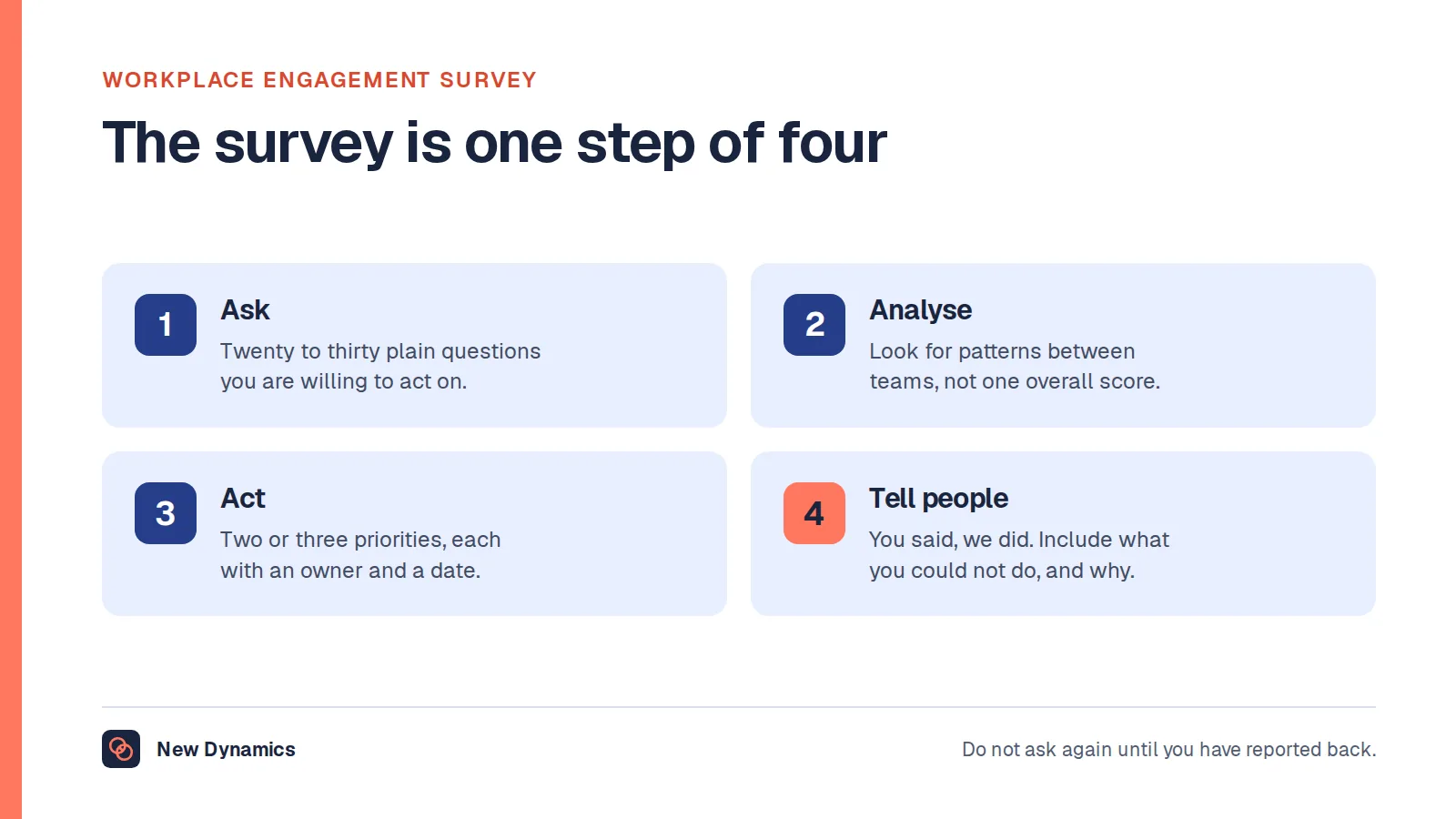
- Close the loop in public. What we heard, what we are doing, what we are not doing and why. Acas describes consultation as something that "must always be a genuine two-way discussion about whether a change is needed and what kind of change is appropriate", and the same standard separates a survey that works from one people stop opening.
The reports that matter

Dashboards are easy to make impressive and hard to make useful. Five outputs are worth more than the rest.
- Response rate by group, not just overall. A falling rate in one team is usually the first sign of a problem, and it arrives before the scores move.
- Change over time on the stable questions, with the threshold applied so that trends do not quietly re-identify a small team.
- Free-text themes with the raw comments protected. Decide who can read verbatim comments before launch, and tell people that in the invitation.
- Comparison between managers' own view and their team's, where the tool supports it. The gap is the most actionable number in the whole survey.
- An export you control, so your analysis is not trapped in the product.
What to ignore: a single composite engagement score with no definition, and any benchmark you cannot interrogate. If a provider cannot tell you which organisations are in a benchmark and how the question was worded, it is decoration.
Questions to ask a provider

- Is this anonymous, confidential or pseudonymous, in your own words, and who can re-identify a response?
- Show me the threshold being enforced on a filtered view and an export, with a team of four.
- Where is the data stored, who processes it, and what happens at the end of the contract?
- How do people without a work email or a company device respond?
- What does the manager actually see, and how long after the survey closes?
- Can we export everything, including comments, in a usable format?
- What does implementation cost us in hours, not licence fees?
Answers in writing. The first two separate the serious providers from the rest.
What usually goes wrong
- Promising anonymity the tool cannot deliver. Covered above, and it is the one that does lasting damage.
- Surveying before you can act. If there is no budget, no owner and no decision ready, the survey becomes a list of promises.
- Results that reach managers two months later. By then the context has changed and nobody remembers the question.
- No threshold. Or a threshold overridden for the leadership team, which is the same thing.
- Buying a platform to avoid a conversation. A survey tells you where to look. It does not tell anyone what it is like to work for a particular manager, and it will not do the conversation for you.
- Changing the questions every round, which makes the trend meaningless.
Do you need dedicated survey software?
Below a hundred people, a simple form tool plus a clear promise can work, provided you apply the same threshold discipline and nobody can match a response to a person. The value of dedicated software is the enforcement: thresholds that cannot be bypassed, comment handling, trends held over years, and reporting that reaches managers without someone rebuilding a spreadsheet each round.
Buy it when you survey regularly, when you need breakdowns by team or site, or when people have reason to doubt that a spreadsheet is private.
Frequently asked questions
What is employee survey software?
It is a tool for asking employees questions on a repeating cycle and reporting the answers: distribution, response tracking, anonymity or confidentiality controls, thresholds that stop small groups being identified, free-text analysis and trends over time. Some products are survey-only and others sit inside a wider engagement or performance system.
Are anonymous employee surveys really anonymous?
Often not. Many tools are pseudonymous, which means identifiers are stored separately rather than destroyed, and the ICO treats pseudonymised data as personal data in the hands of whoever holds the extra information. Ask the provider who can re-identify a response, then describe the real position in the invitation rather than using the word anonymous loosely.
How many responses should a survey report need before it shows a result?
Set a minimum, apply it everywhere including exports and filter combinations, and do not allow exceptions for senior managers. Five responses is a common floor, but the right number depends on how easily people in that group could be identified from the answers themselves.
How often should you run employee surveys?
No more often than you can respond to. A short pulse every quarter with visible action beats a monthly survey that disappears. Keep a small stable set of questions for the trend and rotate the rest, so the comparison stays meaningful.
What should you do with free-text comments?
Decide before launch who may read them, say so in the invitation, and keep that promise. Theme-level reporting with protected verbatim text is usually the right balance, because comments are the part most likely to identify someone by voice or detail even when no name is attached.
Can survey software measure engagement on its own?
No. It measures what people are willing to tell you at one moment, which is useful and partial. Response rates, exit conversations, absence patterns and what managers hear in one-to-ones all belong in the same picture, and a single composite score with no definition behind it is the least useful number in the report.
Your next step: decide the promise first
- Write one sentence saying whether your survey is anonymous, confidential or pseudonymous, and have the provider confirm the tool can deliver it.
- Set the reporting threshold before the first invitation goes out, and test it on your smallest team.
- Agree who reads free-text comments, and publish that in the invitation.
- Book the feedback session now, in the same calendar week the results land, so the loop closes while people still remember answering.
For the questions worth asking and the habits that make the results useful, read and download our employee engagement guide. The guide is free to read, and the PDF uses our short download form.
Want the conversation to continue between surveys rather than once a year? Book a New Dynamics demo and bring your current question set. You can also email contact@new-dynamics.com.