TL;DR
- Three different products are sold as wellbeing: benefits administration, which is an operational and tax problem; discount and perk platforms, which are a procurement deal; and wellbeing content and support, which is the one people mean and the hardest to evaluate.
- The tax rules shape the design. Salary sacrifice reduces an employee's contractual cash pay, requires a contract change each time someone opts in or out, and must not take cash earnings below the National Minimum Wage.
- If the cause of poor wellbeing is workload, rota instability or a manager, a platform will produce a usage dashboard and no change. Diagnose first. This article describes the United Kingdom position and is general information, not tax or legal advice.
A wellbeing platform is bought after a bad engagement survey, and the hope is that an app will move the number. Twelve months later the usage report says eighteen per cent, the survey has not moved, and the people with the worst scores are the ones who never had time to open it.
This article separates the three products sold under this heading, sets out the tax and pay rules that shape benefits administration, explains why usage is the wrong measure, and gives the questions to ask. It names no products and is general information rather than tax or legal advice.
Most of what people describe as wellbeing at work is the quality of the relationship with their manager. See how New Dynamics continuous feedback supports that conversation rather than replacing it.
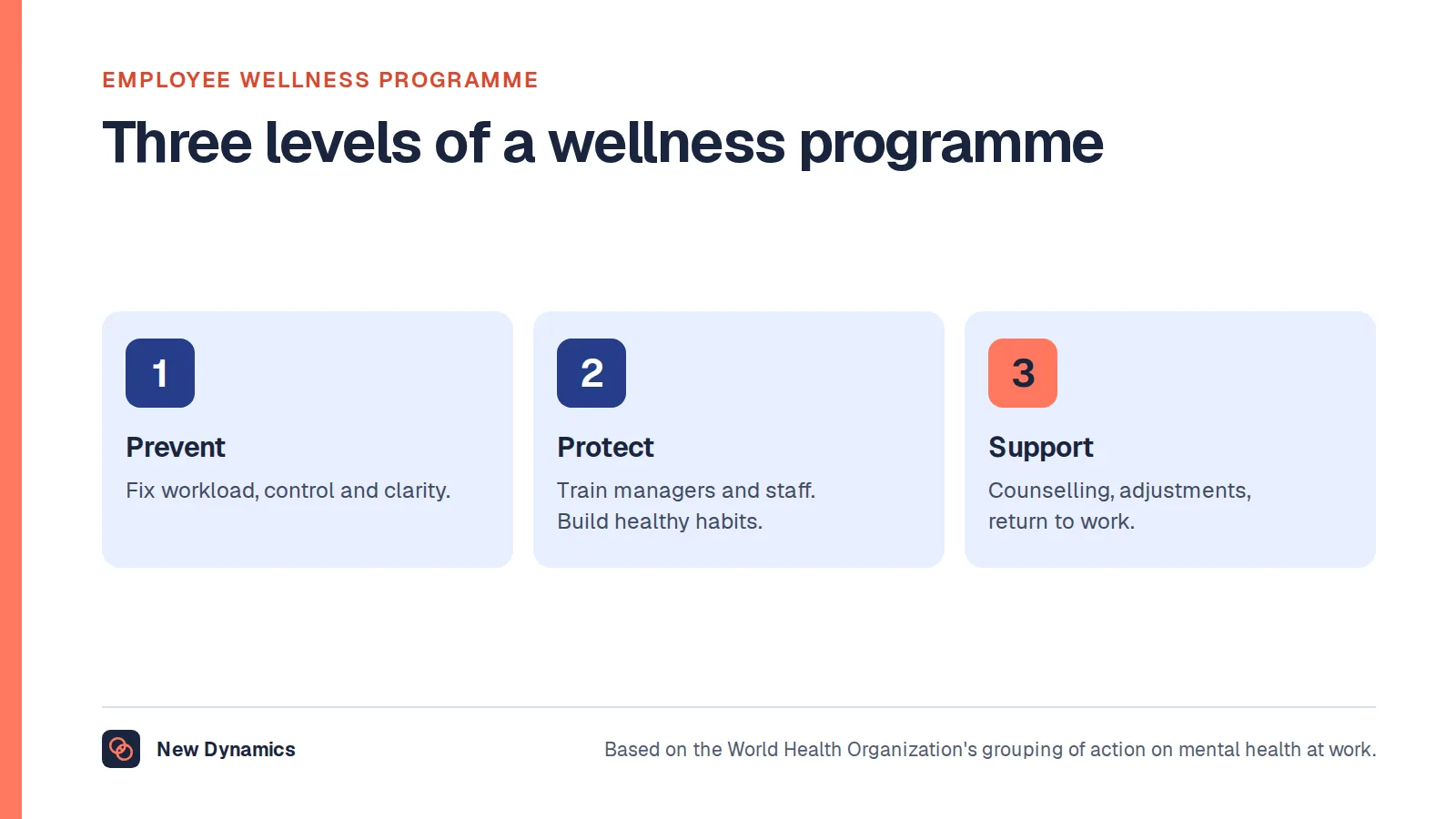
If you are designing the programme rather than buying a platform, our post on the employee wellness programme covers the structure first.
Three products, one label

Benefits administration. Enrolment, life events, pension interactions, salary sacrifice, reporting to payroll. Judge it on accuracy and the payroll join, not on the interface.
Discounts and perks. Retail discounts, cycle schemes, gym rates. This is a procurement and communication exercise. It is genuinely appreciated and it is not a wellbeing intervention.
Wellbeing content and support. Apps, counselling access, courses, mental health resources. The hardest to evaluate, because the measurable output is usage and the outcome you want is something else.
Buying all three from one supplier is reasonable. Evaluating them as one product is not.
The rules that shape benefits administration
Salary sacrifice is where most administrative pain and most mistakes live. Government guidance states that "A salary sacrifice arrangement is an agreement to reduce an employee's entitlement to cash pay, usually in return for a non-cash benefit", and that "If your employee wants to opt in or out of a salary sacrifice arrangement, you must alter their contract with each change".
There is also a hard floor: such an arrangement "must not reduce an employee's cash earnings below the National Minimum Wage (NMW) rates", and employers must put procedures in place to cap deductions so the rates are maintained.
For a platform, that means:
- Contract variation handling, not just a tick box.
- A minimum wage floor check at the point of election, especially for part-time and lower-paid colleagues.
- A clean payroll feed, because the deduction has to be right every period.
- Reporting for anything taxable, including the awards covered in our post on employee recognition software.
The same applies to small perks. HMRC's trivial benefits exemption only holds where all its conditions are met, including that "it cost you £50 or less to provide" and that "it's not a reward for their work or performance", so a platform that cannot separate exempt items from reportable ones leaves the work with payroll.
Get these wrong and the cost is a correction exercise across payroll, which is both expensive and visible to employees.
Why usage is the wrong measure

High usage can mean the content is good or that people are struggling. Low usage can mean the offer is poor or that people are fine. Neither tells you much on its own.
Four better signals:
- Uptake by group, especially among shift workers, lower-paid roles and night staff. A benefit only the office uses is a fairness problem.
- Whether people can actually take it up, such as appointment availability and waiting times for any support service.
- The drivers behind the scores: workload, rota stability, manager quality, job security. Ask about those directly.
- What changed afterwards. A platform is a tool; the outcome you care about is absence, turnover and whether people say the job is sustainable.
If the survey points at workload and you buy an app, the next survey will point at workload and distrust.
Questions for the demo

- Show me a salary sacrifice election that would breach the minimum wage floor, and what the system does.
- Show me the payroll file for a month with a mid-month election change.
- Show me uptake by group, including people without a work email.
- What happens at a life event such as a new child or a change in hours?
- For any support service, what is the actual availability and the waiting time?
- What data do you hold about employees, who can see it, and what is shared back to us?
- What is the export, and what is deleted, at the end of the contract?
Question six matters more here than in most categories. Health-adjacent usage data is sensitive, and an employer should not be able to see who used a counselling service.
What usually goes wrong
- Buying an app instead of fixing the cause, which is the most common and most expensive mistake.
- Launching a benefit the frontline cannot use, such as a scheme requiring a work email or a desk.
- No minimum wage floor check, which creates a pay compliance problem from a benefits decision.
- Aggregate data presented in a way that identifies small teams, which destroys trust in the service.
- Measuring the platform rather than the outcome, so the renewal conversation is about logins.
- Communicating once at launch, after which uptake decays quietly.
Frequently asked questions
What is an employee wellbeing platform?
It is usually one or more of three things: benefits administration, a discount and perks scheme, and wellbeing content or support such as counselling access and courses. They are bought together and should be evaluated separately, because they succeed or fail for different reasons.
Does a wellbeing platform improve wellbeing?
It can improve access to support and make benefits easier to use. It cannot change workload, rota instability, pay or a difficult manager, which are the usual drivers of poor wellbeing at work. Diagnose the cause before choosing a tool.
What are the rules on salary sacrifice?
It reduces an employee's entitlement to cash pay in exchange for a non-cash benefit, the contract must be altered each time someone opts in or out, and the arrangement must not take cash earnings below the National Minimum Wage. Employers are expected to cap deductions so that the rates are maintained.
Should employers see who uses a counselling service?
No. Usage of health-adjacent support is sensitive, and individual-level visibility deters exactly the people the service exists for. Expect aggregate reporting only, with thresholds that prevent small groups being identified.
How do you measure whether a wellbeing programme works?
Look at uptake by group rather than overall, whether support is actually available when people try to use it, the drivers people report in surveys, and outcomes such as absence and turnover over time. Logins are an activity measure, not a result.
How do you reach shift and frontline workers with benefits?
Choose schemes that work without a work email or a company device, communicate through the channels those teams actually use, and check uptake separately for them. A benefit the office uses twice as much is a fairness issue worth fixing before adding another scheme.
Your next step: diagnose before you buy
- Take your last survey and write down the top three drivers people actually named.
- Check whether any of them can be addressed by a platform. Usually one can, at most.
- If benefits administration is the pain, test the minimum wage floor and the payroll file first.
- Agree the measures before launch, with uptake split by group rather than reported as one number.
For the wider habits that affect how work feels day to day, read and download our employee engagement guide. The guide is free to read, and the PDF uses our short download form.
Want to see what is actually driving the scores before buying another app? Book a New Dynamics demo and bring your last survey. You can also email contact@new-dynamics.com.