TL;DR
- A wellness programme is the set of things an employer does to protect and improve the health of its people. The most effective part is rarely a perk. It is the way work is designed and managed.
- The World Health Organization recommends three kinds of action: change working conditions that harm mental health, train managers and workers, and support individuals. Most programmes do only the third.
- Start by asking people what is affecting their wellbeing. Fix workload, control and support first, then add a small number of initiatives that staff have asked for, and measure the result.
Many workplace wellness programmes follow a familiar script. There is a fruit bowl, a lunchtime yoga class, a meditation app and a poster about resilience. Meanwhile the team is two people short, the deadlines have not moved and nobody has seen their manager for a month.
This article offers 40 employee wellness program ideas that are worth your time, grouped by type. It begins with the part that matters most, which is the work itself, and ends with a simple way to plan, launch and measure a programme for your own staff.
Wellbeing depends heavily on everyday management. See how New Dynamics continuous feedback supports the regular check-ins in which workload and support are discussed before they become problems.
This article is general information. It is not medical or legal advice.
What is an employee wellness programme?
An employee wellness programme, or wellbeing programme, is the set of things an employer does to protect and improve the health of its people. It can cover mental, physical, financial and social wellbeing.
A wellbeing initiative is a single activity within it, such as a mental health training course. A personal wellness programme is an individual's own plan, which an employer can support with time, money or tools.
The spelling differs by country: programme in the UK, program in the US.
Start with the work
The World Health Organization's fact sheet on mental health at work says that poor working environments, “including discrimination and inequality, excessive workloads, low job control and job insecurity”, pose a risk to mental health. It estimates that 12 billion working days are lost every year to depression and anxiety, at a cost of US$ 1 trillion per year in lost productivity.
WHO groups effective action into three kinds.
- Prevent. WHO recommends “organizational interventions that directly target working conditions and environments”, such as flexible working arrangements, or frameworks to deal with violence and harassment.
- Protect and promote. This includes manager training for mental health, training for workers in mental health awareness, and interventions that help individuals to manage stress, including “opportunities for leisure-based physical activity”.
- Support. Help people with mental health conditions to take part and thrive in work, for example through reasonable adjustments and return-to-work programmes.
Most wellness programmes concentrate on the individual end of the second group. WHO puts the first group first, and much of it costs little.
In Great Britain, the Health and Safety Executive gives employers a practical map. Its Management Standards cover “six key areas of work design that, if not properly managed, are associated with poor health, lower productivity and increased accident and sickness absence rates”.
| Area | What it covers, in the HSE's words |
|---|---|
| Demands | “workload, work patterns and the work environment” |
| Control | “how much say the person has in the way they do their work” |
| Support | “the encouragement, sponsorship and resources provided by the organisation, line management and colleagues” |
| Relationships | “promoting positive working to avoid conflict and dealing with unacceptable behaviour” |
| Role | “whether people understand their role within the organisation” |
| Change | “how organisational change (large or small) is managed and communicated” |
If your people are struggling in one of these areas, no app will make up for it.

40 wellness programme ideas
Work design and workload
These are the prevention ideas. Do these first.
- Review workloads each quarter, and stop or postpone work when teams are over capacity.
- Agree core hours for meetings, and keep one afternoon a week free of internal meetings.
- Set norms for out-of-hours messages. For example, no reply is expected before the next working day.
- Offer flexible start and finish times wherever the work allows it.
- Make sure that everyone can take their full annual leave, and that cover is arranged.
- Give people a say in how they do their work and in decisions that affect them.
- Make sure that every role has clear priorities and one manager who sets them.
- Plan changes with the people affected, and communicate early and often.
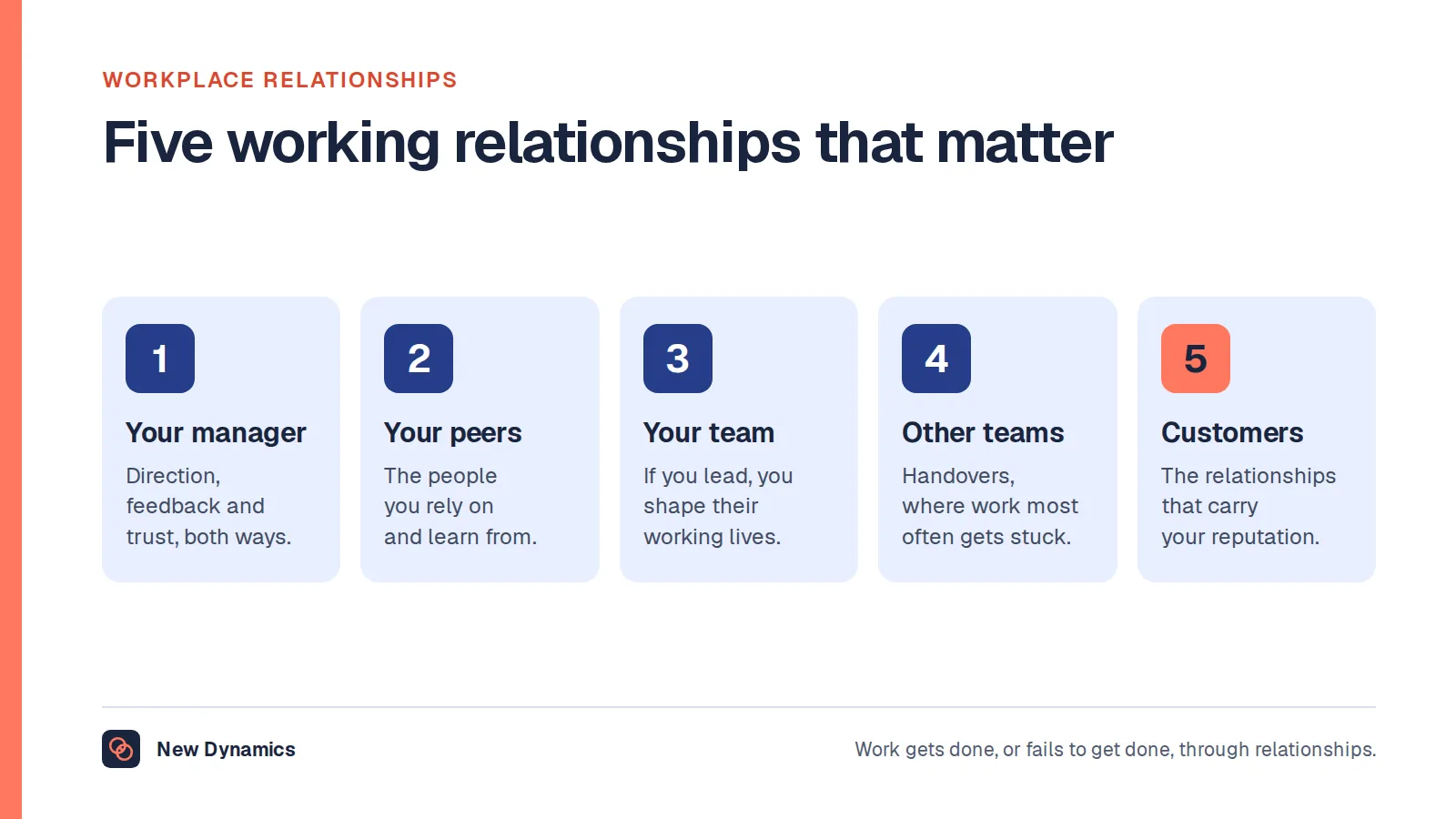
- Deal promptly with bullying, harassment and unacceptable behaviour. See our guide to workplace relationships.
- Include a question about workload and wellbeing in every one-to-one.
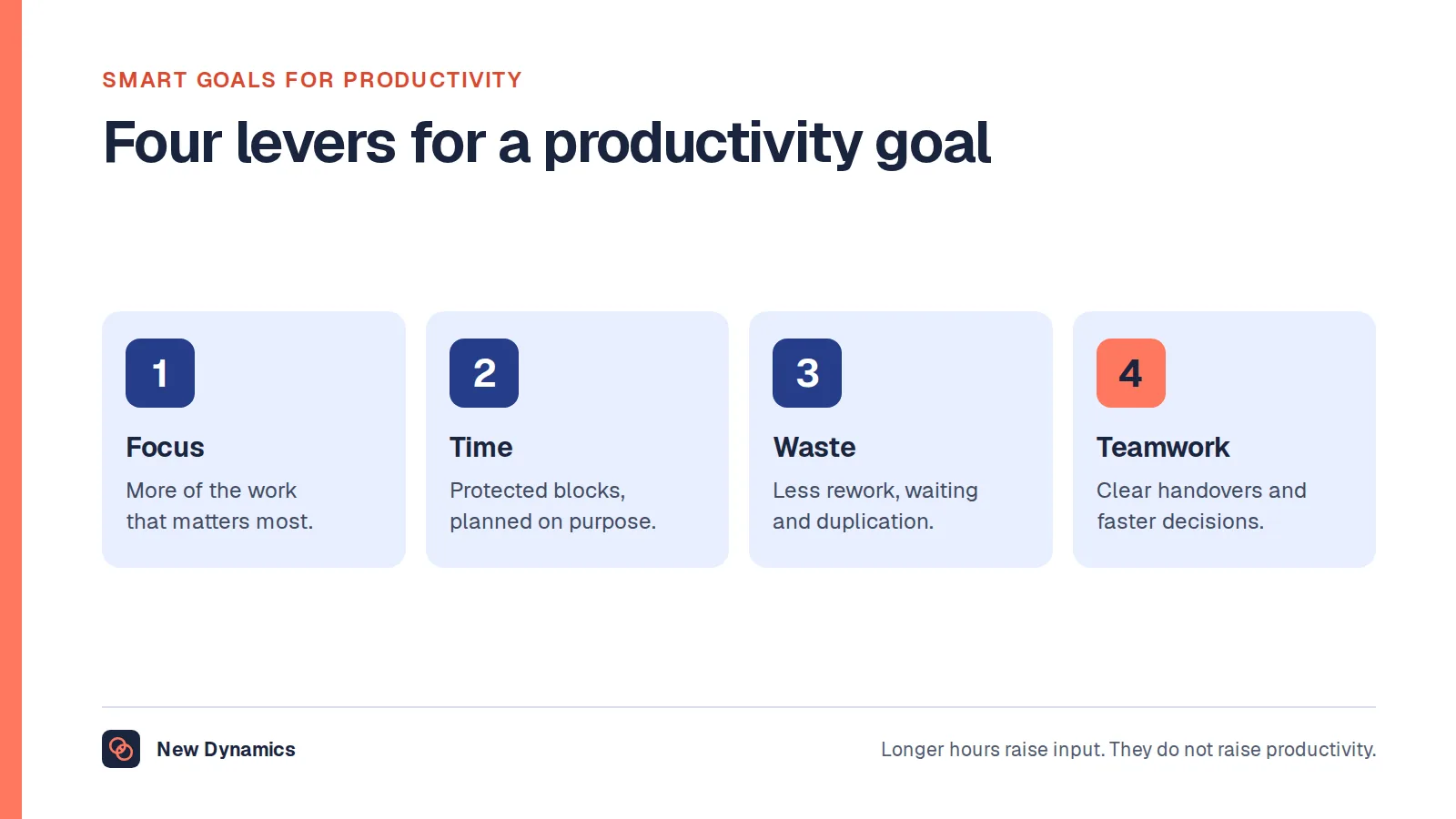
Our SMART goals for productivity show how to improve output without longer hours.
Managers and culture
- Train managers to spot signs of distress, to have a supportive conversation and to point people to help.
- Give every manager a team small enough for regular one-to-ones.
- Ask leaders to model healthy habits: taking leave, leaving on time and talking openly about pressure.
- Offer mental health awareness training for all staff, to improve knowledge and reduce stigma.
- Train a group of volunteers as mental health first-aiders or wellbeing champions, with clear limits to their role.
- Recognise good work regularly. Feeling valued is part of wellbeing. See our employee recognition quotes.
- Make it safe to raise concerns, with more than one route. See how to make an open door policy real.
Mental health support
- Provide an employee assistance programme with confidential counselling, and remind people that it exists.
- Agree reasonable adjustments with people who have mental health conditions, such as changed hours or duties.
- Offer a phased return to work after long absence, with regular check-ins.
- Provide wellness action plans that people can complete and share with their manager if they choose.
- Give access to a quiet room for breaks, prayer or recovery.
- Hold peer support groups, such as for carers, new parents or people going through the menopause.
Physical health
- Offer workstation assessments and good equipment, at home as well as in the office.
- Encourage walking meetings and proper lunch breaks away from the desk.
- Subsidise gym membership, fitness classes or a cycle-to-work scheme.
- Organise optional team challenges, such as a step count month, that people of all abilities can join.
- Offer health checks, flu vaccinations or eye tests at work.
- Provide healthy food options where you provide food at all.
- Offer help to stop smoking, or to drink less, for those who want it.
Financial wellbeing
- Pay fairly and on time, and explain how pay decisions are made. It is the foundation of financial wellbeing.
- Offer financial education sessions on budgeting, pensions and debt, from an independent provider.
- Provide access to salary-linked savings, or affordable loans through a credit union.
- Signpost free, independent debt advice.
- Make sure that expenses are repaid quickly, so that staff do not fund the business.
Social connection and purpose
- Give new starters a buddy, and introduce them to the people they need to know.
- Support volunteering with paid time off.
- Hold regular, inclusive social events at different times and without a focus on alcohol.
- Create ways for remote staff to connect, such as virtual coffee pairings.
- Share stories of the difference that people's work makes to customers.

How to start a wellness programme for staff
- Ask first. Run a short survey or a few listening groups. Ask what helps and what harms wellbeing at work. The HSE's six areas make a good structure. Our workplace engagement survey questions include wellbeing items.
- Look at your data. Absence, turnover, overtime, unused leave and exit interviews all tell you where the pressure is.
- Fix one thing about the work. Choose the biggest issue people raise, such as workload in one team, and act on it visibly.
- Choose a few initiatives that people asked for. Three that are well used beat twelve that nobody knows about.
- Equip managers. They are the programme. Give them training, time and permission to adjust work.
- Communicate simply and often. One page that says what is available and how to use it.
- Make it inclusive. Check that shift workers, remote staff, part-timers and people with disabilities can take part.
- Review every six months. Keep what is used and valued. Drop what is not.
WHO stresses that action on mental health at work should be taken “with the meaningful involvement of workers and their representatives”. Involving staff is also the best way to make sure that the programme is used.
How to measure a wellness programme
Measure at three levels.
- Reach. How many people know about each element, and how many use it?
- Experience. What do people say in surveys about workload, control, support and whether the organisation cares about their wellbeing?
- Outcomes. Watch absence, turnover, overtime and unused leave over time, alongside performance.
Be modest about cause and effect. Many things influence absence and turnover. Look for patterns over a year or more, and treat individuals' use of confidential services as private. Report only anonymous totals.
Common mistakes
Perks in place of fixes. Yoga does not offset a workload that is too heavy. People see the gap, and trust falls.
Putting it all on the individual. Resilience training implies that the problem is the person. Sometimes the problem is the job.
Ignoring managers. A programme that managers do not understand or support will not be used.
One size for all. A lunchtime class is no use to the night shift.
Pressure to take part. Wellness activities should always be optional, and never part of how performance is judged.
Launch and forget. Without reminders and review, take-up tends to fade.
Breaking confidentiality. Health information is sensitive. Handle it strictly in line with data protection law. See our employee data protection guide.

Frequently asked questions
What is an employee wellness programme?
It is the set of things an employer does to protect and improve the health of its people, covering mental, physical, financial and social wellbeing. It includes how work is designed and managed, as well as services and activities such as counselling, health checks and fitness schemes.
What are good wellness program ideas for employees?
Start with work design: manageable workloads, flexible hours, meeting-free time and clear roles. Then train managers, offer confidential counselling, support physical activity, provide financial education and create chances for social connection. Ask staff which they would value.
How do you start a wellness programme for staff?
Ask people what helps and harms their wellbeing, look at your absence and turnover data, fix one issue about the work itself, choose a few initiatives that staff asked for, equip managers, communicate simply and review every six months.
Do workplace wellness programmes work?
The World Health Organization recommends action on working conditions first, along with training for managers. Programmes made up only of individual perks are less likely to help if workload, control and support are poor. Measure your own results over time.
What are low-cost wellbeing initiatives?
Many of the most effective cost little: reviewing workloads, agreeing norms for out-of-hours messages, meeting-free afternoons, regular one-to-ones, encouraging people to take leave, walking meetings, a buddy for new starters and signposting free advice services.
What is a personal wellness programme?
It is an individual's own plan for looking after their health, such as sleep, exercise, breaks and boundaries around work. Employers can support it with flexible hours, time for appointments, access to services and managers who respect the plan.
Your next step: ask three questions
- At your next team meeting or in a short survey, ask: what helps your wellbeing at work, what harms it, and what one change would make the most difference?
- Group the answers under the six HSE areas.
- Choose one issue about the work itself, and act on it this month.
- Tell people what you did, and ask again in six months.
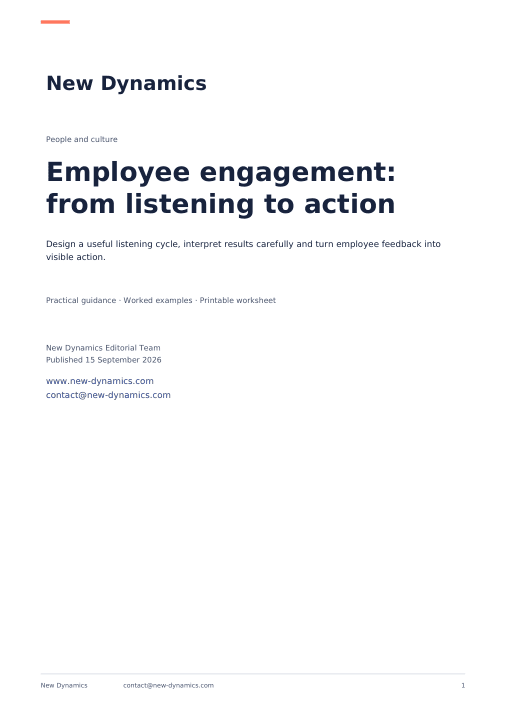
For a fuller approach to listening and acting on what you hear, read and download our employee engagement guide. The guide is free to read, and the PDF uses our short download form.
Want workload, support and recognition to be part of every manager's regular check-ins? Book a New Dynamics demo and bring your current approach. You can also email contact@new-dynamics.com.