TL;DR
- Induction and onboarding are different jobs. Induction is the first day or days: the welcome, safety, systems and the rules of the place. Onboarding runs to a first meaningful contribution, usually across about 90 days.
- The checklist below is written out in full in four phases, before day one, day one, the first week and the first 90 days, and every item names an owner, because an item with no owner is a wish.
- Three things are not optional for a UK employer: the right to work check before employment begins, the principal statement of employment particulars on the first day, and induction training proportionate to the risks of the job.
Most employee onboarding checklists fail in the same way. They are a list of things the organisation needs from the new person, and almost nothing the new person needs from the organisation. The forms get signed, the laptop arrives, the boxes are ticked, and six weeks later the new starter still cannot explain what good looks like in their role.
This article separates the two things that the phrase gets used for, induction and onboarding, and then gives you the checklist in full, in four phases, with an owner against every item. Nothing here is hidden behind a download.
If you want the tasks, the early goals and the first manager conversations running on one path rather than in three different places, see how New Dynamics onboarding handles a new starter.
Induction and onboarding are not the same thing
Search results treat these as synonyms. They are not, and the distinction is the most useful thing on this page.
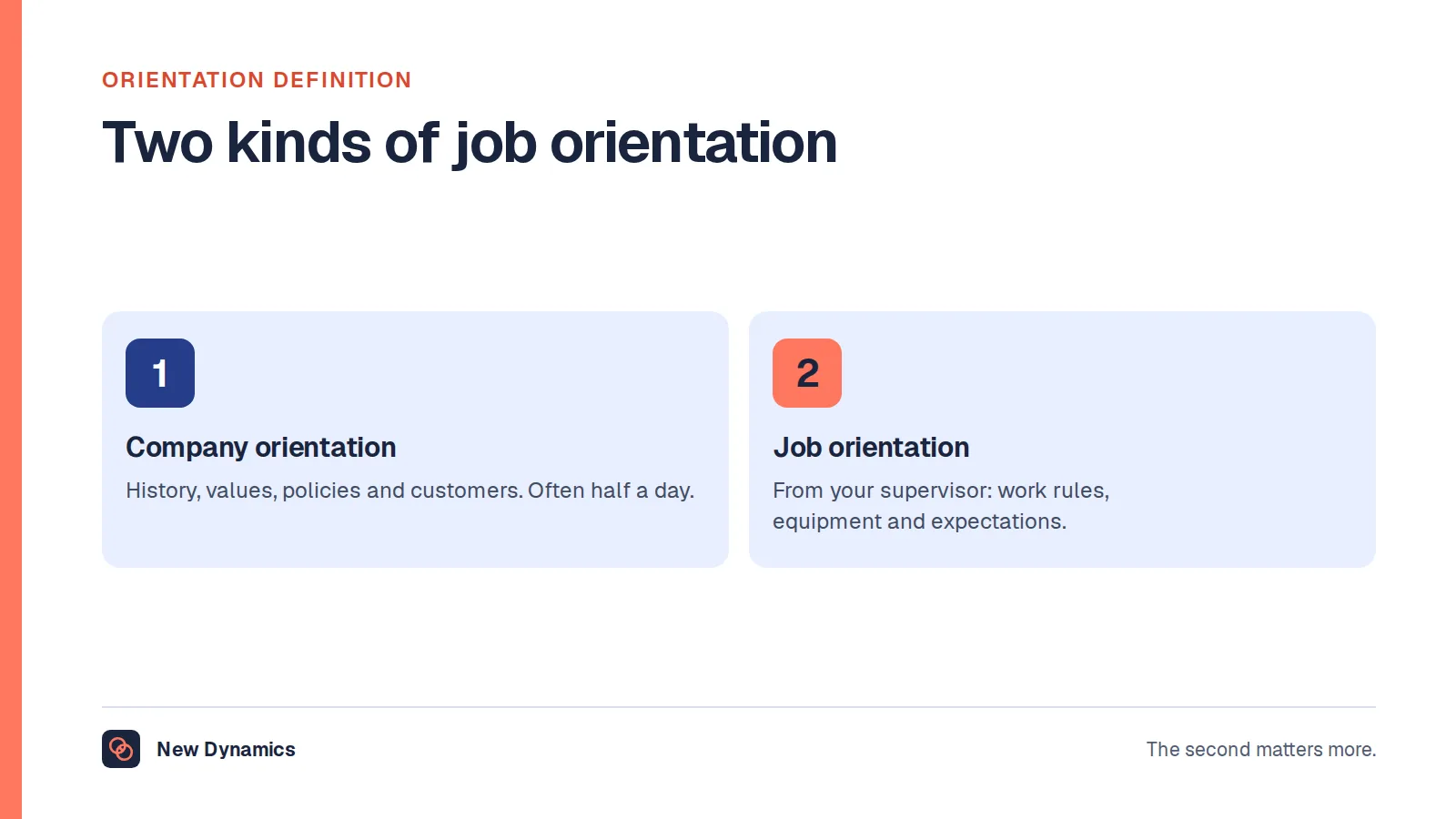
Induction is the first day or days. It is bounded, mostly the same for everyone, and largely about safety and permission to operate: who you are, where things are, what the rules are, how to get into the systems, what to do if the fire alarm goes. In the UK this is the word people use. In the US and in a lot of software, the same event is called orientation. Our post on employee orientation covers that vocabulary in more detail.
Onboarding is the whole arc from offer acceptance to the point where someone makes a first meaningful contribution, which for most roles lands somewhere in the first 90 days. It is specific to the role and the person. It includes context, relationships, expectations and feedback, none of which can be delivered in a day.
Conflating them has a predictable result: a very good induction day, treated as the finish line. The person is safe, logged in and legally employed, and nobody has told them what the team is trying to achieve this quarter.

What a workplace induction is, and what an induction day covers
A workplace induction is the structured introduction an employer gives a new worker before they start doing the job unsupervised. An induction day is simply that introduction packed into a single day, which is common in larger organisations and in sectors where several people start at once.
A reasonable induction day covers four things: the welcome and the people, the essentials of employment and policy, health and safety for the actual work, and system access. That is it. Everything else that often gets stuffed into an induction day belongs in the weeks afterwards, where it stands a chance of being remembered.
The health and safety part is not a formality, and the Health and Safety Executive is blunt about why. Its guidance on workers who are new to the job states that "Workers are as likely to have an accident in their first 6 months at work as during the whole of the rest of their working life." The same page tells employers to "Provide an induction. Plan it carefully, including photos of hazards where possible, and use plain, simple language.", to "Provide adequate supervision. Make sure workers know how to raise concerns." and to "Provide relevant information, instruction and training about the risks new workers may be exposed to and the precautions they will need to take to avoid them." That is Great Britain, under the Health and Safety Executive's remit, and it is general information rather than legal advice.
Two consequences for your checklist. First, induction training is an item with a date and a record, not a slide deck sent by email. Second, supervision in the early weeks is part of the induction, so the manager's diary is part of the preparation.
The employee onboarding checklist, phase by phase
Here is the checklist in full. Each item names an owner. Where two functions touch an item, the owner is whoever is accountable for it being done, not everyone involved.
If you want this as a working document you can adapt, our 90-day onboarding checklist template is the same shape with space for dates and names.
Phase 1: before day one
This is the phase that gets skipped and the phase that decides how the first day feels.
- Right to work check completed and recorded. Owner: HR. This must happen before employment begins, not on the first morning.
- Principal statement of employment particulars prepared and ready to issue on day one. Owner: HR.
- Signed offer, bank details, emergency contact, pension enrolment and payroll record created. Owner: HR.
- Start date, arrival time, place, dress code, parking or travel notes and the name of the person meeting them sent in one message. Owner: HR, written by the manager where the detail is team-specific.
- Equipment ordered, built and tested, including anything needed for a reasonable adjustment. Owner: IT.
- Accounts, email, building access and the specific systems for the role requested and confirmed. Owner: manager raises, IT delivers.
- Desk, locker, uniform or vehicle allocated. Owner: facilities or the site lead.
- First-week plan written, hour by hour for day one and day by day after that. Owner: manager.
- Buddy asked, and they have said yes. Owner: manager.
- Team told who is joining, when, and what they will be working on. Owner: manager.
- Induction training booked, with the health and safety content matched to the actual job. Owner: HR or the site safety lead.
- The role's first 90 days drafted: what the person should be able to do by day 30, 60 and 90. Owner: manager.
Phase 2: day one
The test of a good first day is simple. At the end of it, does the new person know who they are working with, what they are here to do, and who to ask when something goes wrong?
- Someone is waiting for them at the agreed time and place. Owner: manager, with a named fallback if the manager is away.
- Principal statement of employment particulars handed over. Owner: HR.
- Right to work documents filed and the check record closed off. Owner: HR.
- Induction: fire exits, first aid, incident reporting, the hazards of their own job and the precautions. Owner: HR or the site safety lead.
- Logins proven to work, with the person logging in themselves rather than being told the password works. Owner: IT.
- Tour of the places they will actually use: their desk, the kitchen, the toilets, the exits, the stores. Owner: buddy.
- Introductions to the immediate team, in person or on a call, with names written down somewhere they can look again. Owner: manager.
- A conversation about the job itself: what the team is trying to achieve, where this role fits, and what the first few weeks look like. Owner: manager.
- Lunch with someone. Owner: buddy.
- One small, finishable task, if the role allows it. Owner: manager.
Phase 3: the first week
The first week is where context arrives. Spread it out and keep the afternoons lighter than the mornings.
- Role expectations written down and agreed, not described once in a corridor. Owner: manager.
- Mandatory training completed, with the record saved. Owner: HR.
- Wider written statement issued or scheduled, since the remaining particulars are due within two months. Owner: HR.
- Introductions beyond the team: the people whose work connects to theirs, and what each connection is for. Owner: manager.
- Access gaps found and fixed, because something is always missing. Owner: buddy raises, IT fixes.
- Policies that actually apply explained in person: expenses, absence, holiday booking, flexible working, who to tell and when. Owner: HR.
- A first real piece of work started, with support arranged and a visible deadline. Owner: manager.
- End-of-week conversation: what is clear, what is not, what is missing. Owner: manager.
- Induction feedback collected while it is still accurate. Owner: HR.
Phase 4: the first 90 days
This is the half of onboarding that most checklists never reach.
- Day 30 check-in: is the role as described, is anything blocked, is the support right. Owner: manager.
- Day 60 check-in: first contributions reviewed, feedback given in both directions, training needs named. Owner: manager.
- Day 90 check-in: expectations against performance, and an explicit decision about the probation period where one exists. Owner: manager, with HR on the process.
- Objectives moved from onboarding goals to the normal cycle the rest of the team uses. Owner: manager.
- Buddy arrangement formally ended, with thanks, rather than left to fade. Owner: manager.
- Development conversation: what this person wants next, now that they know what the job is. Owner: manager.
- Onboarding data reviewed: where people stalled, what was missing, what to change for the next joiner. Owner: HR.

The UK requirements that are not optional
Most of a checklist is your choice. Three items are not. The following applies to the United Kingdom and is general information rather than legal advice. Take advice on your own circumstances.
The right to work check, before employment begins. GOV.UK guidance on checking a job applicant's right to work states: "You must check that a job applicant is allowed to work for you in the UK before you employ them." It also tells employers to "keep copies during the applicant's employment and for 2 years after they stop working for you", and warns that "You could face a civil penalty if you employ an illegal worker and have not carried out a correct right to work check."
The written statement of employment particulars, with the principal statement on the first day. GOV.UK guidance states that "An employer must give employees and workers a document stating the main conditions of employment when they start work." On timing: "The employer must provide the principal statement on the first day of employment and the wider written statement within 2 months of the start of employment." The wider statement is where pensions and pension schemes, collective agreements, non-compulsory training and the disciplinary and grievance procedures go.
Induction training proportionate to the risk of the work, as set out in the Health and Safety Executive guidance quoted above.
A probation period, by contrast, is not a legal requirement at all. Acas guidance states: "There's no legal requirement to have a probation period. And they can be any length of time." Acas describes a probation period as a time at the start of employment to check if someone is suitable for a job, and notes that probations of six months or less might not be appropriate for all roles, for example where a role needs extended training and assessment. If you do run one, the day 90 conversation above is where the decision belongs, and it should be a decision rather than a silence.

Who owns what: the manager's part versus HR's part
Onboarding falls over at the handover between HR and the manager, so draw the line explicitly.
HR owns the parts that must be identical for everyone and auditable afterwards. The right to work check. The employment particulars. Payroll and pension enrolment. Mandatory training and its records. The induction content that applies to the whole organisation. The template of the process, and the data that says whether it is working.
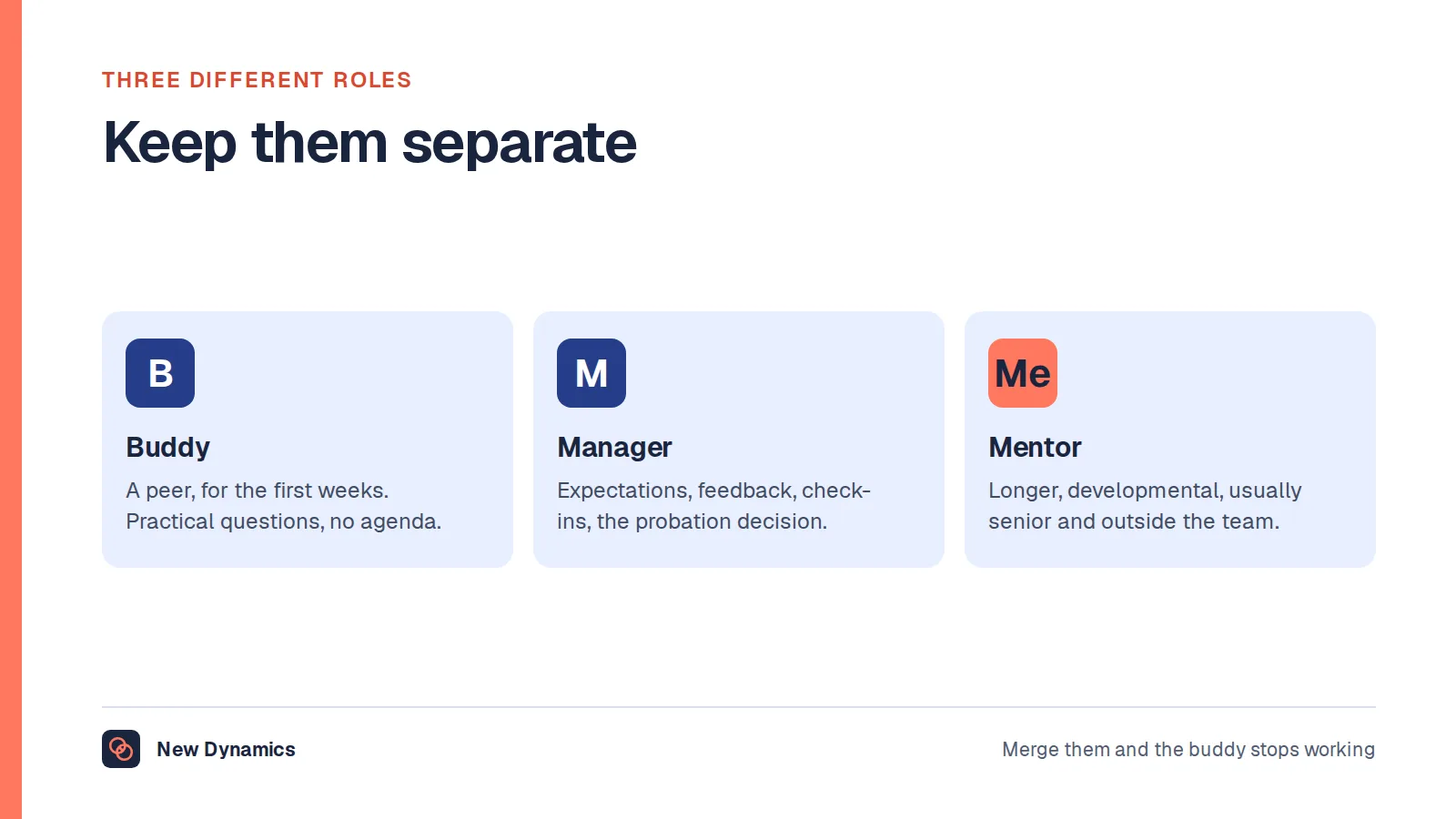
The manager owns everything that is specific to this role and this person. What the job is for. What good looks like by day 30, 60 and 90. Who the person needs to know and why. The first piece of real work. The feedback. The probation decision. None of this can be delegated to a system or to HR, because none of it is known outside the team.
The practical failure mode is a manager who believes HR is doing onboarding, and an HR team who believe the manager is. The fix is not a longer checklist. It is a checklist where every line carries a name, and a manager who gets the first-week plan into their diary before the person starts.
A buddy, and why it is not the manager's job
A buddy is a peer who answers the questions a new starter will not take to their manager: where the good coffee is, whether that meeting is optional, what the acronym means, whether it is normal that nobody has replied yet.
Pick someone who does similar work, is not in the reporting line, and is not being assessed on it. Ask them, do not assign them. Tell them what the role is and what it is not: a buddy is not an assessor, a trainer or a stand-in manager, and should never be asked to report back on how the new person is getting on. Our post on the onboarding buddy sets out the scope week by week and the things to keep away from the role.
Set an end date. A buddy arrangement that is never closed tends to stop happening in week three and leave everyone vaguely guilty about it.
Check-ins at 30, 60 and 90 days
Three conversations, with different jobs.
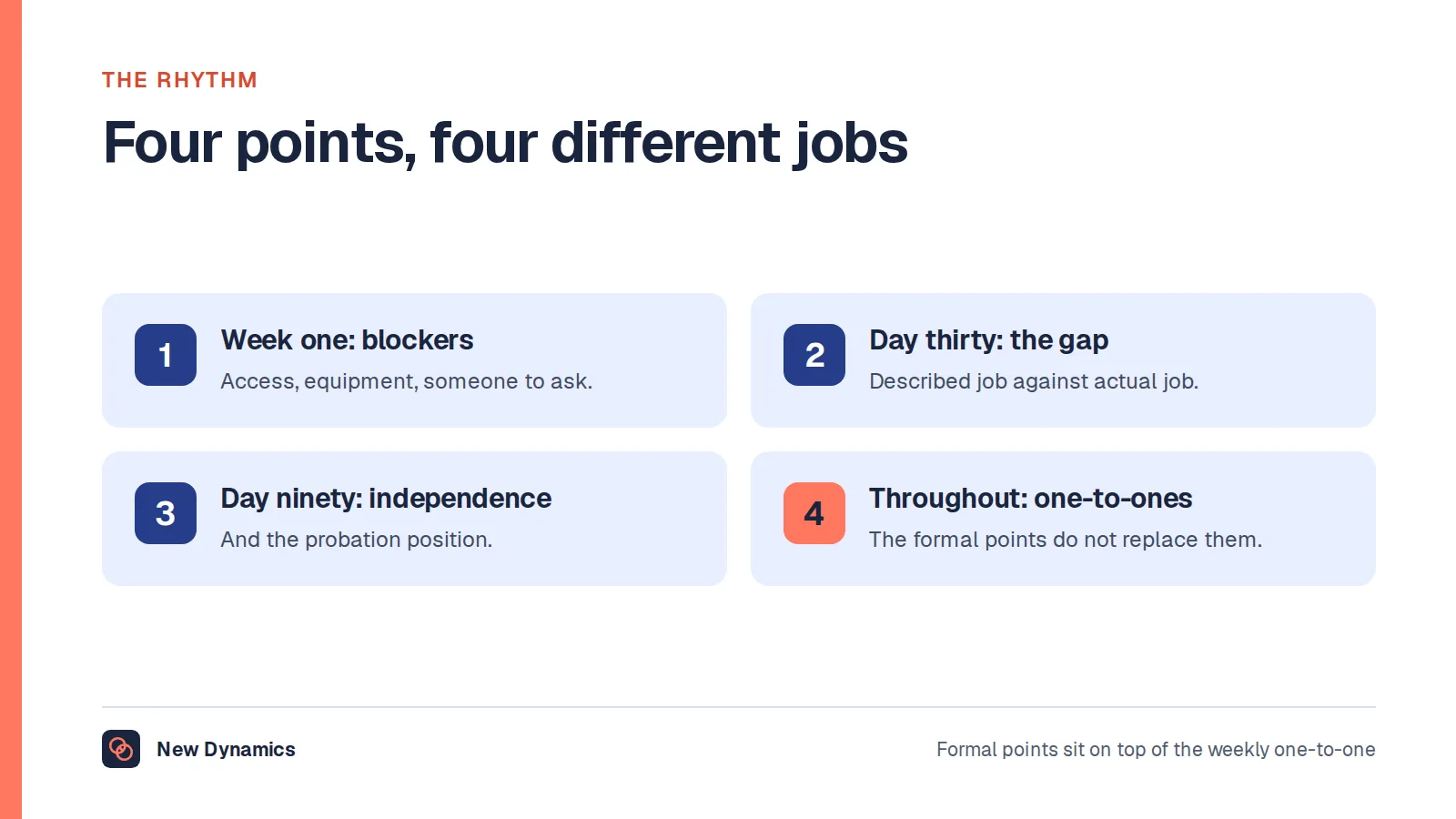
Day 30 is about the organisation, not the person. Is the role what we described at interview? Is anything blocking you? Is anything still missing? What has been confusing? This is the only moment when someone can see your onboarding with fresh eyes, and the answers are a direct instruction about what to fix for the next joiner.
Day 60 is about the work. The first contributions are now real enough to discuss. Give specific feedback, ask for it in return, and name any training gap while there is still time to close it.
Day 90 is about expectations against performance, and it is where a probation decision is made and said out loud. If a conversation at day 90 contains a surprise, the problem happened at day 30 and nobody raised it. Our post on onboarding check-ins has the questions for each one.
Onboarding someone remote
Remote onboarding fails on the things nobody writes down, because overhearing is how most of an office induction actually happens.
- Send the equipment so that it arrives before the start date, and test that the person can log in before day one rather than discovering a problem at nine on Monday.
- Book the introductions. In an office they happen by accident. Remotely, every one of them has to be a calendar invitation with a stated purpose.
- Run day one on video with a named host, and keep it shorter than an office day one. Six hours of calls with strangers is not a welcome.
- Replace corridor access with a standing short daily call in week one, dropping to a couple a week after that.
- Write down the unwritten rules: core hours, response expectations, which channel means urgent, whether cameras are expected, how to signal that you are stuck.
- Be explicit about the health and safety items that still apply, including workstation setup at home, and about who the person contacts in an emergency.
Onboarding someone with no work email or desk
Checklists are usually written for a desk worker with a laptop, which leaves out a large part of the workforce: drivers, care staff, warehouse and production teams, retail, hospitality, contractors on site.
- Do not route anything essential through an email address they do not have. Paper, a shared terminal, a phone call, or a personal device they have agreed to use for a specific purpose.
- Make the induction physical and local: the actual machine, the actual hazards, the actual route, in plain language, which is what the Health and Safety Executive guidance asks for.
- Give one named person on site who answers questions, and one named person who fixes problems. On a shift pattern these may not be the same person every day, so write the names on the rota.
- Issue the principal statement on paper on the first day and keep a signed record, because there is no inbox to fall back on.
- Watch out for a first shift that nobody told the shift supervisor about. The single most common failure in shift onboarding is a new starter arriving to a supervisor who did not know they were coming.
- Make the day 30 and day 90 conversations happen inside paid time. If a check-in depends on someone's own time, it will not happen.
What goes wrong
- The checklist is all admin and no context. Every item serves the employer: forms, assets, training records. Nothing on it tells the person what the team is for, what good looks like, or who to ask. The paperwork is complete and the person is lost.
- Completion is treated as success. A 100% completion rate measures whether tasks were closed, not whether anybody can do their job. Count days to a first meaningful contribution and the 90-day leaver rate as well, and look at where in the sequence people stall rather than at one percentage. Our post on onboarding statistics explains which of these figures are published anywhere and which you have to produce yourself.
- Everything lands on day one. Fourteen policies, twelve introductions and four systems, none of which survive to Tuesday.
- No owner on the items. "IT access" with no name beside it is a queue nobody is in.
- The manager has not blocked the time. The plan was written and the diary was not, so week one is spent waiting.
- It stops at the end of induction. The first day is excellent and days 10 to 90 are undesigned, which is exactly the half that determines whether the hire works.
- It is the same for a graduate and a director. The legal and safety floor is shared. The context, the first work and the pace are not.
- Nothing is learned from it. Nobody asks the last three joiners what was missing, so the same thing is missing for the next one.
Frequently asked questions
What is the difference between induction and onboarding?
Induction is the first day or days: the welcome, health and safety, the rules of the place and system access. Onboarding is the whole arc from offer acceptance to a first meaningful contribution, usually about 90 days, and it includes context, relationships, expectations and feedback. Induction is one part of onboarding, not a shorter word for it.
What is a workplace induction?
It is the structured introduction an employer gives a new worker before they do the job unsupervised. It covers the people and the place, the essentials of employment and policy, health and safety for the actual work, and getting into the systems they need. The Health and Safety Executive asks employers to plan it carefully and use plain, simple language.
What happens on an induction day at work?
Expect to meet the people you will work with, hand over or receive employment paperwork, cover fire exits, first aid and incident reporting, go through the hazards and precautions of your own job, prove that your logins work, see the places you will actually use, and have a conversation with your manager about what the role is for. A good induction day ends earlier than people expect.
What should be on an employee onboarding checklist?
Four phases, each item with a named owner. Before day one: right to work check, paperwork, equipment, access, a first-week plan, a buddy and induction booking. Day one: a welcome, the principal statement, induction training, working logins and a conversation about the job. First week: expectations, mandatory training, introductions, a first real task and a Friday check-in. First 90 days: check-ins at 30, 60 and 90 days, a probation decision where one applies, and a review of what to fix for the next joiner.
What does an employer have to do by law before a new starter's first day?
Under United Kingdom rules, the right to work check comes first. GOV.UK guidance says you must check that a job applicant is allowed to work for you in the UK before you employ them, and keep copies during their employment and for two years after they stop working for you. This is general information rather than legal advice.
When must a new employee get their contract or written statement?
GOV.UK guidance states that the employer must provide the principal statement on the first day of employment and the wider written statement within two months of the start of employment. The principal statement covers things like pay, hours, holiday entitlement, work location and any probation period. Pensions, collective agreements, non-compulsory training and the disciplinary and grievance procedures can follow in the wider statement.
Your next step: turn this into a working document
- Take the four phases above and put a real name against every line for your next joiner, not a function.
- Check the three non-negotiables are actually in your process with a date and a record: right to work before employment, principal statement on day one, induction training matched to the job.
- Put the day 30, 60 and 90 conversations in the manager's diary now, before the start date, because they are the items most likely to be dropped.
- Ask your last three joiners what was missing, and fix the two most common answers before the next one arrives.
To work from a version you can edit and hand to a manager, use our 90-day onboarding checklist template, or read the wider employee onboarding guide for the thinking behind it.
Want onboarding tasks, early goals and the 30, 60 and 90-day conversations on one path, with an owner visible against each one? Book a New Dynamics demo and bring your current checklist. You can also email contact@new-dynamics.com.