TL;DR
- An equal pay claim is a contract claim. Section 66 of the Equality Act 2010 reads a sex equality clause into the contract: “If the terms of A's work do not (by whatever means) include a sex equality clause, they are to be treated as including one.”
- The time limit did not change on 1 October 2026. Schedule 12 to the Employment Rights Act 2025 moved section 123 of the Equality Act from three months to six. It does not touch section 129, which already gave an equal pay claimant six months from the last day of the employment.
- Arrears reach further back than in any other pay claim. Section 132 sets the arrears day in England and Wales at “The day falling 6 years before the day on which the proceedings were instituted”, and in Scotland at five years.
Two people do the same job for the same employer and one is paid more. That is not, by itself, an equal pay claim, and the law turns on details that have little to do with how unfair the difference feels. The two that decide most cases are who the claimant compared themselves with, and when they filed.
This article sets out what the claim is in Great Britain, the three ways work counts as equal, why the comparator has to be a real named person, who proves what, and the time limit and arrears period, both of which are unlike any other pay claim. It is general information about England, Wales and Scotland and it is not legal advice. Northern Ireland has its own equal pay legislation and nothing below applies there.
The defence an employer needs is a reason written down when the pay decision was made. See how New Dynamics workflows hold the stages, approvals and dated evidence of your own pay and review process, so a decision from four years ago can still be explained.
Equal pay and the gender pay gap are not the same thing
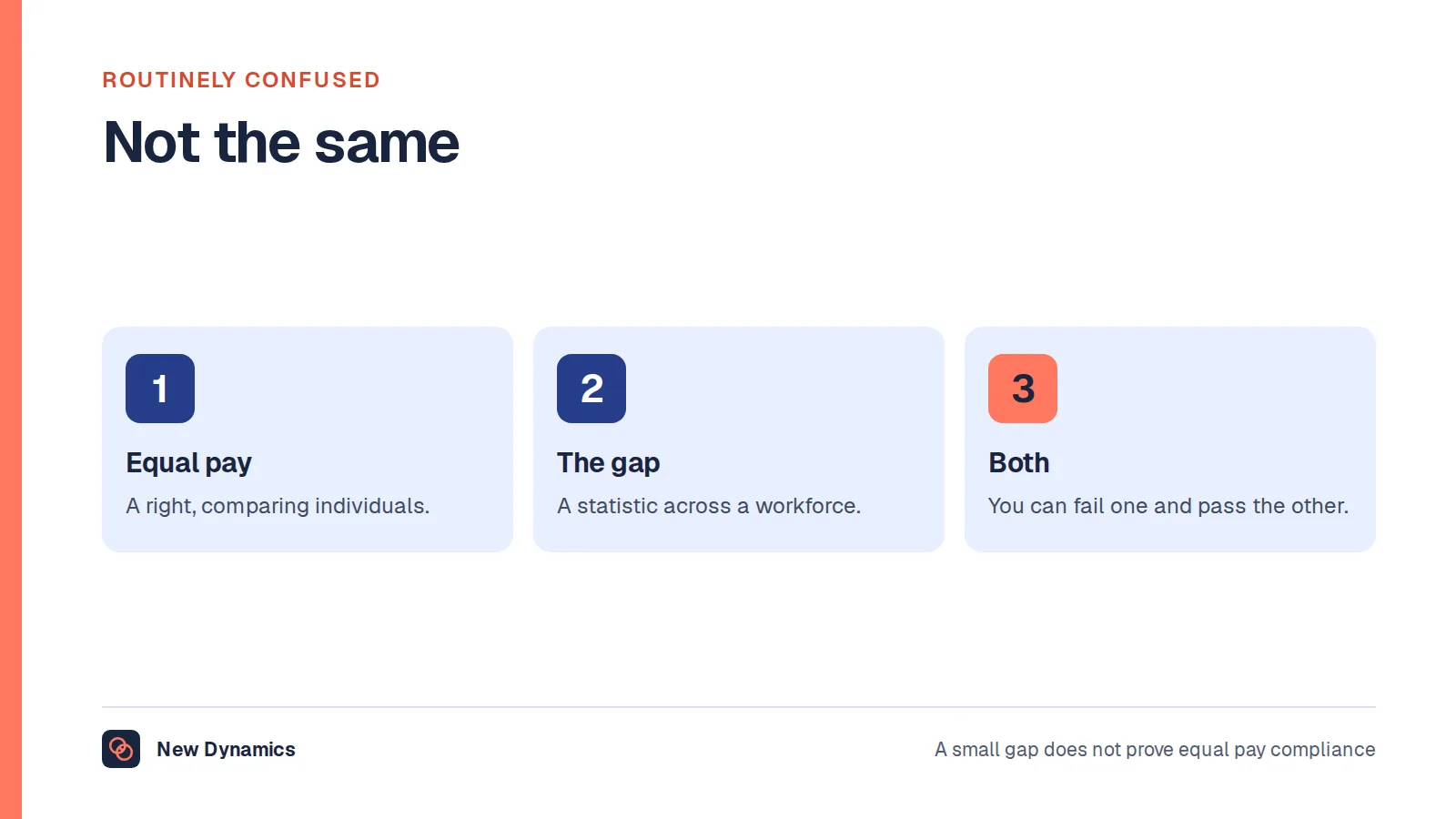
Readers conflate these constantly. Acas settles it in one line on its guidance about equal pay and the law: "Equal pay and gender pay gap reporting are not the same thing."
Equal pay is a right belonging to one person about their own contract, measured against one named colleague. The Equality and Human Rights Commission puts it as "men and women in the same employment performing equal work must receive equal pay, unless any difference in pay can be justified". The gender pay gap is a statistic, "a measure of the difference between men's and women's average earnings across an organisation or the labour market". An employer can publish a small gap and still lose a claim, or publish a large gap while paying every individual lawfully.
The reporting duty is a separate matter, covered in our posts on pay equity and transparency at work. This article is about the claim.

What an equal pay claim is in law
It is a contract claim. Part 5 Chapter 3 of the Equality Act 2010, headed equality of terms, came into force on 1 October 2010 and works by rewriting the contract rather than by compensating hurt feelings.
Section 66 provides that "If the terms of A's work do not (by whatever means) include a sex equality clause, they are to be treated as including one." Where "a term of A's is less favourable to A than a corresponding term of B's is to B, A's term is modified so as not to be less favourable", and where A has no corresponding term at all, one is read in. Section 127 gives the tribunal jurisdiction over "a complaint relating to a breach of an equality clause or rule."
Two consequences catch people out. The comparison is term by term, not package against package, so a better bonus does not cancel a worse sick pay term. And it covers contractual terms rather than salary alone: the EHRC list runs from non-discretionary bonuses and overtime rates to redundancy pay, hours of work, sick pay and benefits in kind.
The claim is rarer than the arguments about it suggest. The Ministry of Justice's Tribunals statistics quarterly: April to June 2026, published 10 September 2026, records 107 equal pay jurisdictional complaints among the 90,028 received in the 2025 to 2026 financial year, against 4,912 for sex discrimination. Those annual figures are marked as revised. That table "Includes data for single employment tribunal cases on the Reform system", and equal pay litigation is mostly multiple claims, so the true count is higher. Our HR statistics hub holds the wider picture.
The three ways work counts as equal
Section 65 gives three routes, and a claim has to pick one.
- Like work. Work that is "the same or broadly similar", where "such differences as there are between their work are not of practical importance in relation to the terms of their work". Occasional heavy lifting by one person is not usually a difference of practical importance.
- Work rated as equivalent. Work where "a job evaluation study gives an equal value to A's job and B's job in terms of the demands made on a worker". Section 80(5) defines such a study as one evaluating jobs "by reference to factors such as effort, skill and decision-making".
- Work of equal value. Work that is "neither like B's work nor rated as equivalent", yet "nevertheless equal to B's work in terms of the demands made on A". Different jobs entirely. The EHRC lists court findings including a clerical assistant equal to a warehouse operative and a school nursery nurse equal to a local government architectural technician.

A job evaluation scheme cuts both ways, which employers underrate. Under section 131(6), where a study has already given the two jobs different values, the tribunal "must determine that A's work is not of equal value to B's work" unless it suspects the evaluation "was based on a system that discriminates because of sex, or is otherwise unreliable". A current analytical scheme is a defence. A stale or sex-specific one is evidence against you. Our post on pay bands and job evaluation covers how the schemes are built.
The comparator has to be a real person
This is where most self-assessed claims fail. Section 64 requires that "a person (A) is employed on work that is equal to the work that a comparator of the opposite sex (B) does". B is an actual colleague, not an average and not a hypothetical reasonable man. The EHRC's Statutory Code of Practice on equal pay is explicit about the alternative: "Where a woman has evidence of direct sex discrimination in relation to her contractual pay but there is no actual comparator doing equal work, so that a sex equality clause cannot operate, she can claim sex discrimination based on a hypothetical comparator."
Section 79 sets who qualifies: the same employer or an associate of it, at the same establishment or at one where "common terms apply at the establishments", and also where "a single body is responsible for setting or continuing the terms on which A and B are employed", or where both are "governed by the same collective agreement".
He does not have to be there now. Section 64(2) says the work B does is "not restricted to work done contemporaneously with the work done by A", and Acas, in its advice for employees last updated 7 November 2024, says "A comparator can be someone who currently works for your employer, or someone who used to." The choice also belongs to the claimant. The EHRC states that "It is for the woman to select the man or men she wants to be compared with", that "Her employer cannot influence the choice of comparator", and that the comparator "does not have to give his consent to being named in the equal pay claim."
The material factor defence, and who proves what
Once equal work and a worse term are established, the burden moves. The EHRC states the effect: "If a woman proves that she is doing equal work to a man, there is a legal presumption that any difference in their pay is because of their sex, unless the employer can show that a 'material factor' explains the difference."
Section 69 sets the test. The clause has no effect where "the responsible person shows that the difference is because of a material factor" whose use does not involve treating A less favourably because of sex and, where the factor disadvantages one sex as a group, "is a proportionate means of achieving a legitimate aim". Section 69(6) adds the limit employers forget: "a factor is not material unless it is a material difference between A's case and B's."
The EHRC says the factor must be genuine, must cause the difference, must be "significant and relevant", must "explain the pay difference with 'particularity'", meaning the employer can show how each factor was assessed and applied in that person's case, and must not be tainted by direct or indirect sex discrimination. A reason nobody wrote down at the time rarely survives that. Section 69(3) does hand employers one fixed point: "the long-term objective of reducing inequality between men's and women's terms of work is always to be regarded as a legitimate aim." Pay protection while a new structure beds in can be justified. Pay protection with no end date usually cannot.
The time limit, and why the 2026 reform does not change it
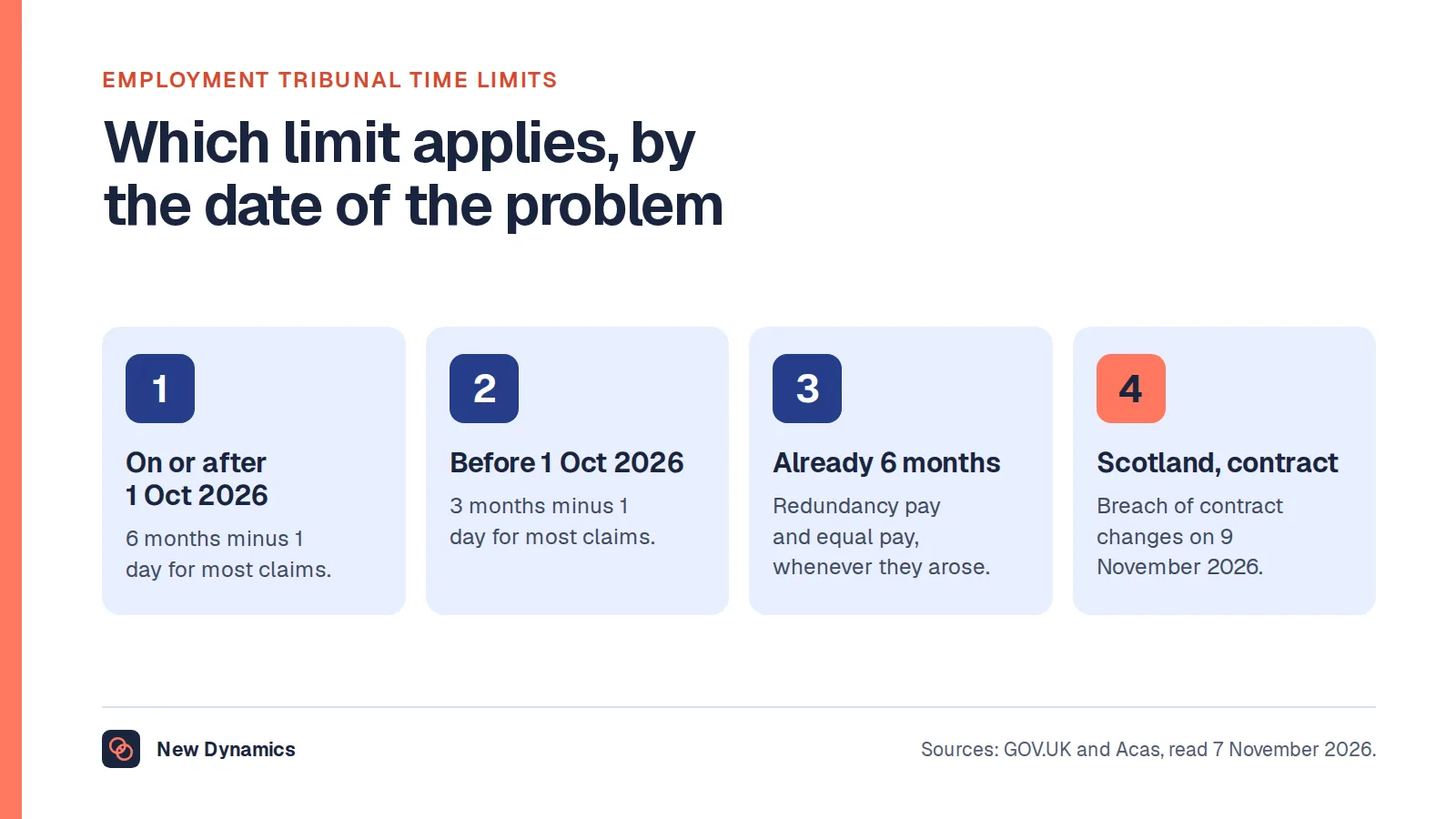
On 1 October 2026 the ordinary tribunal limit in Great Britain moved from three months to six. Equal pay claims were already at six months, and they run from a different starting point.
Section 129 says proceedings "may not be brought in an employment tribunal after the end of the qualifying period", and for a standard case that period is "The period of 6 months beginning with the last day of the employment or appointment." Not the last underpayment. The last day of the job. The EHRC spells out the consequence for employers: where the claimant still works for you "the time limit has not started", and where the claimant has left, "the six-month time limit started from the date they left". Three variants move the start: a stable work case runs from the day the stable working relationship ended, a concealment case from the day the worker "discovered (or could with reasonable diligence have discovered) the qualifying fact", and an incapacity case from the day the incapacity ceased.
The 2026 change applies to the other claim. Schedule 12 paragraph 18 of the Employment Rights Act 2025 reads: "In section 123 of the Equality Act 2010 (discrimination etc at work), in subsection (1)(a), for '3' substitute '6'." It came into force on 1 October 2026 by S.I. 2026/954, regulation 3. Section 123 is the ordinary discrimination limit, counted from the date of the act. Schedule 12 makes no amendment to section 129, so the equality of terms limit is untouched, and Acas's page on employment tribunal time limits, last updated 1 October 2026, lists equal pay claims among those that already had "6 months minus 1 day".
Two official sources now disagree, and the statute governs. The EHRC Statutory Code of Practice says of the equal pay limit: "This is different from sex discrimination claims for which the time limit is ordinarily three months from the last act of discrimination." That was right when the Code was written. Section 123(1)(a) now reads six months for an act done on or after 1 October 2026. Do not take the three month figure from the Code.
Notifying Acas pauses the equal pay clock too, because section 140B applies to the section 129 limit. A grievance pauses nothing: Acas is blunt that "Going through grievance, disciplinary or appeal procedures does not change your time limit." Our post on employment tribunal time limits works through the mechanics.

How far back the arrears go
An unauthorised deduction claim is capped at two years of arrears by section 23(4A) of the Employment Rights Act 1996. An equal pay claim is not, and that is what makes it expensive.
Section 132 lets the tribunal "order an award by way of arrears of pay or damages", but not "in respect of a time before the arrears day". For a standard case in England and Wales the arrears day is "The day falling 6 years before the day on which the proceedings were instituted". In Scotland it is the first day of "the period of 5 years ending with the day on which the proceedings were commenced". In a concealment or incapacity case in England and Wales it is "The day on which the breach first occurred", with no backstop at all. The EHRC adds that where the tribunal limit has passed, a breach of contract claim in the civil courts may still be possible within six years, or five in Scotland. Our post on back pay covers how arrears are calculated once liability is settled.
A win can also force an audit. Under the Equality Act 2010 (Equal Pay Audits) Regulations 2014, in force from 1 October 2014, where a tribunal finds an equal pay breach "the tribunal must order the respondent to carry out an audit", subject to four exceptions including where "the disadvantages of an audit would outweigh its benefits". If the employer has a website the audit goes on it "for a period of at least 3 years", and each penalty for non-compliance "must not exceed £5,000".
Equal pay claim or sex discrimination claim about pay
These are not alternatives you choose between. The Act allocates them. Section 71 applies to a term "that relates to pay, but in relation to which a sex equality clause or rule has no effect", and lets the sex discrimination provision reach that term only where the treatment is direct or combined discrimination. Section 70 blocks the reverse overlap, so a term already modified by a sex equality clause cannot also be run as sex discrimination.
- A real comparator doing equal work, paid more. Equal pay claim under section 66. Six months from the last day of employment, arrears up to six years.
- No comparator, but evidence the decision was because of sex. Direct sex discrimination under section 13 on a hypothetical comparator. Six months from the date of the act, for an act on or after 1 October 2026.
- Wholly discretionary pay. Outside the sex equality clause, so a discrimination claim instead.
- A practice that disadvantages women as a group. Indirect discrimination, which Acas notes is the usual analysis where part-time workers get a lower hourly rate, because "generally more women than men work part time".
The practical difference is the clock. Someone still in post has no equal pay deadline running at all, and may have a long out of time discrimination claim.
Pay secrecy clauses do not stop the comparison
A contract term banning staff from discussing pay is often why a difference goes unnoticed for years. For this purpose it does not work. Section 77 makes a term purporting to prevent or restrict someone "from disclosing or seeking to disclose information about the terms of P's work" unenforceable against them "in so far as P makes or seeks to make a relevant pay disclosure", and the same applies to asking a colleague, which "includes a former colleague". A relevant pay disclosure is one made "to find out whether or to what extent there is, in relation to the work in question, a connection between pay and having (or not having) a particular protected characteristic."
Two limits matter. The clause falls away only to the extent of that purpose, so two colleagues comparing salaries out of curiosity are not protected. And section 77(4) makes seeking, making or receiving such a disclosure a protected act, so disciplining someone for asking is a separate claim.
The statutory equal pay questionnaire is gone. Section 138, which gave claimants a statutory process for obtaining information from an employer, was omitted on 6 April 2014 by the Enterprise and Regulatory Reform Act 2013. What replaced it is an ordinary letter. Acas recommends "a question and answer process" and tells employers to answer "as it might help to resolve the problem and avoid possible legal action".
What an employer should do before a claim arrives
The EHRC is direct: "An audit is the easiest and most effective way of checking if you have a problem with equal pay", and its Code of Practice says "The Commission recommends all employers carry out regular equal pay audits." Its five steps are deciding the scope, determining where men and women are doing equal work, collecting pay data, finding the causes of gender pay differences, and developing an action plan.
The two guidance sources differ on the size threshold, and neither is law. Acas says to check "by doing an equal pay audit if you have 50 or more staff" and a shorter equal pay review "if you have fewer than 50 staff". The EHRC offers its five step audit guide to organisations "with more than 50 employees" and its three step review guide to those "with 50 or fewer employees". At exactly 50 they point different ways. Neither is a legal duty, because the only compulsory audit is the one a tribunal orders after a breach. If you are near 50, do the audit.
Then write the reason down when you decide, because particularity is the defence and a starting salary above the band is defensible only if the hiring difficulty was recorded at the time. Keep job content accurate rather than just job titles, which is why Acas tells employers to "make sure that men and women who do the same work do not have different job titles". And keep one pay structure, since Acas good practice is to "be consistent when deciding people's pay and contractual terms and conditions, for example have one pay structure for the organisation and limit who can decide on salaries for new staff".
For the policy behind all of this, read and download our compensation policy guide. The guide is free to read, and the PDF uses our short download form.
Frequently asked questions
What is an equal pay claim?
It is a claim that your contract holds a term less favourable than the corresponding term of a real colleague of the opposite sex doing equal work for the same or an associated employer. Section 66 of the Equality Act 2010 reads a sex equality clause into every contract of work, and the claim asks a tribunal to enforce it.
How long do I have to make an equal pay claim?
Six months, and in a standard case section 129 of the Equality Act 2010 starts that period on "the last day of the employment or appointment" rather than on the date you were underpaid. If you are still employed, the clock has not started. Notifying Acas pauses it, and a grievance does not.
Does the Employment Rights Act 2025 change the equal pay time limit?
No. Schedule 12 paragraph 18 to that Act substituted "6" for "3" in section 123(1)(a) of the Equality Act 2010, the ordinary discrimination limit, with effect from 1 October 2026. Schedule 12 makes no amendment to section 129, which governs equality of terms claims, and those already ran for six months.
Can I bring an equal pay claim without a comparator?
Not an equal pay claim. Section 64 requires a comparator of the opposite sex who actually does equal work. Where no such person exists, the EHRC Statutory Code of Practice says a claimant with evidence of direct sex discrimination in her contractual pay "can claim sex discrimination based on a hypothetical comparator" instead, on the section 123 time limit.
How far back can an equal pay award go?
Section 132 of the Equality Act 2010 sets the arrears day for a standard case in England and Wales at "The day falling 6 years before the day on which the proceedings were instituted", and in Scotland at five years before proceedings were commenced. Where the employer concealed the inequality, or the claimant had an incapacity, the arrears day in England and Wales is the day the breach first occurred.
Is a pay secrecy clause in my contract enforceable?
Not against a relevant pay disclosure. Section 77 of the Equality Act 2010 makes such a term unenforceable so far as you make or seek a disclosure to find out whether pay is connected to a protected characteristic, and treats asking, telling and receiving as protected acts. Discussing pay out of curiosity is not covered.
Your next step: find out when the clock starts
Pick one group where men and women plausibly do equal work, for example two job families on the same grade. Pull the contractual terms, not just basic pay, and compare them term by term. Where a difference appears, find the written reason recorded at the time. If there is no written reason, you have found the real problem, and you have found it before anyone names a comparator.
Then check the clock. For everyone still employed, no equal pay deadline is running, which means today's unexplained difference can still be six years of arrears in 2032.
Want the reason behind a pay decision recorded while it is still true, rather than reconstructed four years later? Book a New Dynamics demo and bring your current pay review process. You can also email contact@new-dynamics.com.
The Equality Act provisions above were read on legislation.gov.uk on 7 November 2026, which states the Act is up to date with all changes known to be in force on or before that date. The EHRC pages and Statutory Code of Practice were read in the UK Government Web Archive capture of 7 April 2026, because the Commission's live site refused our request.