TL;DR
- Most of UK workplace transparency is already compulsory and dated: written particulars on the first day of employment, a wider written statement within 2 months, notice of a change within one month, an itemised pay statement at or before every payday, and a subject access response within one month.
- Gender pay gap reporting bites at 250 employees on the snapshot date, which is 5 April for private, voluntary and other public authority employers and 31 March for most public authorities. GOV.UK and Acas word the threshold differently, and the 2017 regulations govern.
- Section 77 of the Equality Act 2010 is narrower than its reputation. A pay secrecy term is unenforceable only in so far as the person makes or seeks a 'relevant pay disclosure', meaning one made to find out whether pay is connected to a protected characteristic.
Ask ten people what transparency in the workplace means and you get ten descriptions of a mood: openness, honesty, no surprises. None of them tell a manager what to do on Monday. The better question is narrower and much easier to answer, because a large part of workplace transparency in the United Kingdom is already compulsory, already dated and already written down.
This article sets out what a UK employer must disclose, to whom and by when, and what transparency does not require, which is where policies overreach. It is general information about the position in the United Kingdom, not legal advice.
Day one is where most of this lands, so it helps if the paperwork and the first conversations sit on the same path. See how New Dynamics onboarding connects a person's first day to their first meaningful contribution.
Transparency is a set of dated duties, not a mood
Vague transparency policies fail because they cannot be audited. "We are open with our people" has no deadline, no recipient and no test. The statutory duties have all three. Meet the five below, on time, and you have a defensible floor. Culture work then does what it is good at. Our guides to a working open door policy and a speak up culture cover that half.

Day one: the written statement of employment particulars
Section 1 of the Employment Rights Act 1996 is a transparency duty about terms. It states that "Where a worker begins employment with an employer, the employer shall give to the worker a written statement of particulars of employment", and that "the statement must be given not later than the beginning of the employment".
Not within two months of starting, and not when the contract is signed. GOV.UK puts the split plainly on its page on the written statement of employment particulars: "The employer must provide the principal statement on the first day of employment and the wider written statement within 2 months of the start of employment."
The section 1 list is specific. Pay, the intervals at which it is paid, terms about hours including "whether or not such hours or days may be variable, and if they may be how they vary", holiday entitlement stated so that it can be "precisely calculated", sick pay, pensions, notice, job title, place of work, any probationary period "including any conditions and its duration", and any training the employer requires and will not pay for.
Three points get missed.
- It covers workers, not only employees. Amendments in force from 6 April 2020 replaced "employee" with "worker" through most of section 1.
- Silence must be declared. Section 2(1) says that where there are no particulars to enter under a heading, "that fact shall be stated". A blank is not compliance.
- Changes have their own clock. Section 4(3) requires a written statement of the change "at the earliest opportunity and, in any event, not later than one month after the change in question".
The written statement is not the contract, and GOV.UK says so directly. For the difference, see our post on the employment contract.
Every payday: the itemised pay statement
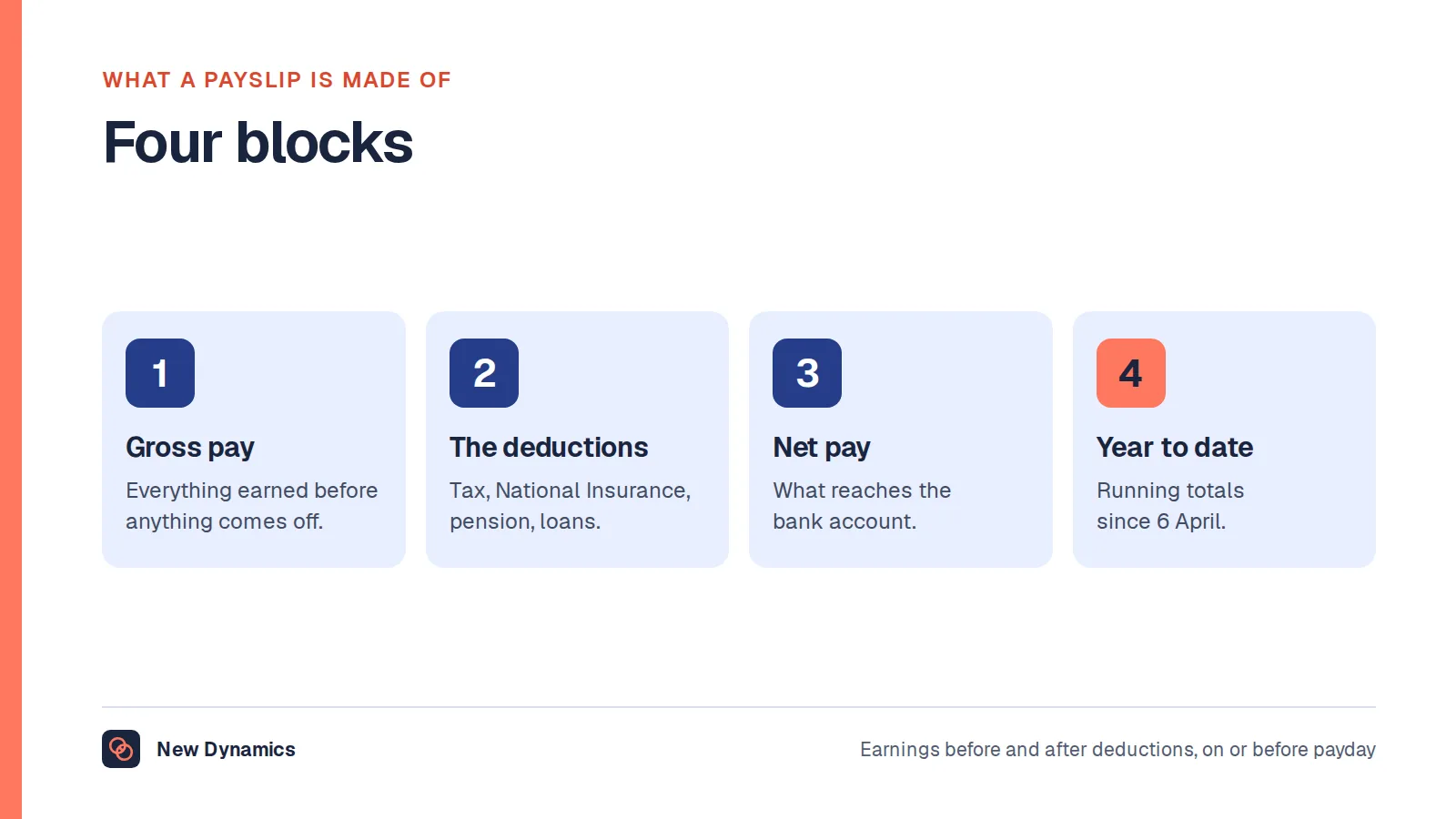
Section 8 gives a worker the right to a written itemised pay statement "at or before the time at which any payment of wages or salary is made". It must show the gross amount, any variable deductions and the purposes for which they are made, the net amount, how split payments were made, and, where pay varies by reference to time worked, the total hours as a single aggregate figure or as separate figures for different types of work or rates of pay.
GOV.UK's payslips page adds the rule for fixed deductions: employers "can choose to do this either on a payslip, or in a separate written statement. This separate statement must be sent out before the first payslip. Employers must update this every year." That standing statement comes from section 9, which requires it to be re-issued in consolidated form at intervals of not more than twelve months. Our post on pay stub deductions goes through the lines themselves.
Once a year, at 250 employees: gender pay gap reporting
This is the only duty here that discloses something publicly rather than to an individual.
Regulation 1(2) of the Equality Act 2010 (Gender Pay Gap Information) Regulations 2017 defines a "relevant employer" as "an employer who has 250 or more employees on the snapshot date". GOV.UK agrees: "Any employer with 250 or more employees on a specific date each year (the 'snapshot date') must report their gender pay gap data."
Two official pages word this differently. Acas, on equal pay and the law, says "Employers with more than 250 staff must report their organisation's gender pay gap", which read literally would exclude an employer with exactly 250. The regulations govern, and they say 250 or more. At exactly 250 on your snapshot date, you report.
The dates are on GOV.UK's page on when to report, in its words:
- Snapshot dates: "31 March for most public authority employers" and "5 April for private, voluntary and all other public authority employers".
- Reporting deadlines: "30 March for most public authority employers" and "4 April for private, voluntary and all other public authority employers".
Regulation 2 lists six figures: the mean and median hourly pay gaps, the mean and median bonus pay gaps, the proportions of men and women paid bonus pay, and the proportions of men and women in the lower, lower middle, upper middle and upper quartile pay bands. Regulation 15 requires publication on your own website "in a manner that is accessible to all its employees and to the public" and "for a period of at least three years", as well as on the government service. Private and voluntary sector employers add a written statement confirming the information is accurate, signed by a director or equivalent under regulation 14.
GOV.UK is blunt about failure: "It is against the law to fail to report your gender pay gap data by the deadline." The Equality and Human Rights Commission "may take enforcement action if you do not report on time, or report inaccurate data. This can lead to court orders and fines", and a non-reporter gets a "late badge" that is "visible to the public". Action plans are voluntary for now, and GOV.UK says that "Subject to legislation, these will become mandatory from spring 2027".

A gap is not an equal pay finding
The published number measures workforce composition, not any individual's pay. The Office for National Statistics release Gender pay gap in the UK: 2026, published on 22 October 2026, reports that the gap for full-time employees "was 6.8% in April 2026, down from 7.2% in April 2025", and that for all employees it "decreased to 12.3% in April 2026, down from 13.0% in April 2025". The same release says the measure "is a measure across all jobs in the UK, not of the difference in pay between men and women for doing the same job". Acas makes the same separation: "Equal pay and gender pay gap reporting are not the same thing." For the wider published picture, see the statistics hub.
On request: what people can see about their own data
The UK GDPR right of access turns transparency into something an individual can trigger. Under the ICO's guidance on the right of access, a person is entitled to confirmation that you are processing their information, a copy of it, and supplementary information: your purposes, the categories held, the specific recipients, retention periods, their rights to rectification, erasure, restriction and objection, their right to complain to you and to the ICO, the source if you did not get it from them, and whether you use automated decision-making, including "meaningful information about the logic involved".
The clock is one calendar month. The ICO explains the arithmetic: "To calculate a month, you must start from the actual date you receive the request, fee or other requested information and count forward to the end of the same date in the following month." You can extend "by a further two months" where the request is complex or the person has made several requests, but you must say so and explain why within the first month. A request is not complex "just because you have to rely on a processor to provide the information you need to respond". For the records side, see our employee data protection guide.
Monitoring: you must say what you are collecting
Monitoring is where a transparency policy is tested, because the employer holds all the information. The ICO's guidance on monitoring workers is direct: "You must make sure workers are aware of how and what personal information you are collecting during any monitoring." It adds that "You must keep privacy information up-to-date" and "You must also tell workers when you introduce changes."
On planning: "If you are planning to introduce monitoring, you should seek and document the views of your workers or their representatives (such as trade unions), unless there is a good reason not to. If you decide not to, you should record this decision along with a clear explanation."
Covert monitoring is exceptional rather than available. The ICO says "It is unlikely that you will be able to justify covert monitoring in most usual circumstances", that it "should only be authorised by senior management", and that it needs a data protection impact assessment. Monitoring data is disclosable to the person it is about: "You must make the personal information you collect through monitoring available to workers if they make a subject access request (SAR), unless an exemption applies." Our post on employee monitoring software covers the practical side.
Where they apply: the ICE Regulations 2004
The Information and Consultation of Employees Regulations 2004 create a right for employees to ask to be informed and consulted about the business they work in. Two numbers decide whether they are live for you.
The first is size. Schedule 1 applies them to undertakings with "At least 50" employees from 6 April 2008, and regulation 4 makes that an average: the number employed in each of the previous twelve months, added together and divided by 12, with an option to count anyone contracted for 75 hours or less in a month as half an employee.
The second is demand. Regulation 7 requires the employer to start negotiations on receipt of a valid employee request, and a request is valid only if made by at least 2% of the employees, subject to a floor and a ceiling: "Where the figure of 2% in paragraph (2) would result in less than 15 or more than 2,500 employees being required ... that paragraph shall have effect as if, for the figure of 2%, there were substituted the figure of 15, or as the case may be, 2,500." In a 500-person business that is 15 people, not 10. The 2% figure replaced 10% with effect from 6 April 2020.
Where the standard provisions apply, regulation 20 sets the subjects: the development of the undertaking's activities and economic situation, the development of employment within it, and decisions "likely to lead to substantial changes in work organisation or in contractual relations". That is the closest thing in UK law to a duty to tell staff how the business is doing. How you hold those conversations is covered in our post on formal and informal communication.
What transparency does not require
Two limits are worth knowing precisely, because policies routinely promise more than the law does and then have to retreat.
Named colleagues' pay is not disclosable. The right of access is a right to your own information. The ICO states it plainly: "The right of access allows people to access their own personal information. They are not entitled to information about other people", unless their own information also relates to that person or they are acting on someone's behalf. Gender pay gap reporting requires six aggregate figures, not a pay list, so it does not change this.
Section 77 is narrower than its reputation. It is usually summarised as "pay secrecy clauses are unenforceable". Read it. Section 77 of the Equality Act 2010 says a term preventing disclosure of information about the terms of a person's work "is unenforceable against P in so far as P makes or seeks to make a relevant pay disclosure". Subsection (3) defines that term: "A disclosure is a relevant pay disclosure if made for the purpose of enabling the person who makes it, or the person to whom it is made, to find out whether or to what extent there is, in relation to the work in question, a connection between pay and having (or not having) a particular protected characteristic."
So the clause is disapplied for the purpose of checking whether pay tracks sex, race, disability, age or another protected characteristic. It is not disapplied for a general conversation about who earns what, and it creates no right to be told anybody's salary. Subsection (4) adds the protection that matters most: seeking such a disclosure, making one and receiving the information are all treated as "protected acts" for victimisation purposes. The section extends to England, Wales and Scotland, so check Northern Ireland guidance separately.
The honest employer position is therefore neither "we publish everything" nor "pay is confidential". Publish the pay structures, the ranges and the rules for movement, keep individual pay private, and make sure nobody is disadvantaged for asking whether pay is fair.

Where no official source publishes a figure
Transparency is usually sold on outcomes: more trust, higher engagement, lower turnover. We are not going to put a number on that, because no official United Kingdom source publishes one. The ONS measures earnings, hours and labour market flows, not whether an employer's disclosure practices moved its trust score. Acas and the ICO publish duties and good practice, not effect sizes. The figures that circulate here come from vendor and consultancy surveys with undisclosed samples, and we do not quote those.
What you can measure is your own compliance, and the audit below is where to start.
Frequently asked questions
What is transparency in the workplace?
In the United Kingdom it is best understood as a set of specific disclosure duties rather than a general style. The main ones are written particulars of employment on day one, an itemised pay statement at or before each payday, gender pay gap reporting at 250 or more employees, access to a person's own data on request, and information and consultation where the 2004 Regulations apply.
Why is transparency important at work?
The practical answer is that much of it is compulsory and dated, so failing at it creates tribunal claims, enforcement action by the Equality and Human Rights Commission and a publicly visible late badge on the gender pay gap service. The cultural benefits are real, but no official UK source quantifies them, so treat any figure on trust or engagement with suspicion.
Does my employer have to tell me what colleagues earn?
No. The right of access covers your own personal information, and the ICO says people "are not entitled to information about other people". Gender pay gap reporting publishes aggregate figures, not salaries. You can ask about pay structures and ranges, and under the Equality Act you can ask questions aimed at finding out whether pay is linked to a protected characteristic.
Are pay secrecy clauses illegal in the UK?
Not in general. Section 77 of the Equality Act 2010 makes such a term unenforceable only in so far as the person makes or seeks a relevant pay disclosure, which subsection (3) defines as one made to find out whether pay is connected to having or not having a protected characteristic. Outside that purpose the clause can still bite, and section 77 extends to England, Wales and Scotland only.
When do I have to report my gender pay gap?
Within 12 months of your snapshot date. GOV.UK gives the reporting deadlines as 30 March for most public authority employers and 4 April for private, voluntary and all other public authority employers, with snapshot dates of 31 March and 5 April respectively. You must do it for every year you have 250 or more employees on your snapshot date.
What must we tell staff about monitoring them?
The ICO says you must make sure workers are aware of how and what personal information you are collecting, must keep your privacy information up to date and must tell workers when you introduce changes. You should also seek and document their views, or their representatives' views, before introducing monitoring, and record your reasons if you decide not to.
How long do we have to answer a subject access request?
One calendar month from the date you receive the request, counted forward to the same date in the following month. You can extend by a further two months where the request is complex or the person has made several requests, but you must tell them and explain why within the first month.
Your next step: audit the five duties
- Pull the last ten starters and check a compliant principal statement was issued on or before the first day, and the wider statement within 2 months.
- Check one payslip per pay group against section 8, including the hours figure where pay varies by time worked, and confirm your standing statement of fixed deductions has been re-issued within twelve months.
- If you reached 250 employees on your last snapshot date, confirm all six figures are on your own website, accessible to staff and the public, and that they will stay there for three years.
- Time your last three subject access responses against the calendar month rule, not against working days.
- Read your contract templates for pay confidentiality wording, and check it does not purport to stop a question about whether pay is linked to a protected characteristic.
For a framework covering worker information, access and retention, read and download our employee data protection guide. The guide is free to read, and the PDF uses our short download form.
Want starters, terms and pay conversations recorded in one place, so the day-one paperwork and the first check-ins happen together? Book a New Dynamics demo and bring your onboarding checklist. You can also email contact@new-dynamics.com.