TL;DR
- The limit depends on when the problem happened, not on when you read about it. GOV.UK states that you usually have "6 months, if the problem happened on or after 1 October 2026" and "3 months, if the problem happened before 1 October 2026". Acas words the same rule as six months minus one day, and three months minus one day.
- The change is in force, not pending. Section 111(2)(a) of the Employment Rights Act 1996 now reads "six" months, substituted with effect from 1 October 2026, and regulation 4 of the commencement regulations keeps the old limit for anything whose relevant date fell earlier.
- Notifying Acas stops the clock, and only if you do it in time. Section 207B says the period from the day after you contact Acas to the day you receive the certificate "is not to be counted", and gives you at least one month after the certificate. A grievance pauses nothing at all.
A missed deadline ends a claim that would have won on its facts, which is why the figure in Great Britain moving on 1 October 2026 matters more than most changes in employment law. Guidance written before that date gives three months. Some official pages written after it still do.
This article sets out the employment tribunal time limits in force now, quoted from the statute and the commencement regulations with the dates named, how notifying Acas pauses the clock, what the certificate is for, why a grievance buys you nothing, and what the published figures say about how long a claim takes. It is general information about England, Wales and Scotland, and it is not legal advice. Northern Ireland has its own tribunal system and its own rules, and nothing below applies there.
Most of what a tribunal later asks to see is a record somebody should have kept at the time. See how New Dynamics workflows put the stages, approvals and dated evidence of your own process in one place, so a decision from eighteen months ago can still be explained.

Which limit applies depends on when the problem happened
GOV.UK's guide on making a claim to an employment tribunal puts it in two lines. Under the heading "How long you have to make a claim", it says you usually have "6 months, if the problem happened on or after 1 October 2026" and "3 months, if the problem happened before 1 October 2026". It also says where the clock starts: for losing your job unfairly, "the period begins from the date your employment ended"; for discrimination, "from the date the most recent incident in your claim happened"; and for unauthorised deductions from pay, "from the date you were not paid correctly".
Acas puts the same rule in days, which is how tribunals count it. Its page on employment tribunal time limits, last updated 1 October 2026, states that "The law on time limits changed on 1 October 2026", and that for a problem before that date you have either "3 months minus 1 day" for most claims or "6 months minus 1 day" for a few. For a problem on or after it, "You have 6 months minus 1 day for most claims."
Three details there are easy to miss.
- Some claims already had six months. Acas lists statutory redundancy pay claims, equal pay claims, certain claims made against a trade union, and certain claims by members of the armed forces.
- Scotland is on a different date for one claim type. "In Scotland, the time limit for breach of contract claims will not change until 9 November 2026."
- The deadline is a time of day, not just a date. Acas works an example: paid the wrong amount on 1 October 2026, "Your time limit starts on 1 October 2026 and ends at 11:59pm on 31 March 2027."
What the statute says, and when the words changed
The change is in force. It is not a reform waiting for a commencement date.
Section 111 of the Employment Rights Act 1996 now provides that a tribunal shall not consider an unfair dismissal complaint unless it is presented "before the end of the period of six months beginning with the effective date of termination". The annotation on that word records it being substituted with effect from 1 October 2026 by the Employment Rights Act 2025. Section 111(2)(b) keeps the long-standing escape valve: a tribunal may allow "such further period as the tribunal considers reasonable in a case where it is satisfied that it was not reasonably practicable for the complaint to be presented" in time. Do not plan around it. On the odds for a late claim, the Acas time limits page is blunt: "It's up to the judge to decide whether they will accept your claim. However, in most cases time limits are strictly enforced."
The commencement instrument is the Employment Rights Act 2025 (Commencement No. 5 and Transitional Provisions) (Amendment) Regulations 2026, made on 1 September 2026. Its explanatory note says it brings into force the provisions "which extend time limits for instituting claims to employment tribunals from three to six months". Regulation 4(1) is the part that decides your case: "The amendments made by Schedule 12 to the 2025 Act do not apply in any case where the relevant date occurs before 1st October 2026." The Schedule then names that relevant date claim by claim. For unfair dismissal it is "The effective date of termination". For an unauthorised deduction it is the date the wages were paid, or the last deduction in a series.
Unlawful deduction from wages, and the two year backstop
An unlawful deduction claim, which the statute calls an unauthorised deduction, runs on the same new figure. Section 23 of the Employment Rights Act 1996 requires a complaint to be presented "before the end of the period of six months beginning with" the date of payment of the wages from which the deduction was made, that word also substituted with effect from 1 October 2026. Where there is a series of deductions, section 23(3) points to "the last deduction or payment in the series".
A second limit sits on top, and it has not moved. Section 23(4A) stops a tribunal considering any part of a deduction claim "where the date of payment of the wages from which the deduction was made was before the period of two years ending with the date of presentation of the complaint". A long-running underpayment can therefore be in time and still be recoverable for two years only.
Two official Acas pages disagree, and the statute decides
Acas's own pages do not currently say the same thing, and the difference is exactly the kind that costs someone a claim.
The time limits page quoted above, last updated 1 October 2026, gives six months minus one day for a problem on or after that date. Acas's page on how early conciliation works, also last updated 1 October 2026, says under "Time limits for making a claim": "You might only have 3 months minus 1 day from the date the problem at work happened." We read both on 7 November 2026.
The statute governs, and the statute reads six months for a relevant date on or after 1 October 2026. Do not use the shorter figure to conclude that you are already out of time, and do not rely on the longer one without checking the date your own claim runs from. Acas itself says that "Working out time limits can be complex", and that "If you need to work out your exact time limit, you might need to get legal advice."

The Acas step you cannot skip, and the certificate
Notifying Acas is not optional, even though early conciliation itself is. Section 18A of the Employment Tribunals Act 1996 requires that "Before a person ("the prospective claimant") presents an application to institute relevant proceedings relating to any matter, the prospective claimant must provide to ACAS prescribed information, in the prescribed manner, about that matter." Subsection (8) makes the certificate the gate: such a person "may not present an application to institute relevant proceedings without a certificate under subsection (4)". Under subsection (4) the conciliation officer issues it once a settlement is concluded to be impossible, or the prescribed period expires without one.
What happens next is voluntary for both sides. Acas's page on early conciliation, last updated 1 October 2026, says: "Early conciliation is voluntary. You and your employer can choose whether to take part." Decline it and, in Acas's words, "we'll give you a certificate so you'll be able to go to an employment tribunal". The same applies if the employer declines. The process also has a statutory ceiling: "By law, early conciliation can only last for a limited time. This is called the early conciliation period. Early conciliation can last up to 12 weeks."
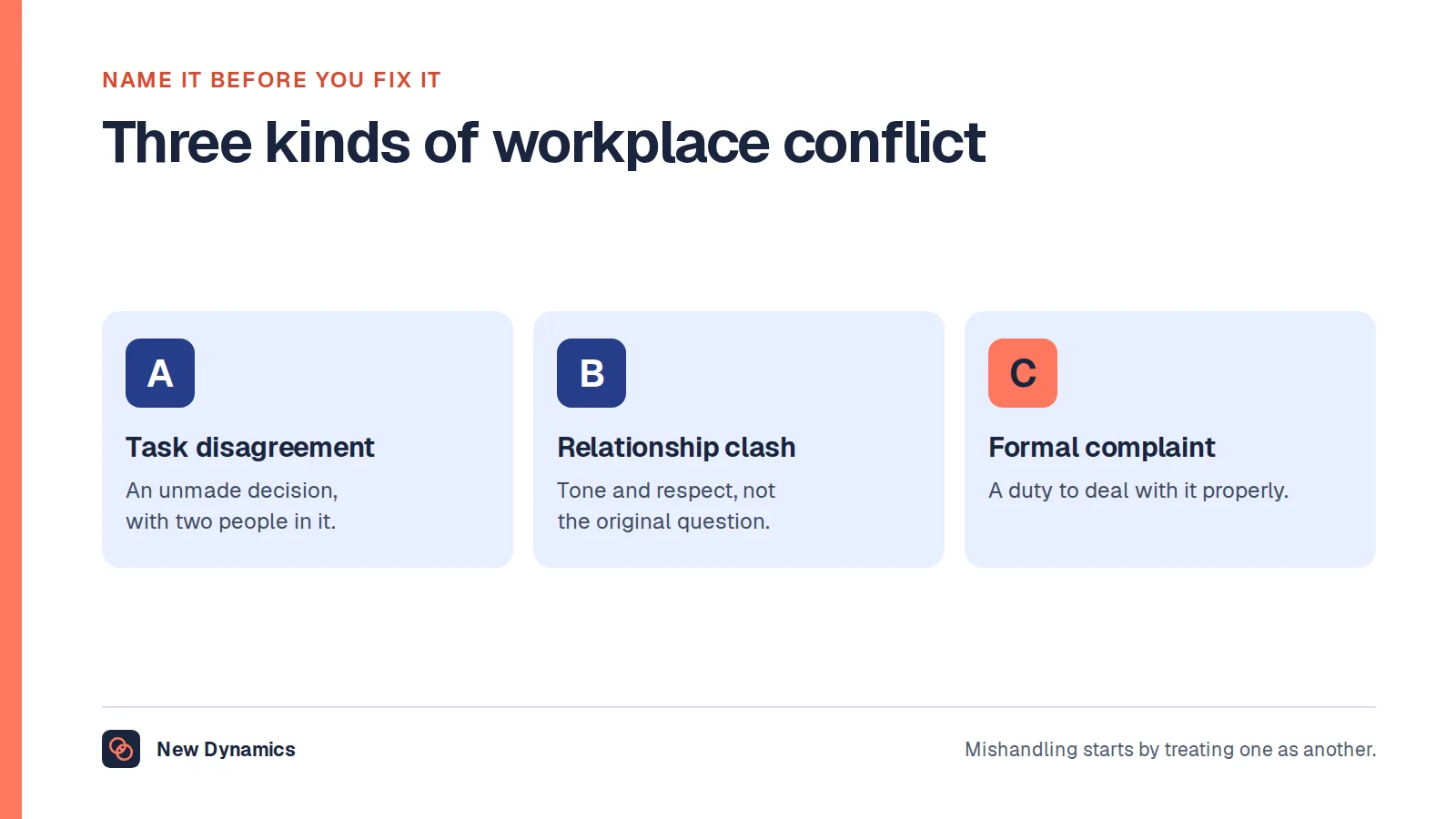
The certificate carries a number, and that number is what form ET1 needs. GOV.UK says plainly: "To make a claim to an employment tribunal, you'll need your early conciliation certificate number." For how conciliation sits alongside mediation and arbitration, our post on workplace conflict sets out the three and what each is for.
How notifying Acas stops the clock: Day A, Day B, and one month
The pause is in section 207B of the Employment Rights Act 1996, which the statute applies to both unfair dismissal and deduction claims. It defines Day A as the day you comply with the requirement to contact Acas, and Day B as the day you receive, or are treated as receiving, the certificate. Then the two operative rules:
- Subsection (3), the pause. "In working out when a time limit set by a relevant provision expires the period beginning with the day after Day A and ending with Day B is not to be counted."
- Subsection (4), the floor. If the limit would otherwise expire between Day A and one month after Day B, "the time limit expires instead at the end of that period".
Acas says the same thing in ordinary words: "When you notify Acas, your time limit will be paused until early conciliation ends. This only applies if you notify Acas within your employment tribunal time limit." And on the floor: "If you've notified us within your time limit, you'll have at least 1 month from the date you received the certificate to make your claim to the employment tribunal."
The condition in the middle of that sentence does the work. Contact Acas inside your limit and the clock stops. Contact Acas after it has run out and there is nothing left to pause.
A grievance pauses nothing
This is the most common and most expensive misunderstanding in the whole subject. Acas states it without qualification: "Going through grievance, disciplinary or appeal procedures does not change your time limit. If those procedures take a long time, you still need to notify Acas before your time limit runs out."
GOV.UK adds the consequence: "You may not be able to claim through an employment tribunal if you miss the deadline - even if it's because you've been trying to resolve the dispute directly."
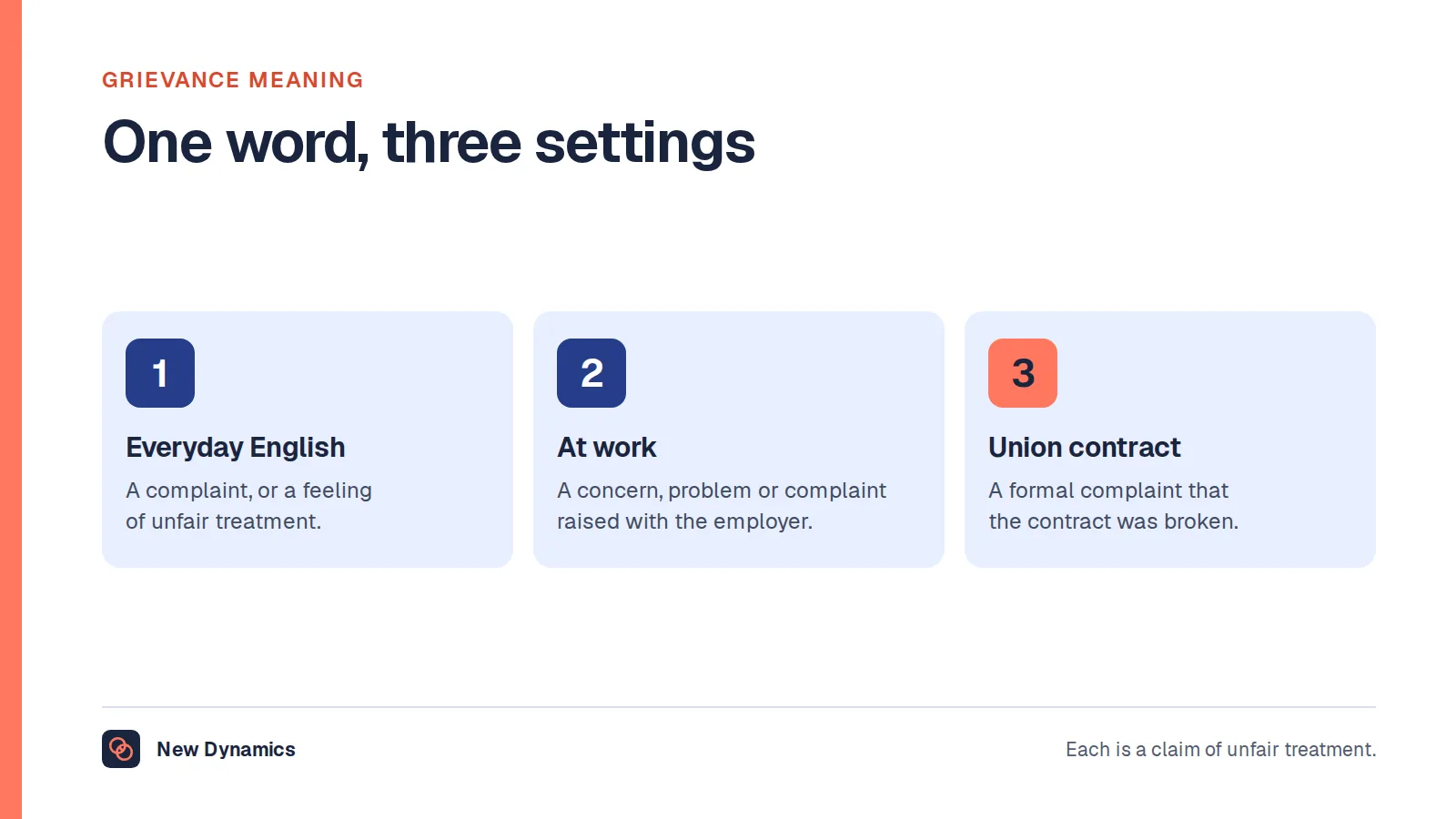
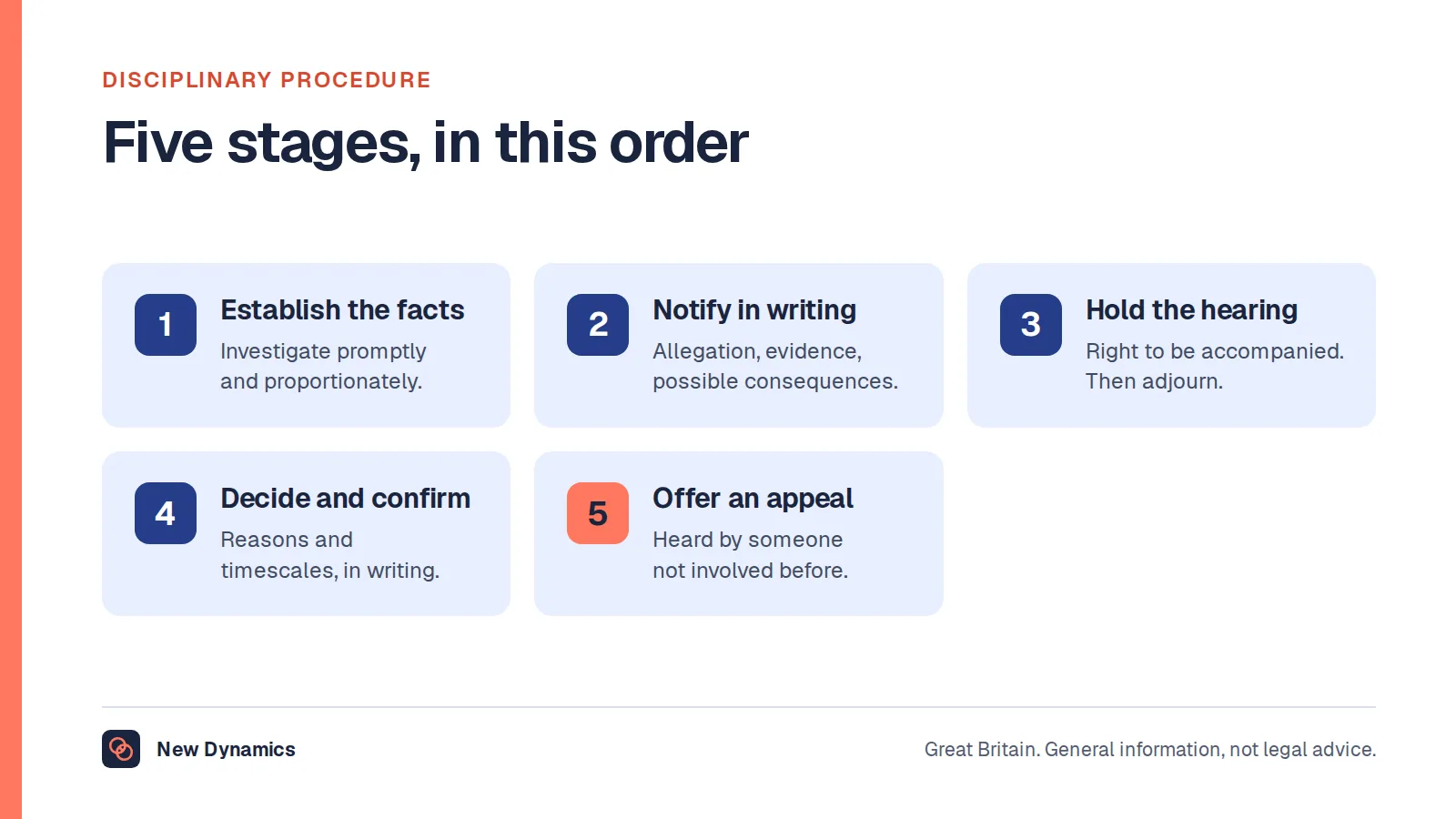
For employers it cuts both ways. A slow internal process does not protect you from a claim, and it is read later as part of the history. Our posts on what a grievance is and on running a disciplinary procedure cover the timescales to hold yourself to.

The employment tribunal process, and how long it takes
GOV.UK's page on what to expect refuses to give a single answer, and is right to: "There is no fixed length of time for an employment tribunal claim. How long it takes depends on: the type and complexity of the case; how many hearings are needed." It adds that "After your final hearing, you'll receive the decision within a few weeks", and that "You do not have to pay a fee to make a claim to an employment tribunal."
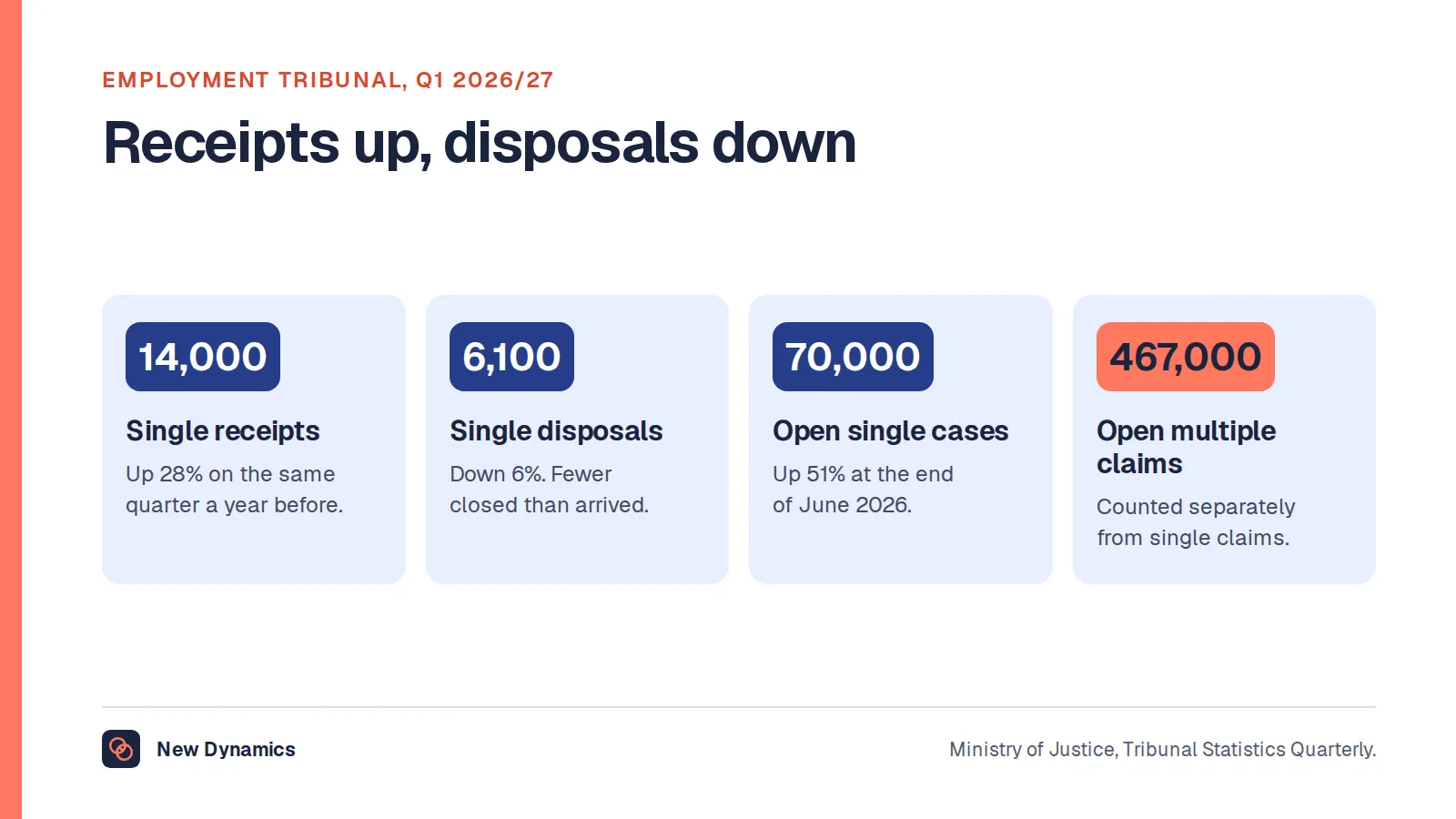
There is, though, published data on how long cases are actually taking. The Ministry of Justice's Tribunal Statistics Quarterly, April to June 2026 includes a timeliness table for single employment tribunal cases on the Reform case management system. For April to June 2026 the mean time to clearance was 40 weeks, with the median at "35 weeks or less" and the upper quartile at "56 weeks or less". A year earlier, in April to June 2025, the mean was 25 weeks, so the table records a 15 week increase.
Read those figures with the caveats the publisher attaches: they cover single cases on the Reform system only, not multiple claims, and are "calculated based on the numbers of accepted claims only". The same release reports single claim receipts up 28% while disposals fell 6%, leaving 70,000 open single claim cases at the end of June. Our post on employment tribunal statistics UK quotes that release in full, and the statistics hub collects the wider set.
What an employer should take from this
The practical consequence of a longer limit is a longer tail. A dismissal in March can now produce a claim form in September, with conciliation on top of that and a hearing the following year, by which time the people who made the decision may have left.
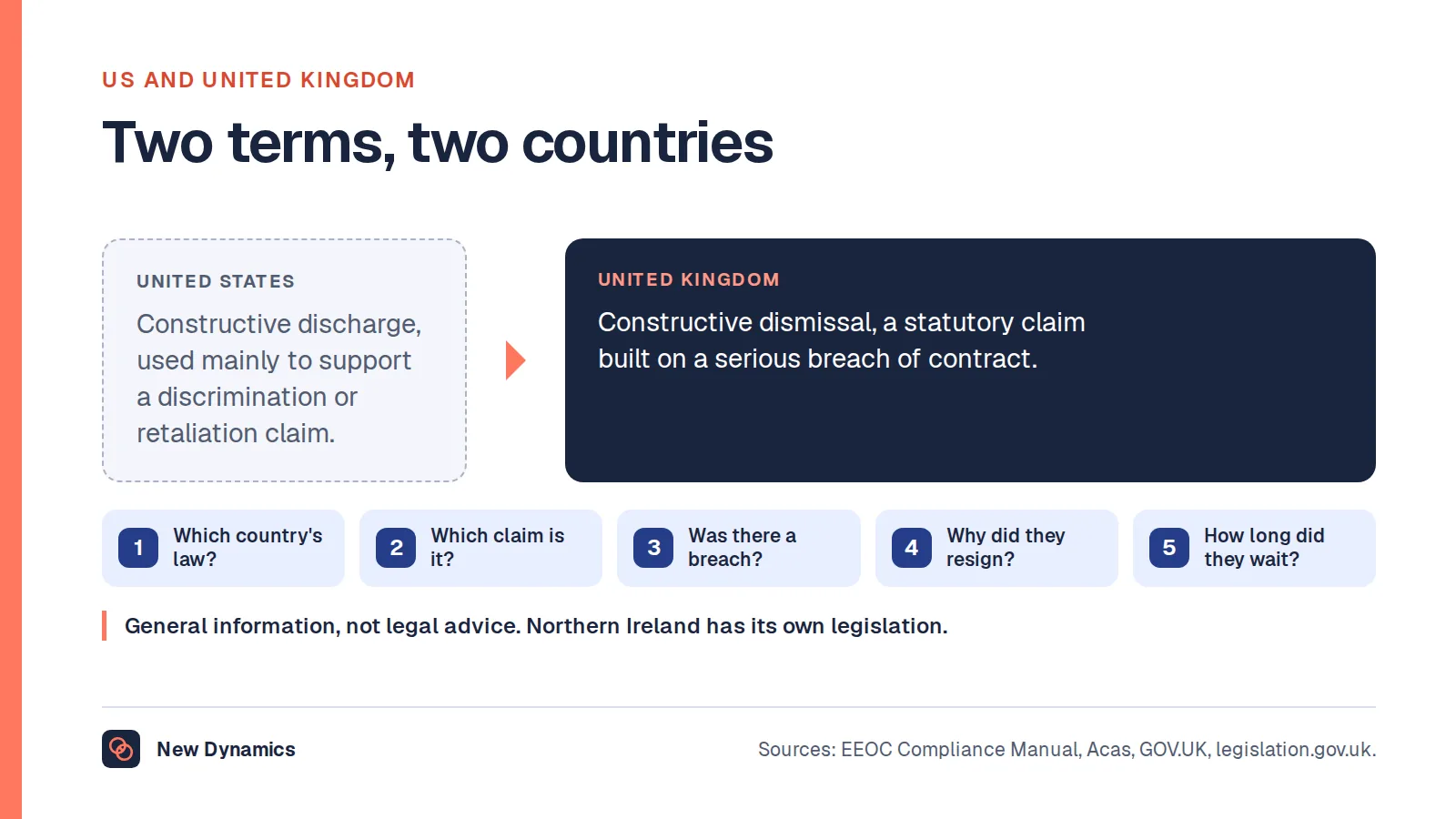
So treat the record as the deliverable. Date every warning, note and meeting outcome when it happens rather than afterwards, and keep the reasons alongside the decision rather than in somebody's inbox. Where a resignation cites your conduct rather than a decision of yours, the clock and the test are different again, and our post on constructive discharge and constructive dismissal sets out both.
Frequently asked questions
What are the employment tribunal time limits in 2026?
It depends on the date of the problem, not the date you claim. GOV.UK states that you usually have "6 months, if the problem happened on or after 1 October 2026" and "3 months, if the problem happened before 1 October 2026". Acas words the same rule as six months minus one day and three months minus one day. Statutory redundancy pay and equal pay claims had six months minus one day already.
Is the three month employment tribunal time limit still the law?
Only for matters whose relevant date fell before 1 October 2026. Section 111 of the Employment Rights Act 1996 now reads six months, substituted with effect from that date, and regulation 4 of the Employment Rights Act 2025 (Commencement No. 5 and Transitional Provisions) (Amendment) Regulations 2026 provides that the amendments "do not apply in any case where the relevant date occurs before 1st October 2026".
Do I have to contact Acas before making a tribunal claim?
Yes. Section 18A of the Employment Tribunals Act 1996 requires a prospective claimant to provide prescribed information to Acas before presenting a claim, and says they "may not present an application to institute relevant proceedings without a certificate under subsection (4)". Early conciliation itself is voluntary. Acas says that "You and your employer can choose whether to take part."
Does Acas early conciliation pause the employment tribunal time limit?
Yes, if you notify Acas inside your time limit. Section 207B of the Employment Rights Act 1996 provides that the period from the day after you contact Acas to the day you receive the certificate "is not to be counted", and that where the limit would otherwise expire within a month of the certificate it expires at the end of that month instead. Acas puts it as "at least 1 month from the date you received the certificate".
What is the time limit for an unlawful deduction from wages claim?
Section 23 of the Employment Rights Act 1996 requires the complaint to be presented "before the end of the period of six months beginning with" the date the wages were paid, for a relevant date on or after 1 October 2026, and three months before it. A separate rule in section 23(4A) prevents a tribunal looking back more than two years from the date the claim is presented.
Does raising a grievance give me longer to claim?
No. Acas states that "Going through grievance, disciplinary or appeal procedures does not change your time limit", and that you must still notify Acas before the limit runs out. GOV.UK warns that you may not be able to claim if you miss the deadline even where you were trying to resolve things directly.
How long does an employment tribunal take?
GOV.UK says "There is no fixed length of time for an employment tribunal claim." The Ministry of Justice's Tribunal Statistics Quarterly for April to June 2026 reports a mean time to clearance of 40 weeks for single employment tribunal cases on the Reform system, with a median of 35 weeks or less, up from a mean of 25 weeks a year earlier. Those figures exclude multiple claims.
Your next step: the four dates, and the record
- For any live dispute, write down the relevant date: the effective date of termination, the date of the incorrect payment, or the date of the most recent act complained of. Everything else follows from it.
- Decide from that date which limit applies, six months minus one day on or after 1 October 2026, three months minus one day before it, and check whether the claim is one of the types that already had six months.
- Note the Acas notification date and the certificate date separately when they arrive. Those are Day A and Day B, and the calculation needs both.
- If any date is close or unclear, get it checked by the Acas helpline, a trade union or a solicitor before relying on a figure from any article, including this one.
To get the written procedures a defensible process depends on into one place, read and download our employee handbook guide. The guide is free to read, and the PDF uses our short download form.
Want the dated record of a decision to exist before anyone asks for it? Book a New Dynamics demo and bring one case you would struggle to reconstruct. You can also email contact@new-dynamics.com.