TL;DR
- A pay band is a named range of pay attached to a group of jobs of broadly equal size. It exists so that pay decisions are consistent, explainable and defensible, rather than improvised one offer at a time.
- Banding follows job evaluation, not the other way round. Acas says equal work is “work that equal pay law classes as the same, similar, equivalent or of equal value”, and one of the three routes is work “found to be equivalent, usually using a job evaluation process”.
- A compa ratio is salary divided by the band midpoint. It describes position in a range and nothing else, so a ratio below one is a question to investigate rather than a verdict on performance.
Sooner or later somebody asks the question directly. Why does she earn more than me? If the honest answer is that she negotiated harder, or joined in a year when budgets were generous, or had a manager who liked her, then the organisation has a pay problem and does not yet have a pay structure.
A pay band is the usual answer to that question. This article explains what a band is, how to build one properly by evaluating jobs before pricing them, how to choose the number of bands, their width, their overlap and their midpoints, and how to read a compa ratio without drawing the wrong conclusion from it. It also covers what salary benchmarking can and cannot tell you, what "competitive salary" means in an advert, and the ways a well designed structure quietly falls apart.
This is general information about the position in Great Britain and not legal advice. Northern Ireland has its own equality legislation and is covered separately below.
Pay conversations go better when the evidence behind them already exists. See how New Dynamics performance reviews keep the year's evidence attached to the cycle that sets the rating, so a pay decision is not reconstructed from memory.
What is a pay band?
A pay band, also called a salary band or a job band, is a named range of pay attached to a group of jobs judged to be of broadly equal size. Each band has a floor, a ceiling and usually a midpoint. Every job that has been evaluated into that band is paid somewhere inside the range, and the range itself is what the organisation has decided those jobs are worth.
Three terms get used loosely and are worth separating.
- A pay band is the range for a group of jobs of similar size.
- A pay structure is the whole set of bands together, with the rules about how people move within and between them.
- A job range usually means the range for one specific job rather than a whole band, which is why broad banding and narrow job ranges are different design choices rather than synonyms.
Salary banding is simply the act of building that structure: evaluating jobs, grouping them and attaching a range to each group.
What problem a pay band actually solves
Three problems, in order of how much trouble they cause.
Consistency. Without a structure, every pay decision is made from scratch by whoever happens to be in the room. Two people hired six months apart into the same job end up thousands apart for no reason anybody wrote down. A band constrains the decision before the negotiation starts.
Explainability. A band gives a manager something true to say. The answer to "why does she earn more than me" becomes a sentence about where each person sits in a published range and what moves somebody through it, rather than an improvised defence that sounds like an excuse because it is one.
Defensibility. This is the one that matters legally. If pay differences between people doing equal work cannot be explained by a reason that stands up, the organisation is exposed. A structure built on job evaluation produces the evidence; an undocumented set of individual deals produces nothing.
Bands also do something less obvious. They tell people what the next step pays, which is the piece most progression documents leave out. If you are writing the levels themselves, our post on the career progression framework covers how to define them and how mapping those levels onto pay is a separate exercise with its own consequences.
Job evaluation comes first, banding second
The common mistake is to start from money. Somebody lists current salaries, draws lines between the clusters and calls the result a band structure. That bakes every existing anomaly into the design and gives it the appearance of a system.
The correct order is to size the jobs first and price them second.
- Describe the job as it is done. Not the job title, not the person, and not the job as it was written three reorganisations ago.
- Evaluate it against consistent criteria. The same factors, applied the same way, to every job in scope.
- Group jobs of similar evaluated size into bands.
- Attach a range and a midpoint to each band, informed by market data.

Analytical job evaluation, and why the method matters
Job evaluation methods divide into two families. Non-analytical methods compare whole jobs against each other or against a benchmark job: ranking, paired comparison, simple classification. They are quick and they are a reasonable first pass in a very small organisation.
Analytical methods break each job into factors and score them separately. Typical factors are knowledge and skill, responsibility, decision making, people management, and the demands of the working conditions. The job's score is the sum of its factor scores, which means two very different jobs can be shown to be the same size, and the reasoning is written down factor by factor.
That written reasoning is the legal point. Acas sets out the law in its equal pay guidance: "Men and women must get equal pay for doing 'equal work'. This is work that equal pay law classes as the same, similar, equivalent or of equal value." It then names three routes by which work can be equal:
- Like work, which Acas describes as "Work where the job and skills are the same or similar".
- Work rated as equivalent, which is "Work that's found to be equivalent, usually using a job evaluation process. This could be because the level of skill, responsibility and effort needed to do the work are equivalent".
- Work of equal value, which is "Work that is not similar but is of equal value. This could be because the level of skill, training, responsibility or demands of the working conditions are of equal value".
So a job evaluation study is not an HR nicety. It is one of the three ways equal work is established, and it is the only one of the three that an employer can carry out deliberately in advance rather than argue about afterwards. Acas also lists what employers should do, including to "carry out job evaluations, where needed, to measure the value of different jobs and identify any that count as 'equal work'" and to "be consistent when deciding people's pay and contractual terms and conditions, for example have one pay structure for the organisation and limit who can decide on salaries for new staff", in its guidance on employer responsibilities.
A scheme that scores jobs on factors has to be checked for bias in the factors themselves. A scheme that rewards physical strength generously and manual dexterity barely at all will produce a defensible-looking structure with an indefensible result. Our post on pay equity covers the audit that tests this after the fact. For the method itself, our job evaluation guide walks through the factors and the scoring.
Band design in practice
Once jobs are sized, four decisions produce the structure. There is no universally correct answer to any of them, which is why they are decisions rather than formulas.
How many bands
Fewer bands than people expect. A long list of narrow grades creates constant pressure for promotion into the next grade, because the only way to earn meaningfully more is to change band. Very broad bands create the opposite problem: enormous ranges inside which nobody can explain why one person sits near the top and another near the bottom.
Most organisations end up with somewhere between five and eight bands across the whole business, sometimes with separate structures for genuinely different labour markets. Start from the evaluated job sizes and let the natural gaps suggest the boundaries, rather than deciding the number first and forcing jobs into it.
Band width
Band width is the distance from floor to ceiling, usually expressed as a percentage of the floor or of the midpoint. Wider bands suit jobs where experience makes a large difference to output and where people stay a long time. Narrower bands suit jobs that are quickly learned and where most jobholders perform similarly.
The practical test is whether somebody can spend a reasonable career inside the band without hitting the ceiling after two years. If they hit it, you have created a population of people who are stuck, and stuck people either leave or get an exception.
Overlap between bands
Adjacent bands normally overlap, so the top of one band sits above the floor of the next. This is deliberate. Overlap means an experienced person at the top of their band can out-earn a newcomer in the band above, which is usually the right outcome and keeps promotion from being the only reward available.
Too much overlap and the bands stop meaning anything, because almost any salary is justifiable in two or three bands at once. Too little and every promotion demands a large jump in pay the budget cannot support.
The midpoint
The midpoint is the reference point of the band and the anchor for everything else. It is normally set at the pay the organisation intends to offer somebody who is fully competent in the job, and it is the figure usually compared with market data. Below the midpoint sits the developing jobholder; above it sits the person who is consistently exceeding what the job requires.
Set the midpoint deliberately against a stated position in the market. "We aim to pay around the median for our sector and region" is a policy. "We pay what we can get away with" is also a policy, but not one that survives being written down.

The compa ratio, explained properly
The compa ratio, short for comparative ratio and sometimes written as the compensation ratio, measures where somebody sits in their band relative to the midpoint. Any compa ratio calculator is doing one division:
Compa ratio = actual salary divided by the band midpoint
Multiply by 100 if you prefer a percentage. That is the whole calculation.
A worked example
The figures below are an arithmetic example only. They are not benchmark data, not a recommendation and not drawn from any survey.
Suppose, purely as an example, a band runs from £32,000 to £48,000 with a midpoint of £40,000.
- A salary of £36,000 gives a compa ratio of 36,000 divided by 40,000, which is 0.90, or 90%.
- A salary of £40,000 gives 1.00, exactly at the midpoint.
- A salary of £46,000 gives 46,000 divided by 40,000, which is 1.15.
The same division works for a group. A team's average compa ratio, or the average for a band, tells you whether that population sits above or below the intended reference point overall.
What a ratio above or below one actually tells you
A ratio of 1.00 means the salary is at the midpoint. Below one means below the midpoint, and above one means above it. That is all it says.
- Below one is normal and expected for somebody new to the job, recently promoted, or still building competence. It is also what you would see if a person has been overlooked for years.
- Above one is normal for a long-serving, fully competent jobholder. It is also what you would see if somebody was hired at a number nobody could justify.
- Above the band ceiling means the structure has been broken for that person, and that needs a recorded decision rather than silence.
The common misreading
The common misreading is to treat the compa ratio as a performance score. It is not. It is a position in a range, and position is the product of hire date, negotiation, time in role, budget cycles and market movement as much as of contribution.
Two consequences follow. First, a low ratio is a question, not a finding: ask why this person is here, and answer in writing. Second, comparing compa ratios between two groups doing equal work is genuinely useful, because a persistent gap between those averages is exactly the pattern an equal pay audit looks for. Use the number to generate questions about the structure, not to grade the people inside it.

Salary benchmarking and its honest limits
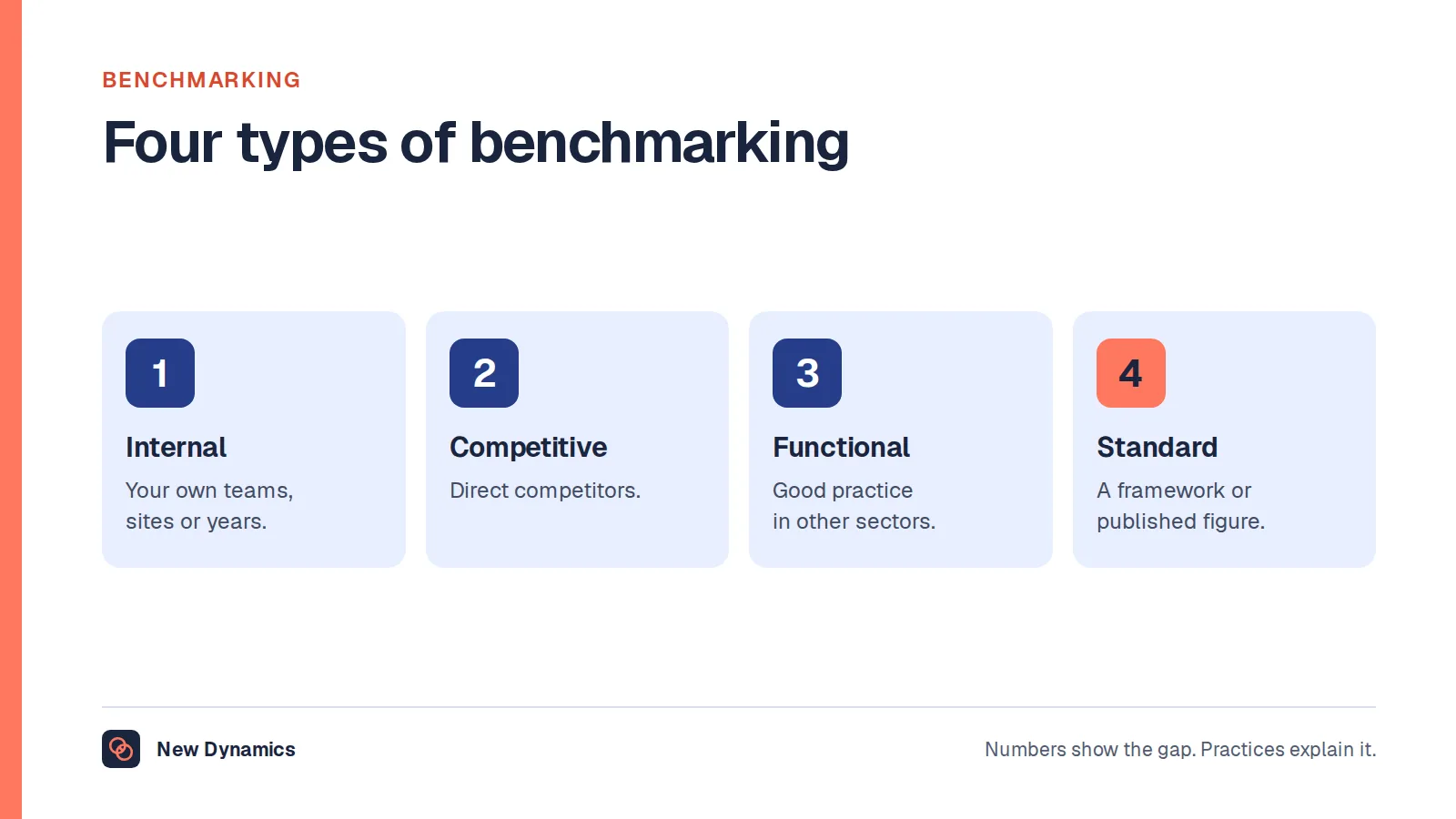
Salary benchmarking is the practice of comparing your pay for a job against what other employers pay for comparable work, so that a band's midpoint reflects something outside the organisation's own history. Our post on benchmarking covers the general method; the pay-specific limits are worth stating plainly.
Job titles are not comparable across employers. A "senior analyst" in one company is a graduate two years in; in another it runs a team of six. Benchmarking matches jobs by evaluated content, which is another reason the job evaluation work has to come first. Matching by title produces confident numbers about nothing.
Published official data and commercial benchmark data are different things. The Office for National Statistics publishes UK earnings by industry and occupation in the Annual Survey of Hours and Earnings, which, as the ONS describes it, "is based on employer responses for a 1% sample of employees, using HM Revenue and Customs Pay As You Earn (PAYE) records" and reports the pay period including a date in April each year. The Employee earnings in the UK bulletin is free, national and reliable at the level of industries and broad occupations. It will not tell you what three named competitors pay a mid-level software engineer in Manchester.
That employer-level detail generally comes from paid commercial salary surveys, where participating employers submit their own data in exchange for the results. Those panels are usually not public, the job matching is done by the provider, and sample sizes for a specific role in a specific region can be small. None of that makes the data useless. It does mean you should ask who is in the sample before treating a number as the market rate.
For the official UK figures themselves, including the measures people confuse with each other, read our post on UK pay statistics rather than taking a restated figure from here. The wider collection sits in our HR statistics hub.
Benchmark data ages. A midpoint set against a survey two years old is a historical fact, not a market position.
"Competitive salary" in adverts, and where transparency is heading
"Competitive salary" and "competitive wages" are, in most adverts, a way of not saying a number. Occasionally the employer genuinely does not know the range. More often the range exists and is being withheld, either to avoid upsetting current staff or to leave room to pay the candidate less than the budget allows.
The cost is real. Candidates who need a number self-select out, applications skew towards people willing to negotiate, and the practice tends to widen rather than narrow existing differences. If you have bands, you can publish the range. If publishing the range would embarrass you, the problem is the structure, not the transparency.
The direction of travel is towards disclosure, and the jurisdictions here need care.
In the UK, the established duty is gender pay gap reporting. Gov.uk states that "Any employer with 250 or more employees on a specific date each year (the 'snapshot date') must report their gender pay gap data", and that "You must report and publish your gender pay gap information within a year of your snapshot date." See the gender pay gap reporting guidance. That is a duty to publish a set of workforce-level statistics. It is not a duty to publish salary ranges in job adverts, and no such general UK duty exists at the time of writing.
In the EU, the pay transparency directive requires member states to introduce rules including pay information for candidates and restrictions on asking about pay history. The United Kingdom is not an EU member state, so the directive does not apply to UK employers and does not create UK obligations. A UK employer with operations inside the EU may be caught by the implementing law of the member states it employs people in, which is a question about those countries' legislation rather than about UK law. Treat any claim that UK employers must comply with the directive as wrong.
Northern Ireland differs. The gov.uk guidance above addresses employers in England, Scotland and Wales, and Acas advises on the law in Great Britain. Northern Ireland has its own equality legislation and its own enforcement body, so an employer with staff there should check the Northern Ireland position separately rather than assuming the Great Britain rules carry across.
Keeping bands current, and the three ways they fail
A pay structure is not a project with an end date. Review the bands on a stated cycle, usually annually: check the midpoints against fresh market data, check where people actually sit, and check whether the job evaluations still describe the jobs as they are now done. Re-evaluate any job that has materially changed, and record the decision either way.
Three failure patterns account for most collapsed structures.
Bands nobody applies. The structure exists in a document and recruitment ignores it. This is the most common failure and the easiest to detect: compare offers made in the last year against the bands they were supposed to sit in. If managers can set pay without the structure being checked, the structure is decoration.
Exceptions that become the rule. An exception is sometimes right, for a genuinely scarce skill or a retention case. The failure is in the record keeping. Every exception needs a written reason, a named approver and a review date, because an exception granted quietly in one year is indistinguishable from an anomaly by the third. When a quarter of a band sits outside it, the band is wrong or the discipline is gone.
Pay drift, and the equal pay risk it creates. Drift is the slow movement of actual salaries away from the structure: starting salaries creeping up for new hires while existing staff move with a general increase, out-of-cycle rises for people who ask, promotions handled by a percentage uplift rather than by placing the person in the new band. Each decision looks reasonable. The cumulative pattern is that people doing equal work are paid differently for reasons nobody chose, which is precisely the exposure job evaluation was supposed to remove. Checking the spread of pay within each band, and the average compa ratio by group, is how you find drift before somebody else does.
Frequently asked questions
What is a pay band?
A pay band is a named range of pay, with a floor, a ceiling and usually a midpoint, attached to a group of jobs judged to be of broadly equal size. Every job evaluated into that band is paid somewhere inside the range. Pay bands and salary bands mean the same thing.
How many pay bands should an organisation have?
Fewer than most people expect. Many organisations settle on roughly five to eight bands across the business, sometimes with separate structures for genuinely different labour markets. Let the evaluated job sizes suggest the boundaries rather than deciding the number first and then forcing jobs into it.
What is a compa ratio?
A compa ratio is actual salary divided by the midpoint of the pay band, expressed as a ratio or a percentage. It describes where somebody sits in their range. A result of 1.00 is exactly at the midpoint, below one is under it and above one is over it, and that is all the number says.
Is a compa ratio below one a bad thing?
Not by itself. A ratio under the midpoint is normal for somebody new to the job, recently promoted or still building full competence. It is also what you would see if a person has been overlooked for years, which is why a low ratio is a question to investigate rather than a conclusion about performance.
What is salary benchmarking, and how reliable is it?
Salary benchmarking compares your pay for a job against what other employers pay for comparable work. Reliability depends on matching jobs by evaluated content rather than by title, and on knowing who is in the sample. Official UK earnings data by industry is published by the ONS; employer-level comparisons usually come from paid commercial surveys whose panels are not public.
Does the EU pay transparency directive apply to UK employers?
No. The directive requires EU member states to introduce pay transparency rules, and the United Kingdom is not a member state, so it creates no UK obligation. A UK employer with staff inside the EU may be covered by those countries' implementing laws. The established UK duty is gender pay gap reporting for employers with 250 or more employees.
Your next step: size the jobs before you price them
- Take one job family and write down what each job actually does now, not what the title suggests.
- Score those jobs against the same factors, and keep the reasoning for each score.
- Group jobs of similar size, then set a floor, ceiling and midpoint for each group against a stated market position.
- Calculate the compa ratio for everybody in one band, look at the spread, and write down the reason for anybody near either end.
- Put a review date in the calendar, and a rule that every exception needs a named approver and a written reason.
For the evaluation method itself, with the factors and the scoring, read and download our job evaluation guide. The guide is free to read, and the PDF uses our short download form.
Want pay decisions to rest on performance evidence that already exists rather than being reconstructed in the meeting? Book a New Dynamics demo and bring your current band structure. You can also email contact@new-dynamics.com.