TL;DR
- Attitude cannot be observed, so it cannot be evidenced, agreed or changed. What you actually saw was something specific: a sentence, a sigh, a reply that never came. Describe that and the conversation becomes possible.
- Rule out four explanations before you raise it: workload, health, neurodivergence and something that happened. Acas says being neurodivergent will often amount to a disability, that no diagnosis is needed, and that mental health affects how someone thinks, feels and behaves.
- Some of what gets called attitude is genuinely conduct, and Acas names examples such as refusing to do work or bullying. That is a different route with its own procedure, not a quiet word about being more positive.
"You have got a bit of an attitude problem." It is the most common unfixable sentence in management. The person hears that you have judged who they are, defends themselves, and leaves with nothing they can do differently tomorrow. Meanwhile the thing that actually bothered you, which was specific and probably fair, never gets said.
This article covers why attitude fails as feedback, how to translate ten common complaints into something observable, the four explanations worth ruling out first, what to say, and what to write in a review. It describes the position in Great Britain and is general information, not legal advice.
Behaviours are easier to raise when there is somewhere to note them as they happen. See how New Dynamics continuous feedback keeps a record of the small things.
Why attitude fails
Three reasons, and the third is the expensive one.
It cannot be observed. You did not see an attitude. You saw a person say something, or not say something, or do something with their face. The attitude is your interpretation, and interpretations cannot be agreed.
It cannot be acted on. "Be more positive" is not an instruction anyone can follow on Monday morning. "When you disagree in a planning meeting, bring an alternative" is.
It reads badly later. "Attitude problem" in a written record is a judgement of character with no evidence attached, in a document that outlives the manager who wrote it, as our post on performance review record keeping explains. It is also the kind of line that, repeated across a team, tends to fall unevenly on people who are direct, junior, new or different in some way.
Ten translations

- "Negative." Said "that will never work" four times in the review meeting without offering an alternative.
- "Not a team player." Turned down three requests to help a colleague last month, while others covered.
- "Defensive." When I raised the late report, the first two minutes were about the system, and we did not get to what you would do differently.
- "Arrogant." Rewrote a colleague's section without telling them, and the client saw the change before she did.
- "Lazy." Picked up two pieces of work last quarter against a team average of six, with no flag that capacity was free.
- "Disengaged." Has not spoken in the last five team meetings, and the handover notes stopped in March.
- "Rude." Told the supplier their delay was unacceptable and unprofessional, in an email copied to their director.
- "Resistant to change." Still using the old process six weeks after the switch, and three others are copying that.
- "Does not take feedback." We agreed the checking step in April and it has not appeared in the last four reports.
- "Low energy." Arrives at the last minute, leaves immediately, and has not volunteered for anything since the reorganisation.
The pattern: a time, a thing that happened, and what it cost. Read the right-hand versions back and notice how many of them raise a question rather than a verdict. Two of them point at workload, two at something that changed in the spring, and one is a straightforward conduct matter.
Four explanations to rule out first

Workload. The person who has stopped volunteering and snaps in meetings is often the person carrying too much. This is the cheapest explanation to check and the one most often skipped.
Health, including mental health. Acas describes mental health as something that "affects how someone thinks, feels and behaves", notes that problems can "be hard to spot because everyone has different signs and signals" and can "fluctuate over time", and says a mental health problem "can be a disability under the Equality Act 2010", in which case the employer must make reasonable adjustments.
Neurodivergence. Directness read as rudeness, no eye contact read as disrespect, a flat tone read as not caring, difficulty with sudden change read as resistance. Acas says that "being neurodivergent will often amount to a disability under the Equality Act 2010", that "a worker does not need a diagnosis to be considered disabled", and that an employer "should offer workers support whether or not they have a diagnosis". You will often not know, which is the point: describe behaviour, ask, and be ready to adjust rather than to rate.
Something happened. A promotion that went elsewhere, a decision taken without them, a complaint they raised that went nowhere. Most sudden changes in demeanour have a date attached, and somebody in the team knows what it is.
Acas also notes that "it can still be discrimination even if the less favourable treatment was not intended". Attitude judgements are interpretations of manner, and manner varies with culture, language, neurotype and confidence, which is exactly where unintended unfairness lives.
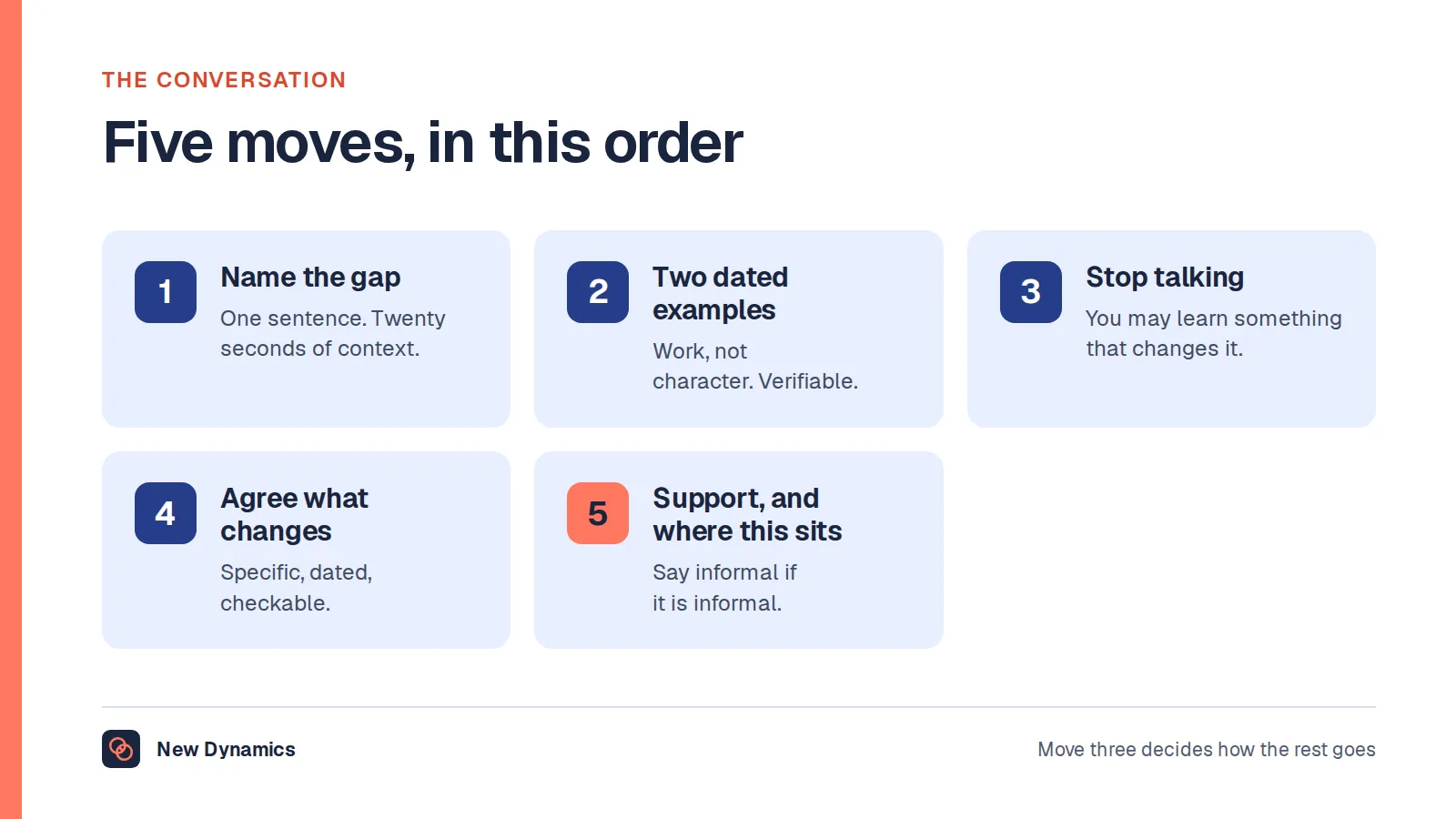
The conversation

Four parts, and the third is the one people skip.
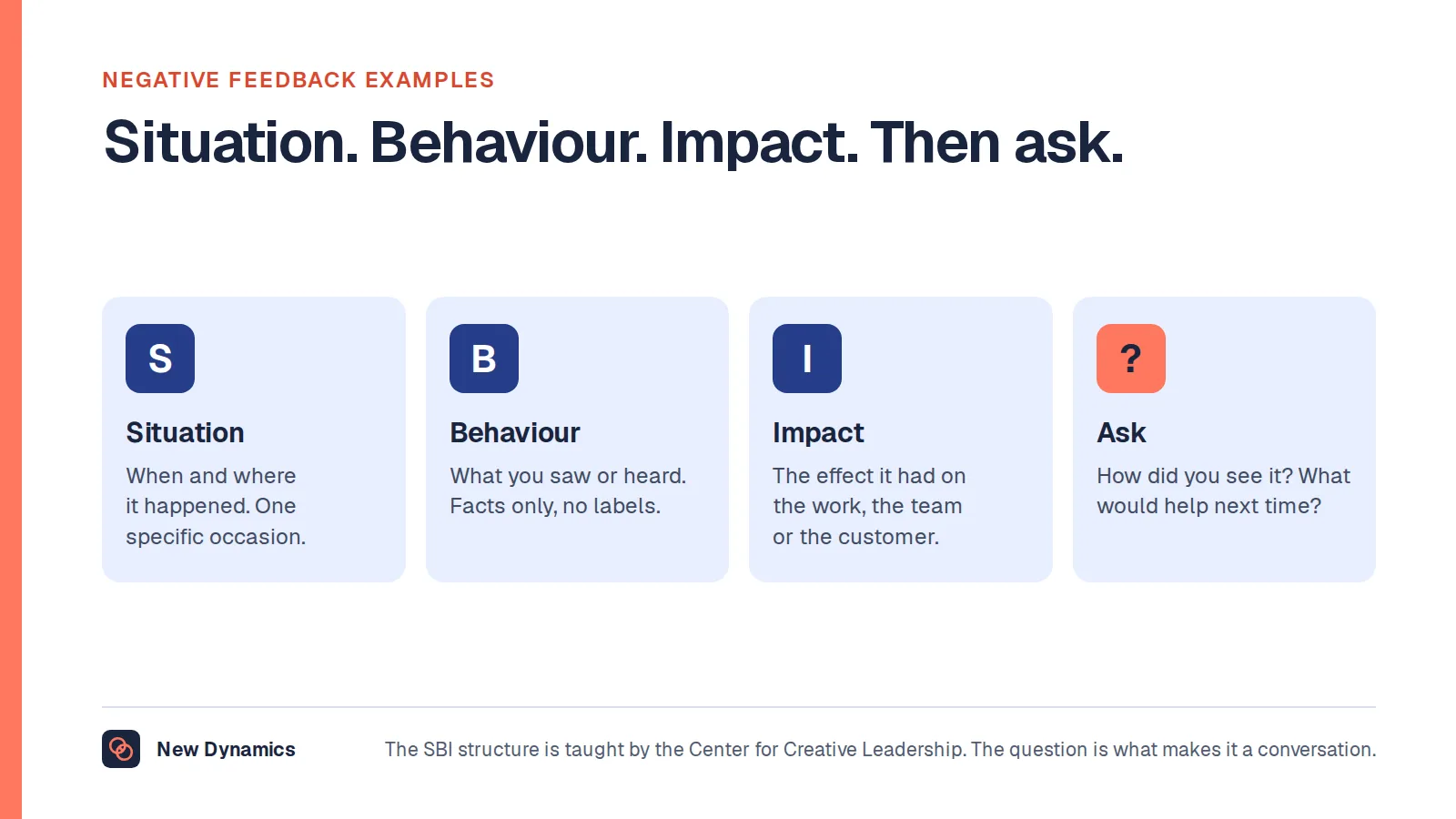
- The behaviour. What you saw or heard, with when.
- The effect. On the meeting, the colleague, the customer, the work.
- The question. Open, and genuinely open. You are about to find out which of the four explanations you are in.
- The agreement. One specific thing, with a date to review it.
Wording to adapt: "In the last three planning meetings you have said the new process will not work, without suggesting an alternative. Two of the newer people have stopped raising ideas after that. What is behind it? ... Right. So the process is adding an hour a day for you, and nobody asked before it changed. Let me take the hour back to the ops group this week. In the meantime, when you see a problem in the meeting, can you bring one option with it?"
Notice what that costs the manager: half the fix was theirs. That is normal, and a conversation that ends with only the employee having an action was usually a conversation about attitude after all. The wider structure is in our post on the underperformance conversation, and negative feedback examples has more wording by situation.
When it really is conduct
Not everything is a misunderstanding. Acas defines conduct as "someone's behaviour at work" and lists examples including "insubordination - for example, refusing to do work" and "bullying", adding that "what kind of problem it is affects how employers should respond".
If what you are dealing with is refusal, aggression, bullying or harassment, that is a conduct route with a procedure attached, not a quiet word about being more positive. Raising it as "attitude" is worse for everyone, including the colleagues on the receiving end, because it produces no record and no change.
Writing it in a review
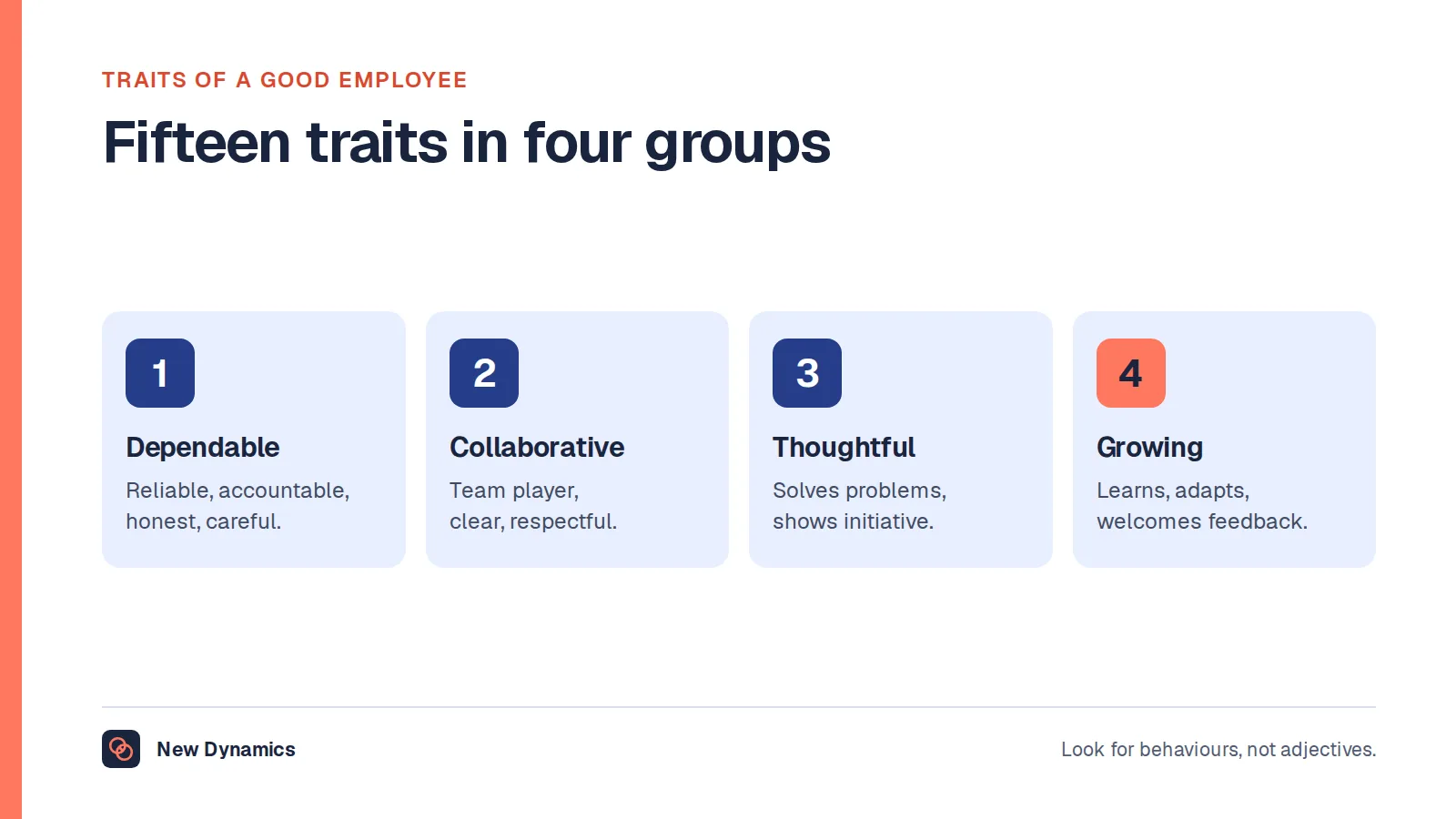
Never write "attitude problem", "negative attitude" or "poor attitude". Write what happened, when, what it affected, and what was agreed. Our post on good employee traits makes the same case from the other direction: traits are only useful once they are described as behaviour.
A usable review line looks like this: "In Q2, raised objections in three planning meetings without alternatives; agreed in May to bring one option alongside any concern, and has done so since." That is specific, it is fair, it shows the improvement, and it survives being read by a stranger in two years.
Frequently asked questions
How do you give feedback about someone's attitude?
Do not. Give feedback about what you observed: what the person said or did, when, and what it affected. Then ask an open question, because the explanation is often workload, health or something that happened rather than character. Finish with one specific agreed change and a date to review it.
What can you say instead of "you have a bad attitude"?
Describe the behaviour and its effect. "You said the new process would not work three times without offering an alternative, and two newer colleagues stopped contributing" can be discussed and acted on. "You have a bad attitude" can only be denied.
Can you put attitude in a performance review?
You can record behaviour, dates and effects, which is what a defensible review contains. A line such as "poor attitude" is a character judgement with no evidence in a document that outlives you, and it is the sort of comment that falls unevenly across a team. Write what happened instead.
What if the attitude is caused by a health condition?
Then the route is support and adjustments rather than rating. Acas says mental health affects how someone thinks, feels and behaves and can be a disability under the Equality Act 2010, and that being neurodivergent will often amount to a disability, with no diagnosis needed for an employer to offer support. Ask what would help, and involve HR. This is general information, not legal advice.
When does an attitude problem become a disciplinary matter?
When it is conduct. Acas gives examples including refusing to do work and bullying, which follow a disciplinary route with its own procedure. Calling that an attitude issue and having a quiet word produces no record and no change, and leaves affected colleagues unprotected.
How do you handle someone who gets defensive about feedback?
Get more specific rather than more general. Return to one dated example, ask how it looked from their side, check any facts they give you, and separate the explanation from the standard. Defensiveness usually eases as the conversation becomes concrete, and it increases when the feedback is about who they are.
Your next step: translate before you talk
- Write the sentence you want to say. If it contains a trait, you are not ready.
- Replace it with what you saw and heard, with dates, and what it cost.
- Check the four explanations: workload, health, neurodivergence, something that happened.
- Decide what half of the fix is yours, and say that part first.
For turning behaviours into feedback and development actions, read and download our competency-based feedback guide. The guide is free to read, and the PDF uses our short download form.
Want behaviours recorded as they happen, so reviews stop reaching for adjectives? Book a New Dynamics demo and bring the line you are trying to write. You can also email contact@new-dynamics.com.