TL;DR
- A true four-day week means fewer hours for the same pay, with output maintained. It is different from compressed hours, where full-time hours are squeezed into four longer days.
- In the UK's 2022 pilot of 61 companies, 56 chose to continue afterwards. Employees reported less stress and burnout, and the number of staff leaving fell by 57%. The companies had volunteered, so treat the figures as encouraging, not conclusive.
- It does not suit every role or every person. The CIPD found most employers thought a move unlikely and that productivity would have to rise to pay for it. Run a time-limited trial with measures agreed in advance.
Few workplace ideas divide opinion like the four-day week. To supporters, it is the obvious next step after the two-day weekend. To sceptics, it is a perk for office workers that the rest of the economy cannot afford. The useful question is a narrower one: what does the evidence show, and would it work here?
This article sets out the four-day week benefits that trials have reported, the drawbacks that employers raise, the main models and six steps for running a fair trial of your own.
A shorter week works only if everyone is clear about what has to be achieved. See how New Dynamics Goals & OKRs keep outcomes visible to the whole team.
What is a four-day week?
The term covers two different arrangements, and the difference matters.
- A true four-day week reduces working time, typically to around 32 hours, with no loss of pay. The organisation expects output to be maintained. 4 Day Week Global, one of the organisations that recruited companies for the UK pilot, calls this its 100:80:100 model: 100% pay, 80% time, for 100% productivity.
- Compressed hours keep full-time hours and fit them into fewer days. GOV.UK describes this under types of flexible working as “working full-time hours but over fewer days”. Four ten-hour days is a common pattern.
A third arrangement, working four days for four days' pay, is simply part-time work. It has always been available, and it comes with a pay cut.
Most of the evidence discussed below concerns the first kind.

What the UK pilot found
The largest trial so far ran in the UK from June to December 2022. The think tank Autonomy published the results, with a quantitative research team from Boston College and University College Dublin. Its summary of the UK four-day week pilot results reports that:
- the trial comprised “61 companies and around 2,900 workers”;
- companies could design their own model, “so long as pay was maintained at 100% and employees had a ‘meaningful’ reduction in work time”;
- of the 61 companies, “56 are continuing with the four-day week (92%), with 18 confirming the policy is a permanent change”;
- “39% of employees were less stressed, and 71% had reduced levels of burnout at the end of the trial”;
- 60% of employees found it easier to combine paid work with care responsibilities;
- company revenue “stayed broadly the same over the trial period, rising by 1.4% on average”;
- the number of staff leaving “decreased significantly, dropping by 57% over the trial period”.
How much weight to give it
These are striking figures, and they deserve two cautions.
First, the companies volunteered. Organisations that sign up for a four-day week trial are likely to be those that expect it to suit them, so the results may not carry over to every employer. Second, the trial was organised by groups that campaign for a shorter working week or sell support for introducing one. That does not make the findings wrong, but it is a reason to read them alongside more sceptical sources.
Treat the pilot as good evidence that a four-day week can work in organisations that choose it and prepare for it. It does not show that it would work everywhere.

Seven benefits of a four-day work week
Drawing on the pilot and on the logic of the idea, these are the advantages most often reported.
- Better wellbeing. Lower stress and burnout were the pilot's strongest findings. A third day allows real rest, and time for the errands that otherwise eat the weekend.
- Retention. A fall of 57% in the number of leavers is large. A benefit that few competitors offer gives people a reason to stay.
- Recruitment. A four-day week stands out in a job advert, and it widens the pool to people who cannot or will not work five days.
- Sharper ways of working. To fit the work into less time, teams cut meetings, protect focus time and drop low-value tasks. Many of those gains would be worth having anyway.
- Easier caring. In the pilot, 60% of employees found it easier to combine work with care responsibilities. That can help with inclusion. See our diversity and inclusion guide.
- Steady output. Revenue in the pilot companies stayed broadly the same. The evidence supports “no worse”, which is the test that matters, more strongly than it supports “better”.
- Lower costs at the margin. Less turnover means less spent on hiring and training, and an office that closes for a day can use less energy.
The drawbacks and risks
An honest assessment has to include the other side. The CIPD surveyed UK employers for its report, The four-day week: employer perspectives. Among its key findings:
- “Employees' preferences for working patterns differ, but most are happy with their current working hours.”
- While the majority of people would like to work fewer hours, “they are not willing to take a pay cut to facilitate this”.
- From the data, “employers appear ambivalent about reducing hours and see a move to a four-day week as unlikely”.
- One challenge for employers that had reduced hours “was that it did not suit everybody in their organisation”.
- Most employers believe there would need to be “an increase in productivity by working smarter and/or investing in technology” to make a four-day week possible without reducing pay.
In practice, the main risks are these.
Work intensifies. If five days of work are pressed into four with nothing removed, the fifth day is paid for with stress on the other four.
Customer cover. Customers still expect answers on Friday. Most organisations stagger days off, which adds scheduling effort.
It does not fit every role. Shift-based, frontline and hourly-paid work is harder to shorten without hiring more people. The CIPD notes that a shorter week “raises the question of how to manage atypical and non-salaried workers”.
Fairness. If office staff get a four-day week and warehouse staff do not, you have created two classes of employee.
Part-time colleagues. People who already work four days for 80% of the pay will reasonably ask what happens to them. Decide before you start.
Compressed hours have their own problems. Ten-hour days are tiring, and they are hard to combine with childcare. See our article on the 8-hour working day.
It is hard to reverse. A benefit that people have planned their lives around is painful to withdraw. That is the strongest argument for a clearly labelled trial.
Four-day week models
The pilot companies were not required to adopt a single model. The report describes “a range of four-day weeks”, from “classic ‘Friday off’ models, to ‘staggered’, ‘decentralised’, ‘annualised’, and ‘conditional’ structures”. In plain terms:
| Model | How it works | Suits |
|---|---|---|
| Friday off | The whole organisation closes on the same day | Firms whose customers do not need daily cover |
| Staggered | Staff take different days off, so that the business stays open for five days | Customer-facing teams |
| Decentralised | Each department chooses its own pattern | Organisations with very different functions |
| Annualised | Hours average 32 a week across the year, with longer weeks in busy seasons | Seasonal businesses |
| Conditional | The shorter week continues only while agreed performance is maintained | Organisations that want a safeguard |
The legal position in the UK
There is no right to a four-day week. There is a right to ask for one. GOV.UK's guide to flexible working says that all employees have the legal right to request flexible working, including a change to “the number of hours they work” or “the days they work”, and that they can make a request “from their first day in a job”. Employers must deal with requests in a “reasonable manner”. The rules are different in Northern Ireland.
If you change working hours for a whole team, you are changing contracts, which needs consultation and agreement. This is general information, not legal advice.
How to trial a four-day week in six steps
- Be clear about why. Retention, wellbeing, recruitment or productivity? The purpose decides the measures.
- Choose the model with the people who do the work. They know where the time goes and what customers need. Include part-time and frontline colleagues in the design from the start.
- Agree the measures and take a baseline. Pick a few: output or revenue, customer satisfaction, turnover, absence and wellbeing survey scores. Our success indicator examples can help, and so can our workplace engagement survey questions.
- Redesign the work first. The pilot gave companies two months of preparation. Use that time to cut meetings, protect focus time, fix slow processes and agree priorities.
- Run a time-limited trial. Six months is typical. Put in writing that it is a trial, how it will be judged and what happens afterwards.
- Review honestly, and decide. Compare results with the baseline, listen to employees, managers and customers, then continue, adjust or stop.

Alternatives if a four-day week will not fit
The goals behind the four-day week can often be met in other ways.
- A nine-day fortnight, which GOV.UK gives as an example of compressed hours.
- Flexitime, with core hours.
- Meeting-free days or shorter default meetings.
- More annual leave, or the option to buy extra leave.
- Genuinely flexible part-time roles, including senior ones.
- Summer hours, with early finishes on Fridays for part of the year.
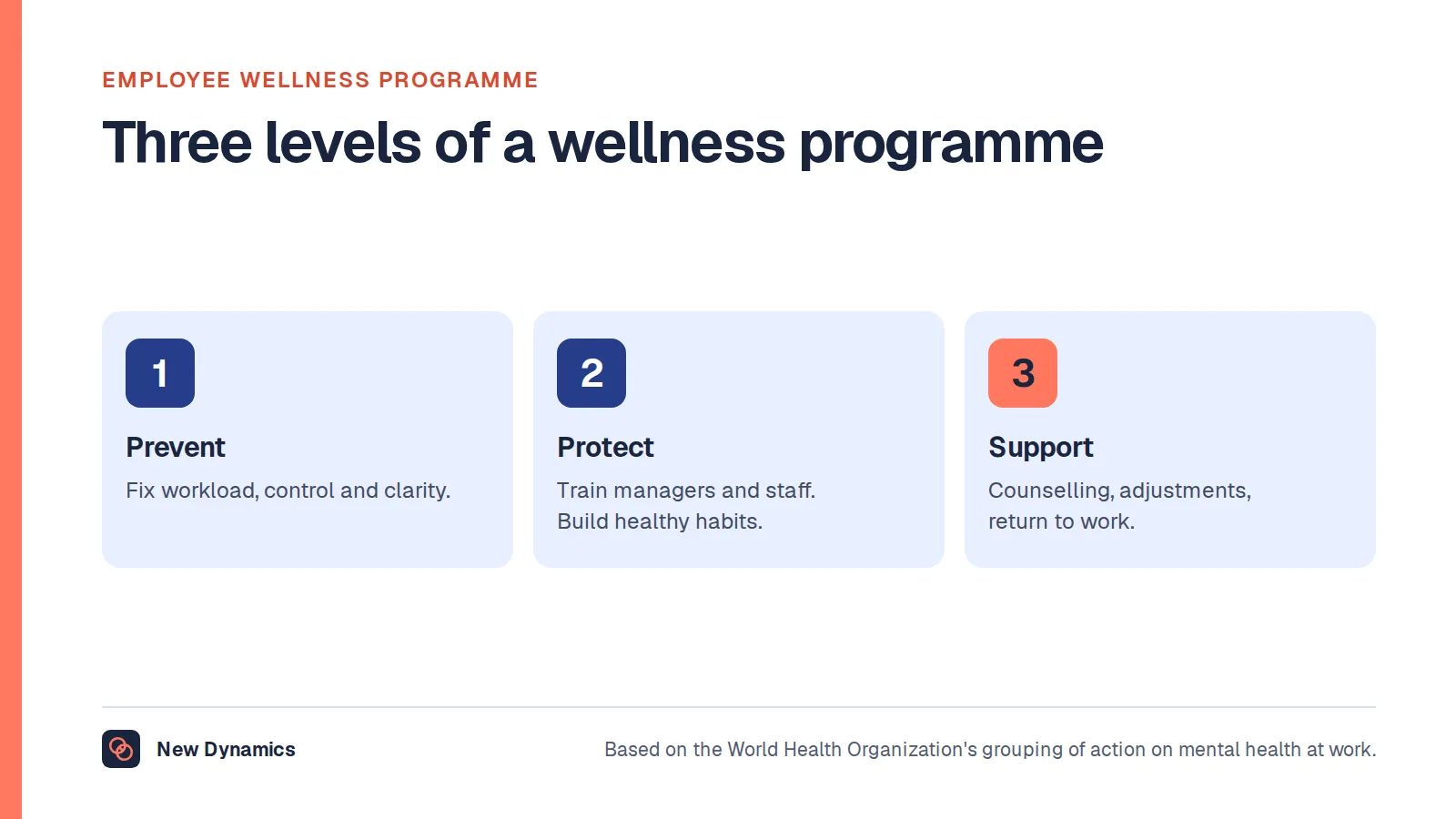
Our guide to the employee wellness program covers the wider picture.
Frequently asked questions
What are the benefits of a four-day work week?
Reported benefits include lower stress and burnout, better retention, easier recruitment, sharper ways of working, more time for caring responsibilities and steady output. In the UK's 2022 pilot, 71% of employees had reduced burnout and staff departures fell by 57%.
What are the disadvantages of a four-day week?
Risks include more intense working days, gaps in customer cover, roles where hours cannot easily be cut, unfairness between groups of staff, questions about existing part-time workers and the difficulty of reversing the change. The CIPD found that it did not suit everyone in organisations that tried it.
Is a four-day week the same as compressed hours?
No. A true four-day week reduces total hours, usually to about 32, with no loss of pay. Compressed hours keep full-time hours and fit them into fewer, longer days. The evidence from the UK pilot concerns reduced hours.
Does productivity fall with a four-day week?
In the UK pilot, company revenue stayed broadly the same over the trial, rising by 1.4% on average. The participating companies volunteered and had two months of preparation, so the result may not apply to every organisation.
Do employees have a right to a four-day week in the UK?
No. Employees have a legal right to request flexible working, including a change to their hours or days, from their first day in a job. Employers must handle requests in a reasonable manner. The rules differ in Northern Ireland.
How do you introduce a four-day week?
Be clear about the purpose, design the model with employees, agree measures and a baseline, redesign the work to remove waste, run a time-limited trial of about six months and review the results honestly before deciding whether to continue.
Your next step: test the idea on paper
- Write down why you are considering it, in one sentence.
- List the three measures that would tell you whether it worked.
- Ask two teams where five hours a week could be saved without harming customers.
- If the answers are encouraging, plan a six-month trial in one part of the organisation.
For policies and routines that make flexible arrangements work, read and download our remote work guide. The guide is free to read, and the PDF uses our short download form.
Want goals and outcomes clear enough that hours matter less? Book a New Dynamics demo and bring your current approach. You can also email contact@new-dynamics.com.