TL;DR
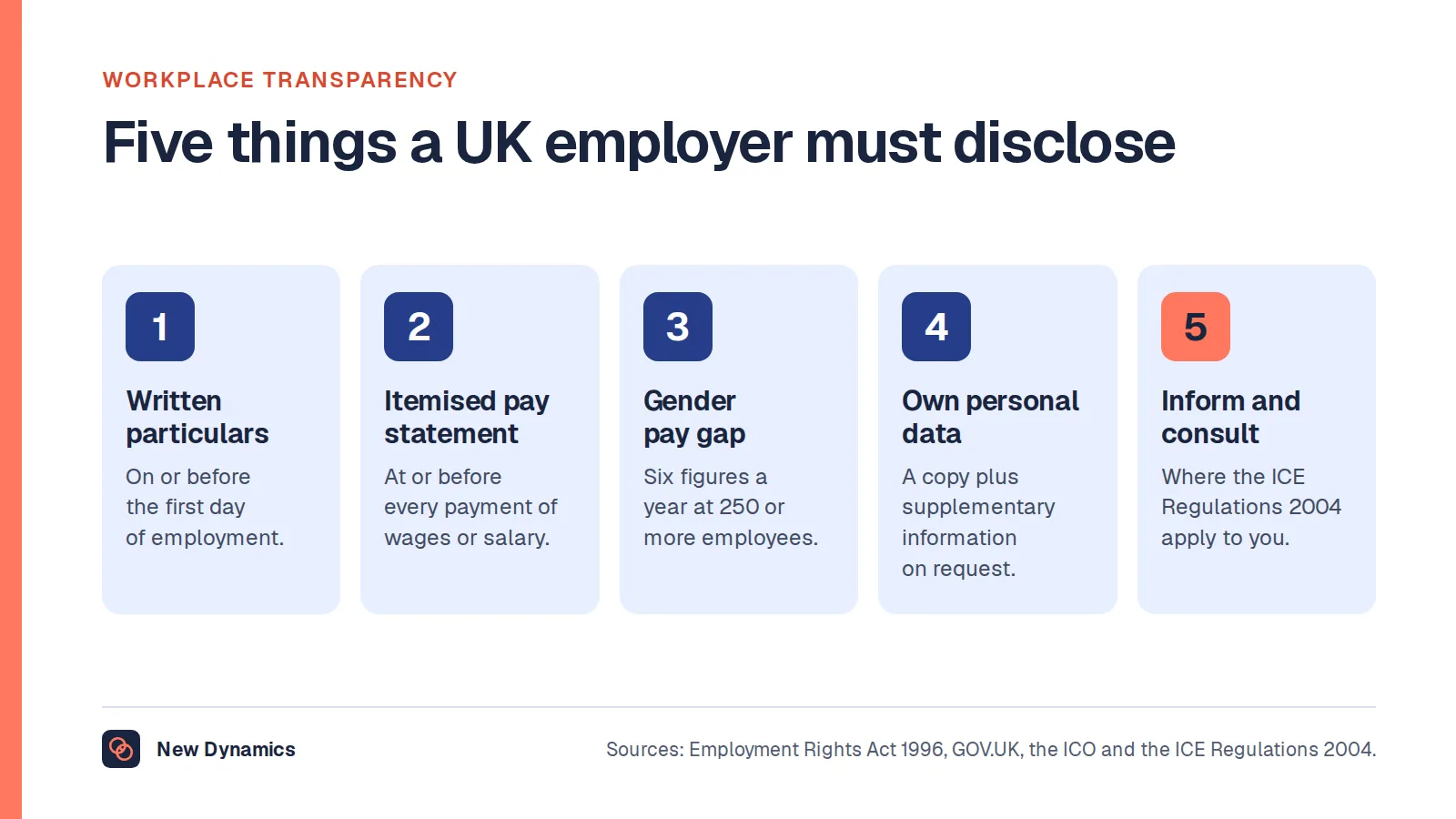
- Six figures are compulsory and nothing else is. Regulation 2 of the Equality Act 2010 (Gender Pay Gap Information) Regulations 2017 lists the mean and median hourly gap, the mean and median bonus gap, the proportions paid a bonus and the proportions in four quartile pay bands. A supporting narrative is something GOV.UK says you can publish, not something you must.
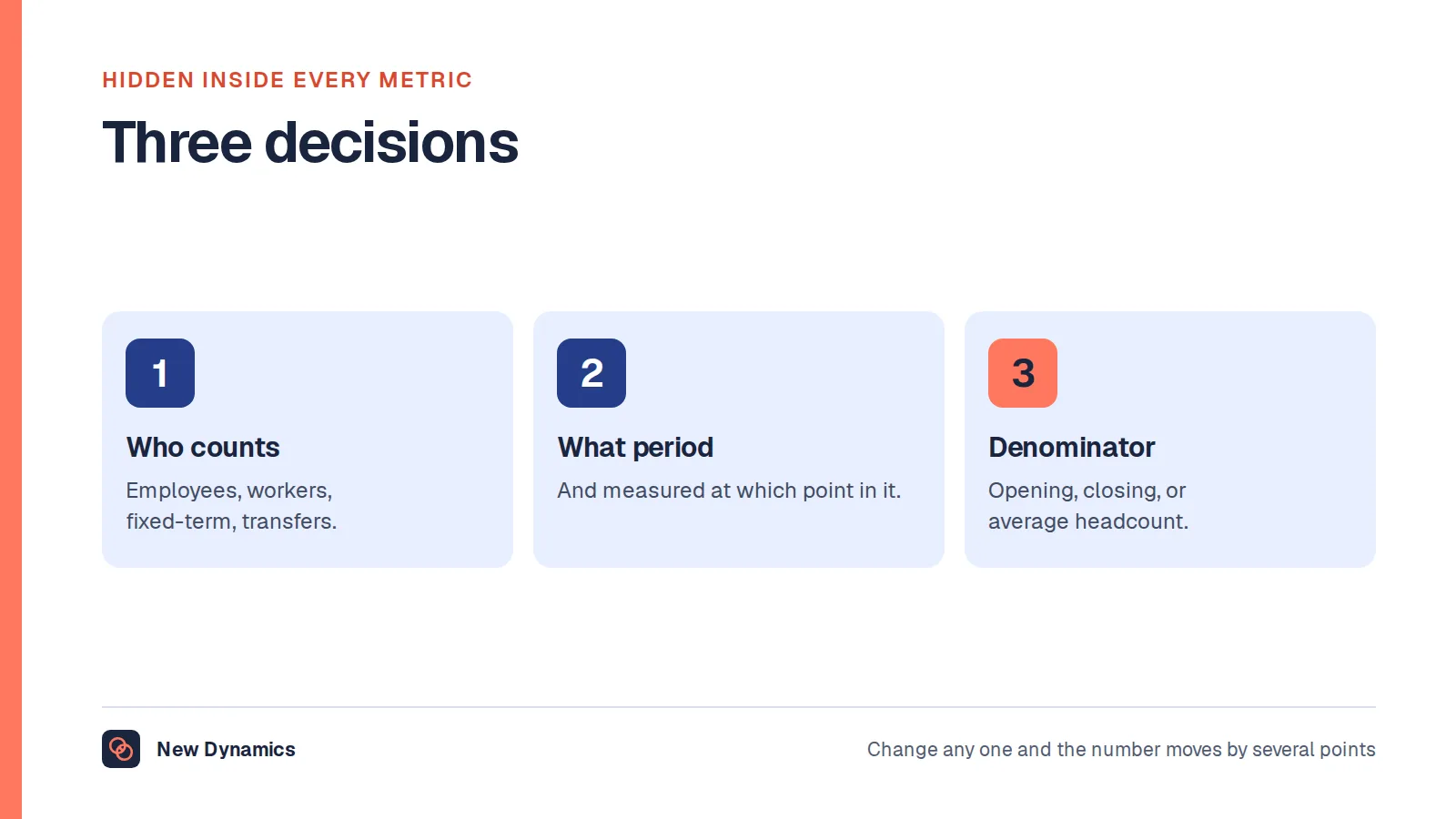
- Two employee lists, not one. GOV.UK says the bonus figures use all relevant employees, while every other calculation uses full-pay relevant employees only, which excludes anyone paid less than usual because of leave. Someone on statutory maternity pay on your snapshot date drops out of the hourly pay gap and stays in the bonus gap.
- Action plans are voluntary today. Section 33 of the Employment Rights Act 2025 came into force on 6 April 2026 and inserts a regulation-making power, section 78A, into the Equality Act 2010. GOV.UK says employers with 250 or more employees have the option to publish a plan and that, subject to legislation, plans become mandatory from spring 2027.
Most gender pay gap submissions go wrong in the same two places. Somebody includes the wrong people, and somebody publishes a narrative believing it was compulsory while missing something that was. Both are avoidable, because the rules are short and they are written down.
This article sets out who has to do gender pay gap reporting, the snapshot dates and the deadline, the six figures the regulations actually require, which employees belong in which calculation, where the result has to appear, and what the Employment Rights Act 2025 changed about equality action plans. It covers Great Britain, which means England, Scotland and Wales, and it is general information rather than legal advice.
The first problem is almost always a headcount question rather than a payroll question. See how New Dynamics org charts keep people, roles and legal entities in one current picture, so you know who sits inside each reporting entity before the snapshot date arrives.
The gender pay gap is not equal pay
This is the single thing readers most often get wrong, so it is worth stating before anything else.
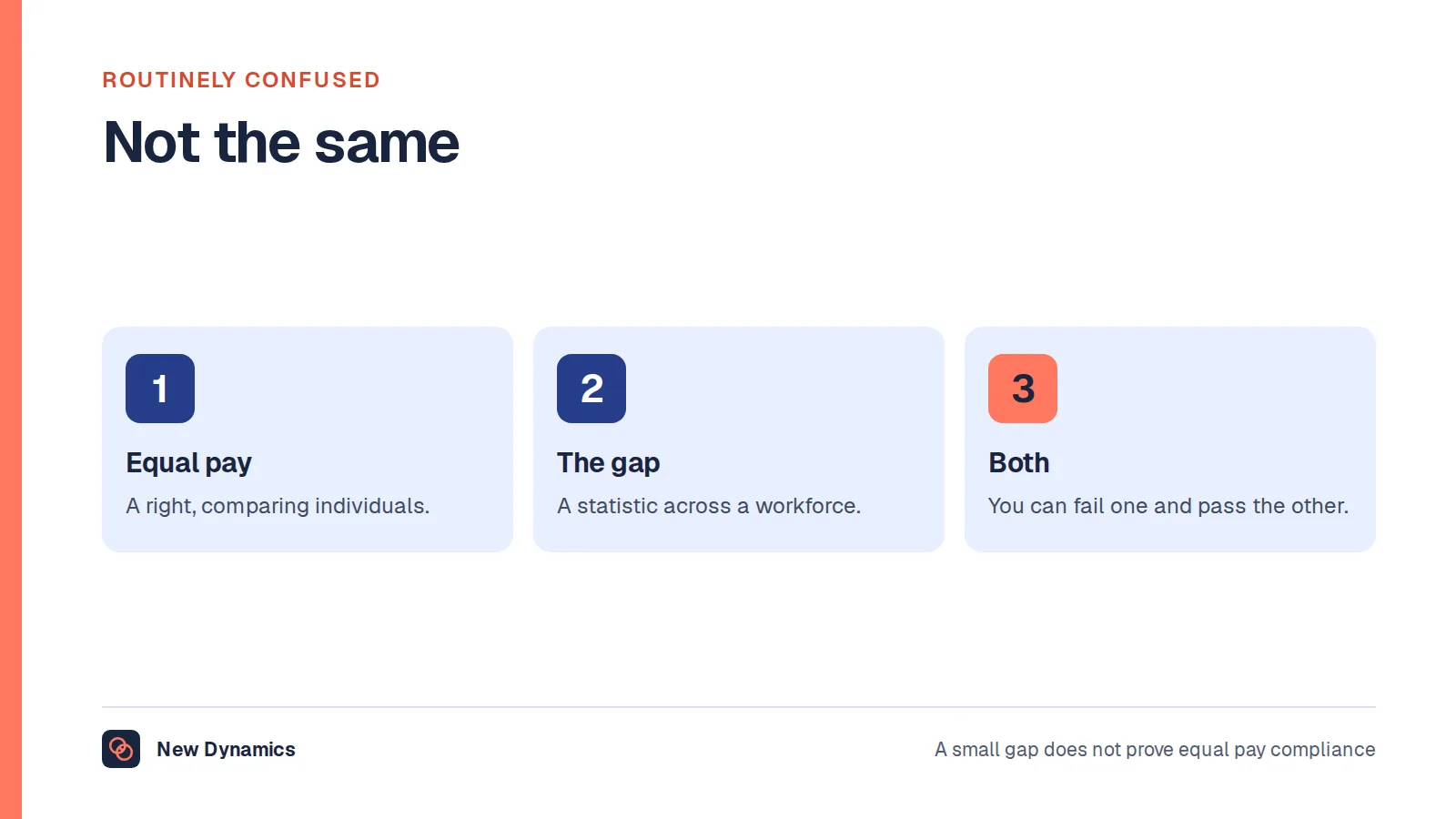
Equal pay is a legal right held by an individual. It compares one person's pay with that of a colleague of the opposite sex doing equal work, and a breach is something a tribunal decides.
The gender pay gap is a statistic about a whole workforce. It compares the average pay of all men with the average pay of all women, with no regard to what job anybody does. The Office for National Statistics release Gender pay gap in the UK: 2026, published on 22 October 2026, says the measure "is a measure across all jobs in the UK, not of the difference in pay between men and women for doing the same job".
The practical consequence is that a published gap of zero is not a defence to an equal pay claim, and a published gap of 20% is not an admission of one. Our post on pay equity covers the equal pay side, including what equal work means and what an audit involves.
Who has to report, and how the headcount works
Regulation 1(2) of the Equality Act 2010 (Gender Pay Gap Information) Regulations 2017, which came into force on 6 April 2017, defines a "relevant employer" as "an employer who has 250 or more employees on the snapshot date". GOV.UK's statutory guidance on who needs to report puts it the same way: "Any employer with 250 or more employees on a specific date each year (the 'snapshot date') must report their gender pay gap data."
Acas words the threshold more loosely, as "more than 250 workers". The regulations govern, and at exactly 250 you report. Our post on transparency in the workplace sets that wording clash out in full alongside the other dated disclosure duties.
The headcount itself has rules that catch people out. GOV.UK says your headcount "is of the number of individual employees you have, not full-time equivalents", and that you must include "people with a contract of employment with you, including if they work part-time, job-share or are on leave". Each part-time worker counts as one. Each person in a job share counts as one, so two people sharing a job are two employees.
Four exclusions matter:
- Agency workers. GOV.UK says "Do not include agency workers, because they are part of the headcount of the agency that provides them."
- Partners. GOV.UK says "Do not include partners in traditional partnerships and limited liability partnerships", because "they take a share of your organisation's profits, and this is not comparable with employees' pay". Salaried partners and LLP members treated as employees for payroll count towards the headcount but are kept out of the calculations.
- Short service. GOV.UK is explicit that "The length of their employment is not relevant. You must include them even if they have only worked for you for one day before your snapshot date."
- Group structures. If you have to report, GOV.UK says you "must calculate, report and publish gender pay gap information for each separate legal entity". A group may also publish combined figures on top, but the entity-level reports are the duty.
If your headcount has fallen below 250, GOV.UK tells you to sign in to the gender pay gap service and change your reporting requirement, which "will ensure your organisation does not receive a 'late badge'". Doing nothing is not the same as being out of scope.
Snapshot dates and the deadline
GOV.UK's page on when to report gives two snapshot dates: "31 March for most public authority employers" and "5 April for private, voluntary and all other public authority employers". The two dates come from two instruments. The 5 April date is in regulation 1(2) of the 2017 Information Regulations. The 31 March date is in Schedule 1 to the Equality Act 2010 (Specific Duties and Public Authorities) Regulations 2017, which defines "snapshot date" as "the 31st March in the year to which the information required by paragraph 2 relates" and applies to a listed public authority "which has 250 or more employees on the snapshot date".
The deadlines are twelve months later: "30 March for most public authority employers" and "4 April for private, voluntary and all other public authority employers". GOV.UK adds that you "should base your gender pay gap calculations on payroll data taken on your snapshot date", so a single day of payroll fixes the whole return.

The six figures, and nothing else
Regulation 2(1) requires a relevant employer to publish six things, and the list has not changed since 2017:
- the difference between the mean hourly rate of pay of male and female full-pay relevant employees
- the same difference using the median
- the difference between the mean bonus pay paid to male and female relevant employees
- the same difference using the median
- "the proportions of male and female relevant employees who were paid bonus pay"
- "the proportions of male and female full-pay relevant employees in the lower, lower middle, upper middle and upper quartile pay bands"

GOV.UK's chapter on making your calculations says you "can report your figures as whole percentages or rounded to one decimal place", and explains the sign: "A positive percentage shows that women have lower pay or bonuses than men in your organisation. A negative percentage shows that men have lower pay or bonuses than women."
A supporting narrative and an action plan sit outside that list. GOV.UK describes a narrative as something a group "can also report and publish" alongside the figures, and tells employers that if "you think there are important factors behind your bonus pay gap, you can highlight them in your supporting narrative". Useful, and optional.
Two employee lists, and the maternity leave trap
This is where submissions get quietly wrong. GOV.UK's chapter on preparing your data says you need two separate lists, because "The payroll data you gather is different for each type of employee". You use "relevant employees" for the bonus figures and "full-pay relevant employees" for everything else.
A full-pay relevant employee is someone paid their usual full basic pay, or their piecework rate, during the pay period containing the snapshot date. GOV.UK says to exclude anyone who "was not paid their usual full basic pay or piecework rate because they were on leave", and names annual leave, maternity, paternity, adoption, parental and shared parental leave, sick leave, special leave and sabbaticals.
So an employee receiving statutory maternity pay on your snapshot date leaves the hourly pay gap and the quartiles, and stays in the bonus gap and the headcount. Someone on strike for two days earns less than usual but is still a full-pay relevant employee, because GOV.UK says striking "does not count as leave".
Two definitions in the regulations decide what counts as pay. Regulation 3 defines ordinary pay as basic pay, allowances, piecework pay, pay for leave and shift premium pay, and expressly excludes "remuneration referable to overtime", pay for redundancy or termination, pay in lieu of leave and anything "provided otherwise than in money". Regulation 4 defines bonus pay as money, vouchers, securities, securities options or interests in securities relating to "profit sharing, productivity, performance, incentive or commission". Overtime is out of both. Benefits in kind are out of ordinary pay.
Regulation 1(3) adds that pay is counted "before deductions made at source", so the figures are gross.
Where it must be published, and who signs it
Publishing on the government service is only half of the duty, and the half people forget is the other one.
Regulation 15(1) requires the information and the statement to be published "on the employer's website", "in a manner that is accessible to all its employees and to the public", and "for a period of at least three years beginning with the date of publication". Regulation 15(2) then requires the same information, plus the name and job title of the signatory, on the government service.
Regulation 14 requires a written statement that "confirms that the information is accurate", signed by a director or equivalent for a company, a designated member for an LLP, a general partner for a limited partnership, or "the most senior employee" for any other type of body. GOV.UK reminds employers that "You are responsible for the accuracy of your data, even if a third party does your calculations."
Equality action plans: what is in force, and what is only legislated
Here is the part that is changing, and the part most often reported loosely.
Section 33 of the Employment Rights Act 2025 is headed "Equality action plans". It was not in force at Royal Assent and, per the commencement note on legislation.gov.uk, came "in force at 6.4.2026 by S.I. 2026/323, reg. 3(1)(7)".
What it does is narrower than the headlines suggest. It inserts a new section 78A into the Equality Act 2010, and section 78A(1) says only that "Regulations may require employers to" develop and publish an equality action plan and publish prescribed information about it. It is a power, not a duty. Until regulations are made under it, no employer is required to publish a plan.
Three details in the new section are worth reading directly. Section 78A(2) says the section "does not apply to an employer with fewer than 250 employees", so the power cannot reach smaller employers at all. Section 78A(4) says matters related to gender equality "include addressing the gender pay gap, and supporting employees going through the menopause". Section 78A(6) says regulations "may not require an employer, after the first publication of information, to publish information more frequently than at intervals of 12 months".
What exists today is voluntary and is for large employers only. GOV.UK's collection on gender pay gap reporting and creating an action plan, published 7 April 2026, says: "You also have the option to produce and publish a voluntary action plan on the gender pay gap service, alongside your gender pay gap data. Subject to legislation, these will become mandatory from spring 2027." The list of actions, published 4 March 2026, is more precise still: "From April 2026, employers with 250 or more employees will be able to produce and publish a voluntary action plan alongside their gender pay gap data. These will become mandatory from spring 2027, subject to secondary legislation."
So the claim that employers of all sizes can publish a voluntary action plan from April 2026 is wrong on both the size and the date framing. The voluntary option is for employers with 250 or more employees, the same population that already reports, and the mandatory step is spring 2027 subject to secondary legislation rather than a date already fixed in law. Acas, on gender pay gap reporting, states it more flatly: "In 2027, publishing an action plan will become mandatory for employers with 250 or more workers." Read alongside section 78A, GOV.UK's qualification is the safer one to plan against.
If you do publish a plan, GOV.UK's guidance on creating one says there are 18 actions to choose from and "You must choose a minimum of 2 actions in your action plan: one must address your gender pay gap, one must support employees experiencing menopause", and that at least two must be marked "new or in progress". Our post on DEI consulting covers what the published evidence says about which interventions hold up.
Recording sex, after the May 2026 update
GOV.UK updated this guidance on 21 May 2026 "following the Supreme Court ruling on the definition of sex in the Equality Act 2010", replacing a section on recording gender with one on recording sex.
The guidance now says that in the Equality Act 2010 the terms male, female, men and women "refer to a person's biological sex", that gender pay gap reporting "must be based on employees' biological sex", and that where an employee has a Gender Recognition Certificate you should "use their biological sex for the purposes of gender pay gap reporting, not the acquired gender recorded on their GRC". It also says you "should not single out individual employees and ask them about their sex or gender identity", and recommends that you do not ask for documentation.
Ethnicity and disability pay gap reporting: the current position
Neither is mandatory. There is no equivalent of the 2017 regulations, and a search of legislation.gov.uk returns no Equality (Race and Disability) Act.
What exists is a commitment. On 25 March 2026 the Office for Equality and Opportunity published its response to the consultation on mandatory ethnicity and disability pay gap reporting, with draft primary legislation at Annex A. The accompanying announcement says "Firms with 250 or more employees will be required to publish 6 key pay-gap metrics and new workforce composition data", that "87% of respondents agreed large employers should report their ethnicity and disability pay gaps", and that the legislation "will seek to build on the current gender pay gap reporting to simplify the process".
Until a Bill passes and regulations follow, any ethnicity or disability pay gap figure you publish is voluntary. Plenty of large employers publish one anyway, and the data work is the same data work.
What the national picture says about your quartiles
Your quartile distribution is the figure that explains the other five, and the national data shows why. The ONS release for April 2026 reports that the gender pay gap for full-time employees "was 6.8% in April 2026, down from 7.2% in April 2025". Split by earnings, the same release gives the full-time gap as "17.3% for employees in the 90th percentile" and "1.5% for employees in the 10th percentile", and notes this pattern "has been consistent over time since records began in 1997".
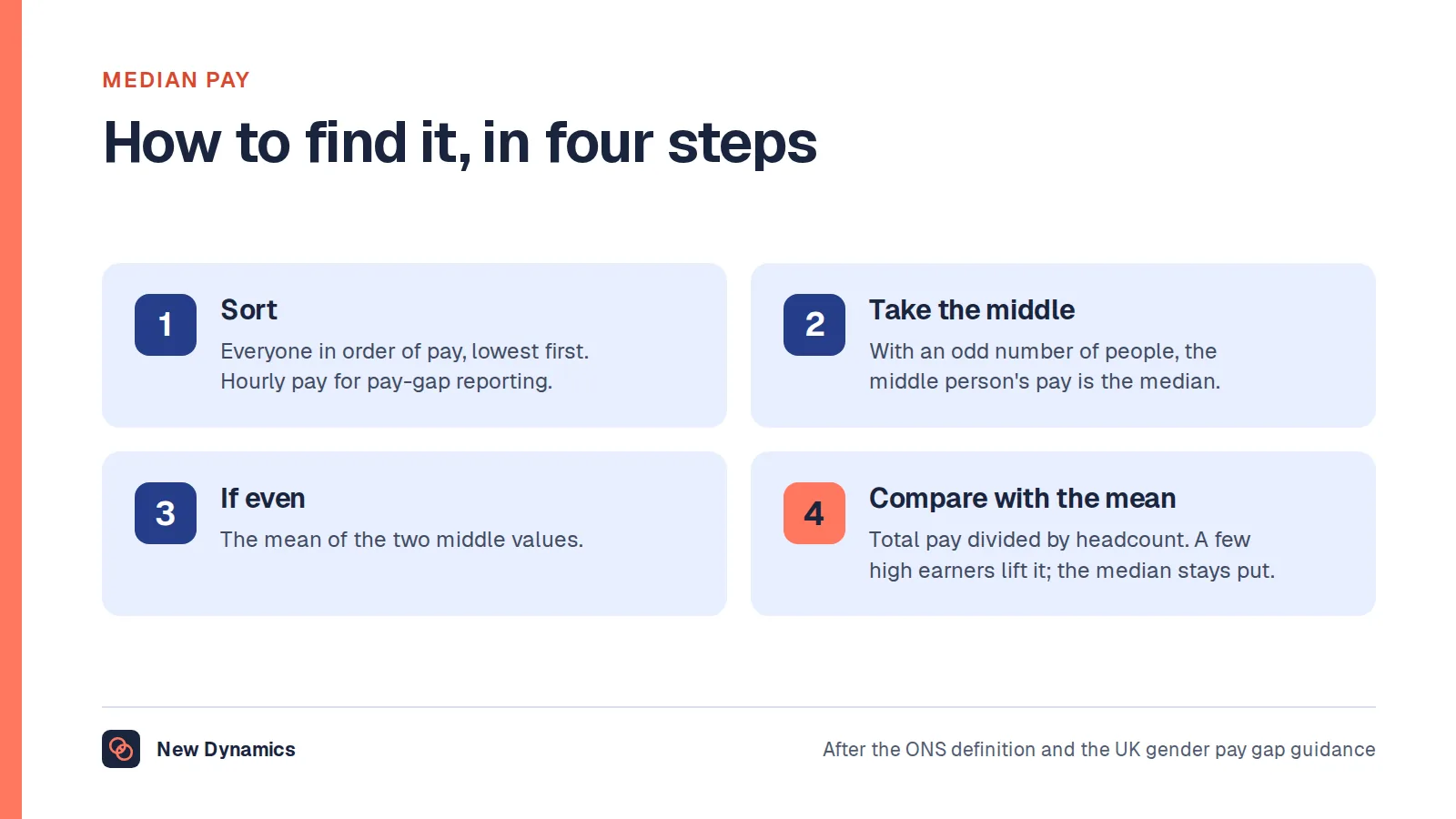
That is composition, not rates for the same job. If your upper quarter is mostly men and your lower quarter is mostly women, your mean and median gaps follow almost automatically. For the wider published picture, see the statistics hub, and for the arithmetic behind the two averages, see our post on median pay.
Frequently asked questions
Who has to do gender pay gap reporting?
Any employer with 250 or more employees on the snapshot date. Regulation 1(2) of the Equality Act 2010 (Gender Pay Gap Information) Regulations 2017 defines a relevant employer as an employer who has 250 or more employees on that date, and GOV.UK uses the same threshold. Each separate legal entity in a group reports on its own. Employers with fewer than 250 employees can report voluntarily if they want to.
What are the gender pay gap snapshot dates and deadlines?
GOV.UK gives snapshot dates of 31 March for most public authority employers and 5 April for private, voluntary and all other public authority employers. The reporting deadlines are twelve months later, on 30 March and 4 April respectively. You must do it for every year you have 250 or more employees on your snapshot date.
Which six figures does gender pay gap reporting require?
Regulation 2(1) requires the mean hourly pay gap, the median hourly pay gap, the mean bonus pay gap, the median bonus pay gap, the proportions of men and women who were paid bonus pay, and the proportions of men and women in the lower, lower middle, upper middle and upper quartile pay bands. Figures can be whole percentages or rounded to one decimal place.
Is a gender pay gap narrative or action plan compulsory?
No. The six figures and a signed accuracy statement are compulsory. GOV.UK describes a supporting narrative as something you can publish alongside the figures. An action plan is currently an option for employers with 250 or more employees, and GOV.UK says that, subject to legislation, plans will become mandatory from spring 2027.
Do employees on maternity leave count in the gender pay gap calculation?
They count in your headcount and in the bonus figures, and they are excluded from the hourly pay gap and the quartiles if they were paid less than their usual basic pay because of leave on the snapshot date. GOV.UK calls the narrower group full-pay relevant employees and excludes anyone on reduced pay due to leave of any kind.
Is ethnicity or disability pay gap reporting mandatory in the UK?
Not yet. There is no Act or regulation requiring it. The government published its consultation response on 25 March 2026 committing to mandatory ethnicity and disability pay gap reporting for employers with 250 or more employees, with draft clauses attached, but until legislation is in force any figure you publish is voluntary.
Where does a gender pay gap report have to be published?
In two places. Regulation 15 requires publication on your own website in a manner accessible to all your employees and to the public, and for at least three years from the date of publication, and also on the government gender pay gap service, together with the name and job title of the person who signed the accuracy statement.
Does overtime count in the gender pay gap calculation?
No. Regulation 3 defines ordinary pay as basic pay, allowances, piecework pay, pay for leave and shift premium pay, and expressly excludes remuneration referable to overtime. Regulation 4 excludes overtime from bonus pay as well. Pay is counted gross, before deductions made at source.
Your next step: fix the headcount before the payroll run
- Decide which legal entities you are reporting for, and get a current list of employees against each one. This is where group structures and job shares cause rework later.
- Write down your snapshot date now, and the reporting deadline twelve months after it. Put both in a calendar with an owner, not a shared inbox.
- Build the two lists separately. Relevant employees for bonus pay, full-pay relevant employees for everything else, with the leave exclusions applied on the snapshot date rather than afterwards.
- Strip overtime and benefits in kind out of ordinary pay, and check that shift premiums and allowances are in.
- Decide, in writing, whether you are publishing a narrative or a voluntary action plan this year, and who approves it. Neither is compulsory yet, so the decision should be deliberate.
- Diarise the website publication as a separate task from the service submission, and set a reminder three years out so the page is not taken down early.
For the policy wording that sits behind all of this, read and download our compensation policy guide. The guide is free to read, and the PDF uses our short download form.
Want the headcount, the legal entities and the role data to be current before the snapshot date rather than reconstructed afterwards? Book a New Dynamics demo and bring last year's submission. You can also email contact@new-dynamics.com.