TL;DR
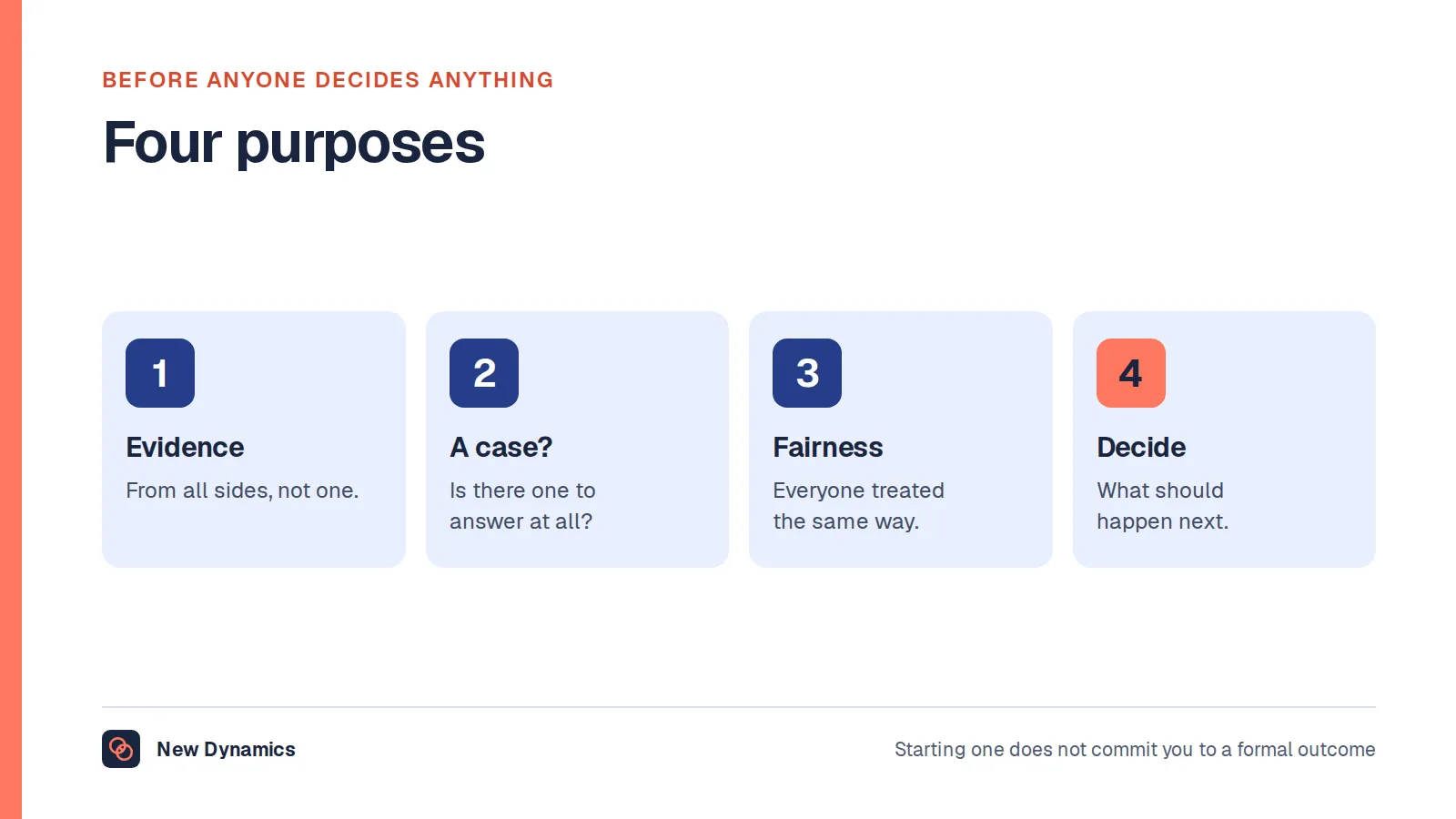
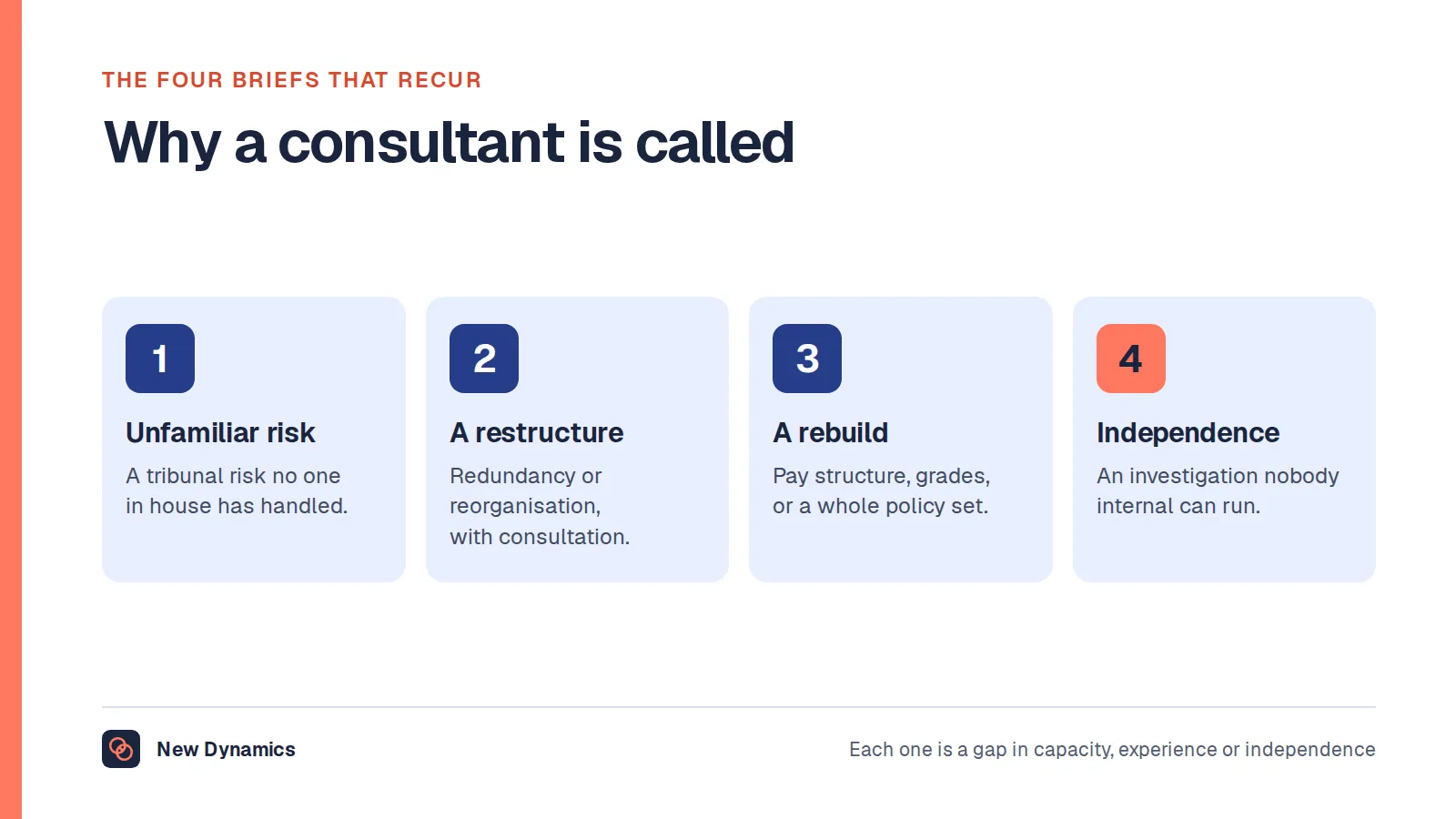
- Most DEI consulting engagements are one of four briefs: a data brief, a process brief, a policy brief, or an investigation that needs independence. They need different people, and the brief decides which you are buying.
- Be careful what you buy on the strength of. On unconscious bias training, GOV.UK quotes the review it commissioned: there is "currently no evidence that this training changes behaviour in the long term or improves workplace equality in terms of representation of women, ethnic minorities or other minority groups".
- A report can increase your exposure as well as reduce it. An employment tribunal in Great Britain may order any person to disclose documents, and after a finding of an equal pay breach it must normally order an audit, which the employer then has to publish.
Two different people search for DEI consulting. One is an employer looking at a representation problem, a pay gap figure or an allegation, wondering whether to bring somebody in. The other is a professional wondering whether this is a career.
This article serves both, in two marked halves. Everything up to and including the certification section is for the employer buying. The section headed "For the career searcher" is for the person thinking of doing the work. Both describe the United Kingdom, Northern Ireland differs on several points below, and none of it is legal advice. The published UK evidence on the most commonly sold DEI intervention is weak, and this article quotes that evidence rather than talking around it.
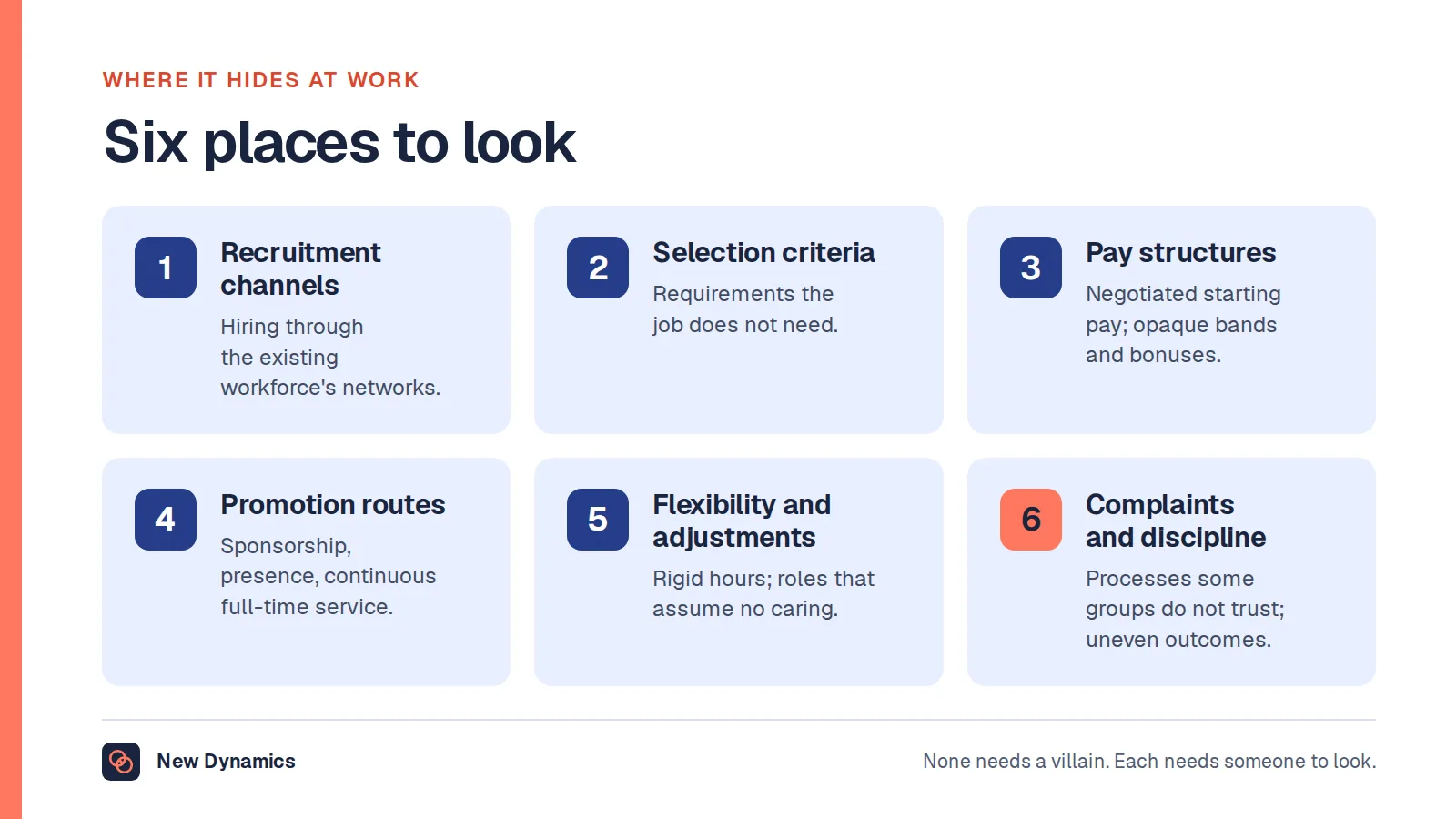
Most of what a good engagement finds lives inside ordinary people decisions: who was rated highly, who was put forward, who got the stretch project. See how New Dynamics performance reviews keep goals, feedback and examples attached to the rating.
New Dynamics is not a consultancy. We make a performance management platform for goals, feedback, recognition, reviews and onboarding. We have no engagement to sell you here, and this article names no firm and no consultant.
For employers: the four briefs a DEI consultant is actually engaged to do

DEI consulting is paid advice, or paid delivery, on equality, diversity and inclusion at work, from someone who is not your employee. "Diversity and inclusion consulting", "EDI consultancy" and "inclusion consultant" describe one market, and a diversity and inclusion consultant is not a substitute for a decision: they analyse, draft, investigate, train and recommend, while the employer promotes, pays and signs. What matters is the brief, and the same four briefs recur. They need different people, and conflating them is the commonest scoping mistake.
A data brief: the audit and the pay gap analysis
Somebody reports what your data shows about representation, pay, progression and exits, by group. For gender pay the duty sits in regulations rather than in the Equality Act 2010 directly. The Equality Act 2010 (Gender Pay Gap Information) Regulations 2017, in force from 6 April 2017, define a "relevant employer" as "an employer who has 250 or more employees on the snapshot date", set the snapshot date as "the 5th April", and require publication "within the period of 12 months beginning with the snapshot date". Public authorities have their own instrument, the Specific Duties and Public Authorities Regulations 2017, with a snapshot date of "the 31st March". The statutory guidance on gender pay gap reporting, last updated 21 May 2026, states on its face that it "Applies to England, Scotland and Wales".
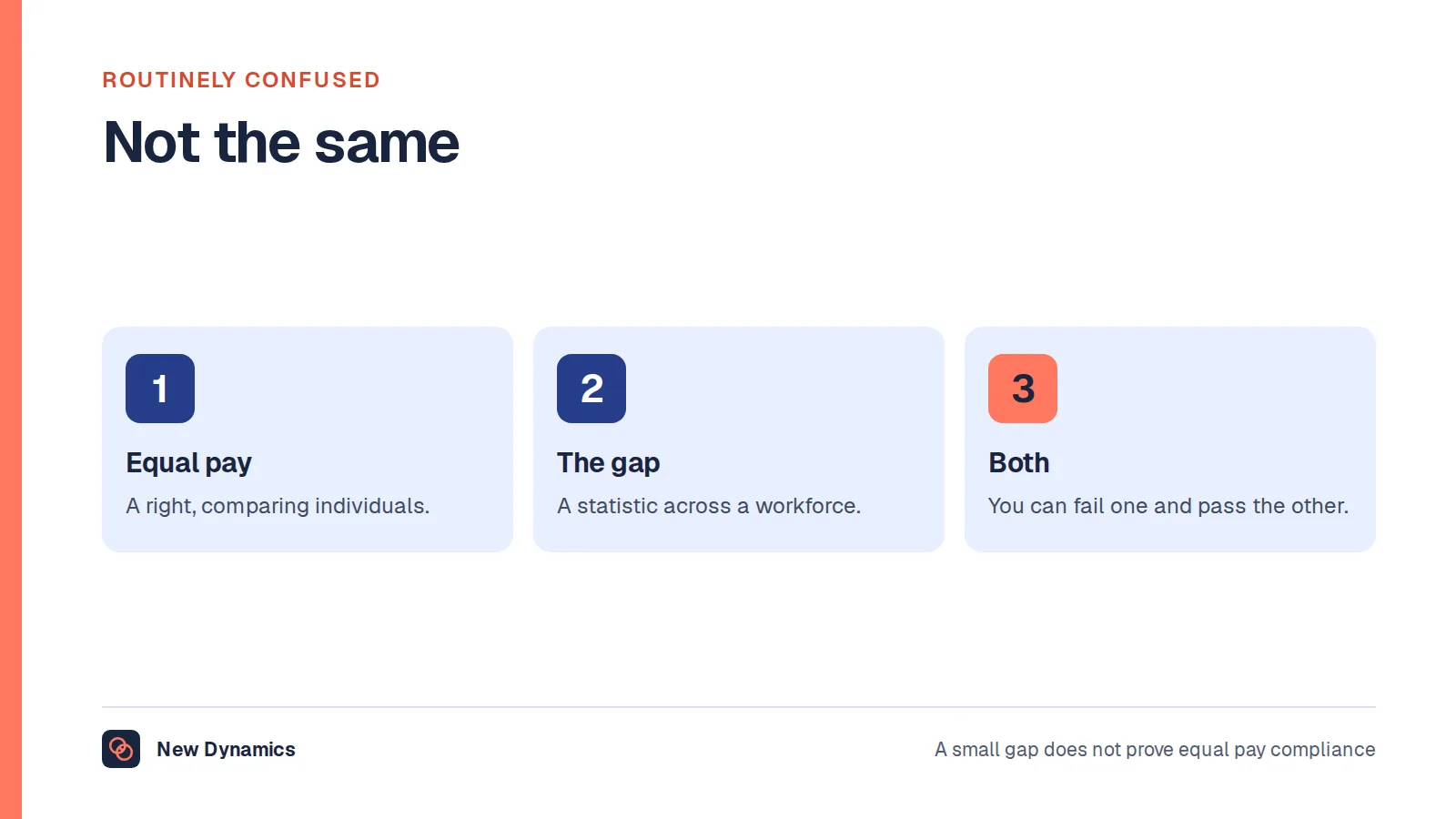
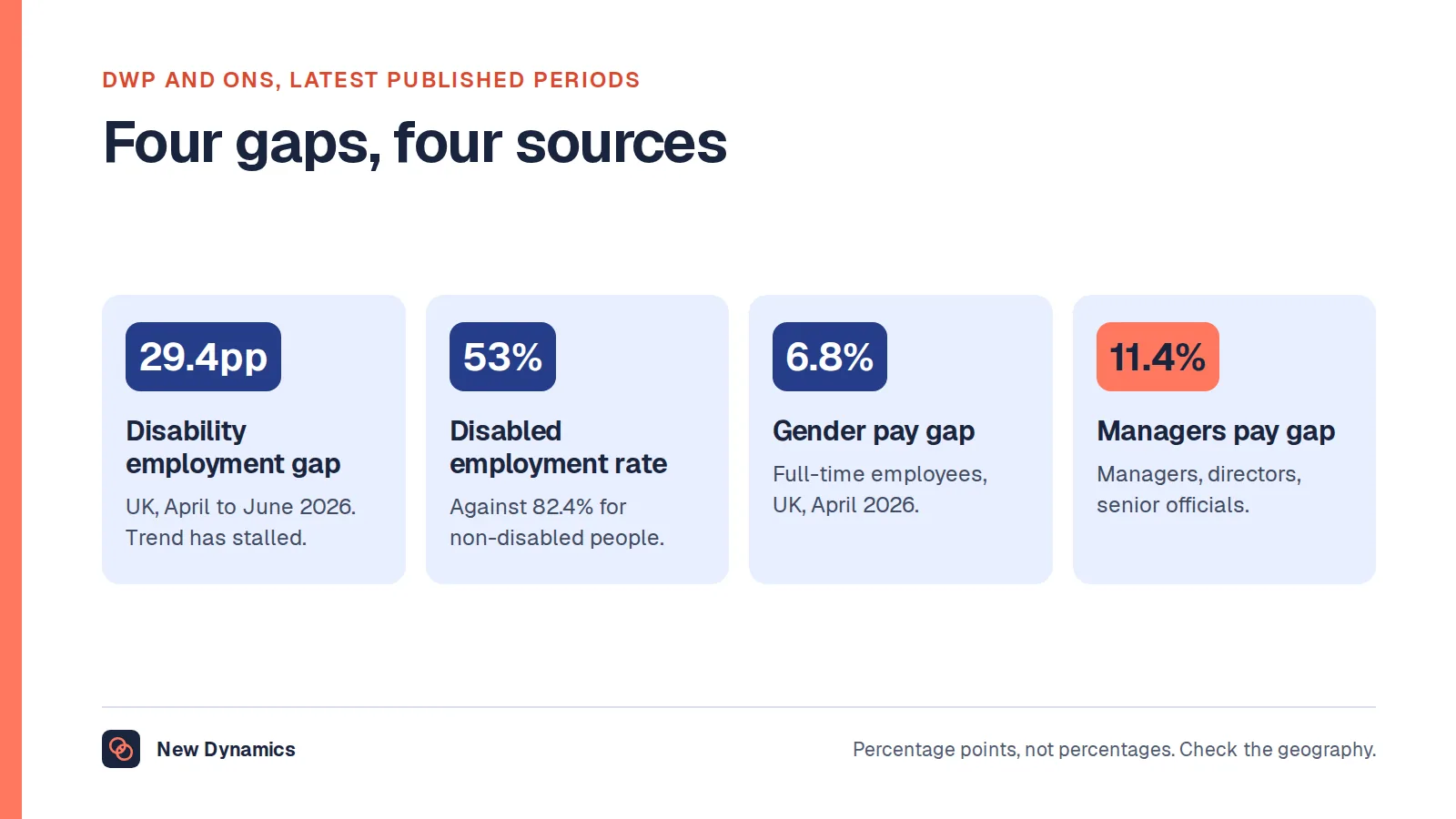
A reporting calculation is not a pay equity analysis, and pay equity separates the two. Nor is the national figure yours. The ONS bulletin Gender pay gap in the UK: 2026, released 22 October 2026, states that the gap for full-time employees "was 6.8% in April 2026, down from 7.2% in April 2025", and warns that you cannot "directly compare to the mandatory employer-reported gender pay gap statistics". See also our UK workforce diversity statistics and the statistics hub.
A process brief: pulling a decision apart
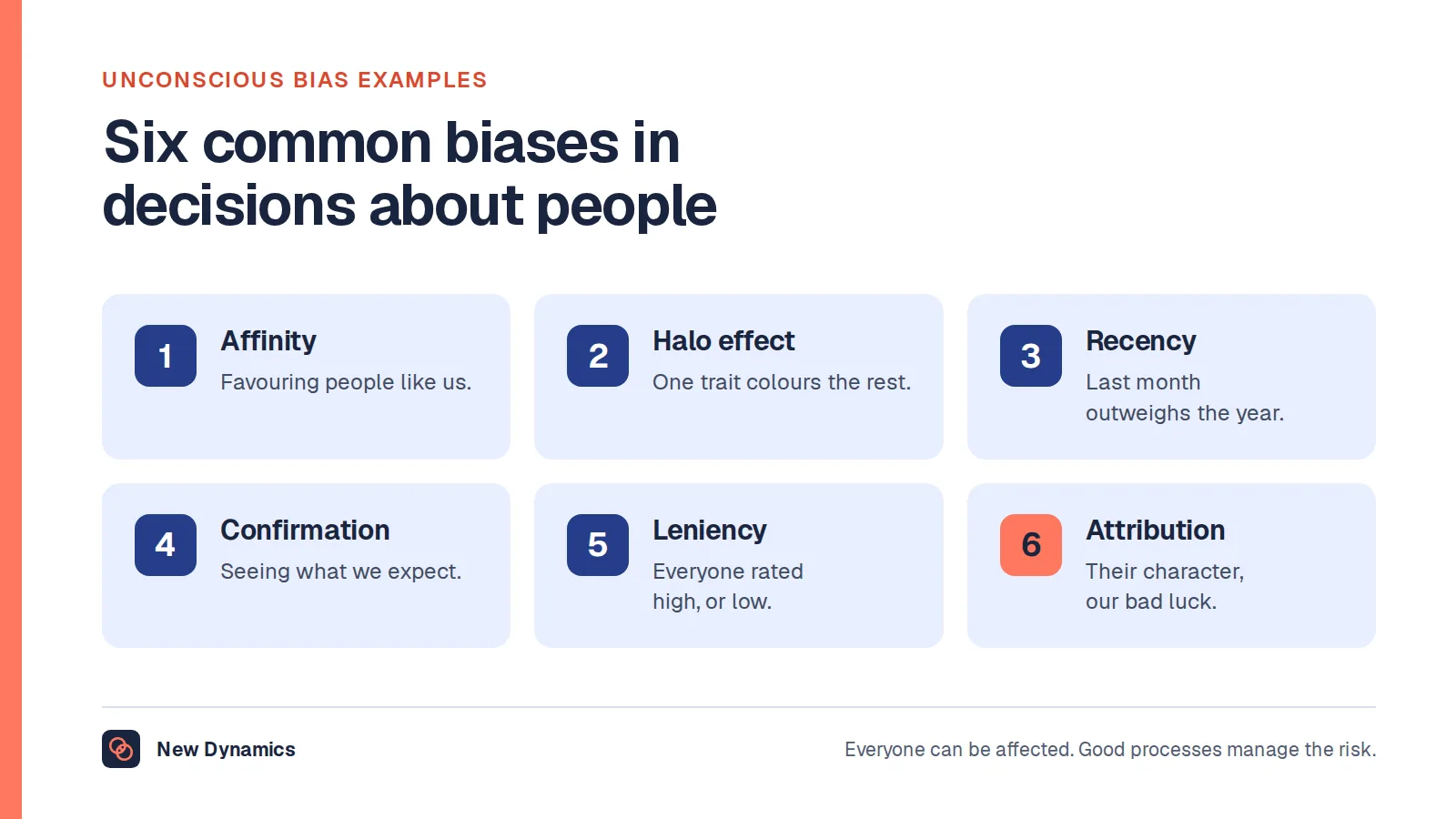
Less often sold, more often useful. Somebody takes one decision process and examines how it runs: the advert, the sift, the interview, the rating, the promotion panel. GOV.UK's guidance on closing your gender pay gap lists eight possible causes, which is a usable scope: pay levels by quarter, promotions, recruitment into lower-paid roles, leavers, bonuses, performance scores, part-time working and caring responsibilities. On performance scores it says to "Look at the performance scores of men and women. If possible, break them down by grade and job", adding that where employees assess themselves, "Research suggests that women rate themselves lower than men". Our performance rating scale and unconscious bias examples articles cover where that shows up.
A policy brief: the handbook and the procedures
Acas advises that "A good start is to have a workplace policy covering equality, diversity and inclusion", and that the action plan should say "who will put the policy and plan into practice and by when", in its guidance on making your workplace inclusive. This suits a fixed fee, and it is where an external document most often sits unread, so the named owner matters more than the drafting.
An independence brief: an investigation nobody in house can run
A harassment allegation against a senior person, or a grievance where everyone who would normally investigate is a witness. Acas's position on external investigators is narrower than some suppliers suggest, and we set it out in workplace investigations and HR consulting. Keep the roles separate, agree written terms of reference, and never let one supplier both investigate and recommend the sanction.
What the published evidence says, honestly

Unconscious bias training: the UK government position
In December 2020 the government published a written ministerial statement on unconscious bias training, dated 17 December 2020. It records that "the Government Equalities Office commissioned the Behavioural Insights Team for a summary of the evidence on unconscious bias and diversity training", and that the report "highlights that 'there is currently no evidence that this training changes behaviour in the long term or improves workplace equality in terms of representation of women, ethnic minorities or other minority groups'", adding that "there is emerging evidence of unintended negative consequences".
On what followed it is unambiguous: "Ministers have concluded that unconscious bias training does not achieve its intended aims. It will therefore be phased out in the Civil Service. We encourage other public sector employers to do likewise." The statement extends that expectation to local government, the police and the NHS.
The report itself is published. Unconscious bias and diversity training: what the evidence says, first published 15 December 2020 and last updated 18 August 2023, states that "training interventions do not seem to be effective at improving diversity outcomes within workplaces", and its conclusion on spending is the sentence a buyer should keep: "We therefore do not recommend prioritising the use of resources on unconscious bias or diversity training over alternative interventions which have a more promising evidence base."
What the Equality and Human Rights Commission found
Research report 113, Unconscious bias training: an assessment of the evidence for effectiveness, by Doyin Atewologun, Tinu Cornish and Fatima Tresh, was published in March 2018. Its PDF opens; the Commission's ordinary website pages did not open for us at all, so this is read off that document.
Its findings are a mixed picture, not a flat negative. Such training "is effective for awareness raising" and "can be effective for reducing implicit bias, but it is unlikely to eliminate it". Critically, "Evidence of behaviour change as an outcome of UBT is limited." It also found "potential for back-firing effects when UBT participants are exposed to information that suggests stereotypes and biases are unchangeable", and that "only 18 sources of evidence were both relevant to the research question and adopted the minimum standards for quality research".
Its recommendation is the one to hold a supplier to: "For organisational level change to happen, organisational structures, policies and procedures must be targeted directly, perhaps overhauled."
What is better evidenced
The honest contrast is not that nothing works. It is that the better-supported interventions change a decision rather than a state of mind.
In March 2026 the Office for Equality and Opportunity published Action plans: list of actions, dated 4 March 2026, described as "Evidence-informed actions to reduce your gender pay gap and support employees experiencing menopause". It states that "From April 2026, employers with 250 or more employees will be able to produce and publish a voluntary action plan alongside their gender pay gap data", that "These will become mandatory from spring 2027, subject to secondary legislation", and that employers "must choose at least 2 actions". Each page applies to England, Scotland and Wales.
The guidance on using fair and structured interview techniques states that "Structured interviews are more likely to lead to fairer outcomes for applicants compared to unstructured methods", and our semi-structured interview article covers the mechanics. The guidance on setting targets to improve gender representation is pointed about vague ambitions: "Specific targets may be more likely to create change than broad goals such as 'creating an inclusive culture', which may be ineffective unless linked to specific actions."
Note the hedging: "may be", "suggests", "more likely to". A supplier who turns that into a promise has gone beyond the source.
The claim we are not going to repeat
You will see a confident figure claiming that companies in the top quartile for diversity outperform their peers financially by a stated percentage. We are not citing it, and nor should a proposal you are reading. Those figures come from consultancy publications rather than official statistics; they are correlational, so they cannot show that diversity produced the financial result rather than the reverse; and their provenance and method have been contested in published reanalyses. If a supplier mentions them, that is the honest framing.
How to brief and scope the work so it changes something

Four moves decide whether the money buys a change or a document.
Name one decision, not the culture. "Improve our inclusion" cannot be quoted against, delivered or checked. "Review how we shortlist for the three engineering grades and tell us where the drop-off is by sex and ethnicity" can be all three.
Agree the data before fieldwork starts. Half of disappointing engagements die on data. Write down what exists, in which system, covering which years, and who releases it. If ethnicity is recorded for forty per cent of staff, the analysis has a forty per cent ceiling, and that should be known in week one, not week six.
Name the internal owner, with a date. Not a steering group. A person who will own the changed process after the supplier has gone. A brief without this produces recommendations nobody is accountable for.
Fix the re-check at the start. Agree which measure gets looked at again, by whom, and when. Twelve months is usually right. If nobody agrees to look again, nobody will.
On fees we publish no numbers, and no official United Kingdom source publishes a day rate or benchmark for this work, so any figure quoted as a market rate is somebody's sample. What you can control is the shape. Work with a countable output should carry a fixed fee, because the supplier estimates it better than you can. Work of unknown length, such as a live investigation, is normally time based. A single paid diagnostic, with no obligation to buy the fix from the same supplier, is often the cheapest useful purchase.
Two questions cost nothing: ask what would make them tell you to stop, and what they will not do.
The measurement problem, and what you can honestly measure
The things easiest to measure matter least, and the thing that matters most is slow.
Attendance and satisfaction are easy, and both are what the Commission report warns against relying on, noting that "self-report measures of behavioural intentions ... do not actually tell us whether behaviour did change as a result of UBT". The GOV.UK report places "less value on research which evaluates on participant experience alone" because "these outcome measures have little relationship to actual behaviour change".
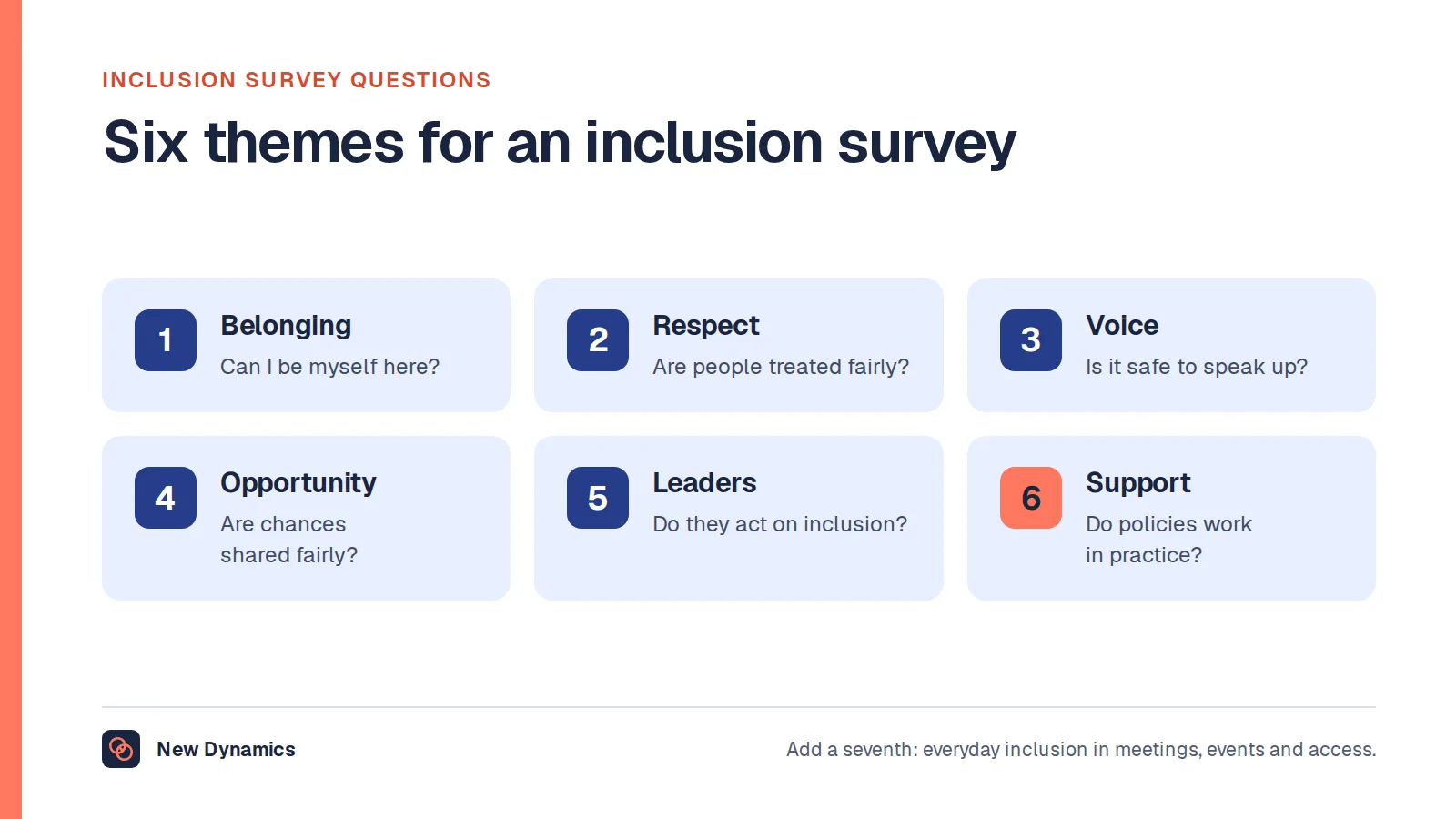
What you can honestly measure falls into three tiers. Decision outcomes are the real thing: conversion at each recruitment stage by group, promotion application and success rates, the distribution of performance ratings, allocation of development work, and exit rates by group and grade. Experience is softer but real: an inclusion survey tells you something no dataset will, and our inclusion survey questions set out a method. Activity, meaning sessions delivered, belongs in the audit trail and is not a result.
Three honest limits. Small numbers defeat most analysis: in a team of twelve, one leaver moves a percentage by eight points and means nothing. Disclosure rates cap what you can see, and people disclose less where they trust the employer less, so data quality is itself a signal. Attribution is close to impossible, because you cannot run your organisation twice. A supplier offering a return-on-investment figure for an inclusion programme is selling a model, not a measurement.
None of it works without record keeping: see New Dynamics workflows for what that looks like when a system holds the history, and HR metrics for choosing the measures.
When the report is the risk
A DEI report can increase your exposure as well as reduce it. The tribunal rules below apply to Great Britain, with Northern Ireland running its own industrial tribunal system. General information, not legal advice.
A report is a document, and documents can be ordered up. Rule 33 of the Employment Tribunal Procedure Rules 2024 provides that "The Tribunal may order any person in Great Britain to disclose documents or information to a party ... or to allow a party to inspect such material". A consultant's report sits inside that power, and whether a particular document is privileged is a question for a lawyer, not one to leave until a claim arrives.
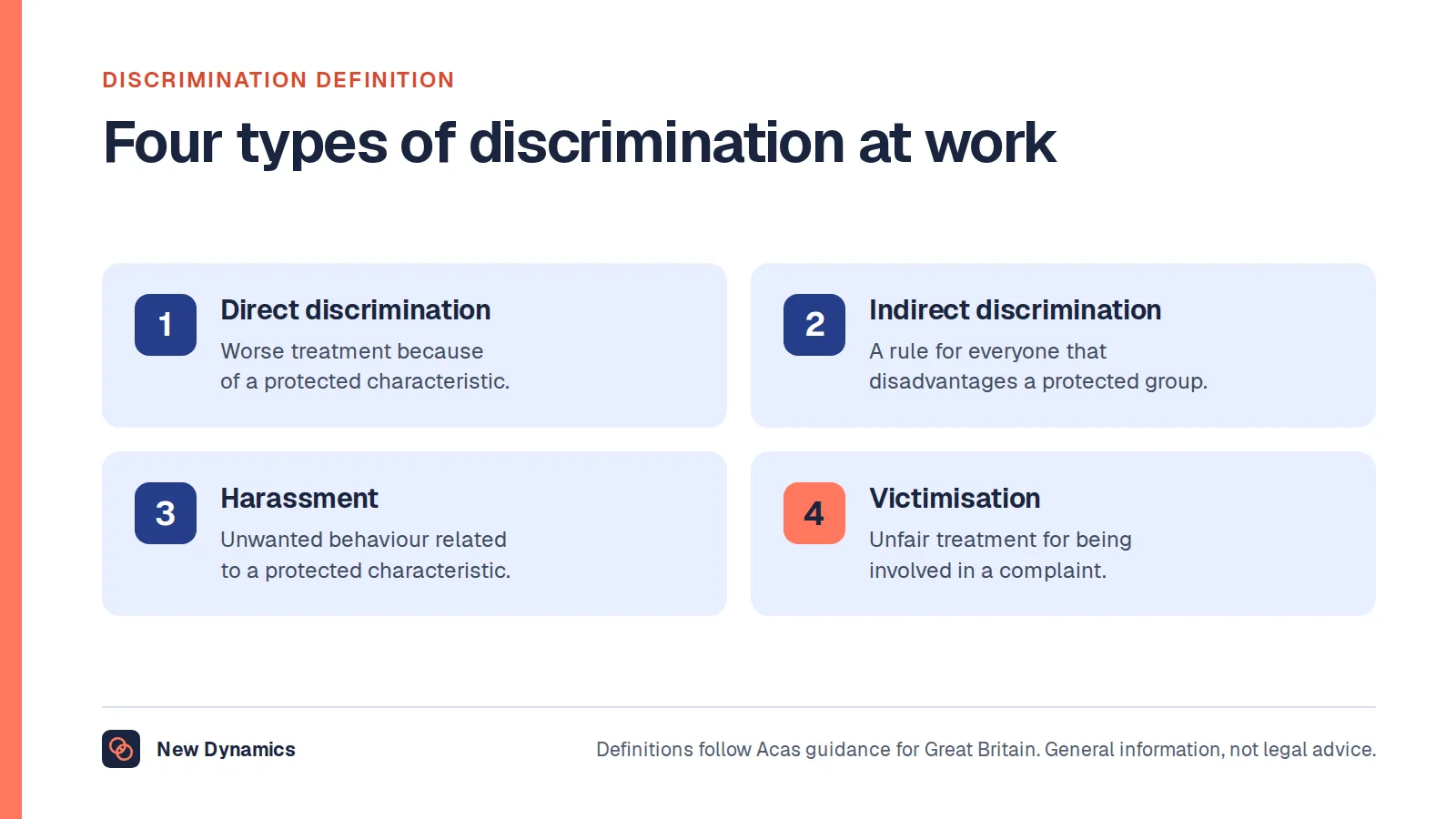
An unexplained finding can do work against you. Section 136 of the Equality Act 2010 provides that "If there are facts from which the court could decide, in the absence of any other explanation, that a person (A) contravened the provision concerned, the court must hold that the contravention occurred", unless "A shows that A did not contravene the provision", and "court" includes an employment tribunal. A report recording a pattern and offering no explanation has written down half of that structure. The answer is not to avoid looking: record the explanation beside the finding, or record that you are investigating it.
Positive action is where good intentions become unlawful. In Great Britain, section 158 of the Equality Act 2010 permits action that is "a proportionate means" of helping people who share a protected characteristic "overcome or minimise that disadvantage". Section 159 goes further for recruitment and promotion, but only where "A is as qualified as B to be recruited or promoted" and the employer "does not have a policy of treating persons who share the protected characteristic more favourably". A quota is not within those conditions. The GOV.UK targets guidance puts it plainly: "You should consider taking legal advice on these activities."
The pay audit point most buyers have never heard. Under section 139A of the Equality Act 2010 and the Equal Pay Audits Regulations 2014, where a tribunal finds an equal pay breach "the tribunal must order the respondent to carry out an audit", subject to exceptions. One is worth knowing in advance: a tribunal must not order one where the information "is already available from an audit which has been completed by the respondent in the previous 3 years". Where ordered, the employer must publish it on its website "for a period of at least 3 years", and a penalty for non-compliance "must not exceed £5,000". A voluntary, competent pay analysis three years old is a materially better position than nothing.
Section 217 of the Equality Act 2010 provides that the Act "forms part of the law of England and Wales", and that only three listed sections extend to Northern Ireland, which has its own equality legislation and enforcement body.
Workforce data in an outsider's hands
This is the practical gap in most engagements, and a buyer can settle it in an afternoon. In the United Kingdom the law is the UK GDPR and the Data Protection Act 2018, and the regulator is the Information Commissioner's Office. General information, not legal advice.
Most of the interesting data is special category data. The ICO's guidance on what is special category data draws the link explicitly: "some of the protected characteristics outlined in the Equality Act are classified as special category data. These include race, religion or belief, and sexual orientation. They may also include disability, pregnancy, and gender reassignment in so far as they may concern information about a person's health." That means you need an Article 9 condition as well as a lawful basis: the ICO describes the conditions as operating "as an additional layer of protection on top of the normal rules" in its guidance on the rules on special category data.
There is a condition built for this work, and its limits are the useful part. Paragraph 8 of Schedule 1, Part 2 to the Data Protection Act 2018 is headed "Equality of opportunity or treatment", and is met where processing "is necessary for the purposes of identifying or keeping under review the existence or absence of equality of opportunity or treatment between groups of people". But paragraph 8(3) says it is not met if the processing "is carried out for the purposes of measures or decisions with respect to a particular data subject", so monitoring data cannot be repurposed into a decision about an individual. Paragraph 8(4) excludes processing "likely to cause substantial damage or substantial distress", and paragraph 8(5) lets an individual give written notice requiring the controller to stop.
It may well need a DPIA. The ICO's guidance on when a DPIA is needed quotes Article 35(3)(b), which automatically requires one for "processing on a large scale of special categories of data referred to in Article 9(1)", and its own list adds "Data matching: combining, comparing or matching personal data obtained from multiple sources". A DEI audit joining payroll, HR records and monitoring responses is both at once.
Responsibility does not travel with the data. On contracts between controllers and processors the ICO states that "Controllers are primarily responsible for overall compliance with the UK GDPR", and that "Whenever a controller uses a processor to process personal data on their behalf, a written contract needs to be in place between the parties". Article 28(3) sets out what it must cover, including sub-processors and end-of-contract provisions: a consultant may use a transcription service or a cloud drive, and at the end they hold a dataset about your employees.
So: give the minimum the question needs; suppress small cells before data leaves your control; write down the condition you rely on; settle the Article 28(3) terms in the engagement letter; agree return or deletion with a date; and tell your people what is being analysed and why. Our employee data protection guide covers the duties that stay with you.
DEI certification: what the landscape actually is
People search for DEI certification expecting a licence. There is not one.
In the United Kingdom there is no statutory regulator of equality, diversity and inclusion practitioners, no protected title, and no register you must join to practise or to sell this work. Anyone may call themselves a DEI consultant tomorrow. We looked for a UK statutory register covering this work and did not find one, and we state that as our own finding rather than quoting it. By contrast, the Health and Care Professions Council says it protects "the public by regulating 15 health and care professions in the UK", keeping "a register of professionals, known as 'registrants', who meet our standards", on its page about what it does. Occupational psychologists sit inside that regime. DEI consultants do not.
What exists instead is membership of professional bodies, plus an unstandardised market in courses. Two bodies, quoted from their own pages:
- The Chartered Institute of Personnel and Development is the professional body for the people profession. Its membership grades run from Student and Foundation through Associate, for "People professionals experienced in HR operational work", to Chartered Membership, for "Experienced people professionals with strategic and operational expertise".
- The Institute of Equality and Diversity Professionals describes itself on its own site as "the professional body of equality, diversity, inclusion and human rights practitioners", and as "an independent body, run by practitioners for practitioners".
Both are membership bodies. Neither is a regulator, neither licenses practice, and membership of either indemnifies nobody. So check these instead, in rough order of usefulness.
- A record of the specific brief, not the field. Someone who has done eleven pay analyses is a different purchase from someone who has run eleven workshops. Ask how many of the thing you are buying, and when they last did one.
- Two references, and the insurance certificate. A named employer of comparable size who bought the same kind of work, plus the indemnity certificate rather than a statement that cover exists.
- Their position on the evidence. Ask what the evidence base is, and what it does not support. A supplier who quotes the diverse-companies-outperform figure as settled fact has told you something.
- What any credential required. For each certificate on the website, ask what was assessed, and whether it was examined or merely attended.
For the career searcher: routes into diversity and inclusion consulting
The rest is for the second reader: the person considering this as work, as a diversity consultant, an inclusion consultant, or a specialist inside a wider practice. Because the work is unregulated there is no gate, so the market is crowded at the generalist end and thin at the technical end. The people who build durable practices are almost always doing something specific that an employer cannot staff for permanently.
Out of an in house role is the commonest route: an HR business partner, an EDI lead or a reward specialist goes independent, usually with a first client who already knows them. The limitation is that one employer's way of working can look like the only way. From a technical specialism is the route with most room: pay and reward analysis, job evaluation, recruitment process design, accessibility and reasonable adjustments, data analysis, and investigations each support independent practice alone, because each is a problem employers meet occasionally and cannot keep staff for. Employment lawyers, occupational psychologists and statisticians also move in, each with a strength and a matching gap.
Two things to be clear-eyed about. The honesty requirement is higher here than in most consulting, because the evidence base will not support the claims the market is used to making, and a practice anchored in method, data, law and process design outlasts one anchored in a position. And the commercial realities are those of any independent practice: professional indemnity cover at the level clients specify, a written engagement letter for everything, and a referral source outside your last employer. Our HR consulting article covers the tax, status and insurance basics, and HR certifications compares the credentials.
Frequently asked questions
What does a DEI consultant do?
A DEI consultant gives paid advice, or delivers defined work, on equality, diversity and inclusion without being the employer's employee. The recurring briefs are a data brief such as a pay gap analysis, a process brief reviewing how recruitment or promotion decisions run, a policy brief, an independent investigation, and training. The consultant recommends; the employer decides.
Does unconscious bias training work?
The published UK evidence is weak. GOV.UK's written ministerial statement of 17 December 2020 quotes the review it commissioned, which found "there is currently no evidence that this training changes behaviour in the long term or improves workplace equality in terms of representation of women, ethnic minorities or other minority groups". Ministers concluded it "does not achieve its intended aims" and phased it out in the Civil Service. The Equality and Human Rights Commission's 2018 assessment found evidence of behaviour change "limited".
Is there a DEI certification you need in the UK?
No. There is no statutory regulator of this work in the United Kingdom, no protected title and no register you must join to practise. Professional bodies offer membership rather than a licence: the CIPD describes Chartered Membership as for "Experienced people professionals with strategic and operational expertise", and the Institute of Equality and Diversity Professionals calls itself "the professional body of equality, diversity, inclusion and human rights practitioners". Check the record of the specific brief, two references and the indemnity certificate.
Do diverse companies really perform better financially?
Be careful with that claim. The widely circulated figures come from consultancy publications rather than official statistics, they are correlational so they cannot show that diversity caused the financial result, and their provenance and method have been contested in published reanalyses. We do not cite them. The better reasons need no disputed number: fairness, the legal duties that apply in the United Kingdom, and decisions that must be defensible anyway.
Can a DEI report create legal problems for an employer?
It can, which is a reason to scope it carefully rather than avoid it. Rule 33 of the Employment Tribunal Procedure Rules 2024 lets a tribunal in Great Britain order any person to disclose documents, and section 136 of the Equality Act 2010 says that where there are facts from which a tribunal could decide a contravention occurred, it must so hold unless the employer shows otherwise. Record the explanation alongside any finding. Northern Ireland differs, and this is general information, not legal advice.
What are the data protection rules when a consultant analyses our workforce data?
Most of it is special category data. The ICO notes that protected characteristics including race, religion or belief and sexual orientation "are classified as special category data", so you need an Article 9 condition as well as a lawful basis. Paragraph 8 of Schedule 1, Part 2 to the Data Protection Act 2018 gives an equality monitoring condition, but it is not met where processing "is carried out for the purposes of measures or decisions with respect to a particular data subject".
Your next step
If you are the employer:
- Write the problem as one decision, in one sentence, before you contact anybody.
- Decide which of the four briefs you are buying, and buy them separately if you want more than one.
- Audit your data first: what exists, for what share of staff, covering which years.
- Ask every supplier what the evidence base is, and what it does not support.
- Settle the Article 9 condition and the Article 28(3) terms before day one.
- Name the internal owner and the re-check date in the brief itself.
If you are considering the career, count your cases by type rather than your years, pick a technical specialism you can evidence, and learn the evidence base well enough to say what it does not support.
For a step-by-step approach with a worksheet, read and download our diversity and inclusion guide. The guide is free to read, and the PDF uses our short download form.
Once a consultant has told you that your ratings or promotions show a pattern, somebody has to run the next cycle differently and keep the evidence. Book a New Dynamics demo and bring the process you run today, or email contact@new-dynamics.com.