TL;DR
- A general manager is responsible for the organisation of a whole company, site or business unit: its strategy, operations, people, customers and money, with a profit and loss account of their own. GM is also the title for the manager of a single hotel, restaurant or store.
- The job has seven responsibilities: set direction and plans, run operations, lead and develop the team, own the profit and loss, serve customers and the market, keep the business compliant and safe, and report to the owner, board or regional management.
- A restaurant general manager carries the same seven responsibilities in one venue, with food hygiene, licensing and rotas added. Job descriptions should state the scope, the P&L, the team and who the GM reports to.
Most managers own a function: sales, operations, finance, a kitchen. The general manager owns all of them at once, for a company, a site or a business unit, and is the person the owner or the board holds responsible for the whole result. A general manager job description has to describe breadth without becoming a list of every department's duties.
This article gives a job profile of the general manager, sets out seven responsibilities, explains how a restaurant general manager's job differs, lists the skills employers look for, covers the routes into the role and gives a template and the mistakes that weaken GM adverts.
A GM's week is a string of short conversations across every part of the business, so goals need to be visible without a meeting. See how New Dynamics Goals & OKRs keep targets and progress in one place.
Job profile: what is a general manager?
The Cambridge Dictionary defines a general manager, abbreviated GM, as “a person who is responsible for the organization of a whole company”, and its examples show the range: the general manager of a small hotel, and the general manager of a newspaper. In sport, mainly in the United States, the same title means the person who decides which players and staff a team has.
Three versions of the job share the title.
| Version | Scope | Reports to |
|---|---|---|
| Company general manager | A whole small or medium company, or a country or division of a larger one | Owner, board or group executive |
| Business unit general manager | A product line, region or division with its own profit and loss | Divisional or group executive |
| Site general manager | One hotel, restaurant, store, plant or venue | Owner, area or regional manager |
What unites them is accountability for a profit and loss account and for every function that feeds it. The open textbook Principles of Management, published by OpenStax, describes in its section on what managers do the research of John Kotter, who studied general managers over five years and found that they spend most of their time with others, that “the breadth of topics in their discussions with others was extremely wide”, and, quoting Kotter, that “It is not at all unusual for a general manager to cover ten unrelated topics in a five-minute conversation.” The job description should reflect that breadth.
General manager responsibilities: seven areas
- Set direction and plans. Translate the owner's or group's strategy into an annual plan for the unit, with targets for revenue, margin, service and people, and review it quarterly.
- Run operations. Make sure the product or service is delivered every day to standard, on time and at cost, through the heads of department who run each part.
- Lead and develop the team. Hire, direct, coach and review the management team; set the tone for the whole workforce; deal with performance and succession.
- Own the profit and loss. Budget, forecast, control costs, approve spend and explain variances; the GM is the first person asked why the number moved.
- Serve customers and the market. Know the customers, watch competitors, resolve the escalated complaint, and decide on pricing and offer within group rules.
- Keep the business compliant and safe. Health and safety, licensing, employment law, data protection and any sector regulation, with the GM accountable for the systems even where specialists run them.
- Report upward. Give the owner, board or regional management an honest account of results, risks and plans, and bring decisions that exceed the GM's authority.

The restaurant general manager
The restaurant GM is the site version of the job, and the most searched. The UK National Careers Service's restaurant manager profile says restaurant managers “organise the day-to-day running of their venue and make sure customers are happy with the food and service they receive”, with typical hours of 42 to 44 a week including evenings and weekends.
Its day-to-day tasks map onto the seven responsibilities above with the venue's specifics added: planning menus with chefs, organising shifts and rotas for kitchen and waiting staff, managing stock control and budgets, working with food and drink suppliers, making sure the restaurant follows licensing, food hygiene and health and safety rules, recruiting and training staff, planning large events and dealing with customer complaints. The NCS lists two requirements: a food hygiene certificate and enhanced background checks. A GM of a larger restaurant, hotel restaurant or group site adds the profit and loss, the head chef and front-of-house manager as direct reports, and reporting to an owner or area manager.
For the hotel version of the same job, see our self-introduction for a hotel management interview, which describes the general manager's accountabilities from the candidate's side.
Skills employers look for
The NCS lists for restaurant managers customer service, leadership, the ability to motivate and manage staff, teamwork, the ability to accept criticism and work under pressure, business management skills, patience and calm in stressful situations, and knowledge of the trade. For a general manager of any kind, six things.
- Commercial judgement. Reading a P&L and knowing which lever to pull.
- Breadth. Enough understanding of every function to direct its head and to notice when something is wrong.
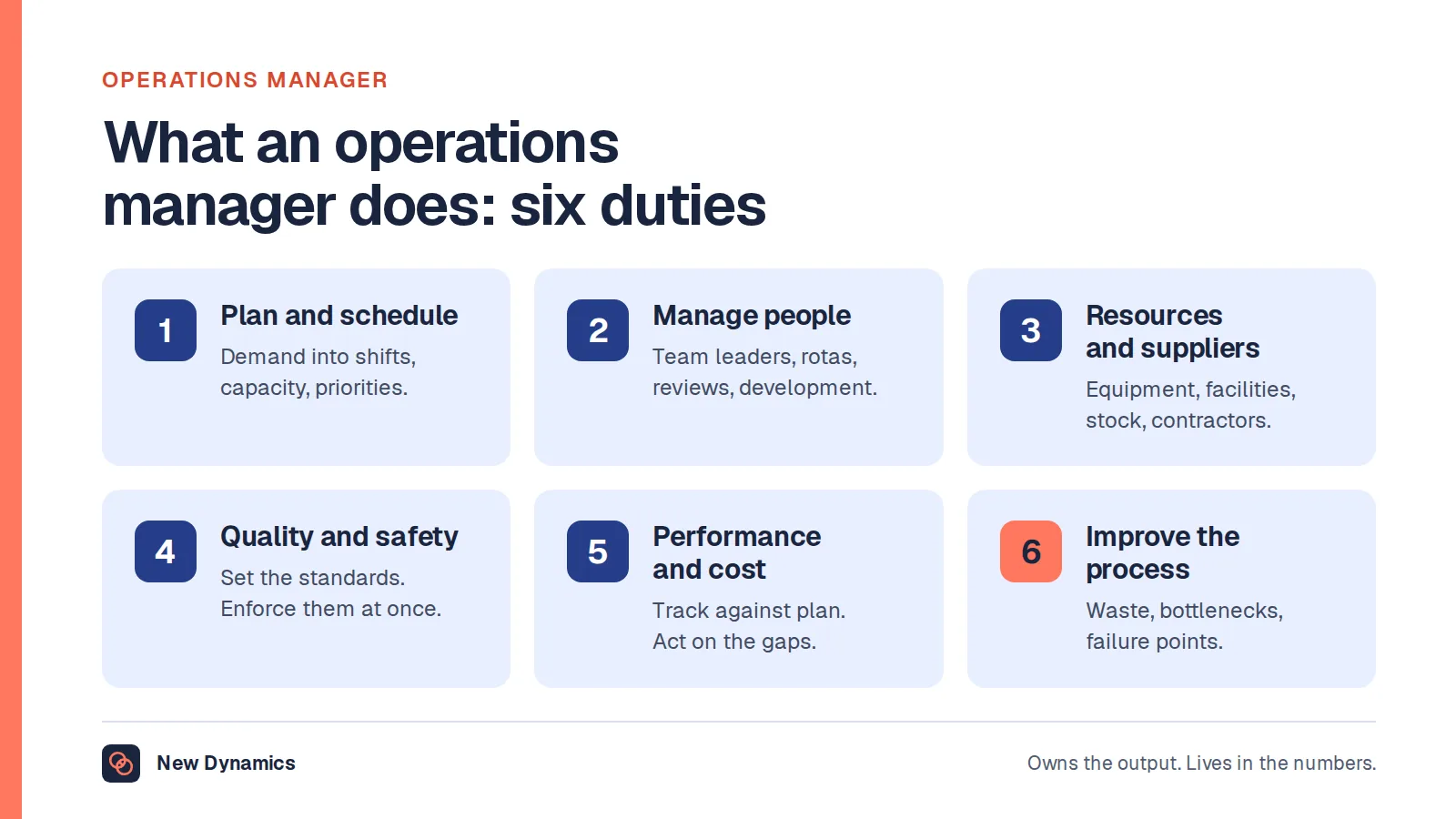
- Leadership of managers. The GM manages the people who manage; the skill is different from running a team directly. Our operations manager job description describes the function the GM most often came from.
- Decisiveness with incomplete information. Kotter's finding that GMs rarely make big decisions in their conversations does not mean they avoid them; it means they make them between conversations, quickly.
- Customer sense. The escalated complaint tells the GM more than the report does.
- Composure. The GM's mood is the site's mood.

Routes into general management
From a function. Most GMs were heads of operations, sales or finance first. The NCS says a restaurant manager, with experience, could become a regional manager with a chain, move into large-event catering or set up an independent restaurant.
From site management. Store, restaurant and hotel managers progress to larger sites, then to area or regional roles, then to divisional general management.
Graduate and management schemes. Large groups run programmes that rotate trainees through functions towards site or unit management.
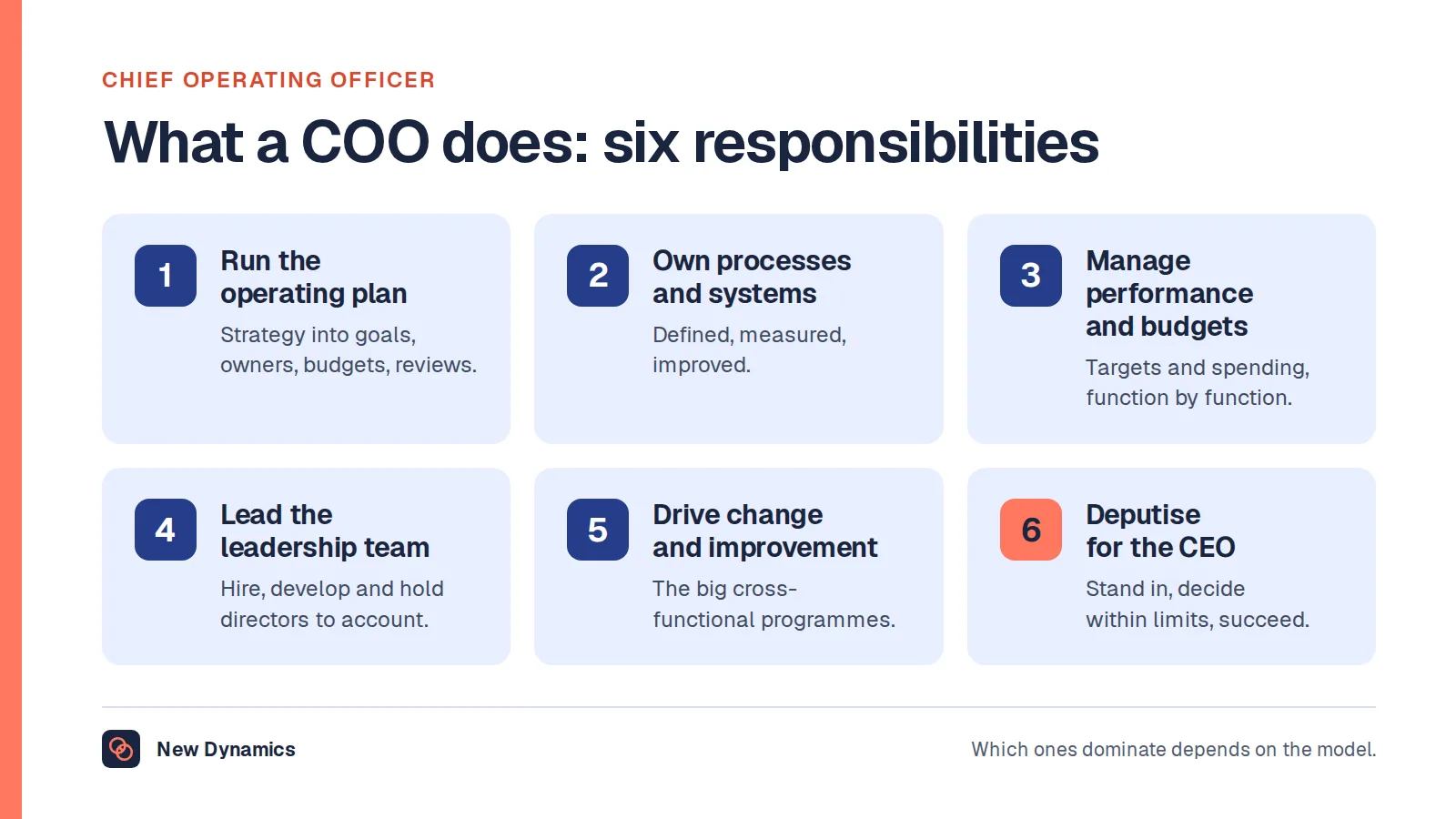
Qualifications. None are required in most sectors. Degrees in business or the sector, professional management qualifications and sector-specific certificates, such as the food hygiene certificate the NCS lists for restaurants, are common. Our chief operating officer job description covers the executive rung above.
Requirements differ by sector and country. Check the rules where you work.
General manager job description template
Adapt the template to your business. Keep every line true.
Job title: General manager, [company / site / business unit]
Reports to: [Owner / managing director / regional director]
Direct reports: Heads of [operations, sales, finance, HR] [or, for a site: head chef, front-of-house manager, assistant manager]
Scope: [Revenue], [n] staff, [sites], full profit and loss accountability
Purpose of the role: To run [unit] as a whole business: delivering its plan for revenue, margin, service and people, leading its management team and keeping it safe and compliant, and reporting results and risks to [the board].
Main responsibilities:
- Build and deliver the annual plan and budget; review quarterly
- Direct daily operations through the heads of department to standard, on time and at cost
- Hire, coach, review and develop the management team; set the standard for the workforce
- Own the profit and loss: forecast, control cost, approve spend, explain variances
- Know customers and competitors; resolve escalations; decide pricing and offer within [group] rules
- Ensure health and safety, [licensing, food hygiene], employment and data compliance
- Report monthly to [the board / regional director] on results, risks and decisions required
Skills and experience:
- Experience of running a [site / unit] with P&L accountability, or leading a major function in one
- Track record of hitting revenue and margin targets through a management team
- Commercial and financial literacy
- Leadership of managers, with examples of developing people into bigger roles
- [Sector requirements, such as a food hygiene certificate and enhanced background checks]
We provide: [Bonus tied to unit results], a seat at [regional / group] planning, management development and a route to [regional / divisional] general management.
State the scope in numbers: revenue, headcount, sites and the P&L. Our job description template explains the overall structure.

Common mistakes in general manager job adverts
Scope missing. Without revenue, headcount and sites, "general manager" could mean anything.
A list of every department's duties. The GM directs the heads; the advert should describe accountability, not tasks.
P&L unstated. Whether the GM owns the profit and loss, and to what authority limit, is the single biggest fact.
Reporting line vague. Owner, board and regional director are different bosses with different expectations.
No development route. GMs who want the regional or divisional role go where it is named.
Frequently asked questions
What is the job profile of a general manager?
A general manager is responsible for the organisation of a whole company, site or business unit, with accountability for its strategy, operations, people, customers, compliance and profit and loss, and for reporting results to an owner, board or regional management. The title covers company, business unit and site versions of the same job.
What are the job responsibilities of a general manager?
Seven areas: set direction and plans, run operations, lead and develop the management team, own the profit and loss, serve customers and the market, keep the business compliant and safe, and report upward with results, risks and decisions required.
What does a restaurant general manager do?
A restaurant GM runs a venue as a whole business: planning menus with the chefs, organising rotas, managing stock and budgets, working with suppliers, keeping the restaurant compliant with licensing, food hygiene and health and safety rules, recruiting and training staff, handling events and complaints, and owning the venue's profit and loss. The National Careers Service lists a food hygiene certificate and enhanced background checks as requirements.
What is the difference between a general manager and an operations manager?
An operations manager runs the delivery of the product or service and reports to the general manager or a director. The general manager owns the whole unit, including operations, sales, people and money, and its profit and loss.
What skills does a general manager need?
Commercial judgement, breadth across functions, leadership of managers, decisiveness with incomplete information, customer sense and composure, on top of sector knowledge and the ability to work under pressure.
How do you become a general manager?
Usually by leading a function such as operations, sales or finance, or by running a site such as a store, restaurant or hotel, then taking on larger units and P&L accountability. Graduate management schemes and business or sector qualifications help; few sectors require a specific qualification.
Your next step
- State the scope in numbers: revenue, headcount, sites, P&L authority.
- Write the seven responsibilities as accountabilities, not department task lists.
- Name the reporting line and the decisions the GM can take alone.
- Agree the first year's measures with the board before the advert goes out.
For writing those measures, read and download our SMART goals guide. The guide is free to read, and the PDF uses our short download form.
Want unit goals, management reviews and development plans in one place for every site? Book a New Dynamics demo and bring your current job description. You can also email contact@new-dynamics.com.