TL;DR
- A generalist is someone who is not specialised: a person whose knowledge and skills cover a broad field rather than one part of it. At work the word describes a role, such as an HR generalist or a general manager, and a way of building a career.
- An HR generalist covers the full range of HR work, from recruitment and contracts to employee relations, pay, policy and training, usually as the front-line adviser to managers. Specialists go deep in one area, such as reward, recruitment or learning.
- Small organisations need generalists; large ones need both. Generalists are valued for judgement across the whole picture, and their careers are built by breadth of experience, evidence of results and a specialism or two held in reserve.
Job adverts ask for “a true generalist”. Career advice warns that generalists are “jack of all trades, master of none”. Both cannot be right, and neither explains what the word means.
This article gives the meaning of generalist, at work and in the dictionary, explains what an HR generalist does, sets generalists against specialists without pretending one is better, says when an organisation needs each, and describes how a generalist career is built and judged.
Generalists are judged on the whole of their work, which is hard to see in a single form. See how New Dynamics performance reviews bring goals, feedback and development into one fair discussion.
What is a generalist?
The Cambridge Dictionary defines a generalist as “(someone who is) not specialized”, and gives the example of children who “need specialist rather than generalist teachers”. Its definition of a specialist is the mirror image: “someone who has a lot of experience, knowledge, or skill in a particular subject”.
The dictionary sense is defined by what a generalist is not. The working sense is more useful: a generalist is someone whose knowledge and skills cover the whole of a field well enough to handle most of what arises in it, to know when a problem needs a specialist, and to bring the specialists' answers together. A good generalist is not someone who knows a little about everything. It is someone who knows the whole shape of the work.
At work the word appears in four ways.
| Use | What it means |
|---|---|
| The dictionary sense | Not specialised; broad rather than deep |
| A role title | HR generalist, marketing generalist, generalist software engineer: one person covering the whole function |
| General management | Roles that span functions, such as general manager, operations director or chief executive |
| A career shape | Breadth built across several areas or functions, rather than depth in one |

What is an HR generalist?
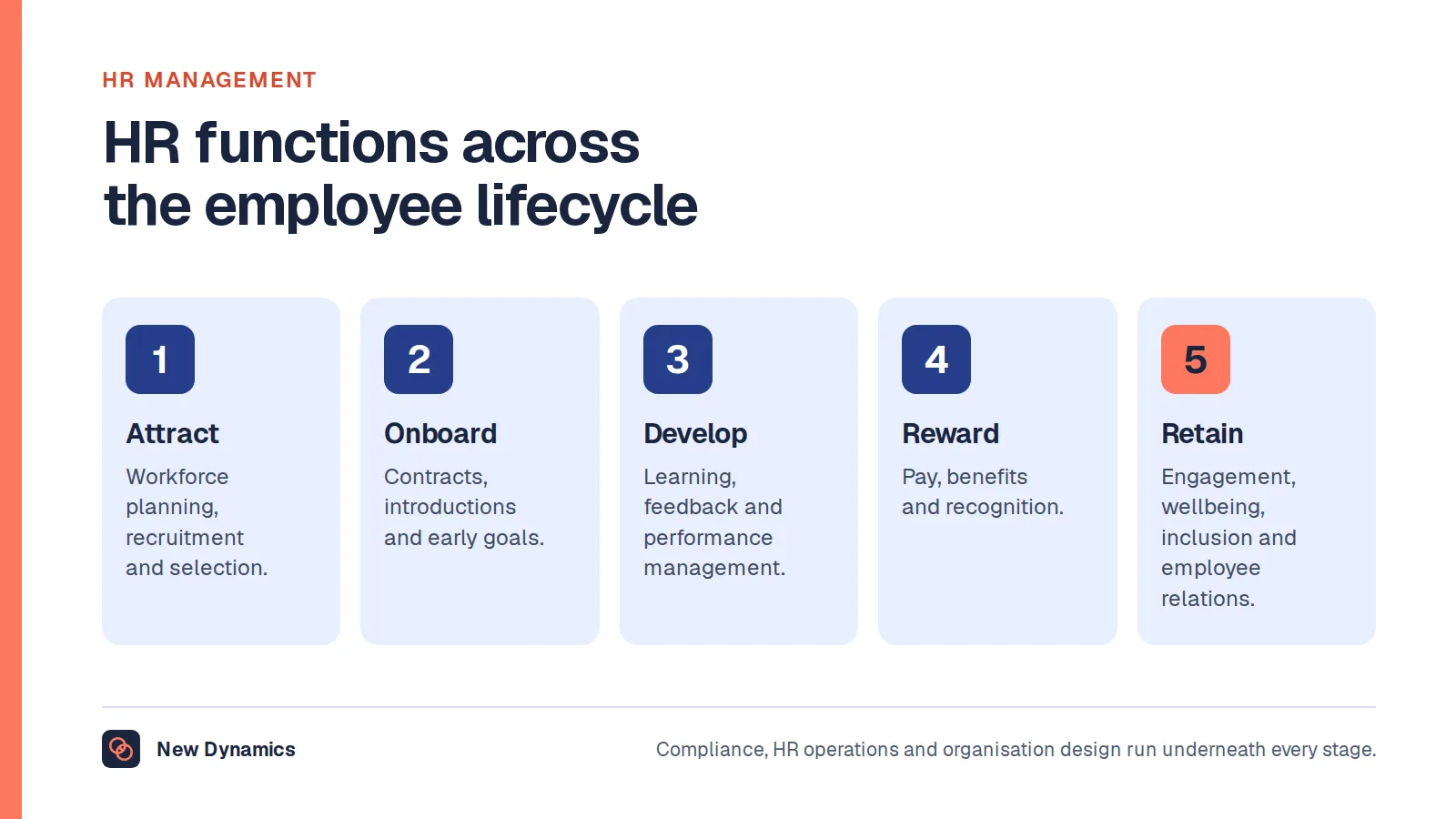
An HR generalist is an HR professional who covers the full range of HR work rather than one part of it. Prospects, the UK graduate careers service, describes the range in its human resources officer job profile: conditions of employment, disciplinary and grievance cases, employee welfare, support and engagement, equality, diversity and inclusion, learning and development, negotiation with external agencies, recruitment and retention, pay and rewards, and policies, procedures and working practices. It adds: “It's possible to work in either a generalist role, covering the full range of HR work, or to specialise in a particular area.”
In the UK the generalist role goes by several titles: HR officer, HR adviser, HR business partner, people partner, and in a small organisation simply HR manager. In the United States HR generalist is the usual title. Skills England's HR support apprenticeship standard, a level 3 standard, describes the job at its front line: people in the role are “typically either working in a medium to large organisation as part of the HR function delivering front line support to managers and employees, or are a HR Manager in a small organisation”, and their work ranges “from transactional to relatively complex, from recruitment through to retirement”.
What an HR generalist does
Prospects' list of an HR officer's responsibilities, regrouped into six areas:
- Recruit and onboard. Write job descriptions, person specifications and adverts, run the hiring process, check the right to work and induct new staff.
- Advise managers. Answer day-to-day questions, and advise line managers on how to apply policies and procedures. Skills England expects the generalist to build managers' own expertise so that they can handle repeated situations themselves.
- Handle employee relations. Deal with welfare, grievances and disciplinary procedures, and negotiate with staff and their representatives on pay, conditions, contracts and redundancy.
- Run pay, contracts and records. Advise on pay and benefits, carry out salary reviews, prepare handbooks, administer payroll and maintain employee records.
- Write and apply policy. Develop and implement policies on working conditions, performance management, equal opportunities, discipline and absence, and interpret and advise on employment law.
- Plan and develop. Analyse training needs with managers, plan and sometimes deliver training, and develop strategies to meet immediate and long-term staffing needs.
The generalist rarely does all six equally. In a small company one person does all of them; in a large one the generalist is the manager's first call and hands the deep work to specialists. Our guide to HR management explains the functions in full.

Generalist vs specialist
Neither is the better professional. They are different answers to different problems.
| Question | Generalist | Specialist |
|---|---|---|
| What do they know? | The whole field, well enough to handle most of it | One area, in depth |
| What are they for? | The first call, the judgement across the picture, the join between areas | The hard problem, the design of the system, the standard |
| Where are they found? | Small organisations, front-line HR, general management | Large organisations, centres of expertise, consultancies |
| What is the risk? | Shallow answers to deep questions, unless they know when to escalate | Narrow answers to wide questions, unless they see the whole picture |
| How do they progress? | Wider scope: more functions, more people, general management | Deeper expertise: senior specialist, head of function, external adviser |
The stereotype that a generalist is “a jack of all trades, master of none” misses what organisations pay generalists for. The value is judgement. A generalist HR adviser who has seen a hundred grievances, fifty redundancies and a few tribunals may not know the case law as well as an employment lawyer, but they know which of this week's problems is the one that could become a case, and that is the knowledge a manager needs first.
When to hire a generalist, and when a specialist
Hire a generalist when:
- the organisation is small enough that one person must cover the whole function;
- managers need a single, trusted point of contact;
- the work is varied and the volume in any one area is too low to justify a specialist;
- you are building a function from nothing and need someone to see what it will need.
Hire a specialist when:
- one area has grown large or risky enough to need depth, such as reward, recruitment at scale, employee relations in a unionised workforce, or people analytics;
- the standard or the system needs designing, not just applying;
- the cost of a wrong answer in that area is high.
Most organisations that grow move from one generalist, to a small team of generalists, to generalists supported by specialists, and eventually to business partners backed by centres of expertise. The job descriptions should change at each stage, and our job description template makes the scope explicit.

Building a generalist career
Breadth is a strategy, not an accident. The generalists who progress tend to do five things.
- Choose breadth on purpose. Take the rotation, the secondment and the unglamorous area. Each one adds a part of the whole picture.
- Keep one or two specialisms in reserve. Deep knowledge of one area, such as employee relations or reward, gives a generalist credibility with specialists and a fallback when the market wants depth.
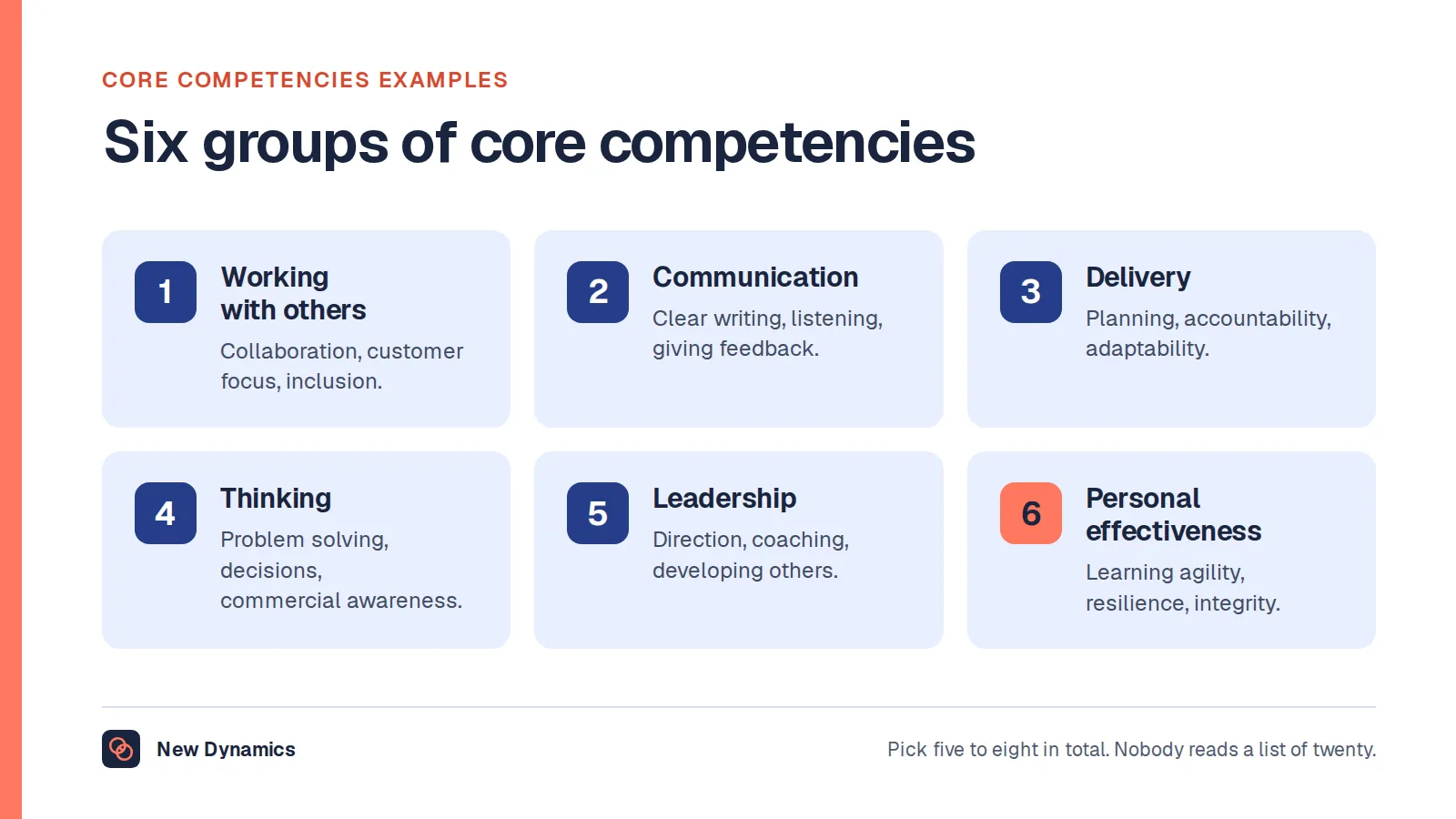
- Collect evidence, not just experience. A reorganisation delivered, a policy that reduced absence, a hiring process that halved time to fill. Generalists are judged on results across the picture, and the results need recording. Our guide to core competencies shows how to describe skills as behaviours and evidence.
- Learn to know what you do not know. The generalist's most important skill is recognising the problem that needs a specialist, and calling them early.
- Aim at scope. The natural next steps are wider ones: HR manager, business partner, head of people, and for some, general management.
For the UK professional route, the CIPD qualifications cover the generalist ground, and our comparison of HR certifications sets out the options.
Frequently asked questions
What does generalist mean?
A generalist is someone who is not specialised: a person whose knowledge and skills cover a broad field rather than one part of it. At work it describes roles that cover a whole function, such as an HR generalist, roles that span functions, such as a general manager, and careers built on breadth.
What is an HR generalist?
An HR generalist is an HR professional who covers the full range of HR work, from recruitment and contracts to employee relations, pay, policy and training, usually as the front-line adviser to managers. In the UK the role is often titled HR officer, HR adviser or HR business partner; in a small organisation it is the HR manager.
What is the difference between a generalist and a specialist?
A generalist knows the whole of a field well enough to handle most of what arises and to know when to escalate. A specialist knows one area in depth and handles the hard problems, the design and the standard in that area. Small organisations need generalists; large ones need both.
Is it better to be a generalist or a specialist?
Neither is better. Generalists are valued for judgement across the whole picture and progress towards wider scope. Specialists are valued for depth and progress towards senior expertise. Many careers combine the two: breadth with one or two specialisms held in reserve.
What skills does an HR generalist need?
Working knowledge of employment law and policy, recruitment, employee relations, pay and benefits, and learning and development; the ability to advise managers clearly and build their confidence; sound judgement about risk; discretion; and the organisation and systems skills to keep records and processes accurate.
What is a generalist role?
A generalist role is one in which a single person covers the whole of a function or several functions rather than one part. Examples include HR generalist, marketing generalist, generalist software engineer, practice nurse and general manager. The scope should be written into the job description so that the holder and the organisation agree what the whole includes.
Your next step: decide what the whole includes
- If you are hiring a generalist, list every area the role must cover and where the specialist support will come from.
- If you are a generalist, write down the areas you have covered and the results you can show in each.
- Name the one or two areas you will deepen next.
- Agree with your manager how breadth will be judged in your next review.
To describe the skills a generalist needs as behaviours and evidence, read and download our competency feedback guide. The guide is free to read, and the PDF uses our short download form.
Want reviews that judge the whole of a generalist's work fairly? Book a New Dynamics demo and bring your current review form. You can also email contact@new-dynamics.com.