TL;DR
- Prepare three things: the team's priorities, a draft written by the employee rather than by you, and an honest picture of their current workload. Most bad goals are set by managers who skipped the second one.
- Decide deliberately what is owned alone and what is shared. A shared goal suits genuinely interdependent work and produces free riders when it does not; an individual goal needs to be something the person can actually influence.
- Acas says objectives should be fair and reflect the employee's usual tasks and workload, which turns into one question managers rarely ask: if this is being added, what is coming off?
Goal season usually consists of a form, a deadline and a manager typing five objectives for somebody else at half past four. The goals are fine on paper, nobody mentions them again until November, and the person they belong to could not recite one of them in March.
This article covers the conversation that produces goals people remember: what to prepare, how to run it, how to decide what is owned alone and what is shared, and what to settle before anyone leaves the room.
Goals only stay alive if they stay visible after the meeting. See how New Dynamics goals and OKRs keep goals, progress and check-ins in one place.
Prepare three things
The team's priorities, written down in a sentence each. If you cannot say what the team is trying to achieve this year, no individual goal below it will make sense.
A draft from the employee. Ask for it a week ahead: what they think their three to five goals should be, in their words. People commit to goals they helped write, and the drafts tell you what they think the job is, which is worth knowing even when it is wrong.
An honest picture of their workload. What they actually do all week, including the parts nobody counts. This is the input that decides whether the goals are real.
The conversation, in five parts

1. Context, briefly. What the team is trying to do and what changed since last year. Two minutes, not a presentation.
2. Their draft first. Let them talk through what they wrote before you say what you had in mind. The gap between the two lists is the most useful thing in the meeting.
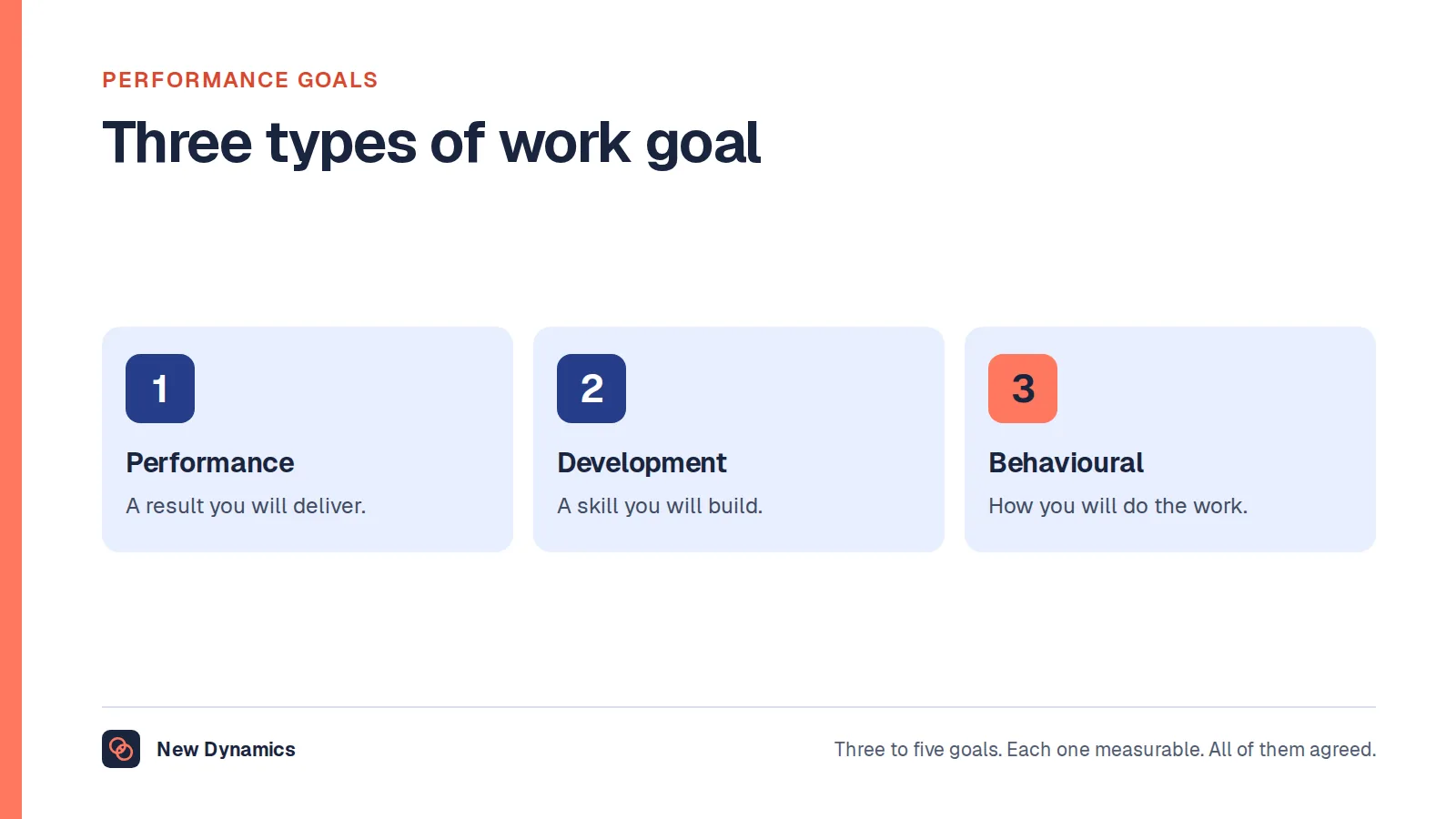
3. Shape the goals together. Three to five is plenty. Acas suggests objectives should be specific, measurable, achievable, relevant and "time-bound - with a reasonable time-frame for achieving them", and its own worked example is modest rather than heroic: reducing average response time to customer emails, agreed with a plan for how, and reviewed after three months.
4. Agree the support. What they need from you: time, training, access, a decision, an introduction. Acas sets a floor here, saying employers "must provide 'adequate resources' to enable an employee to do their job. This might include giving them training". A goal with no support attached is a hope.
5. Write it down, with dates. The goals, the measures, the support and when you will look at them. Acas treats the written record as part of the process and says it should be shared with the employee afterwards.
Forty minutes is usually enough if the draft arrived in advance. If you are writing the goals during the meeting from a blank page, book longer and expect worse goals.
Individual goals and team goals

This is the decision most goal-setting skips, and it matters more than the wording.
An individual goal is owned by one person who can meaningfully influence the result. It is clear, it is assessable at review time, and it tells somebody what their job is this year.
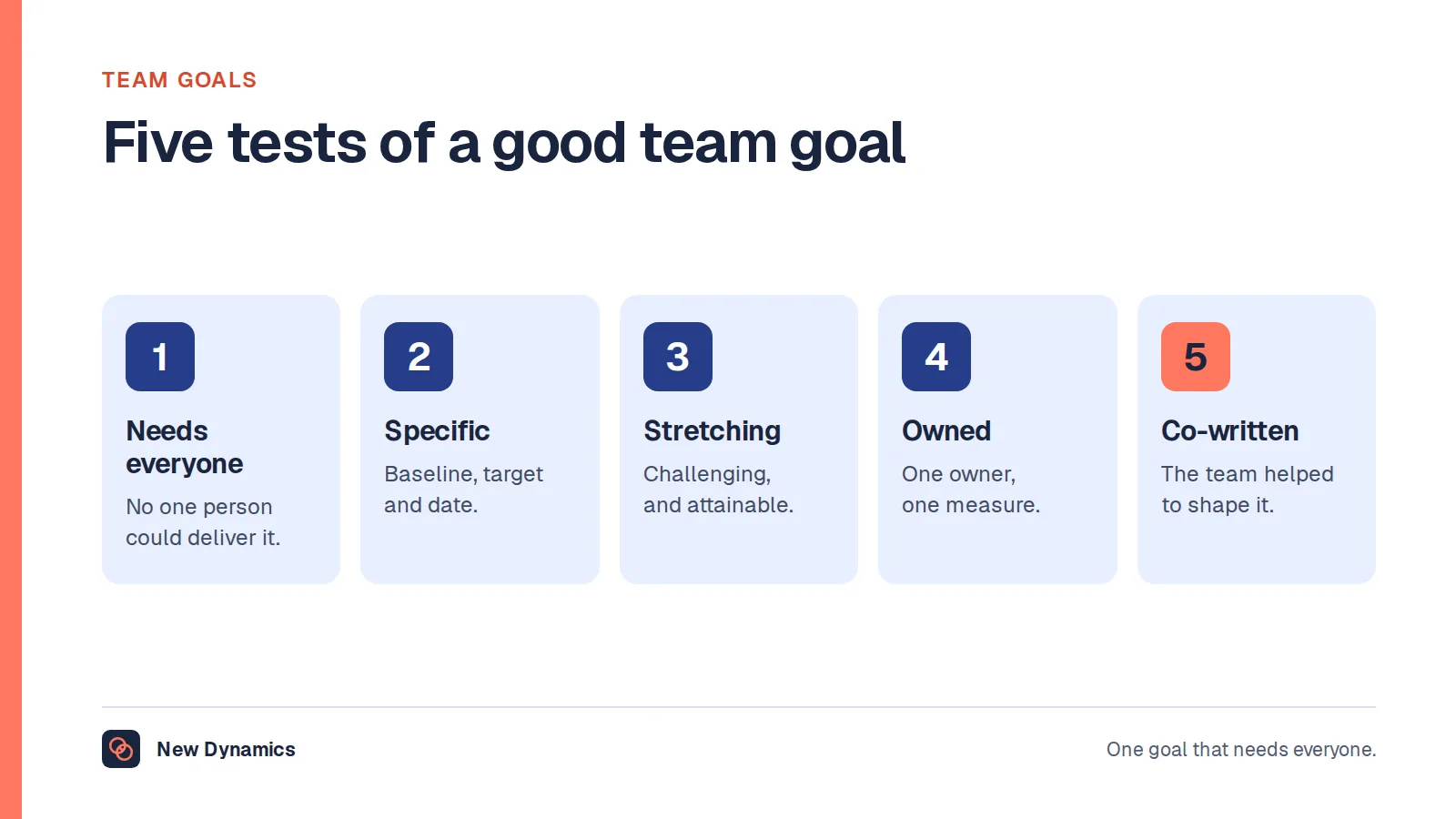
A team goal is owned jointly, and it is the right answer when the work is genuinely interdependent: the outcome depends on several people doing different parts, and splitting it into individual shares would create false precision. Our post on team goals covers writing them and the workshop that produces them.
The trap is the shared goal that is not really shared. If one person could deliver it alone, naming four owners creates a free rider and a resentful colleague. The test: could any individual make this happen on their own? If yes, give it to them.
A mix that works for most teams: two or three individual goals that the person controls, plus one shared goal they genuinely contribute to, with their specific contribution named. Every individual must be able to answer "what is my part of that?" without hesitating.
One more rule. Never set an individual goal whose result depends mostly on somebody else's decisions, a market, or a system nobody controls. Either make the dependency explicit in the wording or choose a measure closer to the person's own work.
The workload question
Acas puts it plainly: "objectives should be fair and reflect the employee's usual tasks and workload", while possibly stretching someone. HSE names Demands, "workload, work patterns and the work environment", among the six areas of work design that affect health and productivity.
Which turns into one question that managers rarely ask and employees rarely volunteer: if this is being added, what is coming off?
Three honest answers are available. Something stops. Something gets smaller. Or nothing changes and the goal is therefore aspirational, which is fine as long as both of you know it. What is not available is adding a fifth goal to a full week and expecting the first four to survive.
When they think it cannot be done
Take it seriously rather than negotiating. Ask what would have to be true for it to be achievable, and listen for the three usual answers: not enough time, a dependency outside their control, or a skill they do not yet have. The first is a workload conversation, the second needs the goal rewording, and the third needs training attached to it.
If you still disagree, say so plainly, record both views, and set a review point earlier than usual. A goal imposed over an objection is worth less than a goal agreed at a lower level, and it poisons the review that follows.
Before anyone leaves the room

Four things, and the meeting is not finished without them.
- What each goal means in practice, said back to you in their words.
- How each one will be measured, and where the number comes from.
- What you owe them, with dates.
- When you will look at it again. Acas's example sets a review three months out, with progress discussed in regular check-ins. Our post on the meeting rhythm covers where those check-ins sit.
Then send the written version the same day. Our post on performance goals examples has sixty worded goals to borrow from if the drafts need sharpening.
Frequently asked questions
How do you run a goal-setting conversation?
Prepare the team's priorities, ask the employee for a draft a week ahead, and get an honest view of their workload. Then give brief context, hear their draft first, shape three to five goals together, agree the support you will provide, and write it down with measures and review dates.
What is the difference between individual goals and team goals?
An individual goal is owned by one person who can influence the result and is assessable for that person. A team goal is owned jointly and suits genuinely interdependent work. If one person could deliver it alone, it should be theirs; shared goals that are not really shared create free riders.
How many goals should someone have?
Three to five, including any shared goal. More than that and nothing is a priority, and the ones that get attention will be whichever were mentioned most recently rather than whichever matter most.
What if the employee thinks a goal is unachievable?
Ask what would have to be true for it to be achievable. The answer is usually time, a dependency outside their control or a missing skill, and each has a different fix. If you still disagree, record both views and set an earlier review point rather than pretending there was agreement.
Should goals change when priorities change?
Yes, openly and with the reason recorded. A goal everyone knows is obsolete damages the credibility of the whole process. Acas suggests discussing progress in regular check-ins and arranging a review after a set period, which is when most changes should surface.
How do you make sure goals are fair?
Start from the team's priorities so each goal connects to something real, check the workload and agree what comes off, make sure each person can influence their own goal, attach the support and training needed, and write it down. Acas says objectives should be fair and reflect someone's usual tasks and workload.
Your next step: ask for the draft
- Ask each person for their own three to five goals a week before you meet.
- Book forty minutes each, and read the drafts before you walk in.
- In every conversation, ask what comes off the list.
- Send the written version the same day, with the review date already in the diary.
For wording goals that hold up at review time, read and download our SMART goals guide. The guide is free to read, and the PDF uses our short download form.
Want goals that stay visible between the conversation and the review? Book a New Dynamics demo and bring last year's objectives. You can also email contact@new-dynamics.com.