TL;DR
- A team goal is a result that the team can only achieve together. It is different from a list of individual goals that happen to belong to people in the same team.
- Good team goals are few, specific, challenging and attainable, and they are written with the team. Google's research found that structure and clarity, including clear goals, is one of five dynamics of effective teams.
- Set three to five a quarter, give each an owner and a measure, link individual goals to them and review progress every week or fortnight.
Many teams have goals in name only. Each person has their own objectives, the manager has a target from above, and the “team goal” is a slide that nobody has looked at since January. The test is simple. Ask three members of the team what the team is trying to achieve this quarter, and see whether you get the same answer.
This article explains what makes a real team goal, gives 40 examples by function, offers an agenda for a goal-setting workshop and shows how to link individual goals and review progress.
Team goals work when everyone can see them. See how New Dynamics Goals & OKRs keeps team objectives, owners and progress in one shared place.
What is a team goal?
A team goal is a result that the team can only achieve together. It depends on the combined work of several people, and success or failure belongs to all of them.
That makes it different from a shared target, which is a number divided up among individuals, and from a set of individual goals that sit side by side.
| Type | Example | Who succeeds or fails? |
|---|---|---|
| Individual goals | Each adviser answers 40 tickets a day | Each person |
| Shared target | The team answers 1,000 tickets a week | Mostly each person |
| Team goal | Cut repeat contacts from 18% to 10% by fixing the five main causes | The whole team |
The third needs advisers, the person who writes help articles and the colleague who talks to the product team to work together. That interdependence is what turns a group into a team. We explain more in why teamwork is important.
Why team goals matter
Google studied 180 of its own teams to find out what made some more effective than others. Its guide to team effectiveness lists structure and clarity among the five dynamics that mattered: “An individual's understanding of job expectations, the process for fulfilling these expectations, and the consequences of one's performance are important for team effectiveness.” It adds: “Goals can be set at the individual or group level, and must be specific, challenging, and attainable.”
Team goals also:
- focus effort on the few things that matter most;
- encourage help. When the goal is shared, helping a colleague is part of your own job;
- make trade-offs easier. A clear goal tells people what to say no to;
- give the team something to celebrate together.
Five tests of a good team goal
- It needs everyone. If one person could deliver it alone, it is an individual goal.
- It is specific. It names a result, with a baseline, a target and a date.
- It is challenging but attainable. Stretching enough to matter, realistic enough to believe in.
- It has an owner and a measure. The whole team is responsible, and one person coordinates and reports.
- The team helped to write it. People commit to goals that they had a hand in.

40 team goals examples
The figures are illustrative. Measure your own baseline first.
Customer service and support
- Cut repeat contacts from 18% to 10% by the end of the quarter, by fixing the five main causes.
- Raise customer satisfaction from 4.2 to 4.5 out of 5 by September, with response times unchanged.
- Reduce median first response time from six working hours to three by June, while keeping reopened tickets at or below 5%.
- Rewrite the 20 most-used help articles by May, and cut tickets on those topics by a quarter.
- Launch weekend cover by 1 April, with no increase in weekday waiting times.
Sales and account management
- Win ten new customers in the healthcare sector by 31 December.
- Raise the win rate on qualified opportunities from 22% to 28% this year, through shared discovery and proposal standards.
- Retain 95% of key accounts through the renewal cycle.
- Cut the average sales cycle from 90 days to 70 by the third quarter.
- Publish four customer case studies, with customer approval, by year end.
Marketing
- Increase qualified enquiries from the website from 120 to 180 a month by the fourth quarter.
- Launch the new product page and campaign by 1 March, with sales trained a week before.
- Raise the email open rate from 28% to 35% by June, with unsubscribes unchanged.
- Agree a single definition of a qualified lead with sales by February, and report against it monthly.
- Publish two useful articles a week for a quarter, each reviewed by a subject expert.
Product and engineering
- Raise the share of customers who complete setup without help from 40% to 70% by September.
- Cut escaped defects from twelve a quarter to four by year end.
- Reduce average time to restore service from four hours to one by June.
- Ship the reporting feature to ten pilot customers by 30 April, and reach a usefulness rating of 4 out of 5.
- Clear the 30 oldest items of technical debt by the end of the half-year.
Operations and logistics
- Raise on-time delivery from 91% to 96% by September.
- Cut picking errors from 1.2% to 0.5% by June.
- Reduce handover errors between shifts from ten a month to three, using a standard handover note.
- Achieve zero lost-time accidents this year, with every near miss reported and reviewed.
- Cut average order processing time from 48 hours to 24 by the third quarter, with error rates unchanged.
Finance
- Close the month in six working days by June, down from nine, with no increase in audit adjustments.
- Deliver dashboards to every budget holder by working day six each month, from April.
- Cut days sales outstanding from 52 to 45 by year end.
- Automate three manual reconciliations by the end of the half-year.
- Achieve a clean audit, with no major findings.
HR and People
- Reduce average time to fill priority roles from 60 days to 45 by December, while keeping six-month retention at 85% or higher.
- Make sure that every employee has agreed goals by 28 February, and a development conversation each quarter.
- Raise the survey score for “I know what is expected of me” from 68% to 80% by the autumn.
- Give every new starter a 30-60-90 day plan by day five, and raise six-month retention from 82% to 90%.
- Train every people manager in one-to-ones and feedback by the end of the third quarter.
How the team works
These goals are about the team itself. Include one alongside your delivery goals.
- Cut the hours the team spends in recurring meetings by a third by March, without delaying decisions.
- Document the team's ten most frequent processes by June, so that any member can cover for another.
- Hold a short retrospective every month, and complete at least one improvement action each time.
- Raise the team's score for “I feel safe to speak up with a different view” from 60% to 80% by the next survey.
- Make sure that every member can do at least two roles in the team by year end.
For individual goals, see our performance goals examples.

How to set team goals: a 90-minute workshop
- Start from the wider priorities (10 minutes). What is the organisation trying to achieve this year, and what does it need from this team? See how to cascade goals at work.
- Look at where the team is (15 minutes). Review the team's measures, customer feedback and last quarter's results. What is going well? What is not?
- Gather ideas individually (10 minutes). Each person writes down the two or three results that would matter most this quarter. Writing first gives quieter people a voice.
- Group and choose (20 minutes). Cluster the ideas, discuss them and choose three to five. Google's guide to setting goals with OKRs advises: “Pick just three to five objectives - more can lead to over-extended teams and a diffusion of effort.” It also notes that successful goals often come from a mix of top-down and bottom-up suggestions.
- Sharpen each goal (20 minutes). Add a baseline, a target, a date, a safeguard and an owner. Apply the five tests.
- Agree what you will stop (10 minutes). New goals need room. Name the work that will be dropped or postponed.
- Agree the rhythm (5 minutes). When and how you will review progress.
Write the goals where everyone can see them, the same day.
Link individual goals to team goals
Each person should be able to draw a line from their own goals to at least one team goal.
- For each team goal, ask who contributes what, and write it down.
- Include at least one individual goal per person that directly supports a team goal.
- Recognise contributions to team goals in reviews, including help given to others. If reviews reward only individual results, people will stop helping.
- Avoid individual targets that compete with the team goal. A bonus for individual sales volume can undermine a team goal on retention.
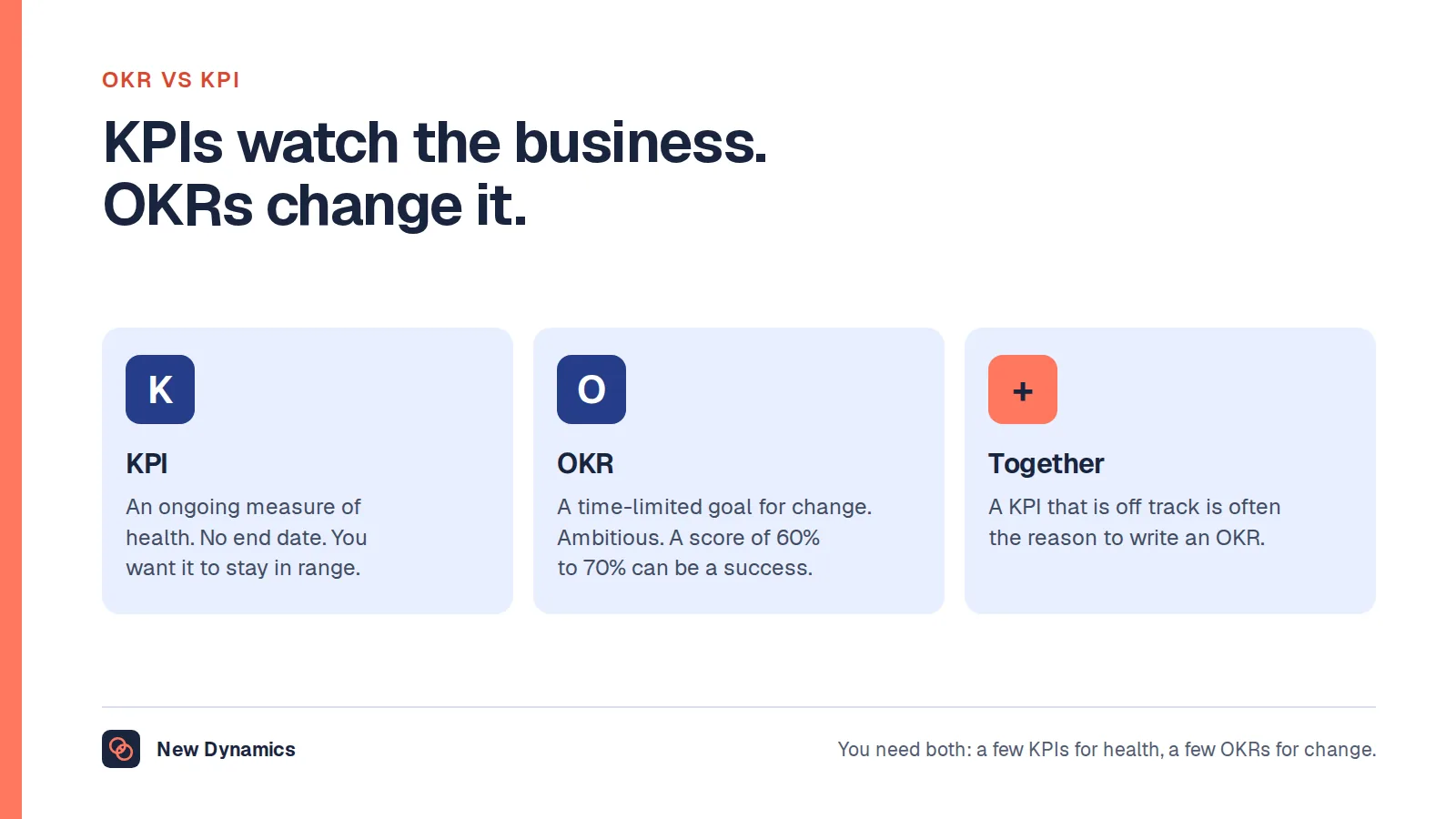
Our guide to OKR vs KPI explains how goals for change sit alongside ongoing measures.
Review progress
- Weekly or fortnightly: ten minutes in the team meeting. For each goal: on track, at risk or off track, and what would help.
- Monthly: look at the measures and the safeguards. Remove obstacles.
- Quarterly: score the goals, discuss what you learned and set the next ones.
- When things change: update the goal openly, and record why.
Keep the tone curious. A goal marked “off track” is a request for help. If people are punished for reporting red, everything will be reported green. Our accountability examples show how to keep honesty safe.
Common mistakes
Individual goals in disguise. If the goal can be split into separate personal targets with no interaction, it is not a team goal.
Too many. Eight goals mean that nothing is a priority.
Handed down without discussion. The direction may come from above. The wording, the measures and the plan should involve the team.
No owner. “Everyone” owns it, so nobody reports on it.
No baseline. “Improve customer satisfaction” cannot be reviewed.
Set and forget. A goal that is reviewed only at the end of the quarter was never really a goal.
Rewards that pull the other way. Check that pay and recognition support the team goal.

Frequently asked questions
What is a team goal?
A team goal is a result that a team can only achieve together, because it depends on the combined work of several people. Success or failure belongs to the whole team. It differs from a set of individual goals held by people who share a manager.
What are examples of team goals?
Examples include: cut repeat customer contacts from 18% to 10% this quarter; close the month in six working days by June; raise on-time delivery from 91% to 96% by September; and ship a new feature to ten pilot customers by the end of April.
How do you set team goals?
Start from the organisation's priorities, review where the team stands, gather ideas from every member, choose three to five goals, add a baseline, a target, a date and an owner to each, agree what work will stop and decide how often you will review progress.
How many goals should a team have?
Three to five a quarter suits most teams. Google's OKR guide advises picking just three to five objectives, because more can over-extend the team and diffuse its effort. Add one goal about how the team works.
What is the difference between team goals and individual goals?
An individual goal can be achieved by one person. A team goal needs several people to work together, and they succeed or fail as a group. Individual goals should link to team goals, so that people can see how their work contributes.
How do you keep a team accountable for its goals?
Give each goal one owner who coordinates and reports, make the goals and their progress visible, review them every week or fortnight, treat an off-track goal as a request for help and recognise contributions to the team result in reviews.
Your next step: run the three-person test
- Ask three members of your team, separately, what the team is trying to achieve this quarter.
- If the answers differ, book the 90-minute workshop.
- Choose three to five goals, and apply the five tests to each.
- Put a ten-minute review in every team meeting.
For a method that connects objectives, key results and check-ins, read and download our OKR guide. The guide is free to read, and the PDF uses our short download form.
Want team objectives, owners and progress in one shared place? Book a New Dynamics demo and bring your team's current goals. You can also email contact@new-dynamics.com.