TL;DR
- A team rhythm has four jobs: saying what matters now, coordinating who is doing what, supporting people individually, and sending information upwards. Each needs a different meeting, and confusing them is why calendars fill up without anything improving.
- Our default is a weekly or fortnightly one-to-one of thirty minutes, a twenty-minute team check-in, and a longer team meeting monthly. Go weekly for new starters, new managers and periods of change, and never let a direct report go a month without a conversation.
- Individual performance belongs in the one-to-one and never in the team meeting. Round-robin status belongs in writing, or in a short check-in, and almost never in a thirty-minute conversation about one person.
Look at a manager's calendar and you can usually see what the organisation values. Five recurring meetings about status, none about people. A weekly hour where twelve people take turns describing work that could have been written down, and no thirty minutes with the person who has been quietly struggling since August.
This article covers what a rhythm actually has to deliver, how often to hold each meeting, what belongs in which, and how to decide what to cut.
Notes and actions from each conversation are easier to keep when they live in one place. See how New Dynamics continuous feedback supports regular check-ins.
Four jobs
Before choosing frequencies, be clear what the rhythm is for.
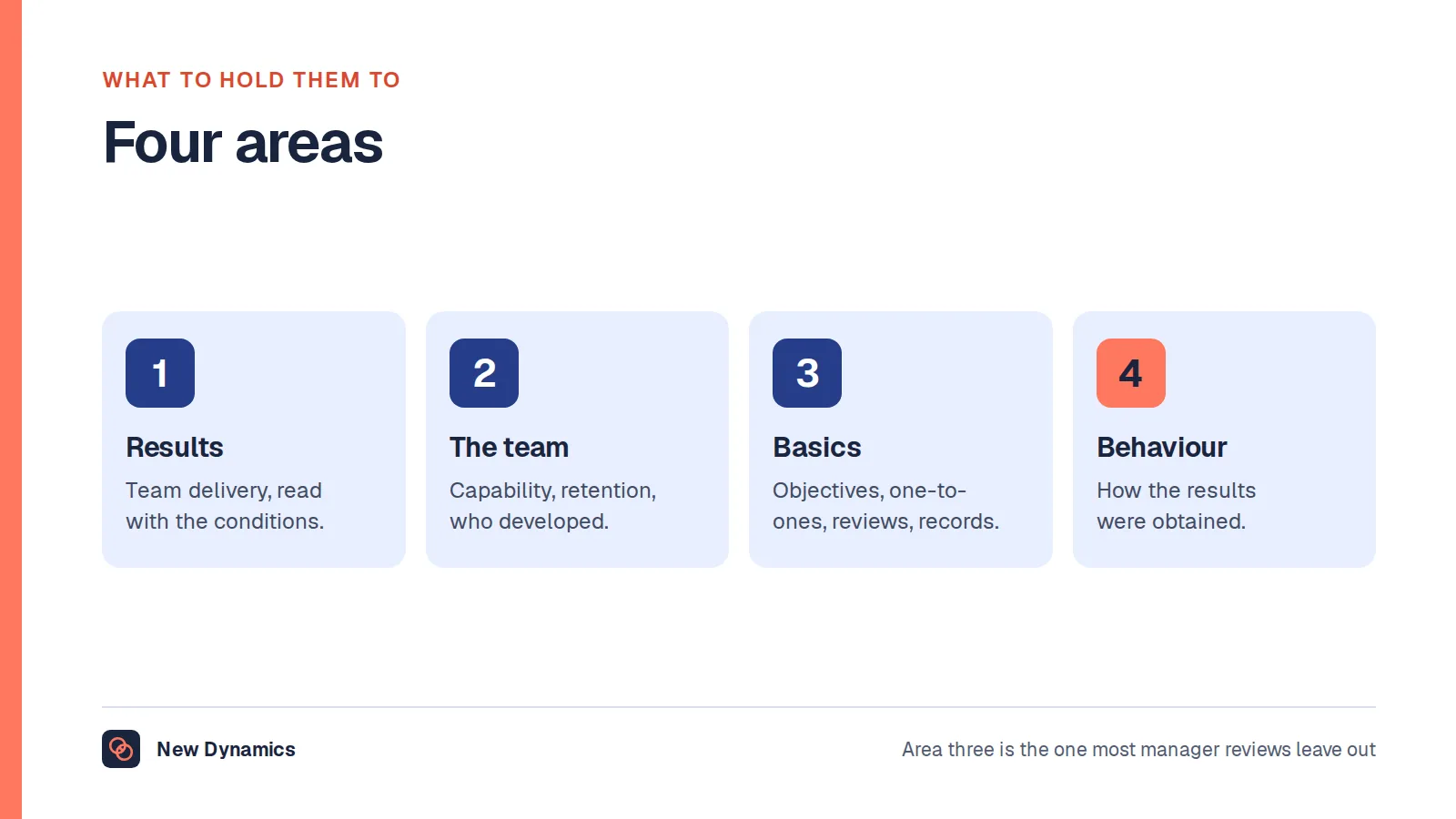
Direction. What matters now, what changed, what we are no longer doing. Coordination. Who is doing what this week, and what is blocked. Individual support. How one person is doing, what they need, what is next for them. Information upwards. What leaders need to hear from people doing the work.
Acas treats the fourth and the third as ordinary management work, saying managers "should still talk to employees informally about their performance on a regular basis" through "sharing regular feedback", coaching and "regular check-ins, sometimes known as one-to-ones". A rhythm that delivers only the first two is common and is the reason people say nothing until they resign.
The three meetings

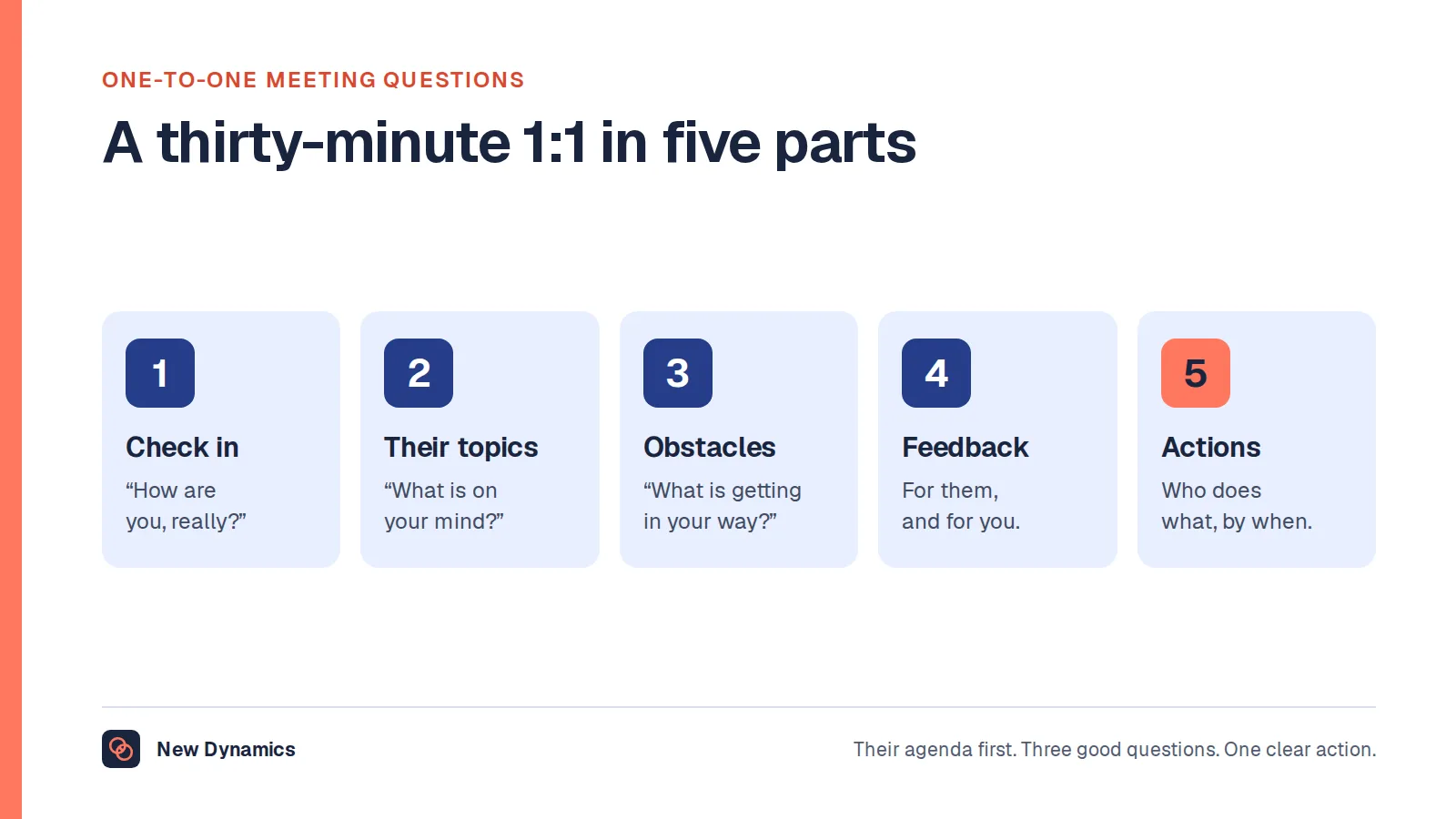
The one-to-one. Thirty minutes with one person, their agenda first. Support, feedback, obstacles, development, anything they are reluctant to say in front of others. Our post on one-to-one meeting questions has seventy to choose from.
The team check-in. Twenty minutes, standing or on a call, focused on the week: what is moving, what is blocked, what needs a decision. Not a status report to the manager, which belongs in writing.
The team meeting. Longer and less frequent. Direction, decisions, a piece of work somebody walks everyone through, and change. HSE lists Change, "how organisational change (large or small) is managed and communicated in the organisation", among the six areas of work design that affect health and productivity, and this is the meeting where that communication either happens or does not.
Cadence defaults

These are our recommendations rather than rules, and they assume a manager with five to eight direct reports.
- One-to-one: weekly or fortnightly, thirty minutes. Weekly for anyone new, anyone in a new role, anyone struggling and anyone you rarely see. Fortnightly for experienced people in a stable period, with the gap never stretching past a month.
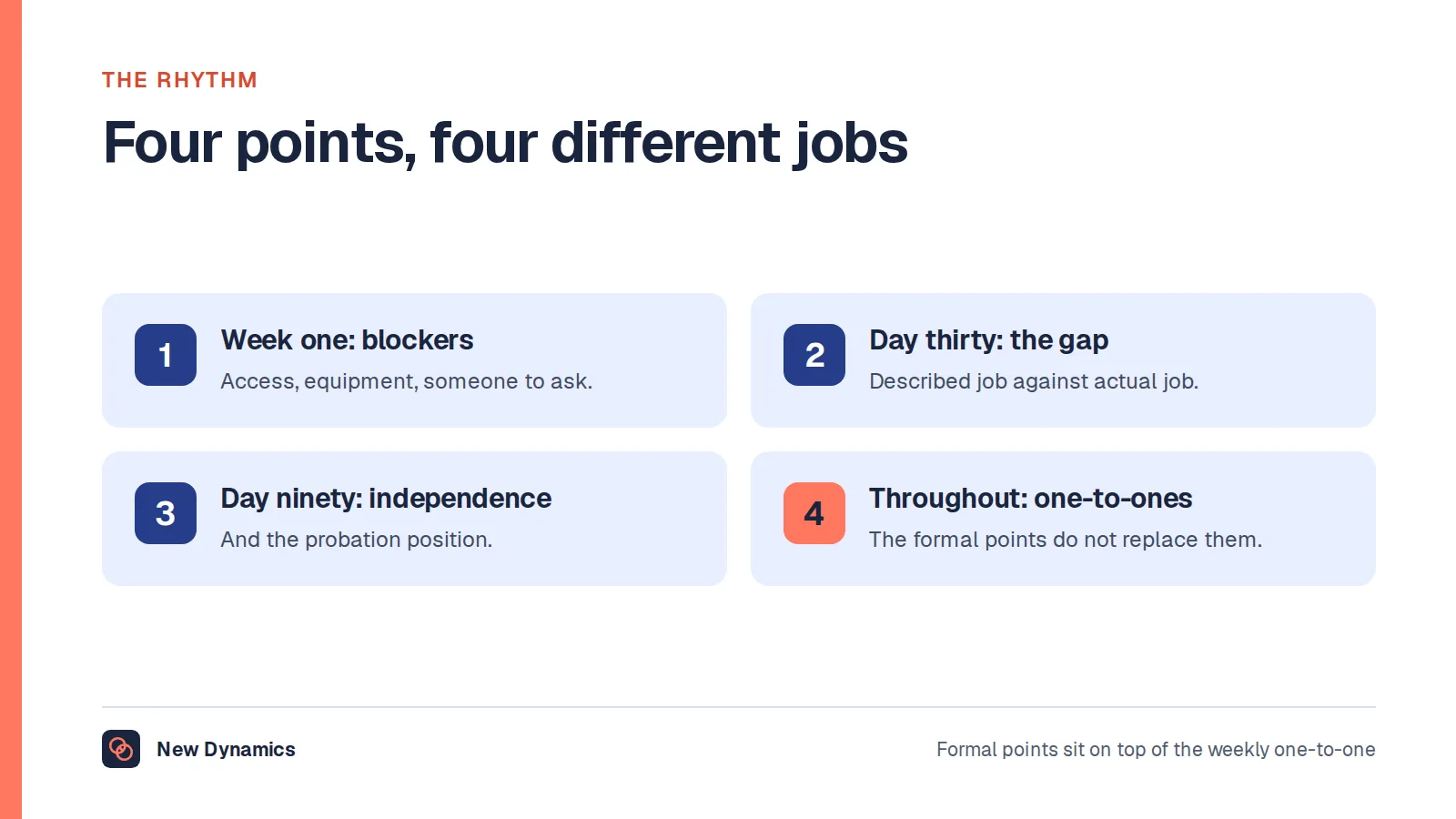
- New starters: weekly for the first three months, which matches what Acas expects during probation, where employees "should also have regular informal check-ins throughout their probation period". Our post on onboarding check-ins covers the first ninety days.
- Team check-in: weekly, twenty minutes. Shorter and more often beats longer and less often for coordination.
- Team meeting: monthly, forty-five to sixty minutes. More often than that and it becomes a status meeting; less often and change gets communicated by rumour.
- During a reorganisation or a crisis: increase both, temporarily, and say that it is temporary.
Two rules that matter more than the numbers. Do not cancel a one-to-one; reschedule it, in the same week. And when you must choose between the team meeting and the one-to-ones, keep the one-to-ones.
What belongs where

Only in a one-to-one: feedback on an individual's performance, pay and progression, anything personal, anything someone would be embarrassed to hear in front of colleagues, and development.
Only in a team setting: decisions that affect everyone, changes to priorities, the thing one person learned that the rest should know, and work that needs coordinating between several people.
In writing, not in a meeting at all: routine status, numbers that do not need discussion, and anything where the purpose is for the manager to be reassured.
The most damaging confusion is individual performance raised in a team meeting, even gently, even as a joke. It teaches everyone that the room is not safe, and it costs more than the ten minutes it saved.
The second most damaging is the one-to-one that is really a status check. If a manager spends their thirty minutes asking what everyone is working on, the person in front of them learns that this slot is about reassurance rather than support, and stops bringing anything difficult to it.
Work out what to cut
The arithmetic is worth doing once a quarter. Multiply the length of each recurring meeting by the number of attendees by its frequency, and you have the monthly cost in hours. A weekly hour with twelve people is twelve hours a week, which is most of a full-time role.
Then ask three questions of each meeting: what decision does it produce, what would happen if it stopped for a month, and could it be shorter or written down? HSE's Demands area covers "workload, work patterns and the work environment", and recurring meetings are workload that is rarely counted as such.
Cut the status meeting before you cut the conversation.
Remote and hybrid teams
Nothing in a distributed team happens in a corridor, so the rhythm carries more weight. Three adjustments work.
- Keep the one-to-one cadence higher than you would in an office, because the informal signals that tell you somebody is struggling are mostly missing.
- Make the team check-in a conversation, not a round-robin. On a call, a round of twelve updates is twelve people half-listening. Ask what is blocked and who needs ten minutes with whom.
- Write more down. Anything decided in a meeting where some people were in a room must be written, or the people who were not there learn it late and secondhand.
Five signs the rhythm is wrong
- You find out about problems from somebody other than the person who has them.
- The team meeting is mostly people reading out what they did.
- One-to-ones get cancelled in busy weeks, which are the weeks they matter.
- Nobody can say what decision last week's recurring meeting produced.
- A direct report has gone a month without a proper conversation and nobody noticed.
Keeping the record
Write down what was agreed, in both kinds of meeting. Acas says "it's important to keep a written record of what is discussed" and that it should be shared with the employee afterwards. For a one-to-one, five lines is enough: what was discussed, what was agreed, what you owe them, what they owe you, and the date of the next one. Those notes are what make the annual review possible, as our post on manager performance describes.
Frequently asked questions
How often should one-to-ones be?
Weekly or fortnightly for thirty minutes, as a default. Go weekly for new starters, people in new roles, anyone struggling and anyone you rarely see in person. Never let a direct report go more than a month without one, and reschedule rather than cancel when something clashes.
What is the difference between a team meeting and a one-to-one?
A one-to-one is about one person: support, feedback, obstacles and development, with their agenda first. A team meeting is about shared things: direction, decisions, changes and coordination. Individual performance belongs in the first and never in the second.
What should a weekly team check-in cover?
Twenty minutes on the week ahead: what is moving, what is blocked, what needs a decision. It is not a status report for the manager, which belongs in writing, and it is not where individual feedback is given.
How long should a one-to-one be?
Thirty minutes is usually right. An hour tends to fill with status, and fifteen minutes is not long enough for anything difficult to surface. If you consistently finish early, the questions are too narrow rather than the slot too long.
Should you cancel one-to-ones when you are busy?
Reschedule, do not cancel. A cancelled one-to-one tells the person they are the lowest priority on a bad week, which is exactly when they most needed the slot. If the calendar is impossible, shorten it to fifteen minutes rather than dropping it.
How do you decide which recurring meeting to cut?
Cost each one in hours per month, then ask what decision it produces, what would happen if it stopped for a month, and whether it could be shorter or written instead. Cut status meetings before conversations, and tell people why you are cutting it.
Your next step: audit one month
- List every recurring meeting you run, with length, attendees and frequency, and total the hours.
- Check whether every direct report has a one-to-one in the diary for the next four weeks.
- Cut or halve the meeting that produces no decision, and say why.
- Start writing five lines after each one-to-one and sharing them.
For an agenda, a worksheet and a method, read and download our manager one-to-one guide. The guide is free to read, and the PDF uses our short download form.
Want notes and actions from every conversation in one place? Book a New Dynamics demo and bring your current calendar. You can also email contact@new-dynamics.com.