TL;DR
- GOV.UK says almost all people classed as workers are legally entitled to 5.6 weeks' paid holiday a year. For someone working a five day week that is at least 28 days, and 28 days is also the cap. Bank holidays do not have to be paid leave, but an employer can count them inside the 5.6 weeks.
- Leave builds up from the first day of the job. Acas says workers accrue holiday from the day they start working, including during a probationary period, sick leave and statutory family leave. Irregular hours and part-year workers accrue at 12.07% of the hours they work in a pay period.
- Holiday pay has to look like normal pay, so commission and regularly paid overtime count. Payment in lieu of statutory leave is only lawful when someone leaves. An unlimited leave policy does not remove any of this, and it makes the leaving calculation harder, not easier.
A manager wants to know whether three people can be off in the same week. Payroll wants to know what to pay someone whose earnings are half commission. A new starter wants to book a fortnight after six weeks in the job. Someone on a four day week has read that the minimum is 28 days and wants to know why their contract says 22.4.
Every one of those questions comes back to the same two things: one number set by law, and the choices an employer makes on top of it. This article sets out UK holiday entitlement in order, from the statutory minimum through accrual, holiday pay, carry over and the notice rules, and then turns to the employer half: writing the policy, deciding how many people can be away at once, and whether unlimited leave is worth doing.
Leave rarely goes wrong at the calculation. It goes wrong in the handover, when a request sits in a manager's inbox and nobody records the answer. See how New Dynamics workflows keep requests, approvals and records on one visible path.
This is general information for England, Scotland and Wales rather than legal advice.
PTO, vacation and annual leave: the same idea, different words
Say this once and the rest of the article reads easily. PTO (paid time off) and vacation are American terms. The UK equivalent is annual leave, or simply holiday. Everything below answers the American phrasing in UK terms.
- PTO, PTO leave, PTO time, PTO days. In the United States, a single bank of paid days that covers holiday and often sickness too. In the UK you would call the holiday part annual leave, and sick leave is handled separately.
- A PTO request, a paid time off request, a vacation time off request. A holiday request. The notice rules below apply to it.
- PTO accrual. How the balance builds up. The UK word is accrual too, and the rules are set out further down.
- Personal time off, or a personal day. Not a UK legal category. In practice it comes out of annual leave, or out of a separate discretionary allowance if your policy creates one. Statutory time off for dependants is a different right again, and it is unpaid unless your contract says otherwise.
- Voluntary time off (VTO). In the United States, usually unpaid time an employer offers when work is quiet and employees can choose to take it. The UK nearest equivalents are agreed unpaid leave or a contractual lay-off clause, both of which need care and should not be confused with annual leave.
- Personalised PTO. A marketing term for policies that let people choose how to use a pot of days, for example swapping a bank holiday for a date that matters to them. For the UK version of that idea, see our article on floating holidays.
- Management leave. Not a UK term of art. Employers use it for two quite different things: an extra discretionary allowance for salaried managers, or paid time away while something is investigated. If you mean the second, call it what it is and follow a proper process, as in our article on suspension from work.
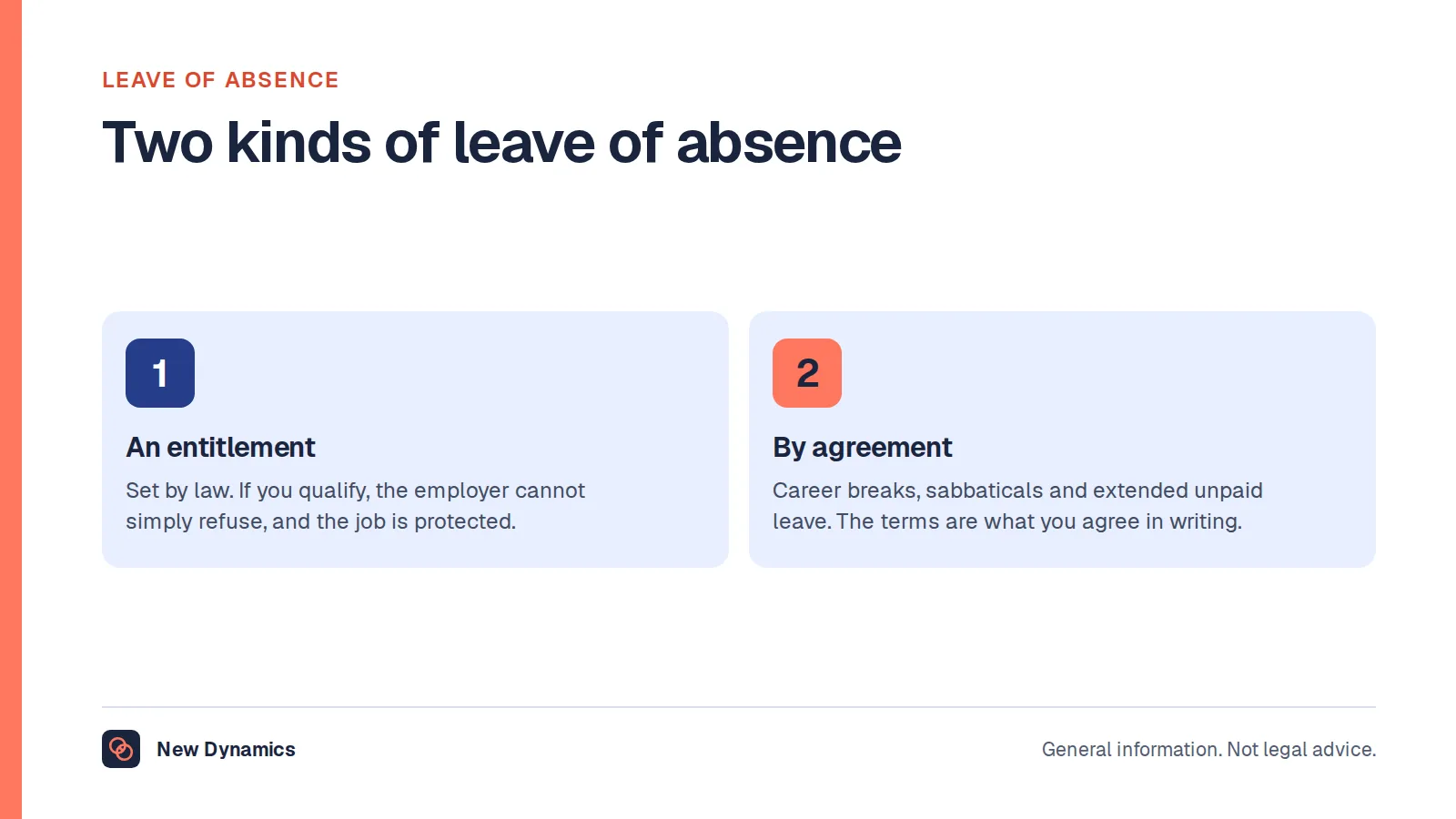
Annual leave is only one of the types of leave at work. The others include sick leave, maternity, paternity, adoption and shared parental leave, unpaid parental leave, time off for dependants, bereavement leave, jury service and time off in lieu. For longer absences and the difference between leave you are entitled to and leave an employer may grant, see our article on a leave of absence.
The statutory minimum: 5.6 weeks, capped at 28 days
GOV.UK's guidance on holiday entitlement states the floor plainly: “Almost all people classed as workers are legally entitled to 5.6 weeks’ paid holiday a year (known as statutory leave entitlement or annual leave).” That includes agency workers, workers with irregular hours and part-year workers.
Translated into days for the most common pattern: “Most workers who work a 5-day week must receive at least 28 days’ paid annual leave a year. This is the equivalent of 5.6 weeks of holiday.”
The same page caps it. “Statutory paid holiday entitlement is limited to 28 days. For example, staff working 6 days a week are only entitled to 28 days’ paid holiday.” So 28 days is both the floor for a five day week and the ceiling for everyone. Working a sixth day does not buy more statutory leave.
Bank holidays are the detail that causes most arguments. GOV.UK: “Bank or public holidays do not have to be given as paid leave. An employer can choose to include bank holidays as part of a worker’s statutory annual leave.” Acas puts the same point from the worker's side in its guidance on checking holiday entitlement: “Bank holidays might be included in this paid holiday. Workers should check their contract if they’re not sure.”
In other words, a contract offering “20 days plus bank holidays” and a contract offering “28 days including bank holidays” can both be lawful in England and Wales, where there are eight permanent bank holidays. One of them feels considerably more generous, which is why the wording belongs in the contract and the handbook rather than in a manager's head.

Part-time, irregular hours and part-year workers
The entitlement is expressed in weeks for a reason. A week means a week of that person's work.
Acas: “Someone who works part time is still entitled to 5.6 weeks’ statutory paid holiday. The entitlement will be in proportion to the hours they work.” GOV.UK gives the arithmetic and the consequence: “Part-time workers who work regular hours for the whole year are entitled to at least 5.6 weeks’ paid holiday, but this will amount to fewer than 28 days.” Its example: “if they work 3 days a week, they must get at least 16.8 days’ leave a year (3 × 5.6).” A four day week comes out at 22.4 days, which is why that figure appears in so many contracts.
Two groups have their own rules. Acas defines them in its guidance for irregular hours and part-year workers: “Someone is an irregular hours worker if, under their contract in that year, their hours in each ‘pay period’ are variable.” A part-year worker has a contract that “says there are periods of at least a week when they are not required to work and which they are not paid for”, while the contract itself continues all year round. Term-time staff are the classic case.
For those two groups, GOV.UK says: “They will build up (‘accrue’) leave depending on the hours they’ve already worked, rather than getting a fixed number of days or hours.” Acas sets out the rate: they accrue holiday “at 12.07% of the hours they work in a pay period”, on the last day of that pay period. The figure comes from the statutory 5.6 weeks itself, not from a rule of thumb.
Three practical consequences. Part-timers who never work Mondays should not lose out when several bank holidays fall on a Monday, so pro-rate the bank holiday allowance rather than giving the days as they fall. Anyone whose days change should have entitlement recalculated, not quietly left alone. And GOV.UK's holiday entitlement calculator is the quickest way to settle a disputed figure, because both sides can run it.
Accrual: how annual leave builds up
Accrual means the leave balance building up as time is worked, rather than the whole year's entitlement being available on day one.
Acas is clear about when it starts: “Workers ‘accrue’ (build up) holiday from the day they start working.” It adds that this includes when someone is on “a probationary period, sick leave, statutory leave”, for example maternity, paternity, adoption or shared parental leave. GOV.UK says the same about family leave on its page on how to calculate leave entitlement: “The leave year and holiday entitlement is not affected by maternity, paternity or adoption leave. The employee still builds up (‘accrues’) holiday over these periods.”
There is a specific rule for a first year of employment. GOV.UK: “An employer can use an accrual system to work out a worker’s leave during the first year of the job. Under this system, a worker gets one-twelfth of their leave in each month.” Its worked example: someone on a five day week with 28 days “After their third month in the job, they’d be entitled to 7 days’ leave (a quarter of their total leave, or 28 ÷ 12 × 3).” Where a new starter joins part way through a month, the guidance says they “can accrue one-twelfth of their leave from their first day”, rounded up to the nearest half day, unless the employer chooses to calculate that first month in proportion to the days actually worked instead.
Note what this rule is not. It applies in the first year, and only if the employer chooses to use it. After the first year, a regular hours worker normally has the whole year's entitlement available across the leave year, subject to the booking rules. Running a permanent accrual system for long-serving staff is a policy choice that needs to be written down, and it cannot reduce anyone below the statutory minimum for the leave year as a whole.
Irregular hours and part-year workers are the exception: for them the hours-based accrual above is how entitlement is worked out, every year.

Holiday pay: it has to look like normal pay
Paying annual leave at bare basic pay is one of the most common mistakes in UK payroll.
Acas, on calculating holiday pay: “When a worker takes holiday, they should be paid the same as when they’re at work.” It lists what must be included: “payments linked to doing tasks required in the contract, for example commission”, “payments related to professional or personal status, for example for length of service, seniority or professional qualifications”, and “other payments, for example overtime payments, if a worker has regularly been paid these during the last year”.
GOV.UK's section on holiday pay says the same thing in one sentence: “‘Normal’ rate of pay includes commission, regular overtime payments, and any payments related to length of service or professional qualifications.” It adds that it “does not usually include bonus payments”.
One wrinkle worth knowing before you build a spreadsheet. GOV.UK says employers must pay at least four weeks of the statutory entitlement at the normal rate, and the remaining 1.6 weeks at a basic rate. Plenty of employers pay all 5.6 weeks at the normal rate instead, because two different rates inside one entitlement is an administrative cost and an argument waiting to happen.
So the test for a commission-earning salesperson or a warehouse worker on regular Saturday overtime is simple: does a week of holiday leave them materially worse off than a week at work? If it does, check the calculation.
Carrying leave over
The default position is that statutory leave is taken in the leave year it belongs to. Acas's guidance on carrying over holiday sets out where that gives way.
- Where the employer got in the way. Workers can carry over holiday “if their employer does not let them take all their holiday or does not encourage them to take it all”, up to “a maximum of 4 weeks’ holiday entitlement”. Encouraging people to take leave is part of the duty, not a nicety.
- Long-term sickness. “If a worker is on long-term sick leave, they can carry over a maximum of 4 weeks’ holiday entitlement.” And then: “They must use it within 18 months starting from the end of the leave year in which they accrued it.”
- Statutory family leave. Where someone could not use their entitlement because they were on maternity or other statutory leave, “they must be allowed to carry the holiday over to the next leave year.”
- Contractual leave above the statutory minimum. Acas says the contract “should say if they can carry over any of this holiday and how much”. That is yours to decide, so decide it in writing.
A use-it-or-lose-it rule is therefore workable for ordinary cases, and unlawful if applied to the exceptions above. The safer policy says both things.
Payment in lieu, and untaken leave when someone leaves
This one is short and absolute. GOV.UK, on taking holiday before leaving a job: “The only time someone can get paid in place of taking statutory leave (known as ‘payment in lieu’) is when they leave their job. Employers must pay for untaken statutory leave, even if the worker is dismissed for gross misconduct.”
So you cannot buy out statutory leave during employment, however much a willing employee would prefer the cash, and you cannot withhold the payment on exit as a sanction. Where an employer offers more than 5.6 weeks, GOV.UK says “they can agree separate arrangements for the extra leave”.
Two more points for leavers. During a notice period “the worker may be able to take whatever is left of their statutory annual leave”, and an employer can require leave to be taken during notice using the notice rules below. If someone has taken more leave than they had accrued, “their employer must not take money from their final pay unless it’s been agreed beforehand in writing”, so that clause needs to exist before you need it.
Booking annual leave: notice, refusal and told-to-take leave
The statutory default notice periods are set out in GOV.UK's section on booking time off, and they surprise people in both directions.
- A worker giving notice. “The general notice period for taking leave is at least twice as long as the amount of leave a worker wants to take, plus 1 day. For example, a worker would give 3 days’ notice for 1 day’s leave.” Acas's example for a longer request: ask “at least 20 days before” for 10 days off.
- An employer refusing or cancelling. “An employer can refuse a leave request or cancel leave but they must give as much notice as the amount of leave requested, plus 1 day. For example, an employer would give 11 days’ notice if the worker asked for 10 days’ leave.”
- The limit on refusal. “Although employers can refuse to give leave at a certain time, they cannot refuse to let workers take the leave at all.”
- Telling people when to take leave. Employers can “tell their staff to take leave, for example bank holidays or Christmas” and “restrict when leave can be taken, for example at certain busy periods”. The notice for that “is at least twice as long as the leave they want their staff to take”, so a five day Christmas shutdown needs at least ten days' notice, and Acas uses exactly that example.
- Leave has to be leave. If an employer requires leave to be taken, GOV.UK says “they need to make sure that the worker can relax, rest and enjoy leisure during their holiday. For example, an employer cannot force a sick worker to take leave.”
If your contract sets different notice periods, GOV.UK says the contract applies. Most employers do set their own, usually asking for more notice for longer absences. Put the number in the policy, and make the request route the same for everyone.
Writing an annual leave policy
Seven decisions cover almost every question a manager will ask you.
- The leave year. Fixed dates for everyone, or each person's anniversary. GOV.UK says an employer “should tell their staff the dates of their statutory leave year as soon as they start working”. Fixed dates are easier to administer; anniversaries spread the year-end rush.
- Bank holidays. Inside the 5.6 weeks or on top of it, and how part-timers get their proportionate share.
- Notice and approval. How much notice for how long an absence, who approves, how quickly a decision is given, and what happens when the approver is away.
- Cover limits. How many people can be off at once, by team and by skill, and who breaks a tie between two requests for the same week.
- Carry over. The general rule, the exceptions above, and any deadline for using carried days.
- Part days and first year. Whether half days are allowed, and whether you use the first-year accrual system.
- Leaving. How the final balance is calculated and the written agreement covering over-taken leave.

How much leave can be off at once?
Start from arithmetic rather than instinct. 5.6 weeks is 10.8% of a 52 week year, so a team that spread its leave perfectly evenly would have roughly one person in nine away on any given working day, before sickness, training or family leave. Nobody spreads leave evenly. Requests concentrate in school holidays, the last week of August and the fortnight before Christmas.
Three rules make the cover question manageable. Set the limit per skill, not per headcount, because two of five people being off matters only if they are the two who can run payroll. Publish the limit so the answer does not look arbitrary, and make first come first served the tie-break unless you have a better written rule. And watch the opposite failure: people with large untaken balances in the autumn are a carry-over problem and often a workload problem, and Acas treats encouraging people to take their leave as part of the employer's job.
Unlimited leave, honestly
An unlimited leave policy, usually branded unlimited PTO, removes the stated allowance. People take what they need with their manager's agreement, and no balance is published.
How it works in practice. Requests go through the normal approval route. Managers judge them against workload and cover rather than against a number. Many organisations pair the policy with a stated minimum, for example a requirement to take at least four weeks, precisely because the number is what gives people permission.
The claim you will hear. Supporters say people take more leave under an unlimited policy; critics say they take less, because there is no balance to spend and no obvious benchmark for what is reasonable. Both claims circulate widely and we have not found official UK statistics that settle either one. Treat them as claims, not findings. If you adopt the policy, measure the days your own people actually take before and after, and you will have the only evidence that matters for your organisation.
What does not change. The statutory floor still applies underneath. Workers remain entitled to 5.6 weeks of paid leave, paid at normal pay, with the carry-over protections for sickness and family leave intact. Unlimited means no upper limit, not no entitlement.
The accrual and payment-on-termination problem. This is the practical catch that policy documents tend to skip. Statutory leave accrues, and on termination GOV.UK requires payment for untaken statutory leave. If you have stopped tracking a balance, you have no agreed figure to pay out, and the leaver has every incentive to argue that little of their 5.6 weeks was taken. The answer is to keep recording leave taken even though nothing is deducted from an allowance, so that statutory entitlement can be evidenced and the final payment calculated. An unlimited policy is a communications decision, not a reason to stop keeping records.
So is unlimited leave good? It suits organisations with trusted managers, salaried roles, real cover and a stated minimum. It works badly where cover is tight, where managers already refuse ordinary requests, or where the real aim is removing a balance-sheet liability, because the statutory part of that liability does not go away.
Which rules apply where
The entitlement described here is the position in England, Scotland and Wales, which is where GOV.UK's guidance and Acas's advice apply. Northern Ireland has its own working time legislation and its own guidance. The headline is similar: nidirect's guidance on holiday entitlements says a worker is “entitled to a minimum of 5.6 weeks paid annual leave (28 days for someone working five days a week)” and that “bank and public holidays can be included in your minimum entitlement”. The detail is not guaranteed to match, so check the Northern Ireland guidance rather than assuming, and take advice on any live dispute. None of this is legal advice.
Frequently asked questions
What is the minimum holiday entitlement in the UK?
GOV.UK says almost all people classed as workers are legally entitled to 5.6 weeks' paid holiday a year. For someone working a five day week that is at least 28 days, and GOV.UK also caps statutory paid holiday entitlement at 28 days, so working six days a week does not increase it. Bank holidays do not have to be given as paid leave, but an employer can count them inside the 5.6 weeks.
What does PTO mean at work, and what is the UK equivalent?
PTO stands for paid time off. It is an American term for a bank of paid days that an employee can use for holiday and, in many US policies, for sickness too. The UK equivalent for the holiday part is annual leave or holiday, and sick leave is treated separately here. A PTO request in UK terms is simply a holiday request.
How does annual leave accrual work?
Acas says workers accrue, meaning build up, holiday from the day they start working, including during a probationary period, sick leave and statutory leave such as maternity or paternity leave. In the first year of a job an employer can use an accrual system under which a worker gets one-twelfth of their leave each month. Irregular hours and part-year workers accrue at 12.07% of the hours they work in a pay period.
Does holiday pay have to include overtime and commission?
Yes, where they are part of normal pay. Acas says a worker on holiday should be paid the same as when they are at work, and that holiday pay must include commission and overtime payments the worker has regularly been paid during the last year. GOV.UK wording is similar: normal rate of pay includes commission, regular overtime payments and payments related to length of service or professional qualifications, and it does not usually include bonuses.
Can an employer refuse a holiday request?
An employer can refuse a request for particular dates, and GOV.UK says the notice for refusing or cancelling must be as much as the leave requested plus one day. What an employer cannot do is refuse to let a worker take the leave at all. Employers can also require leave to be taken at set times, such as a Christmas shutdown, giving notice of at least twice the length of the leave.
How does unlimited paid time off work in the UK?
Requests go through the normal approval route and no allowance is published, so managers judge them on workload and cover. The statutory 5.6 weeks still applies underneath, paid at normal pay, with the usual carry-over protections. Keep recording leave taken even if nothing is deducted, because untaken statutory leave must still be paid when someone leaves and you need a figure to pay.
Your next step: get the leave year on paper
- Write down your leave year dates, your bank holiday treatment and your part-time calculation, then check one part-timer's entitlement against GOV.UK's holiday entitlement calculator.
- Check one holiday payslip for a commission earner and one for someone on regular overtime. If a holiday week pays less than a working week, fix the calculation first.
- Set the cover limit per skill for each team, publish it, and give managers a tie-break rule they can defend.
- Pull the leave balances for everyone with more than half their entitlement untaken four months before year end, and prompt those people now rather than in December.
- If you are considering unlimited leave, decide the stated minimum and the record you will keep of leave taken before you announce anything.
For the policy wording that sits behind all of this, in language staff will actually read, use our employee handbook guide. The guide is free to read, and the PDF uses our short download form.
Want holiday requests, approvals, cover limits and leave records on one visible path instead of four inboxes and a spreadsheet? Book a New Dynamics demo and bring your current leave process. You can also email contact@new-dynamics.com.