TL;DR
- A housekeeper cleans and maintains rooms and public areas to a set standard, in a hotel, a private home, a care home or a hospital. Housekeeping is the department; a cleaner does the cleaning part of the job, usually in offices and public buildings.
- The six duties are preparing for the shift, cleaning and making up rooms, cleaning public areas, restocking and laundry, reporting maintenance and lost property, and working safely with chemicals and equipment.
- Employers ask for reliability, pace, attention to detail, physical fitness and discretion. In the UK, employers must assess the risks of cleaning work, including chemicals, slips, skin disease and lifting, and train staff accordingly.
A hotel with three hundred rooms turns every one of them in a few hours each morning, to the same standard, whoever slept there. The people who do it are rarely seen by guests and are the reason guests come back. The same skills keep private homes running, care homes safe and offices fit to work in.
This housekeeper job description explains what the job involves in hotels, homes and care settings, sets out six duties, lists the requirements that employers set, separates the housekeeper from the cleaner, summarises the UK safety rules that apply to cleaning work, gives a template that you can adapt and suggests how to describe the work on a CV.
Housekeeping teams are often large and the first week decides who stays. See how New Dynamics onboarding brings tasks, early goals and manager conversations into a clear path for a new starter.
What is a housekeeper?
The Cambridge Dictionary's general definition of a housekeeper is “a person, especially a woman, whose job is to organize another person's house and deal with cooking, cleaning, etc.” That is the private household sense. In hotels and institutions the word has grown: a housekeeper is a member of the housekeeping department, which cleans and maintains guest rooms and public areas, and a head or executive housekeeper runs that department. Job adverts today use housekeeper for everyone, and the "especially a woman" of the dictionary is out of date.
In England the hotel version sits within the hospitality apprenticeship standards. The retired Hospitality team member standard, published by Skills England, describes the housekeeping function as being able to “Clean and maintain bedrooms and public areas including furniture, fixtures and fittings, soft and hard flooring; identify and report maintenance needs and check that outcomes of work meet the businesses / brand standards for presentation”. That one sentence is most of the job description.
The title covers three settings.
- Hotels and serviced accommodation. Room attendants, housekeepers, linen porters, supervisors and the executive housekeeper.
- Private homes. A housekeeper who runs the household: cleaning, laundry, shopping, sometimes cooking and managing other staff.
- Care homes and hospitals. Domestic or housekeeping staff who clean to infection control standards and support residents' comfort.
Housekeeper duties: six responsibilities
- Prepare for the shift. Collect the room list or schedule, stock the trolley with linen, supplies and chemicals, and check equipment.
- Clean and make up rooms. Strip and make beds, clean bathrooms, dust, vacuum, empty bins, replace supplies and present the room to the standard, in the time allowed.
- Clean public areas. Corridors, lobbies, lifts, toilets, stairs and back-of-house areas, on a schedule and as needed.
- Restock and handle laundry. Keep linen and supplies flowing, sort and bag used linen, and in smaller settings wash, dry and press it.
- Report maintenance and lost property. Log faults, damage and anything left behind, and hand it to the right person. In hotels this is also where safeguarding concerns and welfare issues are noticed first.
- Work safely. Use chemicals, equipment and lifting techniques as trained, follow infection control where it applies and report hazards.
Private household roles add shopping, cooking, errands and managing tradespeople. Care settings add infection control routines and interaction with residents. The advert should say which.

Housekeeper and cleaner: the difference
Cambridge defines a cleaner as “a person whose job is to clean houses, offices, public places, etc.” The overlap with housekeeping is large, and the difference is scope.
| Question | Housekeeper | Cleaner |
|---|---|---|
| Where | Hotels, homes, care settings | Offices, schools, public buildings, homes |
| Scope | Cleaning plus presentation, linen, supplies, reporting and, in homes, running the household | Cleaning to a specification |
| Standard | The room or home ready for the next guest or the family | The area clean to the agreed schedule |
| Typical employer | The hotel, household or care provider directly | Often a cleaning contractor |
A cleaner's job description is the cleaning part of the housekeeper's: the schedule of areas, the tasks in each, the products and equipment, the standard and the reporting. The safety rules below apply to both.

Housekeeper job requirements
Employers set requirements in four groups.
- Reliability and pace. Turning up for every shift and working to the time allowed per room or area. Housekeeping runs to a clock.
- Attention to detail. Seeing the hair in the bath, the fingerprint on the mirror and the missing teaspoon before the guest does.
- Physical fitness. Bending, lifting, pushing trolleys and being on your feet for the whole shift.
- Discretion and honesty. Working in people's rooms and homes, around their belongings, often unsupervised. Private household roles usually ask for references and sometimes a criminal record check.
No formal qualifications are needed for most roles. Employers train new starters on their standards, chemicals and equipment, and in care settings on infection control. Private households may ask for experience, driving and cooking.
Safety rules that apply to cleaning work in the UK
The Health and Safety Executive's page on common risks in cleaning lists the hazards employers must manage: “risk assessment, slips and trips, dermatitis, musculoskeletal disorders, work at height and COSHH”. COSHH is the Control of Substances Hazardous to Health, the regulations covering cleaning chemicals, and the HSE's COSHH basics explain what a substance hazardous to health is and what employers need to do, including assessment, substitution, control measures, protective equipment and training.
For a housekeeping job description this means four things.
- Training on chemicals before use, with data sheets available and the right protective equipment provided.
- Skin protection, because work-related dermatitis is a recognised risk of wet work and cleaning products.
- Safe lifting and pushing, with trolleys, equipment and room layouts that reduce strain.
- Slip prevention, for the cleaner and for everyone walking through a freshly mopped floor.
This is general information about the UK, not legal advice. Other countries have their own rules.

Housekeeper job description template
Adapt the template to your setting. Keep every line true.
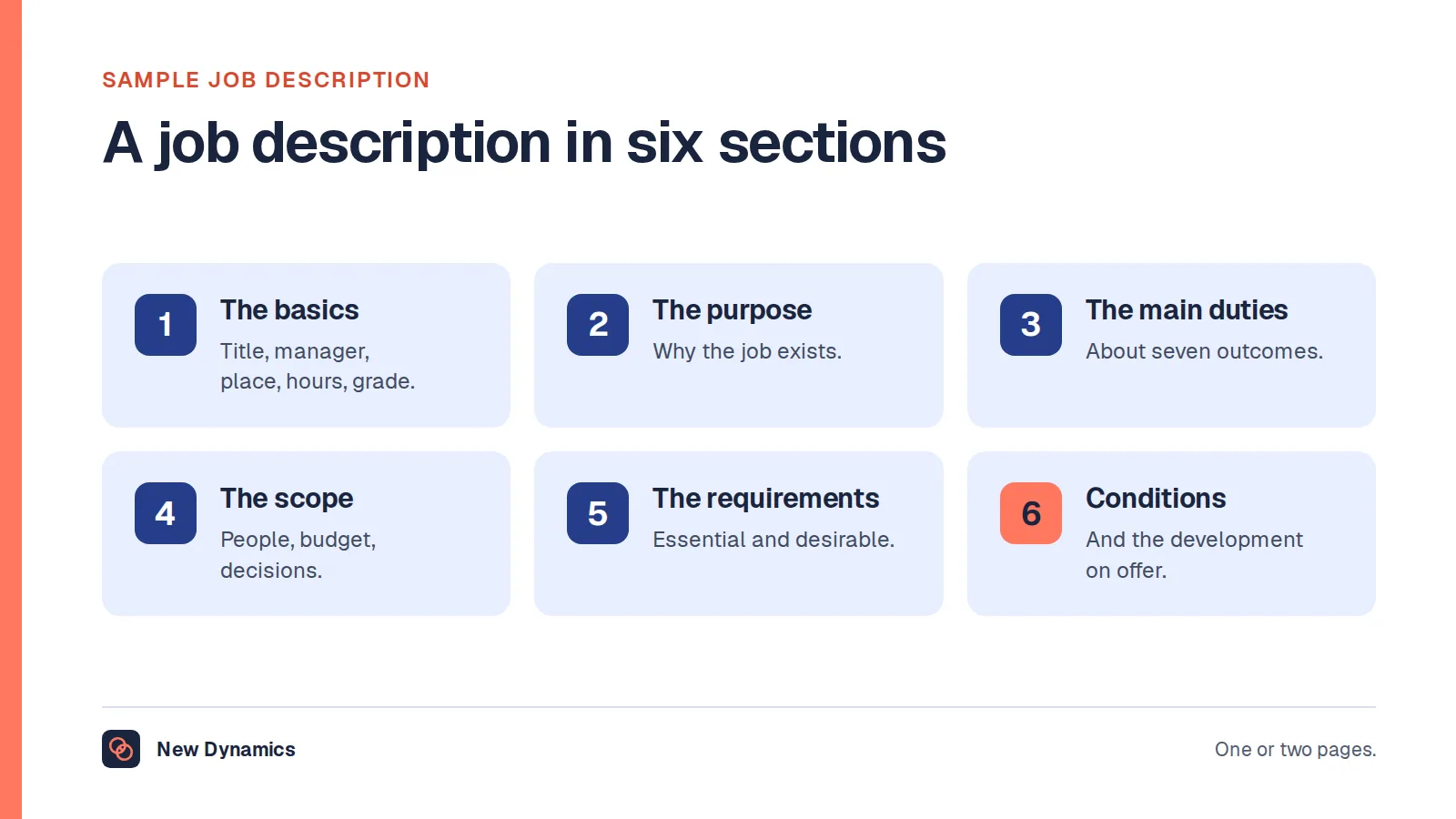
Job title: Housekeeper (room attendant)
Reports to: Housekeeping supervisor or head housekeeper
Hours: [Part-time or full-time], [early starts, weekends, split shifts as applicable]
Purpose of the role: To clean and present rooms and public areas to our standard, safely and in the time allowed, so that every guest arrives to a room that is ready.
Main duties:
- Prepare and stock the trolley and check equipment at the start of each shift
- Clean and make up [number] rooms per shift to the standard checklist
- Clean public areas and back-of-house areas to the schedule
- Restock supplies, sort and bag linen and report shortages
- Report maintenance faults, damage, lost property and any welfare concerns
- Use chemicals, equipment and lifting techniques as trained, and report hazards
Requirements:
- Reliable and able to work to a timed schedule
- Careful attention to detail and pride in presentation
- Physically able to bend, lift and stand for a full shift
- Honest and discreet when working in guests' rooms
- Experience welcome but not required; training on standards, chemicals and safety provided
We provide: Full induction, uniform and protective equipment, a room standard checklist, a named supervisor and a route to supervisor and head housekeeper roles.
Say the number of rooms per shift, the hours and whether the role includes laundry or public areas. Our job description template explains the structure, and our guide to the restaurant host job description covers another front-of-house role in the same standard.
Housekeeping job description for a CV
Employers want evidence of pace, standards and reliability. The lines below are invented examples, to show the form.
- State the volume. “Cleaned and presented 14 rooms per shift in a 200-room hotel to a checked standard.”
- Show standards. “Passed weekly supervisor inspections with no re-cleans in the last year.”
- Show reliability. “Full attendance across a summer season of early shifts.”
- Name the training. COSHH, manual handling, infection control, fire safety.
- For private households, describe the household size, the range of duties and the length of service, and offer references.
Common mistakes in housekeeping adverts
No room count. The number of rooms per shift is the job. Say it.
Hiding the hours. Early starts, weekends and split shifts belong in the first paragraph.
Silence on safety. An advert that does not mention training, protective equipment and safe lifting is telling candidates something.
Treating the role as unskilled. A housekeeper who spots the fault, the lost item or the welfare concern is worth a great deal. Advertise for attention, not just speed.
No route onward. Supervisors and head housekeepers come from the floor. Say so.
Frequently asked questions
What does a housekeeper do?
A housekeeper cleans and maintains rooms and public areas to a set standard. In a hotel that means preparing the trolley, cleaning and making up rooms, cleaning public areas, restocking and handling linen, reporting faults and lost property, and working safely with chemicals and equipment. In a private home it includes running the household.
What are the requirements for a housekeeper job?
Reliability and the ability to work to a timed schedule, attention to detail, physical fitness for bending, lifting and standing, and honesty and discretion in guests' rooms and people's homes. No formal qualifications are usually needed; employers train new starters on standards, chemicals and safety.
What is the difference between a housekeeper and a cleaner?
A cleaner cleans areas to a specification, often for a contractor in offices and public buildings. A housekeeper does the cleaning and also the presentation, linen, supplies and reporting, and in a private home runs the household. The safety rules on chemicals, slips, skin and lifting apply to both.
What should a housekeeping job description for a resume include?
Rooms per shift and the size of the property, inspection results, attendance, the training you have completed such as COSHH and manual handling, and, for private households, the household size, duties and length of service with references.
Do housekeepers need qualifications?
Usually not. Hotels and care providers train on their own standards, products and equipment. In England the hospitality team member apprenticeship standard includes a housekeeping function. Private households may ask for experience, a driving licence or cooking skills.
What safety training should housekeepers get in the UK?
Training on cleaning chemicals under COSHH, with protective equipment and data sheets; skin protection against dermatitis; safe lifting and pushing; and slip prevention. The HSE lists risk assessment, slips and trips, dermatitis, musculoskeletal disorders, work at height and COSHH as the common risks in cleaning.
Your next step
If you are hiring, write down the rooms per shift, the hours and the safety training you provide, and put all three in the first paragraph of the advert. If you are applying, rewrite one line of your CV with a room count and an inspection result.
For a plan that turns a housekeeper's first week into a confident first month, read and download our onboarding guide. The guide is free to read, and the PDF uses our short download form.
Want every new starter in housekeeping to get the same clear start? Book a New Dynamics demo and bring your current approach. You can also email contact@new-dynamics.com.