TL;DR
- A janitor, called a caretaker in the UK and a custodian in some US settings, is employed to take care of a large building such as a school, dealing with cleaning, security, maintenance checks and minor repairs.
- The job has seven duties: open, secure and lock the building, clean and keep communal areas tidy, check heating, lighting and alarm systems, do minor repairs and book contractors, order supplies, prepare rooms and take bookings, and supervise cleaning staff.
- A job specification pairs those duties with a person specification: practical skills, initiative, reliability and enhanced background checks as essentials, with trade experience and a driving licence as desirables. Employers must assess and control cleaning chemicals under COSHH in Great Britain.
Ask a head teacher who the most important person in the building is and, on the right day, the answer is the janitor: the person who found the leak before the pupils did, unlocked at six, cleared the ice from the steps and knows which boiler switch does what. A janitor job description that says "general cleaning and maintenance duties" undersells a job that keeps a building open.
This article gives a job specification of a janitor in two parts: the job description, with what the role is called elsewhere and seven duties, and the person specification with essential and desirable criteria. It adds the skills employers look for, the safety rules the job works within, the routes into the role in the UK, a template and wording for a CV.
Caretakers work alone for much of the day, so the tasks and checks need to live somewhere both sides can see. See how New Dynamics workflows let you shape forms, stages and approvals around the way you work.
What is a janitor?
The Cambridge Dictionary defines a janitor, a term it marks as mainly US or Scottish English, as “a person employed to take care of a large building, such as a school, and who deals with the cleaning, repairs, etc.”, and notes that the UK usually says caretaker. Custodian is a further US variant, common in schools.
The UK National Careers Service profiles the role as caretaker, listing janitor as an alternative title: “Caretakers look after buildings like schools, community centres and apartment blocks, keeping them secure, clean and well-maintained.” Typical hours are 38 to 42 a week, with evenings and weekends.
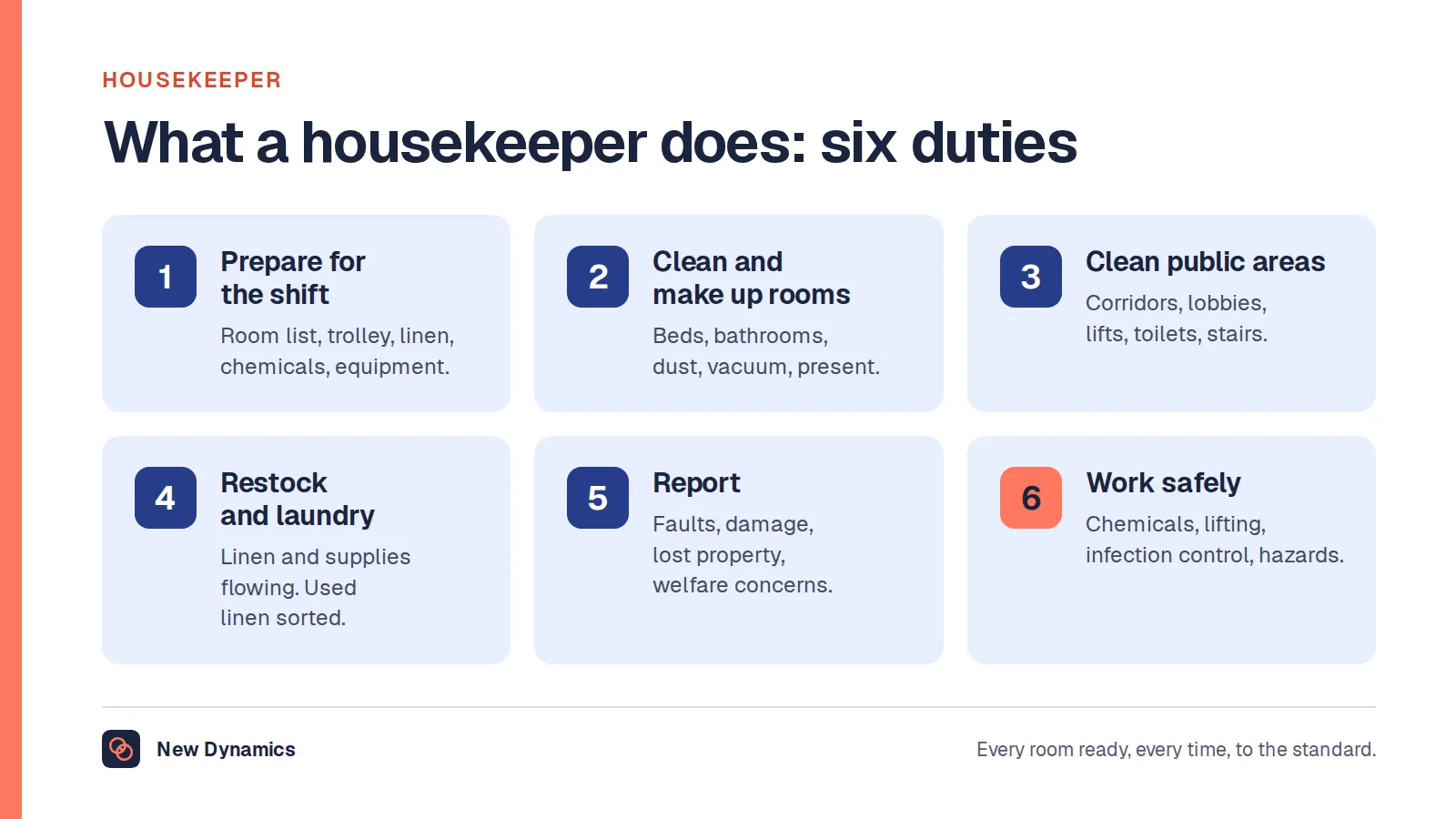
The job sits between two neighbours. A cleaner, which the NCS profiles separately, cleans; a maintenance technician repairs. The janitor does some of both and, in addition, holds the keys, watches the systems and is the building's first responder. Our housekeeper job description covers the cleaning-led role in hotels and homes.
Janitor duties: seven responsibilities
The NCS lists the day-to-day tasks of a caretaker. Grouped into seven:
- Open, secure and lock. Open up buildings in the morning and lock them at the end of the day; know the alarm and be the first call when it goes off.
- Clean and keep tidy. Keep communal areas clean and gardens neat and tidy, and deal with spills, litter, snow and ice.
- Check systems. Make sure heating, lighting and alarm systems are working properly, and carry out day-to-day maintenance checks.
- Minor repairs and contractors. Carry out minor repairs and book outside contractors for major repair work; let them in and check the work. Where the building has plant that needs skilled servicing, the role becomes a maintenance technician job.
- Order supplies. Order fuel, cleaning materials, new equipment and furniture as required.
- Prepare rooms and take bookings. Set up rooms for meetings or community use and take bookings where rooms are available for hire.
- Supervise cleaning staff. Direct and check the work of cleaners where the janitor leads a small team.

Janitor person specification
The job specification pairs the duties with the person needed. Every essential excludes candidates, so keep the list to what the job cannot be done without.
| Criterion | Essential or desirable | Assessed by |
|---|---|---|
| Practical skills: basic repairs, tools, safe use of equipment | Essential | Application, practical |
| Ability to work alone, use initiative and organise the day | Essential | Interview |
| Reliability, especially for early opening and late locking | Essential | References |
| Knowledge of public safety and security | Essential | Interview |
| Courteous with staff, visitors, pupils or residents | Essential | Interview |
| Enhanced background check | Essential | Pre-employment |
| Physical fitness for a physically active job | Essential | Interview, medical |
| Experience in building maintenance, cleaning, plumbing, carpentry, electrics or gardening | Desirable | Application |
| Driving licence | Desirable | Application |
| Level 2 property maintenance or facilities services operative apprenticeship | Desirable | Application |
The NCS lists the skills behind these: initiative, customer service, knowledge of public safety and security, thoroughness and attention to detail, working well with your hands, verbal communication, “a desire to help people”, ambition and the ability to use a computer or hand-held device. It notes that you will need to pass enhanced background checks and may need a driving licence for some jobs. Our guide to job requirements explains the essential and desirable split.

Safety: chemicals, heights and lone working
Cleaning chemicals. In Great Britain, cleaning products are covered by the Control of Substances Hazardous to Health regulations. The Health and Safety Executive's COSHH pages say the regulations “require employers to plan, manage and monitor the substances hazardous to health”, through assessment, control measures, safety data sheets, personal protective equipment and training. The NCS lists mixing cleaning chemicals and detergents “safely and in the right amounts” among a cleaner's daily tasks, and the janitor who orders and stores them carries the same responsibility.
Working at height. Changing a light fitting or clearing a gutter is work at height. The employer should provide the right equipment and training, and say what the janitor may and may not do alone.
Lone working. Early mornings and late evenings in an empty building need a check-in arrangement and a clear procedure for intruders, fire and injury.
Manual handling. Furniture, deliveries and salt bags. Training before the first shift.
HSE guidance applies in Great Britain; employers elsewhere have their own rules, and this is general information rather than legal advice. Our workplace safety tips cover the basics.
Routes into the role in the UK
The NCS lists two routes: applying directly, where you need good practical skills and some employers ask for GCSEs in English and maths, with experience in building maintenance, cleaning, plumbing, carpentry, electrics or gardening useful; or an apprenticeship, the property maintenance operative or facilities services operative level 2, taking one to two years.
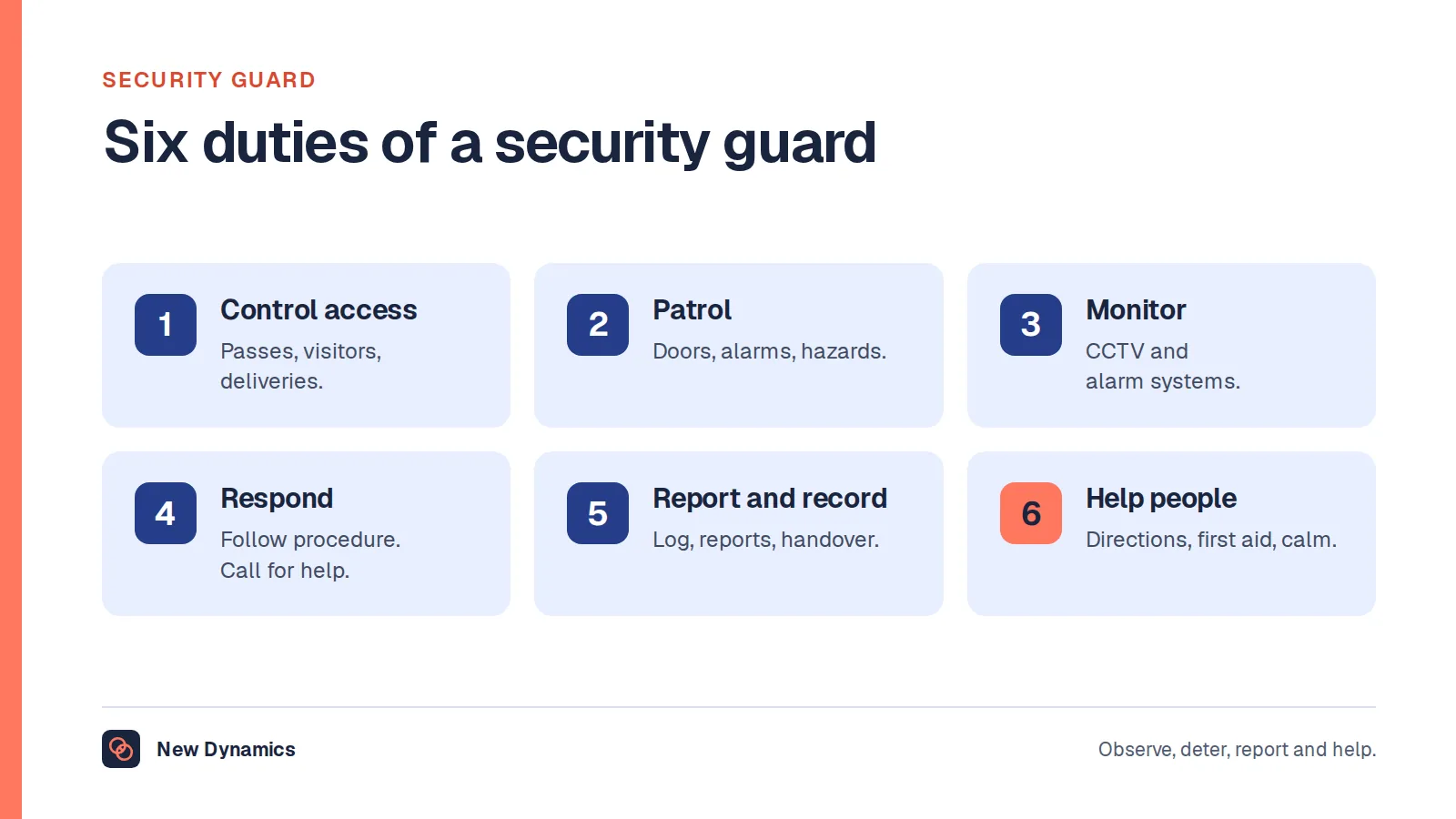
With experience, the NCS says, a caretaker could become a supervisor or move into facility services or cleaning management, or into related areas such as commercial property maintenance, security or work as an accommodation warden with a housing association. Our security guard job description covers one of those neighbouring roles.
Requirements differ in other countries. Check the rules where you work.
Janitor job description template
Adapt the template to your building. Keep every line true.
Job title: Janitor [UK: Caretaker / Site manager]
Reports to: Facilities manager, school business manager or property manager
Hours: [37] hours a week on a split shift, [6.30am to 10am and 3pm to 6.30pm], with occasional evenings and weekends for lettings and emergencies
Purpose of the role: To keep [building] secure, clean, safe and in good repair, open on time every day, and ready for the people who use it.
Main duties:
- Open and secure the building daily; respond to alarms as the first key-holder
- Keep communal areas, entrances and grounds clean and tidy, including snow, ice and litter
- Check heating, lighting, water and alarm systems and report faults
- Carry out minor repairs and arrange, admit and check contractors for larger work
- Order and safely store cleaning materials, fuel and supplies, following COSHH assessments
- Set up rooms for meetings and lettings and manage bookings
- Supervise [n] cleaning staff and check standards
Person specification: see the essential and desirable criteria above, with the assessment method for each.
We provide: Training in COSHH, manual handling, working at height and lone working; uniform and equipment; [on-site accommodation where applicable]; and a route to facilities supervisor.
State the building, the hours honestly, including the split shift and any key-holder call-outs, and whether accommodation is provided. Our job description template explains the overall structure.

How to describe janitorial work on a CV
Write what you looked after and what it meant. The lines below are our own examples.
- “Caretaker for a [600]-pupil primary school: first key-holder, daily systems checks and minor repairs across [n] classrooms and the hall.”
- “Managed lettings for [n] community bookings a month, setting up and clearing rooms.”
- “Carried out COSHH-assessed storage and use of cleaning chemicals; trained two cleaners.”
- “Coordinated contractors for a boiler replacement with no lost opening days.”
- “Kept the site open through [two] winters with a gritting plan.”
Common mistakes in janitor job adverts
Hours glossed over. Split shifts and key-holder call-outs are the job. Say them.
A cleaner's advert for a caretaker's job. If the role includes repairs, systems and security, the pay and the specification should reflect it.
Safety training unstated. COSHH, heights and lone working are legal expectations in Great Britain and practical ones everywhere.
Accommodation vague. If a flat comes with the job, say so and on what terms.
No route onward. Facilities supervisor and property maintenance roles come from this job.
Frequently asked questions
What is the job specification of a janitor?
The job description and person specification together. The duties: open, secure and lock the building, clean and keep it tidy, check heating, lighting and alarm systems, do minor repairs and book contractors, order supplies, prepare rooms and take bookings, and supervise cleaning staff. The person specification: practical skills, initiative, reliability, safety knowledge, courtesy and enhanced background checks as essentials.
What does a janitor do?
A janitor takes care of a large building such as a school: cleaning and tidying, opening and locking, checking systems, minor repairs, arranging contractors, ordering supplies, setting up rooms and supervising cleaners. In the UK the role is called caretaker; in some US settings, custodian.
What is the difference between a janitor and a cleaner?
A cleaner cleans. A janitor or caretaker cleans communal areas but also holds the keys, checks the building's systems, does minor repairs, arranges contractors and often supervises cleaners. The National Careers Service profiles the two roles separately.
What skills does a janitor need?
Practical skills with tools and equipment, initiative and self-organisation, reliability, knowledge of safety and security, attention to detail, physical fitness and courtesy with the people who use the building.
What qualifications does a janitor need?
None are required. Some employers ask for GCSEs in English and maths, and trade experience helps. In England the property maintenance operative and facilities services operative level 2 apprenticeships are routes in. Enhanced background checks are required for most posts.
What safety rules apply to janitorial work in the UK?
Cleaning chemicals fall under COSHH, which requires employers to assess, control and monitor hazardous substances. Working at height, manual handling and lone working each need assessment, equipment and training. HSE guidance applies in Great Britain.
Your next step
- Write the purpose statement with the building and the opening promise in it.
- Decide whether the role is caretaking or cleaning, and pay for what it is.
- Put COSHH, heights and lone working into the duties and the training you provide.
- Plan the first month: keys and alarms, systems walk-through, chemicals and a mentor.
For that first month, read and download our employee onboarding guide. The guide is free to read, and the PDF uses our short download form.
Want daily checks, contractor approvals and reviews for site staff in one place? Book a New Dynamics demo and bring your current job description. You can also email contact@new-dynamics.com.