TL;DR
- An indirect report is anybody below one of your direct reports. You carry accountability for their work without day to day line authority over them, and almost every problem with indirect reporting comes out of that gap.
- The gap does not reduce what the law puts on the employer. Equality Act 2010 section 109(1) treats anything done by an employee in the course of employment as also done by the employer, Health and Safety at Work etc. Act 1974 section 2(1) puts the duty on the employer rather than on a reporting line, and a grievance from an indirect report still falls under the Acas Code.
- No official United Kingdom source publishes a maximum number of indirect reports or a recommended figure. What can be decided is who appraises, who may open a record, and what happens when somebody escalates past their manager.
The awkward thing about an indirect report is not the definition. It is the position the relationship puts you in. You will be asked why their project slipped, why their team has a retention problem, why a complaint about their conduct was not dealt with sooner. You will not be the person who sets their objectives, approves their leave, writes their appraisal or holds their weekly one to one. Accountability sits with you. Authority sits with somebody else.
That gap is manageable, but only if everybody involved knows where it is. This article covers how far down the chain the term reaches, why matrix and dotted-line reporting are a different thing, who may and may not run the appraisal, how to hold a skip-level conversation without cutting the legs from under the manager in between, and what to do the day an indirect report walks past their manager and arrives at your desk. It describes the position in the United Kingdom and is general information, not legal advice.
A reporting line nobody can see is a reporting line nobody honours. See how New Dynamics org charts show roles, managers and the relationships between them in one place.
For the base definitions this article builds on, our post on the meaning of a direct report sets out what a direct report is and what the manager owes them.
What an indirect report is
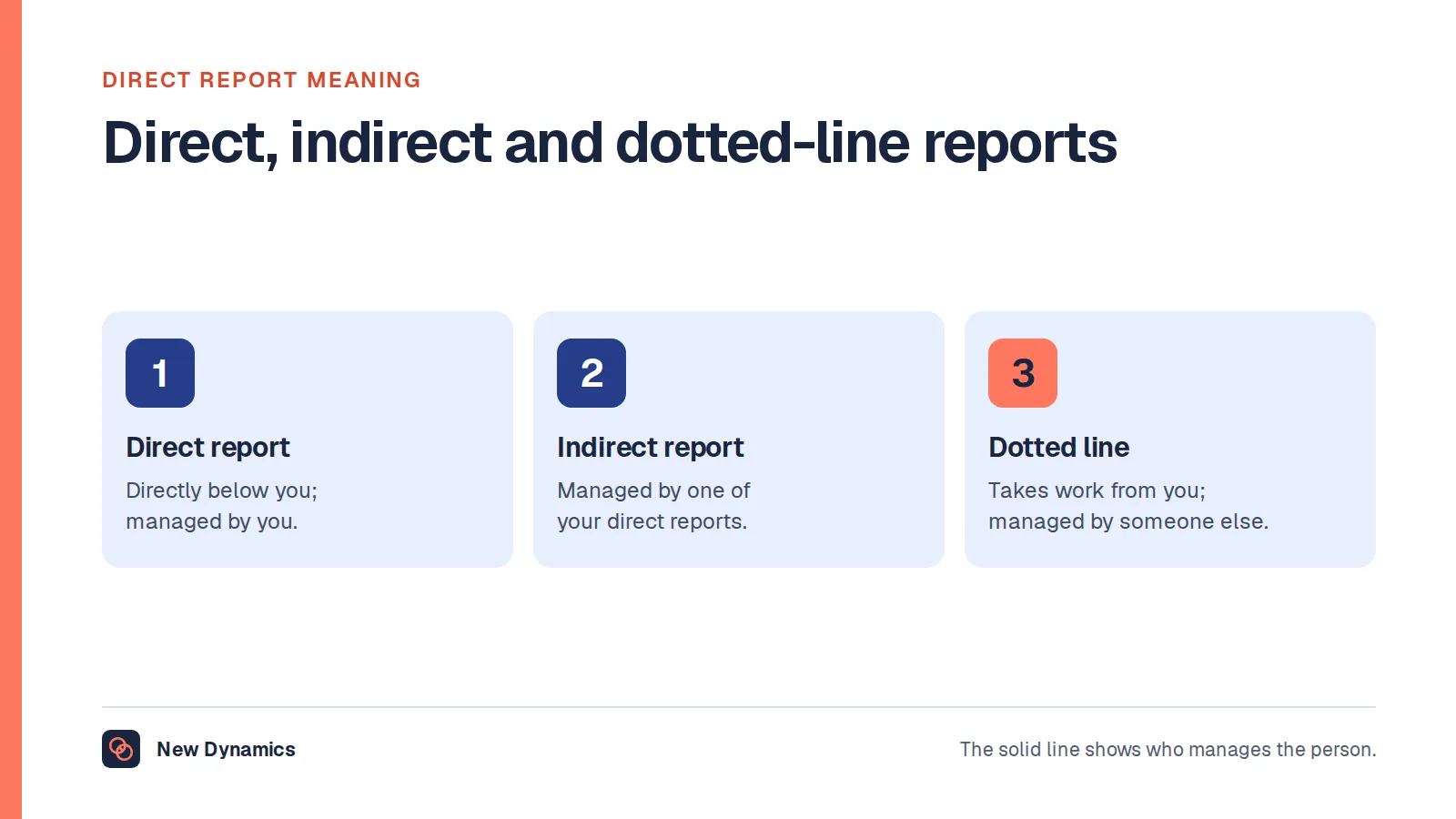
An indirect report is an employee who reports to one of your direct reports. You sit above them in the structure, their work rolls up into yours, and the person who actually manages them is somebody you manage.
Two consequences follow immediately, and they pull in opposite directions.
- You are answerable for the output. When the team under your direct report misses, it is your number. Nobody above you accepts "that was two levels down" as an explanation.
- You have no line authority over the individual. You do not set their objectives, approve their expenses, sign their holiday, rate their performance or discipline them. Doing any of those directly is not a shortcut, it is a decision to take the job off the manager in between.
Living with both at once is the whole skill. The answer is almost never to reach past the manager. It is to manage the manager well enough that you do not have to.

How far down the chain does the term reach?
As far as the chain goes. Everybody below you who is not a direct report is an indirect report: the people reporting to your direct reports, the people reporting to them, and so on to the bottom of the structure. A director with five heads of department, each with four team leaders, each with six staff, has five direct reports and one hundred and forty indirect reports.
In practice people use the phrase loosely for the layer immediately below their directs, because that is the layer they can actually name. It is worth being precise in writing. When a job advertisement says "leads a function of 140", a candidate reads a span. When it says "five direct reports and 140 indirect", a candidate reads a structure. Two very different jobs can hide behind the same headcount.
Skip-level is not a fourth category. It is a name for the conversation, not the relationship: a skip-level meeting is a meeting with an indirect report held without their manager present.
Matrix and dotted-line reporting are not indirect reporting
These three get blurred together constantly, and the blur is expensive, because each one answers the question "who decides?" differently.
| Relationship | Who manages day to day | Who writes the appraisal | Where it goes wrong |
|---|---|---|---|
| Indirect report | Your direct report, not you | Their manager, with your view of their manager | You reach past the manager and both of you lose authority |
| Dotted-line report | Their line manager, for everything formal | Their line manager, usually with your input | The dotted line quietly becomes a solid one and nobody says so |
| Matrix report | Two managers, both with standing claims | Both, through an agreed process | Neither manager owns the trade-off when the two demands collide |
The practical test is not where the line is drawn on the chart. It is who decides what the person works on this week when two people want different things, and who answers for the result.
An indirect report has exactly one line manager, and that manager is below you. A dotted-line report has exactly one line manager too, and that manager is usually not you at all; you simply draw on their work. A matrix report has two managers with real claims at the same time, which is why the arrangement needs a written rule about precedence rather than goodwill. Reviews in a matrix need more than one voice, which is the problem New Dynamics multi-manager reviews is built for.
Calling a matrix relationship "indirect" is the most common of these errors, and it causes the most damage, because it implies a hierarchy that does not exist and lets both managers assume the other one is handling something.
The gap does not reduce what the law puts on the employer
This is the part that catches senior managers out. Your lack of day to day authority over an indirect report is an organisational fact. It is not a legal shield, and the duties below sit on the employer, not on a particular rung of the ladder.
Discrimination and harassment two levels down
Equality Act 2010 section 109(1) is short and wide. It provides that "Anything done by a person (A) in the course of A's employment must be treated as also done by the employer". Section 109(3) closes the obvious escape route: "It does not matter whether that thing is done with the employer's or principal's knowledge or approval". Nothing in the section cares how far down the chain the employee sits. A team leader three levels below a director harassing one of their own staff is, for these purposes, the employer doing it.
What the employer gets instead is a defence, in section 109(4). In proceedings against the employer in respect of something allegedly done by an employee in the course of their employment, "it is a defence for B to show that B took all reasonable steps to prevent A" from doing that thing, or from doing anything of that description. Read that as a to-do list rather than a let-off. All reasonable steps means steps actually taken before the event: a policy people have seen, training that was refreshed rather than issued once at induction, a reporting route that works, and action on what came back through it. A senior manager who never checked whether the layer below them had done any of this has not made the defence easier.
Health and safety is the employer's duty and does not travel down the line
Health and Safety at Work etc. Act 1974 section 2(1) states that "It shall be the duty of every employer to ensure, so far as is reasonably practicable, the health, safety and welfare at work of all his employees". All employees, not all direct reports. Section 2(2)(c) extends the duty in particular to "the provision of such information, instruction, training and supervision as is necessary to ensure, so far as is reasonably practicable, the health and safety at work of his employees".
Supervision is named in the statute. You can delegate the task of supervising to a manager below you. You cannot delegate the duty, and "I had told the team leader to handle it" is an account of how the arrangement worked, not a reason it was adequate.
Who does the appraisal, and who may not
Default position: the direct line manager writes and delivers the appraisal of their own direct report. You do not write appraisals for indirect reports, and you do not rewrite them either.
What you legitimately do is narrower and more useful.
- Calibrate. Compare how your direct reports are rating their teams, and challenge a manager whose distribution looks unlike everyone else's. You are reviewing the manager's judgement, not the employee.
- Supply evidence. If you worked directly with an indirect report on something, give that to their manager as an input, in time to be used, and let the manager weigh it.
- Countersign. Many organisations have the grandparent manager sign off ratings. Sign-off is a check on process and consistency. It is not a second opinion on the person.
- Review your direct report on how they managed. How somebody appraises their own team is part of their job, and that belongs in their review, not in their team's.
Three things not to do. Do not deliver the rating yourself, because the employee will reasonably conclude their manager is a messenger. Do not change a rating without the manager present and persuaded. Do not give an indirect report feedback about their performance that their own manager has not heard first; that is how a manager finds out in the review that their boss has been running a parallel assessment.

What you may look at, and what you may not
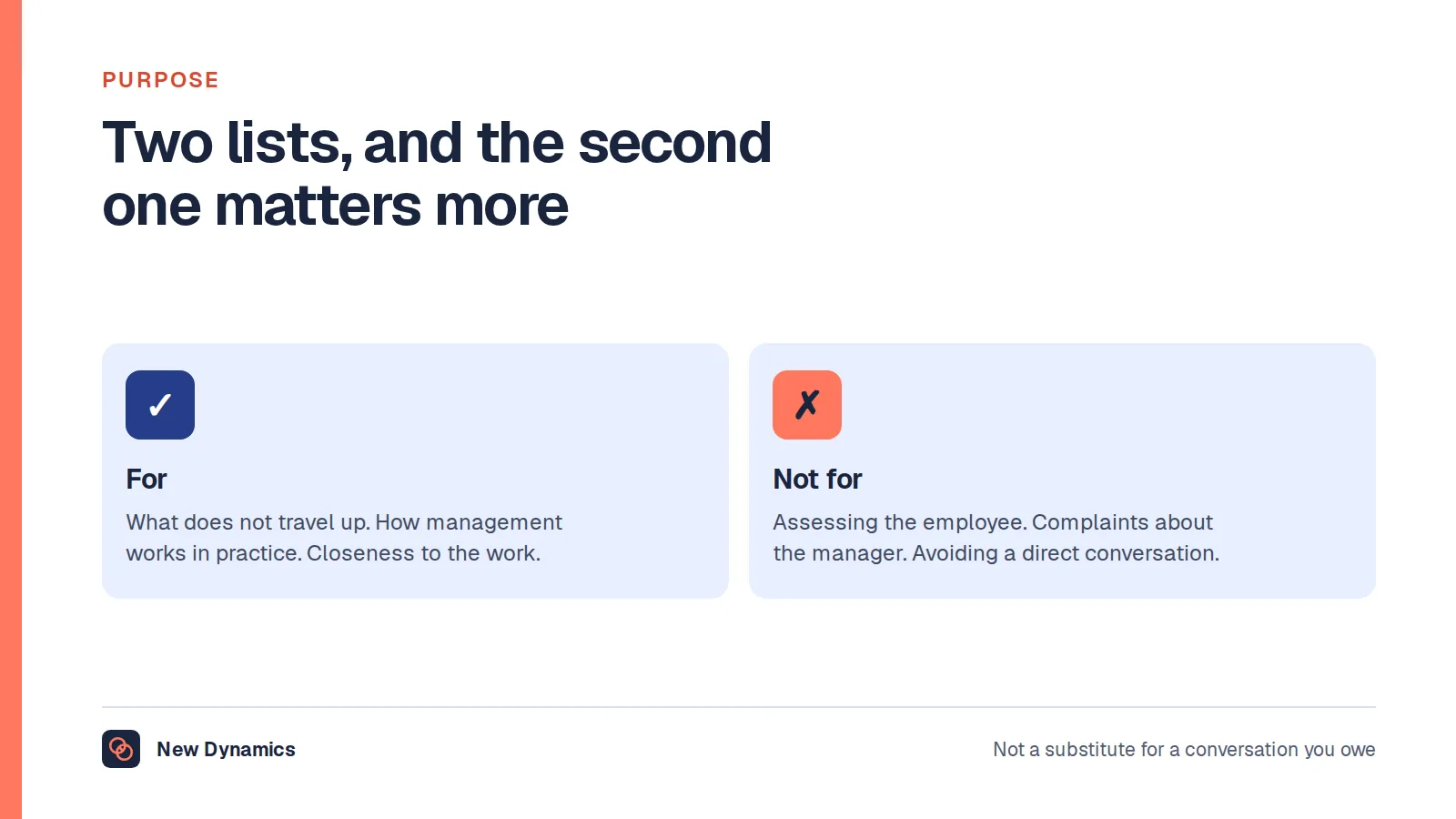
Accountability is not a key to the filing cabinet. A manager looking at an indirect report's record, particularly sickness absence or performance history, needs a reason connected to something they are actually responsible for deciding.
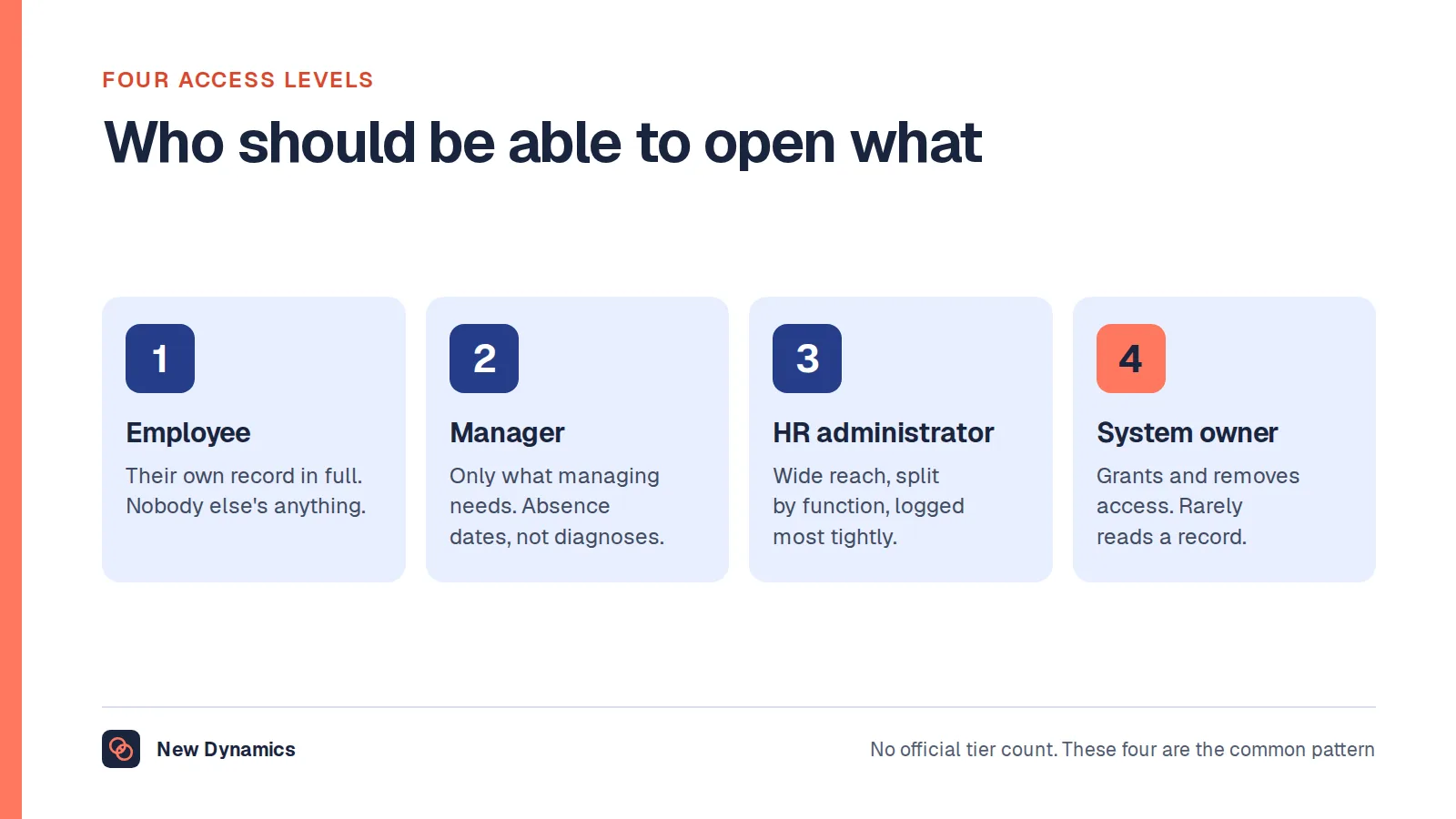
The Information Commissioner's Office puts access on a need-to-know footing. Its guidance on collecting and keeping employment records says records should only be accessed, altered, disclosed or deleted by those authorised to do so, and gives as its own example "ensuring that access to employment records systems is limited to HR staff only, and that managers only have access to the information they need to meet their obligations". On special category information, which includes anything revealing why somebody was off sick, it says you should think carefully about security, "limiting access only to those who need to see it".
The ICO's worked example on the same page is pointed for anyone two levels up. An organisation holding information about workers' health conditions and disabilities "determines which members of staff need to know this information (certain staff in Human Resources and workers' line managers) and makes sure no other staff have access to the records". Line managers. Not every manager above them.
So: aggregate absence for the department, yes, that is your business. One named person's sickness reason, read out of curiosity after a skip-level, no. If you need the detail to make a decision that is genuinely yours, such as a redeployment or a disciplinary appeal, you have a reason and should be able to state it. Our post on access levels for HR data sets out how to draw the grid so the system enforces this rather than relying on restraint.
Skip-level meetings without undermining the manager
A skip-level is the main legitimate contact you have with indirect reports, and the fastest way to damage a manager if you run it carelessly. Four rules do most of the work.
- Tell the manager first, every time. Not permission, notice. A manager who learns about it afterwards spends a fortnight guessing what was said.
- See everybody in a layer, not favourites. Selective skip-levels read as an investigation whether or not one is happening.
- Say at the start what you will do with what you hear. Themes travel upward. Individual complaints go through the proper route. Some things, safety and harassment among them, cannot be kept confidential, and people should know that before they speak, not after.
- Send fixes back through the manager. If something needs doing, the manager does it and gets the credit. If you fix it yourself you have told the team who to come to next time, and you have told the manager they are optional.
Ask about the work and the organisation rather than about the person in between. "What slows you down most?" and "what would you change about how this team runs?" get you further than any question shaped like an invitation to complain. Our guide to skip-level meetings covers the questions and the ground rules in detail.
When an indirect report escalates past their manager
Sooner or later somebody comes to you instead of their manager. Handle this badly in either direction, by brushing them off or by taking over, and you have a bigger problem than the one they brought.
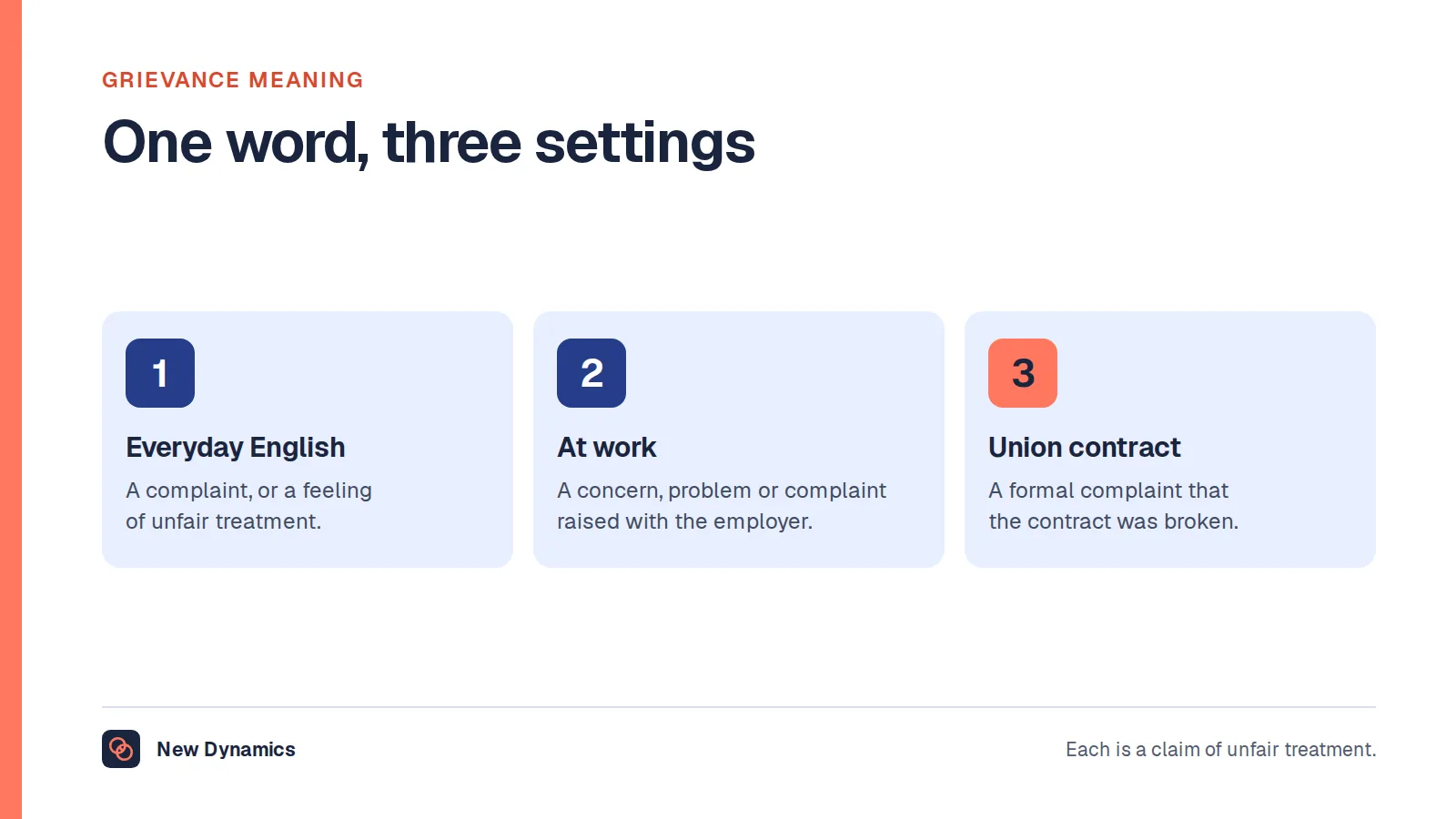
Start by working out which of three things it is. Information you can simply answer, in which case answer it and tell them to keep their manager in the loop. A concern they have not yet raised with their manager, in which case the right move is usually to coach them into raising it, and to tell the manager it is coming. Or a grievance, including one about the manager themselves, in which case the formal route applies.
The Acas Code of Practice on disciplinary and grievance procedures is the relevant standard, and it does not stop applying because the complaint arrived sideways. Paragraph 32 is directly on point: "If it is not possible to resolve a grievance informally employees should raise the matter formally and without unreasonable delay with a manager who is not the subject of the grievance". That is precisely the situation where somebody skips a level, and it means the escalation is not insubordination. It is the Code working. Paragraph 43 adds that an appeal "should be dealt with impartially and wherever possible by a manager who has not previously been involved in the case", which is a reason to hand the first hearing to a peer rather than keep it yourself and leave nobody independent for the appeal.
There is a cost to getting it wrong. The Code states that a failure to follow it does not in itself make a person or organisation liable to proceedings, "However, employment tribunals will take the Code into account when considering relevant cases", and that tribunals "will also be able to adjust any awards made in relevant cases by up to 25 per cent for unreasonable failure to comply with any provision of the Code". The Code was published on 11 March 2015 and Acas has consulted on an updated version, so check the current text before you build a procedure on it. Our post on the meaning of a grievance covers the process end to end.

Two practical points. Write it down the same day, because an informal conversation that later turns out to have been the first report of something serious will be reconstructed from your memory. And do not promise confidentiality you cannot deliver before you know what you are about to hear.
There is no published maximum number of indirect reports
Worth saying plainly, because a figure gets quoted as though somebody official had set it. No United Kingdom government body, regulator or statistics producer publishes a maximum number of indirect reports, a recommended total organisation size per senior manager, or an official ratio of levels to headcount. The Office for National Statistics does not collect a span of control series at all, and consultancy numbers circulating as benchmarks are somebody's internal rule of thumb, repeated until it sounded like a standard. We will not borrow one.
What you can measure is whether the structure is working: how many layers sit between you and the front line, whether each layer has a decision it genuinely owns, and whether anything you care about has to cross four handoffs to reach you. Our post on the average span of control sets out the arithmetic and the published figures that do exist, and the statistics hub collects the rest of the workforce data we cite.
Frequently asked questions
What is an indirect report?
An indirect report is an employee who reports to one of your direct reports, or to someone further down that chain. You are accountable for their work through their manager, but you do not set their objectives, approve their leave or write their appraisal.
What is the difference between a direct report and an indirect report?
A direct report is managed by you and sits directly below you on the chart. An indirect report is managed by one of your direct reports. The difference decides who holds the one to one, who approves leave and expenses, who writes the appraisal and who the employee goes to first.
How many levels down does an indirect report go?
All of them. Everyone below you who is not a direct report is an indirect report, however many layers away. In everyday use people often mean the layer immediately below their direct reports, so it is worth being explicit in a job description or an org chart.
Is a matrix report the same as an indirect report?
No. An indirect report has one line manager who sits below you. A matrix report has two managers with real claims on their time at the same time, which needs a written rule about whose work takes precedence. A dotted-line report takes work from you but is managed and appraised by someone else entirely.
Who should write an indirect report's appraisal?
Their own line manager. You can calibrate ratings across your direct reports, supply evidence where you worked with the person, and countersign for consistency. Delivering the rating yourself or overruling it without the manager present removes the manager's standing with their team.
Can a manager see an indirect report's sickness record?
Only with a reason tied to a decision they are responsible for. The Information Commissioner's Office puts access on a need-to-know basis, says managers should only have access to the information they need to meet their obligations, and names line managers rather than every manager above them in its own example of who needs health information.
Can an indirect report raise a grievance with me instead of their manager?
Yes, and sometimes they should. The Acas Code says an employee should raise a formal grievance with a manager who is not the subject of the grievance, which is exactly the case when the complaint is about their own manager. Follow the formal procedure rather than handling it quietly.
Is there a maximum number of indirect reports a manager should have?
No official United Kingdom source publishes one. There is no government figure, no regulator's limit and no national statistic for span of control. Judge the structure by whether each layer owns a real decision and whether information reaches you before it is too late to act on.
Your next step: close the gap on one team
- Write out your direct reports and, under each, the indirect reports you can actually name. The ones you cannot name are the ones you are accountable for blind.
- For each relationship on the list, mark it indirect, dotted-line or matrix, and check the HR system agrees. Fix any line that has quietly changed shape.
- Check who is named as the appraiser for each indirect report, and that it is their line manager rather than you.
- Open your HR system and look at what you can see about one indirect report. If you can read a sickness reason you have no decision to make about, that is an access problem, not a privilege.
- Put a skip-level round in the diary for one layer, tell the managers before you send the invitations, and agree in advance what you will pass back and how.
- Write down, in one paragraph, what you will do if an indirect report brings you something about their manager, and make sure your direct reports have read it.
For the process behind reviews where more than one manager has a view, read and download our multi-manager performance guide. The guide is free to read, and the PDF uses our short download form.
Want reporting lines, review ownership and record access to match the structure you actually run? Book a New Dynamics demo and bring your org chart. You can also email contact@new-dynamics.com.