TL;DR
- For a United Kingdom employer, sponsorship comes before recruitment. GOV.UK states it plainly: “You'll usually need a sponsor licence to employ someone to work for you from outside the UK.” No international recruitment agency can shortcut that, and GOV.UK adds that “Sponsoring someone does not guarantee that they'll get a visa to work for you in the UK.”
- For a worker, the single most useful rule to know is the fee rule. Section 6 of the Employment Agencies Act 1973 says an employment agency “shall not request or directly or indirectly receive any fee from any person for providing services ... for the purpose of finding him employment or seeking to find him employment”, with narrow exceptions. Anyone asking you to pay to be found a job is the problem, not the solution.
- Report an agency or an employer to the Fair Work Agency, which has replaced both the Employment Agency Standards Inspectorate and the Gangmasters and Labour Abuse Authority. Serious abuse or exploitation at work can be reported free on 0800 432 0804. Immigration rules change often, so this is general information, not legal or immigration advice.
Two people search for international recruitment agencies on the same afternoon, and they want very different things. One is an operations director in Leeds who cannot fill a role locally and wonders whether an agency can bring someone in from abroad. The other is a welder in Lagos or a care worker in Manila, messaged by an agent promising a job in England and asked for money.
The second person is the one at risk. So this article is written for both, and each section says which reader it is for: what an agency does, why a United Kingdom employer usually needs a sponsor licence first, the Skilled Worker route in outline, the duties that stay with the sponsor, and, for the work seeker, the law on fees, the warning signs and where to report one.
Once a sponsored worker starts, the sponsor has records to keep and a person to settle in. See how New Dynamics workflows let you shape forms, stages and approvals around the way you already work, so a hire with extra steps does not live in one inbox. Your right to work and sponsorship records stay your own compliance responsibility.
One statement first, repeated later because it matters: immigration rules in the United Kingdom change frequently. Every figure and duty below was read off the publisher's live page on 5 November 2026 and quoted as the publisher words it. This is general information, not legal or immigration advice. Check the current page and use a regulated adviser.
What an international recruitment agency actually does
The phrase covers several different businesses, and the differences are the whole story.
A cross-border search firm finds candidates in one country for employers in another, and is paid by the employer, usually a percentage of first-year salary or a retained fee in stages. Our article on the staffing agency sets out those fee shapes, which are the same whether the candidate lives in Birmingham or Bangalore.
A licensed labour provider supplies workers, often in agriculture, food processing or care, and may need a gangmaster's licence in Great Britain. The Fair Work Agency runs that licensing and publishes a route to check if a labour provider is licensed.
A migration or relocation consultancy advises on routes and documents. Giving immigration advice in the United Kingdom is a regulated activity, which we come back to below.
And then there are the operations that are none of the above. They use the words "international placement agency" or "agents for international jobs" because those are what people search for, and their business model is the fee they take from the work seeker rather than any placement.
The useful distinction is not the name on the website. It is who pays, and what the business can deliver. The limit applies to every category: an agency can find, screen and introduce a candidate. It cannot grant anyone permission to work in the United Kingdom. Only the Home Office does that, and it does it on the employer's licence.

For employers: sponsorship comes before recruitment, not after
Employers often get this the wrong way round: they run a search, choose a candidate, then ask the agency how to get them into the country.
GOV.UK's guide to UK visa sponsorship for employers opens with the position, quoted as published and as read on 5 November 2026: “You'll usually need a sponsor licence to employ someone to work for you from outside the UK. This includes citizens of the EU, Iceland, Liechtenstein, Norway and Switzerland who arrived in the UK after 31 December 2020.” It “includes unpaid work, like running a charity”, and you will not need a licence for “Irish citizens, those with settled or pre-settled status under the EU Settlement Scheme, those with indefinite leave to remain in the UK”.
Then comes the sentence that should be read out at the start of any conversation with an agency. GOV.UK says: “Sponsoring someone does not guarantee that they'll get a visa to work for you in the UK.”
The licence is yours, not the agency's. GOV.UK lists the sequence as: check your business is eligible, check the job is suitable, choose the licence type, decide who will manage sponsorship, apply online and pay the fee, after which “UK Visas and Immigration (UKVI) may visit your business to check it's suitable.” The eligibility page adds that “You'll need appropriate systems in place to monitor sponsored workers and people to manage sponsorship in your business”.
Two consequences follow for anybody weighing an agency. First, timing: GOV.UK's Skilled Worker visa pages say a licence application “usually takes around 8 weeks to process”, and that the fee is “£611 for small businesses and charities or £1,682 for medium and large organisations” (read 5 November 2026). Fees and times change, so check the live page. If you have no licence and need somebody in post next month, recruiting from abroad is not your route.
Second, promises. An agency that says it can place an overseas candidate without a licence is describing something GOV.UK does not: ask it to show you the page.

For employers: the Skilled Worker route in outline
Most sponsored hiring from outside the United Kingdom runs through the Skilled Worker route, and healthcare and education have separate pages.
GOV.UK's Skilled Worker visa overview describes it in one line: “A Skilled Worker visa allows you to come to or stay in the UK to do an eligible job with an approved employer.” To qualify, the applicant must “work for a UK employer that's been approved by the Home Office”, have “a ‘certificate of sponsorship’ (CoS) from your employer”, “do a job that's on the list of eligible occupations” and “be paid a minimum salary”. GOV.UK adds: “You must have a confirmed job offer before you apply for your visa.”
On salary, read as published on 5 November 2026: “You'll usually need to be paid the ‘standard’ salary rate of at least £41,700 per year, or the ‘going rate’ for your job, whichever is higher.” A lower floor applies in defined cases: the when you can be paid less page says an applicant “can be paid between 70% and 90% of the standard going rate” on meeting one of the listed criteria, and that for a job on the immigration salary list, “You must be paid at least £33,400 per year”. Thresholds move, so open the page before planning a salary.
The occupation is identified by a four-digit code. A code listed as “higher skilled” qualifies, and a “medium skilled” code qualifies only where the job is “on the immigration salary list”, “on the temporary shortage list”, or in the narrow prison officer case described there.
The certificate of sponsorship is the employer's act. GOV.UK: “The certificate of sponsorship is an electronic record, not a physical document.” The applicant “must apply for your visa within 3 months” of getting it, and a decision usually arrives “within 3 weeks, if you're outside the UK”.
One charge the employer cannot pass on. The immigration skills charge page sets the amounts at £480 for the first 12 months and £240 for each additional 6 months for a small or charitable sponsor, and £1,320 and £660 for a medium or large sponsor (read 5 November 2026). Then: “You must pay the immigration skills charge yourself. Your licence may be revoked if you ask the sponsored worker to pay the fee or any costs linked to your application.” If a proposal has the worker funding any part of your sponsorship, that sentence is your answer.
How much of the route is in use is published. The Home Office's accredited official statistics for work-related visas in the year ending June 2026, published 27 August 2026, report that “visas issued for the Skilled Worker route decreased by 26% to 61,120 in the YE June 2026”, and that “Following increases to the skill level requirements, over 100 occupations are no longer eligible for the Skilled Worker visa route.” Refusals rose to “15% in the YE June 2026 compared with 7% in the YE December 2023” across the combined Skilled Worker and Health and Care Worker routes, for the twelve months to 30 June 2026. For figures checked at the publisher, see our HR statistics hub.
A combined refusal rate of roughly one application in seven is not something an agency can promise its way around.
For employers: what to check before you engage an international recruitment agency
Specialism in international recruitment is cheap to claim. These checks are not.
Does the agency know which step you are on? Ask it to describe the sequence: licence, suitable job, certificate, application, decision. An agency that starts with candidates does not work with sponsors often.
Who pays, and is the worker paying anything? Get it in writing that no fee of any kind is charged to the work seeker for finding work, and that no sponsorship cost is recovered from the worker's pay. Ask the same of any partner agency in the candidate's home country, because the fee that matters is usually charged there.
Can you see the chain? International recruitment often runs through a local partner you never meet. Ask who it is, in which country, what it charges candidates, and whether it has been audited. "We work with trusted local partners" is not an answer.
Does it give immigration advice, and is it allowed to? GOV.UK's guide to finding an immigration adviser says that “All immigration advisers must be registered with IAA or be a member of an approved professional body”, meaning the Immigration Advice Authority. If your agency advises on applications, ask what its registration is.
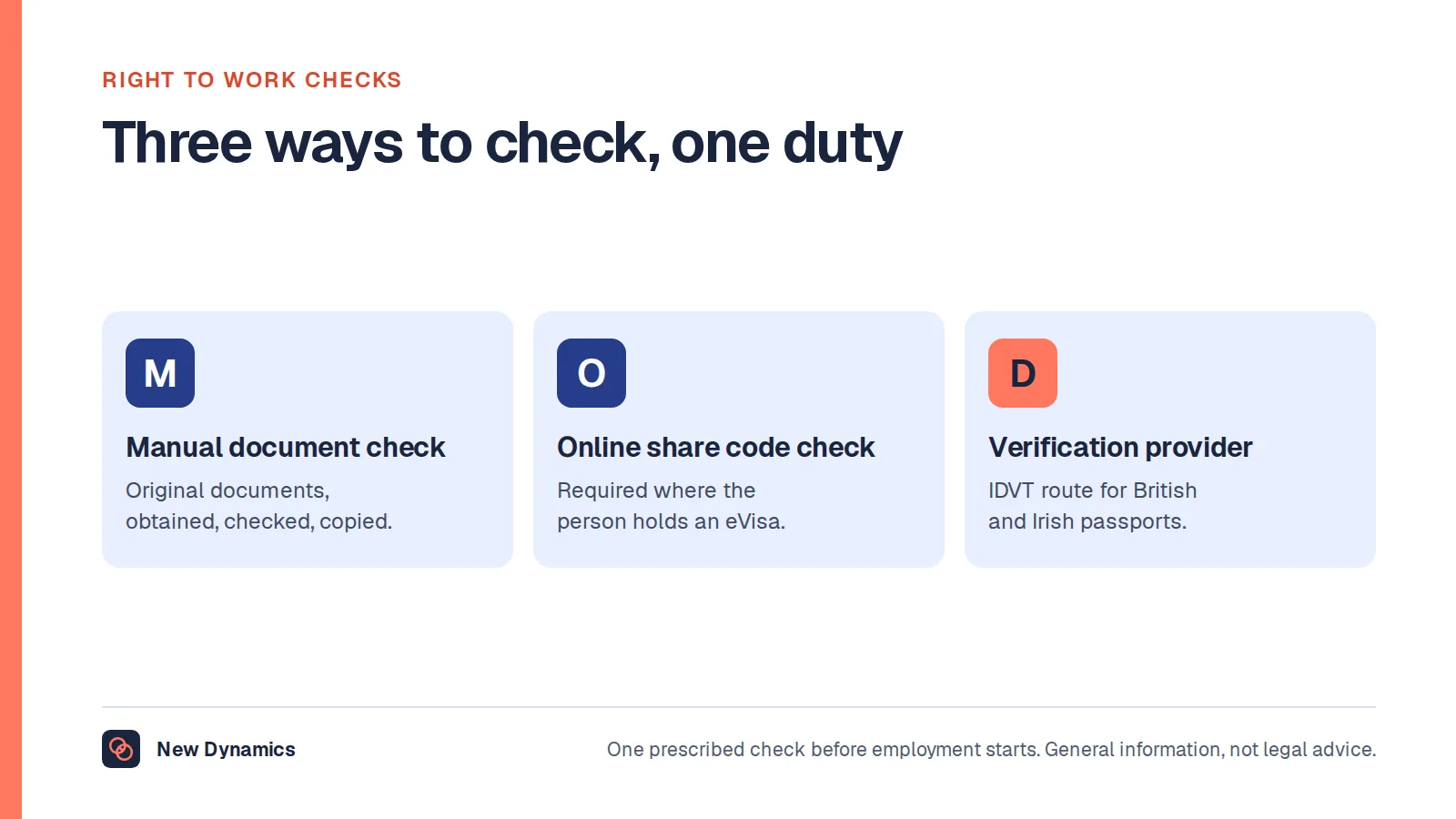
Who verifies documents, and who keeps the evidence? Right to work and qualification evidence is a sponsor duty. Our guide to the share code right to work check covers the check an employer performs. Agree in writing, before anybody is introduced, who bears the cost if a visa is refused.
What does the candidate get told? Ask to see the candidate-facing material. If it promises a visa, implies a guaranteed outcome or mentions a payment by the candidate, stop.
For employers: the compliance duties that stay with you as the sponsor
The licence brings duties no agency can take off your hands, and losing it is the sanction.
GOV.UK's your responsibilities page lists them. You must “check that your foreign workers have the necessary skills, qualifications or professional accreditations to do their jobs, and keep copies of documents showing this”, “only assign certificates of sponsorship to workers when the job is suitable for sponsorship”, “tell UK Visas and Immigration (UKVI) if your sponsored workers are not complying with the conditions of their visa” and “comply with UK employment law”. The consequence follows immediately: “Your licence may be downgraded, suspended or withdrawn if you do not fulfil these responsibilities.”
Then there is the systems duty, which catches organisations running sponsorship out of a spreadsheet. GOV.UK: “You must have HR systems in place that let you: monitor your workers' immigration status, keep copies of relevant documents for each sponsored worker, including evidence you've carried out the relevant right to work checks, track and record workers' attendance, keep worker contact details up to date, report to UKVI if there is a problem, for example if your worker stops coming to work.” Changes in your own circumstances, such as insolvency or a merger, must be reported “within 20 working days”.
The job suitability page says you can sponsor a worker if the job “complies with the UK minimum wage and working time regulations”, and warns that “the worker's visa may be refused and you may lose your sponsor licence if it does not”.
Separately, the right to work regime applies to every hire. GOV.UK's page on penalties for employing illegal workers says you “might have to pay a civil penalty (fine) of up to £60,000 for each illegal worker”, and that “You will not have to pay the civil penalty if you can show you made the correct right to work checks.” Figures change, so check that page.
Recruitment can be delegated. Sponsorship cannot. This is general information about what GOV.UK publishes, not legal or immigration advice, and a regulated adviser is the right person to apply it to your organisation.
For workers: in the United Kingdom, an agency cannot charge you a fee to find you work
If you take one thing from this article, take this. The rule sits in primary legislation. Section 6 of the Employment Agencies Act 1973, headed “Restriction on charging persons seeking employment, etc.”, provides at subsection (1)(a), in the words on legislation.gov.uk read on 5 November 2026:
“a person carrying on an employment agency shall not request or directly or indirectly receive any fee from any person for providing services (whether by the provision of information or otherwise) for the purpose of finding him employment or seeking to find him employment”
The words are wider than people expect. It is not only unlawful to take the money, it is unlawful to request it, and it covers a fee received “directly or indirectly”, which takes in a fee collected by a connected company, a local partner, a named individual or a deduction from later wages. Subsection (2) makes a contravention a criminal offence: “Any person who contravenes this section shall be guilty of an offence”.
Section 6 extends to England, Wales and Scotland. Northern Ireland has its own employment agencies legislation, which we have not opened here, so for work there check that jurisdiction rather than assuming this Act applies.
GOV.UK says the same in plain words on its page about agency fees: “Recruitment agencies cannot charge you a fee for finding or trying to find you work.” An agency “can charge you for certain services, for example CV writing, training or transport”, but it “cannot make you use these services as a condition for finding you work.”
The statutory exception is narrow. Regulation 26 of the Conduct of Employment Agencies and Employment Businesses Regulations 2003, headed “Circumstances in which fees may be charged to work-seekers”, provides that the restriction “shall not apply in respect of a fee charged by an agency for the service provided by it of finding or seeking to find a work-seeker employment in any of the occupations listed in Schedule 3.” Schedule 3 covers certain entertainment and modelling occupations. Unless you are being recruited as a performer or model, that exception has nothing to do with you.
So when an agent calls the fee processing, registration, training, a medical, a "job slot", a visa or a flight, test it against one question: am I being charged, directly or indirectly, in connection with being found work? If yes, in England, Wales and Scotland that is not a price. It is a breach, and a criminal offence.
Remember the employer's side, quoted earlier: a sponsor “must pay the immigration skills charge yourself”, and its “licence may be revoked” if it asks the worker to pay that fee or any linked cost. A genuine sponsored job does not need your money.
This is general information about the published law of England, Wales and Scotland, not legal advice. If you are already out of pocket, take advice from a regulated adviser or a solicitor.
For workers: the warning signs of an illegal or exploitative operation
Some signs point to an agency breaking the fee rules. Others point to something worse, and the government publishes that list.
Money before a job.
- A fee to apply, register or be "put forward".
- A fee for a visa the agent says they will arrange. Applications are made by you, online, to the Home Office, on a certificate the employer issues.
- A job that only materialises after payment, or keeps slipping while more payments are requested.
- A payment to a personal account, in cash or in crypto, with no receipt or contract, or a deduction from future wages to repay the "cost of bringing you over".
Facts that do not survive a check.
- No named employer, or an employer you are told not to contact.
- An employer you cannot find on the Home Office register of licensed sponsors, when the role is supposed to be sponsored.
- A salary below the published threshold for the route, or a job title that does not match the work described.
- Immigration advice from someone who cannot tell you their registration. GOV.UK says to “Check if the adviser is registered and if they charge a fee before you use them”, and warns: “You cannot get your money back if an adviser is not regulated.”
- Pressure to decide today, and a refusal to put anything in writing.
And the signs that mean stop and get help now. The Fair Work Agency's guidance on how to report serious abuse or exploitation at work, updated 3 August 2026 and read on 5 November 2026, says: “You're being seriously abused or exploited at work if you believe you're being controlled, threatened or manipulated. This could be an indicator of modern slavery.” Its published list of signs:
- “being threatened with violence or harm”
- “not being allowed to leave your workplace or accommodation”
- “not being allowed to speak to other people”
- “having your passport taken away”
- “not being allowed to get medical treatment”
- “being forced to live in accommodation provided by your employer”
- “being made to stay in unsafe or unsuitable accommodation”
- “having your wages withheld or being forced to give wages back to your employer”
- “being forced to work to pay off a debt that keeps increasing”
That last one is debt bondage, the usual end point of a recruitment fee charged abroad: the fee is lent, the debt grows, and the work never clears it. A passport taken away is the other standard control. Your passport is yours. An employer or agency may ask to see it for a check, and has no right to keep it.
The guidance is direct about immediate danger: “If you think you or someone else is in immediate risk of injury, call 999 and ask for the police.”

For workers: where to report an agency in the United Kingdom
Enforcement moved, so the body you were told to contact may no longer be right. This is what the GOV.UK organisation pages said when we read them on 5 November 2026.
The Employment Agency Standards Inspectorate page carries one line: “Employment Agency Standards Inspectorate was replaced by Fair Work Agency”. The Gangmasters and Labour Abuse Authority page carries the same kind of line: “Gangmasters and Labour Abuse Authority was replaced by Fair Work Agency”. The GLAA's old website at gla.gov.uk now redirects to the Fair Work Agency page on GOV.UK, which is why a GLAA contact you were given may not work. Gangmaster licensing continues, and the Fair Work Agency runs it.
So the body to go to is the Fair Work Agency, which describes itself in a sentence: “The Fair Work Agency acts to protect workers, support fair competition and ensure employers comply with the law.”
- Serious abuse or exploitation. Use the online form on the reporting guidance page, or email the address GOV.UK publishes for this,
contact@fairworkagency.gov.uk, or phone 0800 432 0804, “Monday to Friday, 9am to 5pm (except public holidays)”. GOV.UK adds that “You can still call outside of these hours and leave a voice message”, that “Calls are free”, that “We can arrange for an interpreter, if needed”, and that “We will not share your details with anyone you tell us about in your report.” - Pay problems, including “not being paid by an employment agency” or “not being paid National Minimum wage”: the complain about pay and work rights form.
- Bullying, harassment, unfair dismissal or a workplace dispute: GOV.UK directs you to Acas. For anything involving a certificate of sponsorship, it directs you to the report an Immigration or Border Crime form.
Contact details change, so open the pages above rather than relying on a number copied from anywhere, including here. You can report even if you paid, even if the agency operates outside the United Kingdom, and on someone else's behalf.
For workers: three free checks
Check the employer is a licensed sponsor. A sponsored job's employer should appear on the Home Office register of licensed sponsors, a “List of organisations licensed to sponsor workers on the Worker and Temporary Worker immigration routes.” No entry, no sponsored job.
Check the route and salary on GOV.UK, not with the agent. Compare what you were told with what the Skilled Worker visa pages publish: occupation code, salary floor, going rate, fee and timescale.
Check the adviser. GOV.UK's guidance on hiring an immigration adviser says to “get a signed and dated receipt if you pay them any money”, and that an adviser “must give you a letter immediately after you hire them” setting out the work, “how much you'll be charged” and “how you'll pay them”.
None of this is legal or immigration advice, and a regulated adviser is the right person to read your offer.
Why this site does not rank or list international recruitment agencies
People search for the best international recruitment agency, top overseas recruitment agencies and lists of agents for international jobs. So we will say it plainly: this site publishes no agency rankings, league tables or directories, for the United Kingdom or anywhere else, and does not name, rank or price agencies.
Two reasons, and neither is coyness. First, we have no evidence base. We do not audit placement records, local partners, what those partners charge candidates, or compliance history, and a list built from marketing pages would look like research without being research. In this category that is not harmless: a directory of overseas recruitment agencies is exactly the artefact a fee-charging operation wants to appear in.
Second, the question does not survive a real vacancy. "Best for international hiring" has no stable answer across a chartered engineer, a seasonal picker and a registered nurse, and for a work seeker the right question is never which agency is best. It is whether this offer stands up to the three checks above.
For employers: when recruiting from abroad is not the answer
Sponsorship is one route, and not always the right one. Four alternatives are worth testing first.
Hire someone already here with the right to work. Many of the people an employer imagines sponsoring already have status, and the check, not the passport, is what you verify. Our article on the share code right to work check explains how.
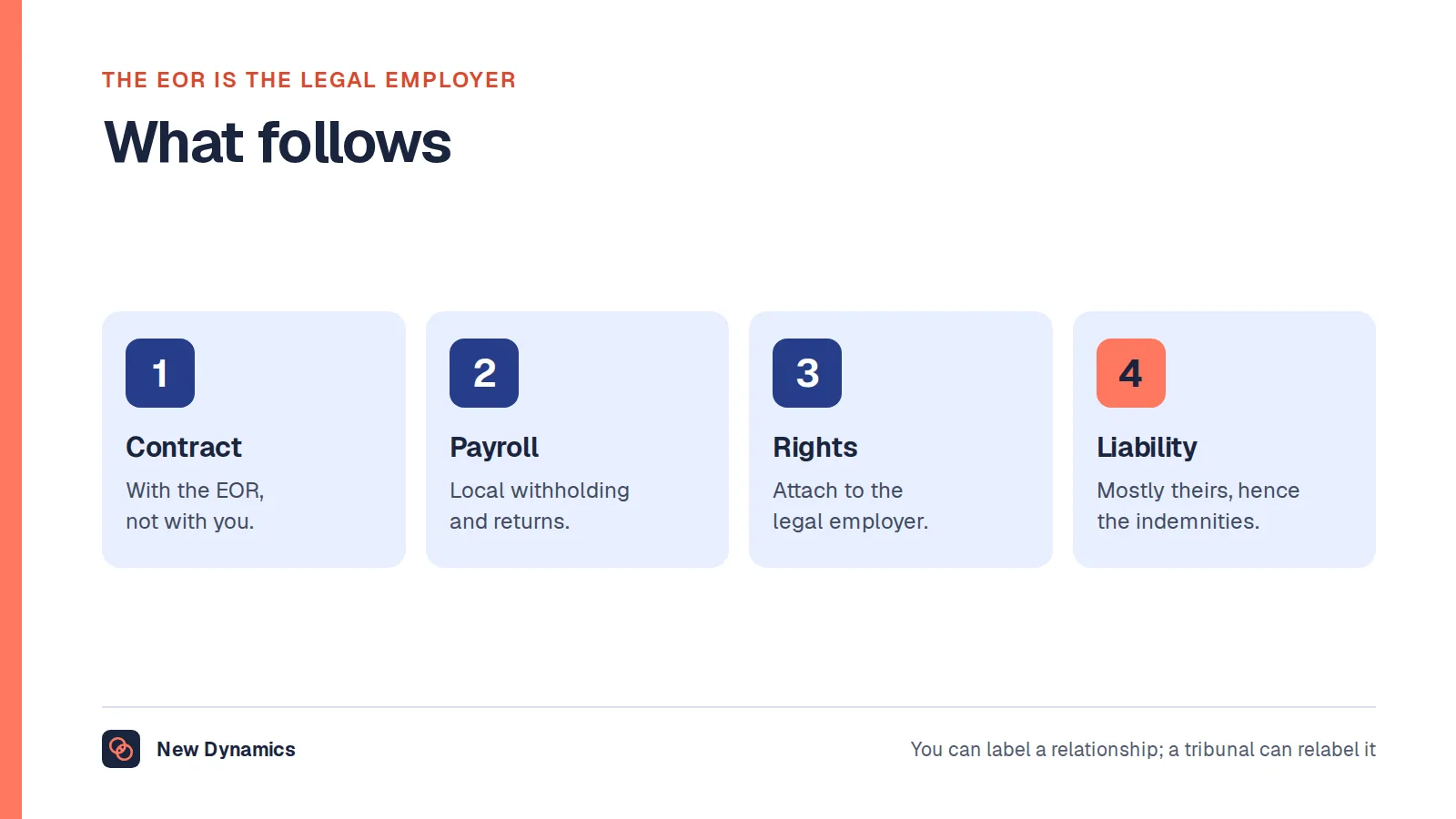
Employ the person where they already live. If the work can be done from abroad, an employer of record can employ someone in a country where you have no entity. Our article on the meaning of employer of record sets out what that does and does not solve.
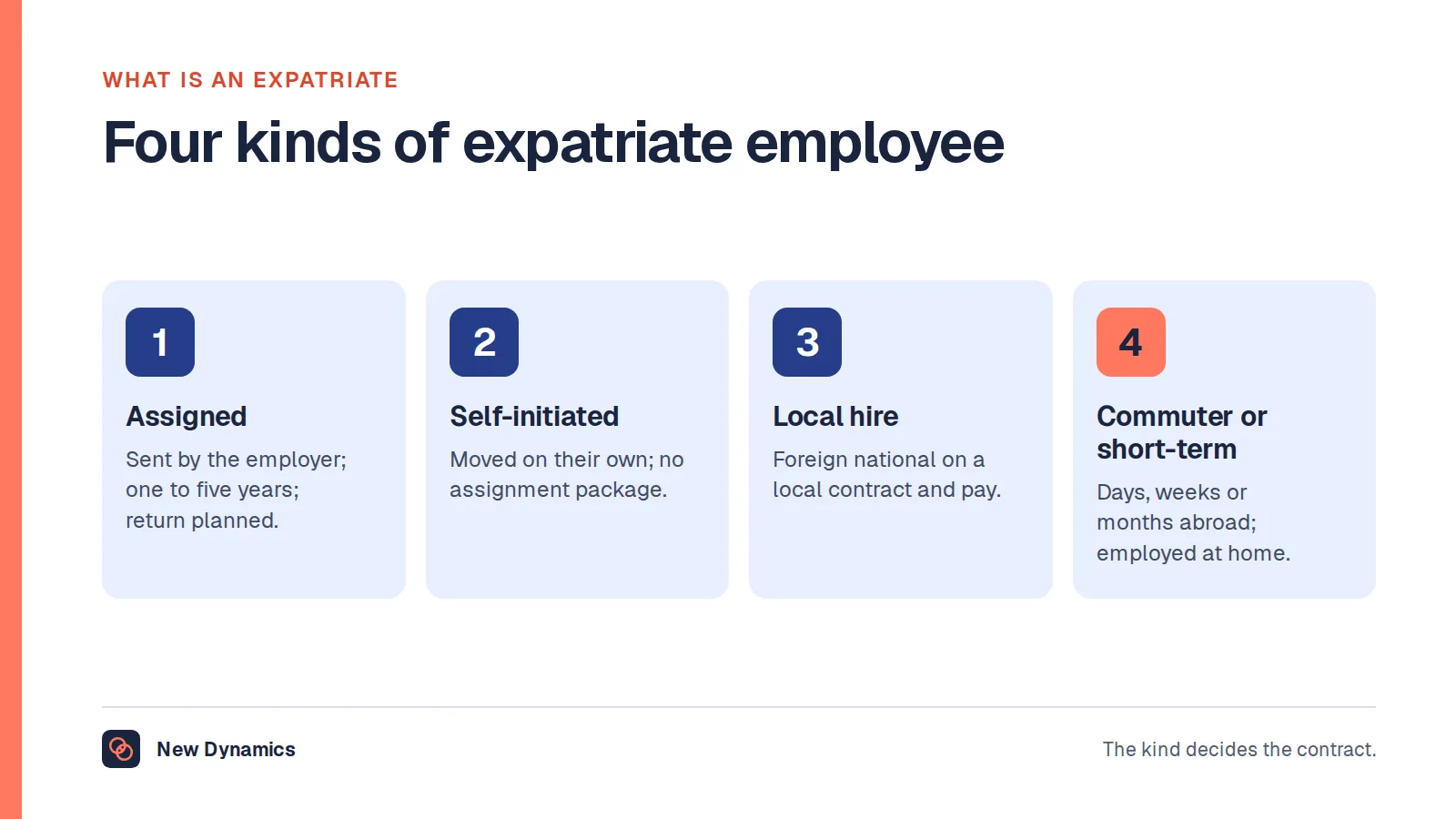
Send someone instead of bringing someone. For a defined project, an assignment may be cheaper. Our article on the meaning of expatriate covers the four kinds of expatriate employee.
Fix the role rather than widening the map. Sometimes a vacancy is not a shortage, it is a salary, a shift pattern or a job description.
Frequently asked questions
What does an international recruitment agency do?
It finds, screens and introduces candidates in one country to employers in another, and is normally paid by the employer. No agency can grant permission to work in the United Kingdom: that follows from the employer's sponsor licence and a Home Office decision.
Can an international recruitment agency get me a UK work visa?
No. GOV.UK states that “Sponsoring someone does not guarantee that they'll get a visa to work for you in the UK”, and the decision is the Home Office's. An agency can introduce you to a licensed sponsor, but a promise of a visa is one nobody can make. General information, not immigration advice.
Can an agency charge me a fee to find me a job in the United Kingdom?
Section 6 of the Employment Agencies Act 1973 says an agency “shall not request or directly or indirectly receive any fee from any person” for services for the purpose of finding them employment. GOV.UK puts it as: “Recruitment agencies cannot charge you a fee for finding or trying to find you work.” Narrow exceptions cover certain entertainment and modelling work.
Do I need a sponsor licence to hire someone from outside the UK?
GOV.UK says “You'll usually need a sponsor licence to employ someone to work for you from outside the UK”, including EU, Iceland, Liechtenstein, Norway and Switzerland citizens who arrived after 31 December 2020. Exceptions include Irish citizens and people with settled status or indefinite leave. Rules change, so check GOV.UK and take advice.
What is the minimum salary for a Skilled Worker visa?
On 5 November 2026, GOV.UK stated: “You'll usually need to be paid the ‘standard’ salary rate of at least £41,700 per year, or the ‘going rate’ for your job, whichever is higher.” A floor of £33,400 applies in defined cases, including a job on the immigration salary list. Thresholds change, so read the live page before relying on a figure.
Who do I report an international recruitment agency to in the United Kingdom?
The Fair Work Agency, which GOV.UK says replaced both the Employment Agency Standards Inspectorate and the Gangmasters and Labour Abuse Authority. Serious abuse or exploitation can be reported online, by email to contact@fairworkagency.gov.uk, or free on 0800 432 0804. For immediate risk of injury, call 999.
Your next step
If you are an employer:
- Check how many of your candidates already have the right to work here, before assuming you need a licence.
- If you do need one, read the GOV.UK sponsorship guide end to end and budget the fee and processing time before briefing any agency.
- Put the no-fee-to-the-work-seeker commitment, and the local partner chain, in the agency's written terms.
- Write down who keeps the sponsor records, and take advice from a regulated adviser on your own facts.
If you are a work seeker:
- Pay nobody to find you work. In England, Wales and Scotland, being asked is itself the breach.
- Check the employer on the register of licensed sponsors, and the route and salary on GOV.UK.
- Keep your passport, every message, and receipts for anything you have paid.
- Report it to the Fair Work Agency, free, on 0800 432 0804, and call 999 if anyone is at immediate risk.
For the fair, consistent selection process any agency should be working to in your name, read and download our recruitment and selection guide. The guide is free to read, and the PDF uses our short download form.
Want sponsored hires, relocations and local starters on the same onboarding steps and review cycle? Book a New Dynamics demo and bring the process you run today. You can also email contact@new-dynamics.com.
Immigration rules in the United Kingdom change frequently. Everything above was read at the publisher on 5 November 2026 and quoted as the publisher words it. It is general information, not legal or immigration advice, and no substitute for a regulated adviser.