TL;DR
- A staffing agency sells three different things. Temporary supply, where the agency engages and pays the worker and you direct the work. Contract placement, for a defined assignment, where the employer may be the agency, an umbrella company or the worker's own company. And permanent placement, where the agency introduces someone and you employ them yourself.
- Agencies charge in three shapes: a margin inside an hourly charge rate, a percentage of first-year salary on a permanent hire, and a retained fee paid in stages for search work. Ask for the pay rate and the charge rate separately, and get the rebate period in writing before you sign.
- In Great Britain the Employment Agencies Act 1973, the Conduct Regulations 2003 and the Agency Workers Regulations 2010 apply, work-seekers cannot be charged a fee for finding work, and the qualifying period is 12 continuous calendar weeks. In the United States the position is federal and state specific, and an agency and its client can be jointly responsible for the same worker. General information, not legal advice.
Most people meet a staffing agency at the worst possible moment. A role has been open for months, somebody has resigned with two weeks' notice, or a contract has been won and the work starts on Monday. The agency arrives as a rescue, and the paperwork is read later.
That is how hirers discover in month four that the charge rate never included holiday pay, or that the person in their building is not employed by anyone they hold a contract with. This article explains what an agency is, what it sells, who employs the worker, how agencies charge, the rules in each jurisdiction, what the American Staffing Association is, how to choose and brief an agency, and the attrition problem inside agencies.
Agency workers still need inducting, and still need to know what good looks like in week one. See how New Dynamics onboarding gives every starter the same checklist and early goals.
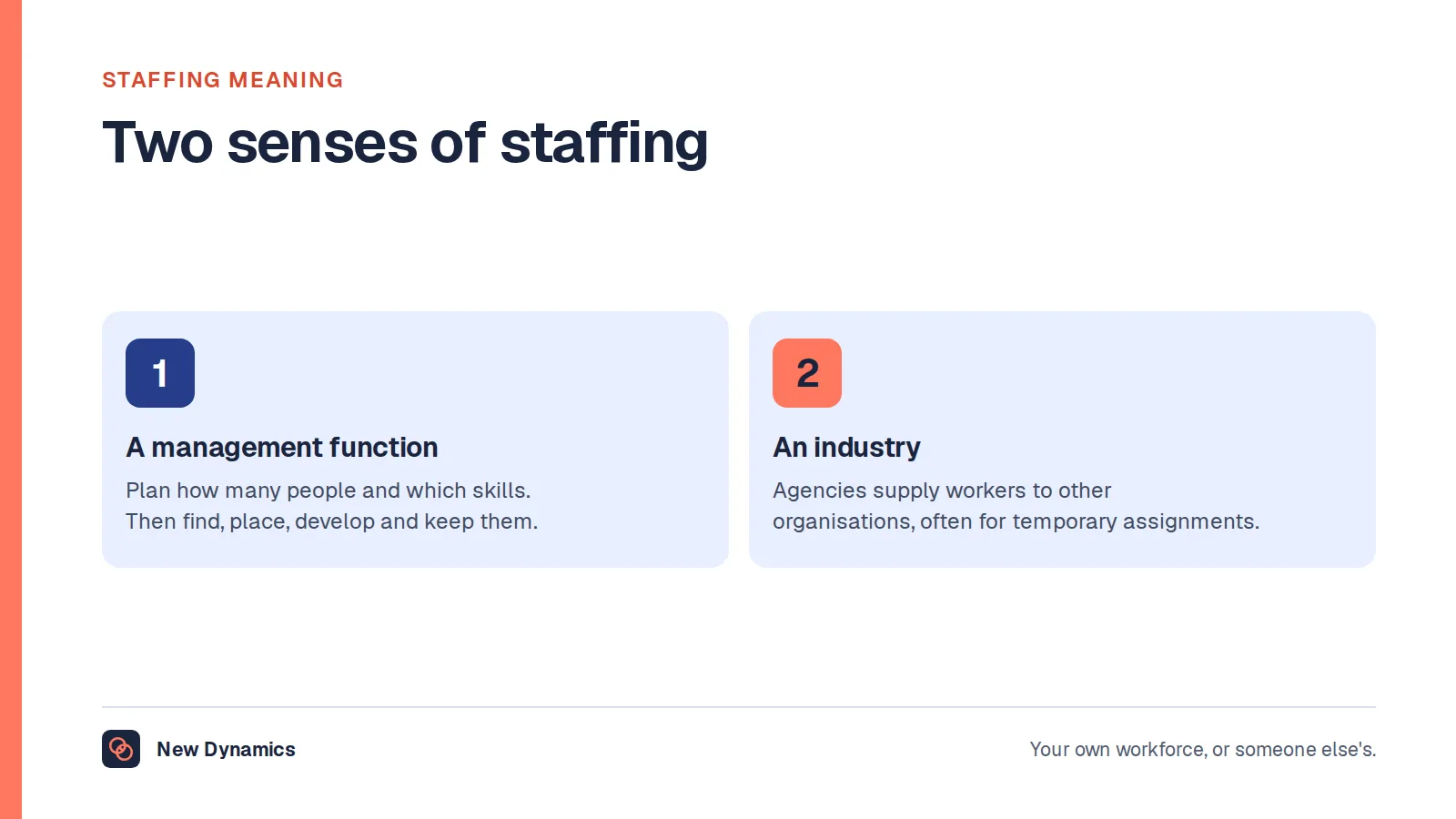
Our article on the meaning of staffing defines staffing as a management function. This one covers the agency.
What a staffing agency is
“Staffing agency” is a commercial term, not a legal one. It covers businesses that call themselves recruitment agencies, employment agencies, temporary work agencies, staffing firms, staffing companies or workforce solutions providers. Searches for a staffing company, staffing firms in a city or the best staffing services land on one industry.
In Great Britain the law does draw a line, and it matters more than the marketing. Section 13 of the Employment Agencies Act 1973 defines an employment agency as the business “of providing services (whether by the provision of information or otherwise) for the purpose of finding persons employment with employers or of supplying employers with persons for employment by them”, and an employment business as the business “of participating in employment arrangements”.
In everyday terms: an agency introduces people who then go on somebody else's payroll, and an employment business supplies people who stay on its own. One firm can be both, and most are. GOV.UK publishes guidance for employment businesses and agencies.
Legislation is quoted as made and is amended over time, so check the current text on legislation.gov.uk. The rules described apply in Great Britain unless another jurisdiction is named. General information, not legal advice.
Three things an agency sells, and who employs the worker
Almost every dispute about an agency comes back to a question nobody asked at the start: who employs this person?

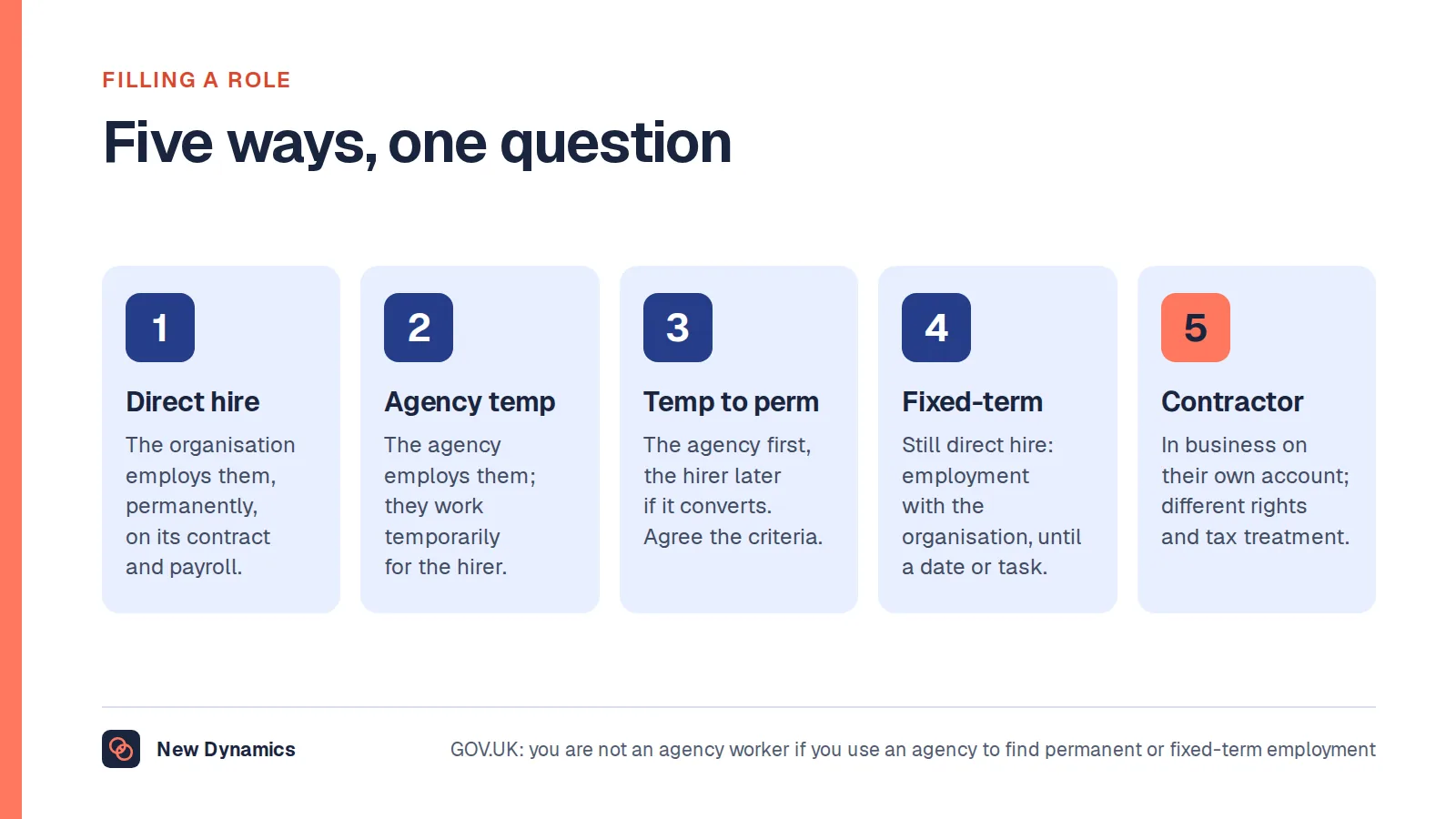
Temporary supply. The agency engages and pays the worker and supplies them to work for you. You direct the work hour by hour and the agency invoices you for the hours. GOV.UK puts the test simply in its guide to agency workers' rights: “You're an agency worker if you have a contract with an agency but you work temporarily for a hirer.”
Contract placement. A defined assignment, longer than a temporary booking and often tied to a project or a season. The employment picture is the most varied: the worker may be employed by the agency, by an umbrella company between the agency and the worker, or engaged through their own limited company. Our articles on employment status and the independent contractor explain why that changes rights, tax and liability.
Permanent placement. The agency introduces a candidate and you employ them directly, on your own contract, from day one. This is also called direct hire, and our guide to direct hire employment compares it with agency, temp to perm, fixed-term and contractor routes.
One hybrid is common enough to name. Temp to perm starts as temporary supply and converts to employment, which has its own fee consequences in Great Britain.
| Arrangement | Worker's contract is with | Who directs the work | Who pays the worker |
|---|---|---|---|
| Temporary supply | The agency | The hirer | The agency |
| Contract placement | The agency, an umbrella company, or none | The hirer or client | Whoever engages |
| Permanent placement | The hirer | The hirer | The hirer |
Write the answer for your arrangement into the first page of the terms. An agency that cannot state it plainly has told you something.
How staffing agencies charge: the three fee shapes
Published rate cards are rare, and prices vary by country, sector, seniority and volume. We do not publish agency prices, because any number we printed would be wrong within a month. What does not change is the shape of the charge, and that is what you need before you negotiate.
A margin inside an hourly charge rate. For temporary supply you agree a charge rate per hour. Inside that one number sit the worker's pay rate, the cost of employing them, and the agency's own costs and margin. In Great Britain those employment costs typically include employer National Insurance, automatic enrolment pension contributions and holiday pay; in the United States, federal and state payroll taxes, unemployment insurance, workers' compensation insurance and any benefits. Ask for the pay rate and the charge rate separately, and which of those costs the gap covers. A single quoted figure hides whether holiday pay is inside it or billed on top.
A percentage of first-year salary. For permanent placement the usual shape is contingent: a percentage of first-year salary, invoiced when the person starts. What counts as salary (basic pay only, or basic plus bonus and benefits) is where most of the argument lives. So is the rebate, sometimes called a claw-back or guarantee period: if the person leaves or is dismissed inside a defined window, you get some or all of the fee back, or a replacement search.
A retained fee paid in stages. For search work, usually senior or scarce roles, the agency is paid in instalments: on engagement, on shortlist, on appointment. You pay whether or not the search succeeds, which buys dedicated effort, and it suits a role where the realistic pool is small and has to be approached rather than advertised.
A fourth shape sits in the terms rather than on the invoice: the transfer fee, charged when a temporary worker becomes your employee. In Great Britain, regulation 10 of the Conduct Regulations restricts it. It defines a transfer fee as “any payment in connection with the work-seeker taking up employment with the hirer”, and requires the contract to give the hirer the option instead to elect for “a hire period of such length as is specified in the contract during which the work-seeker will be supplied to the hirer”. If your terms carry a transfer fee with no extended hire option, read the regulation before agreeing it.
The rules in the United Kingdom
The Act and the Conduct Regulations 2003
The Act sets the framework. The detail sits in the Conduct of Employment Agencies and Employment Businesses Regulations 2003, statutory instrument 2003 number 3319. Its contents list reads like a history of what went wrong in this industry, because each heading is a prohibition or a duty: a “Restriction on charges to hirers”, a “Requirement to obtain agreement to terms with hirers” and “Information to be obtained from a hirer”.
In short: the agency must agree written terms with you before it supplies anybody, must obtain information from you about the role first (which is why a good consultant interrogates your brief), and must confirm the work-seeker is suitable.
No fee to a work-seeker for finding work
This is the clearest protection in the regime, and the one candidates most often do not know. GOV.UK states it without qualification: “Recruitment agencies cannot charge you a fee for finding or trying to find you work.” The page on agency fees sets out the narrow space that remains. Agencies “can charge you for certain services, for example CV writing, training or transport”, must give full written details before charging, and “cannot make you use these services as a condition for finding you work”.
The statutory exception is narrow. Regulation 26 provides that the restriction “shall not apply in respect of a fee charged by an agency for the service provided by it of finding or seeking to find a work-seeker employment in any of the occupations listed in Schedule 3”, which covers certain entertainment and modelling occupations. For everything else, charging a work-seeker to find them work is not a pricing choice, it is a breach.
The Employment Agency Standards Inspectorate, and what replaced it
Enforcement sat for years with the Employment Agency Standards Inspectorate, a small team in the business department that investigated complaints against agencies, inspected records and could seek prohibition orders against the individuals running them. GOV.UK's page for the inspectorate carries one line on its status: “Employment Agency Standards Inspectorate was replaced by Fair Work Agency”.
GOV.UK describes the Fair Work Agency in a sentence: “The Fair Work Agency acts to protect workers, support fair competition and ensure employers comply with the law.” Its pages route complaints about pay and work rights and reports of exploitation at work, so that is where a complaint about an agency starts.
Agency workers and the twelve week qualifying period
The Agency Workers Regulations 2010 give agency workers the right to the same basic working and employment conditions as a comparable employee of the hirer, once a qualifying period has been served. Regulation 7(2) is precise about that period: “To complete the qualifying period the agency worker must work in the same role with the same hirer for 12 continuous calendar weeks, during one or more assignments.”
Each word is load-bearing. It is weeks, not hours, so a worker on two days a week accrues at the same rate as one on five. It is the same role with the same hirer, so a genuine change of role can restart the clock, while shuffling job titles to dodge the threshold is what the anti-avoidance provisions address. And it is continuous, with rules on which breaks pause the clock.
Separately, the agency owes the worker information from the start. GOV.UK's page on the basic information you should receive says a work-seeker must be given “a key information document” and written terms of engagement before being offered work. That document must cover “the minimum rate of pay you can expect”, a sample payslip estimating take home pay, who is paying them, any fees and any benefits. When an assignment is offered, the written statement must cover the start date, the likely length, the work, the location, the hours, expenses, health and safety risks and the qualifications needed.
You do not write those documents, but you are the reason they can be accurate. If the agency cannot tell a worker the hours, the location and the risks, it is because you did not tell the agency.
The rules in the United States: co-employment and joint employment
American practice uses two words that are often treated as synonyms and are not.
Co-employment is an industry term for the commercial reality of temporary staffing: the agency and its client both have a relationship with the same worker, and divide the duties of an employer between them by contract.
Joint employment is a legal conclusion, reached statute by statute. Whether an agency and its client are both employers of the same worker is answered differently under wage and hour law, discrimination law, labour relations law, safety law and each state's own statutes. No single federal test settles it for all purposes, and state law can reach further than federal law, so treat any blanket statement that a client “is” or “is not” the employer with suspicion.
The safety position is the clearest, because the regulator has published it. OSHA's page on protecting temporary workers says that “Temporary staffing agencies and host employers share control over the worker, and are therefore jointly responsible for temporary workers' safety and health”. It is blunt about what that means: “Host employers must treat temporary workers like any other workers in terms of training and safety and health protections”, and “Staffing agencies have a duty to inquire into the conditions of their workers' assigned workplaces.” OSHA adds that it “could hold both the host and temporary employers responsible for the violative condition(s)”.
On pay, protection follows the employment relationship. The Department of Labor's fact sheet on the employment relationship under the Fair Labor Standards Act states: “For a worker to be protected by the minimum wage and overtime pay requirements of the FLSA, the worker must be an ‘employee’ of the employer, meaning that there is an employment relationship between the worker and employer.” The test it describes is one of economic reality, which is why the contract label matters less than how the work is really organised.
Three consequences for an American hirer. Licensing and bonding of employment agencies is a state matter, so check the requirement where the work happens, not where the head office sits. Workers' compensation and unemployment insurance should be evidenced by certificate, because a gap lands on you. And put agency workers through your own safety training. The rules are federal and state specific, and this is general information, not legal advice.
Trade associations, and what the American Staffing Association is
A trade association is funded by the companies in an industry to represent them collectively: to lobby, publish research, run training and certification, and set a code of conduct members agree to follow. Useful, and by design on the industry's side. It is not a regulator: membership is a signal about standards, not a licence, and expulsion is not an enforcement power.
The American Staffing Association is the United States trade body for this industry, and these are its own words from its website rather than a second-hand description. It says: “The American Staffing Association is the voice of the U.S. staffing, recruiting, and workforce solutions industry.” On what it does: “ASA and its state affiliates advance the interests of the industry across all sectors through advocacy, research, education, and the promotion of high standards of legal, ethical, and professional practices.”
Its about pages add a conduct requirement: “ASA members agree to adhere to a strict code of ethics that guides their operations and their interactions with employees and clients.” It also runs a credential, the Certified Staffing Professional.
ASA makes one claim about the size of the industry worth attributing precisely, because it is the association's own figure and not an official statistic: the industry, it says, “provides outstanding job and career opportunities for some 11 million employees per year”. Treat it as ASA's annual characterisation of its own industry.
The United Kingdom has a counterpart. The Recruitment and Employment Confederation says on its about page that “The REC is the voice of the recruitment industry, speaking up for great recruiters” and that members “adhere to our Code of Professional Practice”. Again, a trade body, not the regulator.
So when an agency says it belongs to a staffing association, do not be reassured. Ask which code it signed, what the complaint route is, and whether it will attach the code to your terms.
Why we do not rank agencies or publish local lists
People search for the best staffing agency in New York, staffing agencies in Boston, a staffing company in Boston, staffing firms in NYC, top rated staffing agencies, top US staffing firms, the top IT staffing companies in the USA and the best staffing company in the country. So we will say it plainly: this site does not rank staffing agencies and does not publish local directories, for Boston, New York or anywhere else.
Two reasons, and neither is modesty. First, we have no evidence base for a ranking: we do not audit agencies' placement records, margins or compliance history, and a list assembled from marketing pages is worse than no list, because it looks like research. Second, the question does not survive a real vacancy: “best in Boston” has no stable answer across a warehouse shift, a nonprofit finance director and a controls engineer.

Specialist agencies: engineering, IT and nonprofit staffing
Specialism is the claim in this industry that is cheapest to make and easiest to test. Four questions find out, and they work in any city and any sector.
Can the consultant read the job? Give them the job description and ask what they would change and what is missing. An engineering staffing consultant who cannot tell a design engineer from a manufacturing engineer, or who does not ask which standards and which software, will send you both and let you sort it out. Our competency framework article helps you write the brief that makes the test possible.
Where does the pool come from? A genuine specialist has a network in the field. A generalist has a job board subscription and a keyword search. Ask how many people in this discipline they spoke to last month, and who will own your role, because specialism belongs to consultants rather than logos.
Do they know the sector's constraints? Here the sectors diverge.
- Engineering staffing turns on verifiable competence: professional registration and chartered status, safety-critical qualifications, site access cards, and the standards and tools the role uses. Ask who verifies the certificate and keeps the copy.
- IT staffing turns on contract shapes and status. In Great Britain the off-payroll working rules and umbrella arrangements decide who carries the tax risk, and an agency that cannot explain its position is a liability.
- Nonprofit staffing, which United Kingdom readers know as charity sector recruitment, turns on funding. Posts are often grant funded, so the contract is a fixed term tied to the grant, and pay bands are published. Nonprofit staffing firms that understand this will tell you your shortlist depends on the mission and the flexibility, because they cannot compete on salary.
How to choose an agency and brief it on one role

Write the brief before you call anyone. One page: the work, the skills genuinely required rather than desirable, the hours, the location, the pay range you will actually pay, the start date, the decision maker, and the two or three things that would make you reject an otherwise good candidate. In Great Britain the agency has to obtain this from you anyway, so write it once.
Ask the five questions that separate a good agency from a bad one.
- Who will employ this person, and who pays them? A good agency answers in one sentence and offers to show the contract chain. A bad one says “leave that to us”.
- What does the charge rate cover? Pay rate and charge rate separately, and whether holiday pay, pension and employer taxes are inside it or billed on top.
- What happens if the person leaves in the first month? Rebate or guarantee terms in writing, including the triggers.
- Who carries out the right-to-work and background checks, and who keeps the evidence?
- Who is my named consultant, and who covers for them?
Test on one role, without exclusivity. A single live vacancy tells you more than a reference list, because it shows shortlist quality, speed, how well candidates were briefed (ask them what they were told about you) and whether the paperwork arrives before the person does. Do not sign a preferred-supplier agreement until one role has run end to end.
Then widen deliberately. Two or three agencies who know you well beat ten who do not. If you are weighing agencies against building the capability in-house, our article on recruitment process outsourcing compares the routes.
What to put in the terms
In Great Britain written terms with the hirer are not optional, so the only question is what goes in them. Work through the list before the first candidate arrives.
- Who employs the worker, and the contract chain if an umbrella company or the worker's own company is involved.
- The charge basis, with pay rate and charge rate shown separately, what the gap covers, and what is billed on top.
- The rebate or guarantee on a permanent placement: the window, the triggers, and whether it is a refund or a credit.
- Temp to perm, including the extended hire option that regulation 10 requires as an alternative to a transfer fee.
- Checks and records: who verifies right to work and qualifications, what evidence is kept, and what you can see.
- Ending an assignment: notice on each side.
- Insurance: employers' liability in Great Britain, workers' compensation and unemployment insurance by state in the United States.
- Data protection: controller or processor for each flow, retention, deletion, and what returns to you.
- People and escalation: the named consultant, the cover, the response time, and notice if the consultant changes.
- Governing law and jurisdiction.
The staffing ATS, and your candidate data
A staffing ATS is usually a combined applicant tracking system and client relationship manager: candidates, clients, vacancies, timesheets, compliance documents and placements in one database. It is the agency's main asset, which is why it is worth asking about.
Candidate records the agency created belong to the agency. Notes and feedback created about a candidate for your vacancy are a different matter, and so are your managers' interview notes. Decide which side of the line each sits on and write it down.
Then decide what arrives in your systems. Agencies send CVs by email and shortlists by spreadsheet unless asked otherwise. If you run your own applicant tracking system, give them a route into it, because a fair process you cannot evidence is one you cannot defend. Our articles on the meaning of ATS and the recruitment CRM explain the two halves of that database.
Attrition inside the staffing agency
Whether an agency works for you is largely decided by the consultant who owns your account, and consultant turnover is this industry's standing complaint.
The mechanics are not mysterious. Many desks are paid heavily on commission against monthly or quarterly targets, which rewards closing this month's placement over nursing a relationship that pays next year. New consultants are often hired in cohorts and expected to build a desk from cold activity, which a substantial share do not survive. Progression often means leaving, because the fastest way to increase earnings is to move desk, move firm or set up alone. So staffing attrition costs you twice: agencies lose the people who know your business, and the candidate relationships go with them.
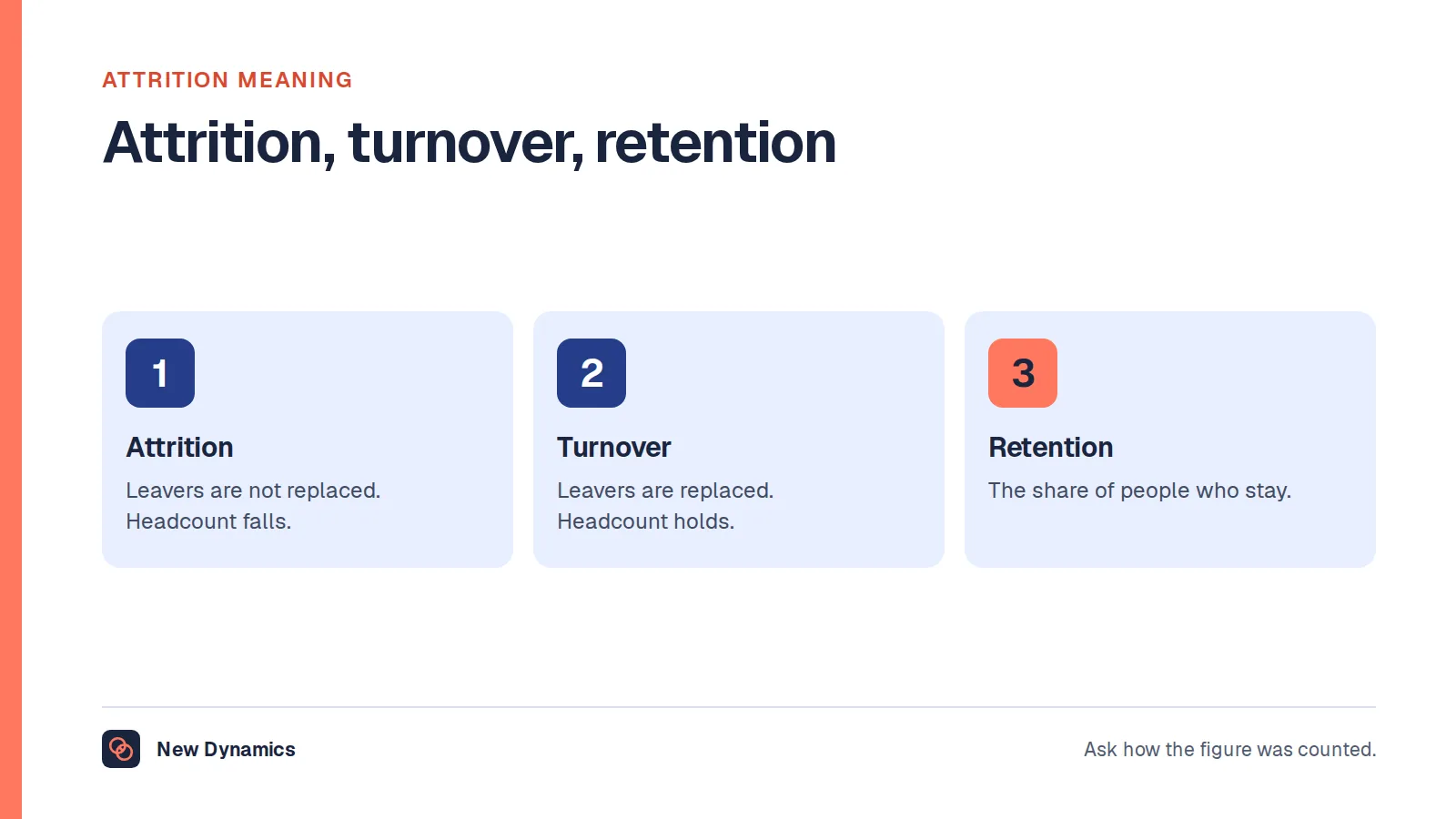
No official statistics body publishes a turnover rate for recruitment consultants specifically, in either jurisdiction, and we will not invent one. The nearest published American measure of churn is the Bureau of Labor Statistics Job Openings and Labor Turnover Survey, which reported a quits rate of 2.1 percent and a total separations rate of 3.3 percent for September 2026. That is every industry together, not staffing, and it is a monthly rate, so take it as context. For the method in your own organisation, see our articles on the meaning of attrition and calculating employee turnover, and our HR statistics hub for figures verified at the publisher.
What you can do about somebody else's attrition is limited, but it is not nothing.
- Name the consultant in the terms, with named cover and notice if they leave or change desk.
- Require a handover note, and ask for your brief, shortlist history and feedback to live in the agency's system, not one inbox.
- Keep your own record of every role, shortlist and outcome, so a new consultant is briefed in twenty minutes.
- Watch the symptoms. A consultant whose last three submissions ignored your stated requirements is either not reading the brief or not staying long.
- Judge the firm on how it handles the change, not on the fact of it. A silent handover is a choice.
The same applies to your side. Agency workers dropped without a word do not come back, and that reputation shows up in the shortlists you are offered.
Frequently asked questions
What does a staffing agency do?
A staffing agency supplies workers to other organisations, or introduces candidates whom those organisations employ. In temporary supply it engages and pays the worker and invoices the hirer for the hours, while the hirer directs the work.
Who employs a worker supplied by a staffing agency?
It depends on the arrangement. In temporary supply the contract is with the agency, while the hirer directs the work. In contract placement the employer may be the agency, an umbrella company or the worker's own company. In permanent placement the hirer employs them directly.
How do staffing agencies charge?
In three shapes. A margin inside an hourly charge rate for temporary supply, covering the worker's pay and the cost of employing them. A percentage of first-year salary for a permanent placement, subject to a rebate period. And a retained fee paid in stages for search work.
What is the American Staffing Association?
It is the United States trade body for the staffing industry. In its own words it is “the voice of the U.S. staffing, recruiting, and workforce solutions industry”, advancing the industry's interests “through advocacy, research, education, and the promotion of high standards of legal, ethical, and professional practices”. A trade association, not a regulator.
What rights do agency workers get after 12 weeks in the United Kingdom?
Under the Agency Workers Regulations 2010, regulation 7(2) says that “to complete the qualifying period the agency worker must work in the same role with the same hirer for 12 continuous calendar weeks, during one or more assignments”. That brings the right to the same basic working and employment conditions as a comparable employee. General information, not legal advice.
Which is the best staffing agency in Boston or New York?
We do not rank agencies or publish local lists, because we do not audit them and the answer changes with every role. Write a one-page brief instead, ask who employs the worker and what the charge rate covers, read the rebate and transfer terms, then test one agency on a single role.
Your next step: run the one-role test
- Write the one-page brief for the role you are hiring now: work, skills, hours, pay range, start date, decision maker.
- Send it to two agencies and ask the five questions. Keep the answers in writing.
- Read the terms before the first candidate arrives.
- Run one role end to end with no exclusivity.
- Induct whoever starts, agency or permanent, on the same checklist.
For the fair, consistent selection process any agency works to in your name, read and download our recruitment and selection guide. The guide is free to read, and the PDF uses our short download form.
Want agency workers, contractors and permanent staff on the same onboarding checklist and review cycle? Book a New Dynamics demo and bring the process you run today. You can also email contact@new-dynamics.com.