TL;DR
- Scheduling pain is rarely about calendars. It is about panels who have not blocked time, interviewers who decline without a reason, and candidates who can only do early mornings. A tool that automates booking into an unprepared diary just moves the mess.
- Build the adjustment duty into the booking step. Acas states that by law you must ask anyone coming to an interview to tell you if they need reasonable adjustments, so that question belongs in the invitation rather than in a later email.
- One-way video interviews save employer time and spend candidate time, and any scoring attached to them is a high-risk use of automation. Keep a human route, and never let a video score alone end an application.
Everyone blames the calendar. In practice, the vacancy that took eleven days to arrange a first interview had three interviewers who never blocked time, a panel chair on leave, a candidate working shifts and a coordinator doing it all by email.
Software can help with exactly one of those. This article covers what interview scheduling software actually fixes, the part of the process that has to change first, the legal duty that belongs in the booking step, where video interviewing earns its place and where it costs you candidates, and the questions worth asking in a demo. It names no products.
What happens after the offer matters as much as the interview. See how New Dynamics onboarding turns an accepted offer into a clear first ninety days.
If you are choosing the wider system rather than a scheduling add-on, our guide to recruiting software covers the requirements a real vacancy breaks on.
What actually causes scheduling pain

- Nobody blocked time. Panels agree to interview and then fill their diaries. The fix is holding slots before the advert closes, which costs nothing.
- No named organiser. Two people half-arranging is slower than one person owning it.
- Declines with no reason. An interviewer who declines without offering an alternative restarts the whole loop.
- No candidate choice. Offering one slot to someone in work guarantees a round trip.
- Reschedules by email. The second attempt is where most of the delay accumulates.
Software fixes four and five well, three partly, and one and two not at all. Fix one and two first, then buy.
The adjustment duty belongs in the booking step
This is the part most scheduling tools handle badly, and it is not optional. Acas states plainly: "By law you must ask anyone coming to an interview to tell you if they need reasonable adjustments so they can attend".
That means the question appears in the invitation the candidate receives, not in a separate email, and the answer has to reach the organiser before the slot is confirmed. In practice, check three things in any tool:
- Can the invitation carry a free-text adjustment question, visible before booking?
- Does the answer reach a person, or sit in a field nobody reads?
- Can the candidate ask for a different format, such as a telephone or in-person interview instead of video?
Acas also notes that interviewers should "ask each applicant the same questions where possible" and that if you make recordings or notes, "you must store them securely and confidentially". Both have implications for the software: shared question sets, and a clear answer about where recordings live and for how long. On that last point the ICO is unambiguous about recruitment records generally: "You must not keep information for longer than you need to."
Live video, one-way video, and the difference that matters
Live video interviews are a format choice. The questions, the panel and the scoring are the same as in person, and the main risks are technical: a poor connection reads as a poor candidate, and someone without a quiet space is disadvantaged.
One-way video interviews, where a candidate records answers for later review, are a different proposition. They save employer time by spending candidate time, usually at the stage when the employer has made the least commitment. Used at volume, with no human reply, they are the single most common source of candidate resentment in modern hiring.
If you use them, three rules keep them defensible:
- Tell candidates how long it will take before they start, and keep it short.
- Offer an alternative for anyone who asks, without requiring a reason.
- Have a person watch anything that leads to a rejection.
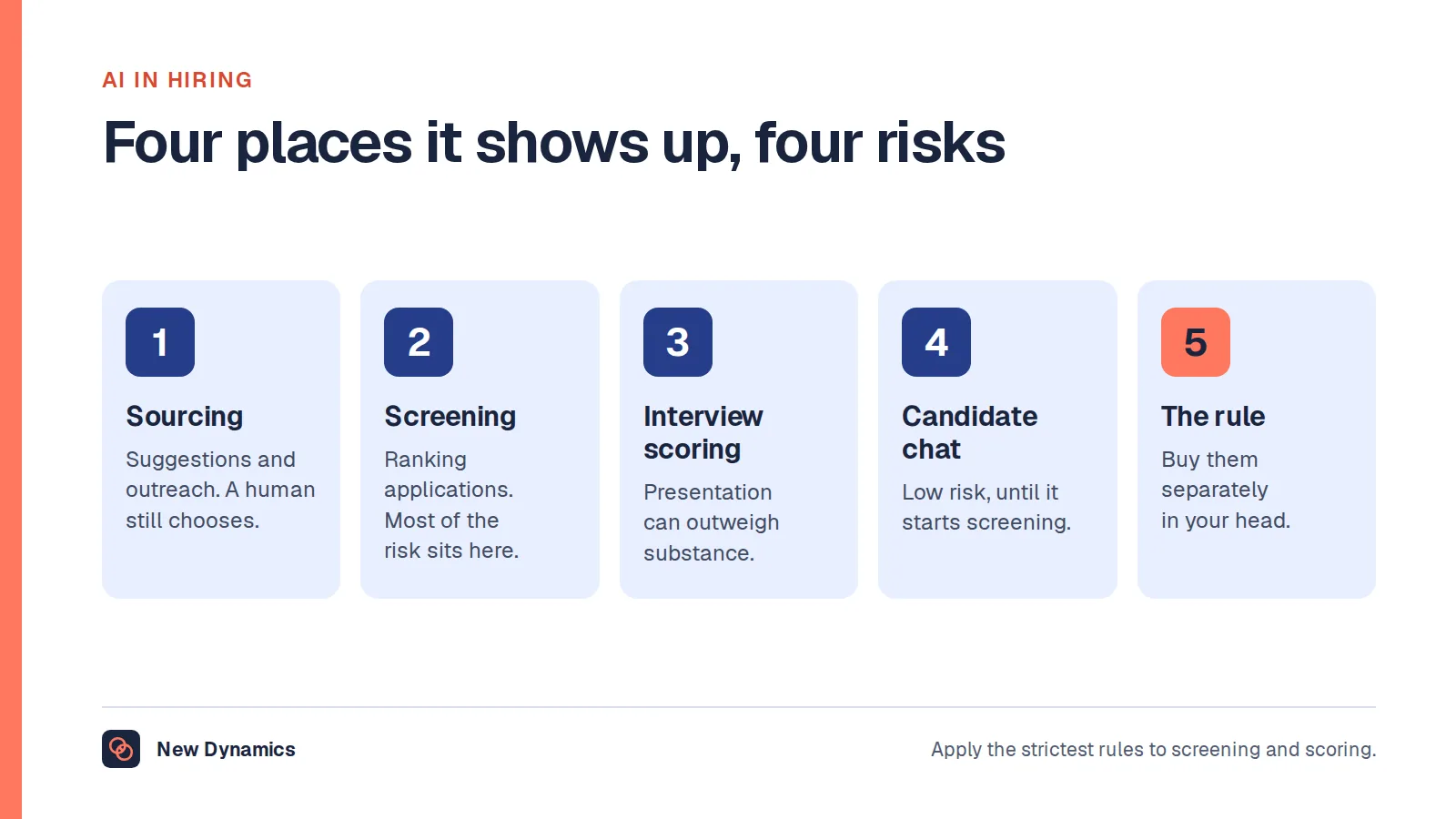
Automated scoring of video is a further step again: it is a high-risk use of automation, because candidates with atypical speech, accents, or disabilities can be scored on presentation rather than content. Our post on AI recruiting tools covers the oversight required, including the rule that a human must be able to disagree with the output and overturn it.
What good scheduling software does

- Reads real availability from the interviewers' calendars, including the ones who use a different system.
- Offers the candidate a choice of slots, with enough spread to suit shifts and caring responsibilities.
- Handles panels, not just one-to-one bookings, including partial panels and substitutes.
- Reschedules without restarting, keeping the original record.
- Sends joining instructions that work, including a dial-in and a named contact if the link fails.
- Records the adjustment question and its answer against the booking.
- Tells you where time goes: days from shortlist to interview, and the step that stalls.
What to be suspicious of: tools that only work if everyone is on one calendar platform, flows that bury the adjustment question, and anything that treats a candidate as a resource to be slotted rather than a person with a job.
Questions for the demo

- Book a three-person panel, then have one decline and show me what happens next.
- Show me the candidate's view on a phone, including the adjustment question.
- Show me a reschedule that keeps the original interview record.
- Where do recordings live, who can see them, and when are they deleted?
- What does a candidate receive if the video link fails two minutes before the interview?
- Which calendar systems do you read and write, and what breaks when someone is outside them?
- What is in the export when we leave?
What usually goes wrong
- Automating a broken process. Fast booking into diaries nobody protected produces fast cancellations.
- The adjustment question added later, which means some candidates arrive to an interview they cannot do well in.
- One-way video as a default, rather than a deliberate choice for a specific stage.
- Recordings kept indefinitely because nobody set a retention period.
- No human contact details, so a candidate with a technical problem has nobody to tell.
Frequently asked questions
What is interview scheduling software?
It is a tool that coordinates interview bookings: reading interviewer availability, offering candidates a choice of slots, handling panels and reschedules, sending joining instructions, and recording what was agreed. Some products also host or record video interviews.
Does scheduling software fix slow hiring?
Partly. It removes the email loops around booking and rescheduling, which is often several days. It cannot fix panels who never block time or a decision stage with no owner, so fix those first and measure the days from shortlist to interview before and after.
Are one-way video interviews a good idea?
They save employer time by spending candidate time, and they are resented when used early and at volume. If you use them, keep them short, say how long they take, offer an alternative format on request without requiring a reason, and make sure a person watches anything that leads to a rejection.
What do you have to ask candidates before an interview?
Acas states that by law you must ask anyone coming to an interview to tell you if they need reasonable adjustments so they can attend. That question belongs in the invitation itself, and the answer has to reach the person arranging the interview before the slot is confirmed.
Can software score video interviews?
Some tools offer it, and it is a high-risk use of automation because presentation, accent and disability can affect the score rather than the substance of an answer. If you use it, a person must be able to disagree with the output and overturn it, and no application should end on a score alone.
How long should you keep interview recordings?
Only as long as you need them, with the period decided, written down and configured rather than left to the default. Acas also expects recordings and notes to be stored securely and confidentially, which means limiting who can see them as well as how long they exist.
Your next step: fix the diary before the tool
- Ask your last three hiring panels whether they blocked interview time before the advert closed.
- Put the adjustment question into the interview invitation this week, whatever software you use.
- Measure days from shortlist to first interview, and find the step that stalls.
- If you demo a tool, make it handle a panel decline and a reschedule live.
For a structured selection process to schedule around, read and download our recruitment and selection guide. The guide is free to read, and the PDF uses our short download form.
Want the first ninety days to be as organised as the interview loop? Book a New Dynamics demo and bring your current onboarding checklist. You can also email contact@new-dynamics.com.