TL;DR
- An information return is a United States filing that tells the IRS about money paid to somebody else. Form 1099-NEC covers pay for services to people who are not your employees; Form 1099-MISC covers rent, prizes, other income and medical payments.
- Form 1096 is only a transmittal for paper. The IRS says in terms: "Use Form 1096 to transmit paper Forms 1097, 1098, 1099, 3921, 3922, 5498, and W-2G", and "Do not use this form to transmit electronically." Anyone filing ten or more returns in the aggregate must e-file, so most employers never touch a 1096.
- A 1099 employee does not exist. Either somebody is an employee reported on Form W-2, or a contractor reported on Form 1099-NEC, and the IRS decides from behavioural control, financial control and the type of relationship. The UK equivalents are Real Time Information, the P60, the P45, the P11D, off-payroll working and the Construction Industry Scheme.
Somebody in HR is asked to "1099 the new designer", and nobody is sure what that means. A finance colleague mentions a 1096, somebody else says the 1096 was abolished, and a third person has printed the form off the IRS website ready to post.
It is worth saying plainly at the start: Form 1099 and Form 1096 are American. They belong to the United States federal tax system, they are issued by the Internal Revenue Service, and there is no UK version of either. This article explains what an information return is, how Form 1099 works and which variants an employer actually meets, what Form 1096 does and when it is not needed at all, how to obtain official paper forms, the deadlines, and the difference between a 1099 contractor and a W-2 employee. A separate section at the end gives a British reader the equivalent machinery.
Filing seasons are deadline problems before they are tax problems. See how New Dynamics workflows give every annual task an owner and a due date rather than a habit.
This is general information about tax and reporting rules, not legal or tax advice. The figures below are quoted from IRS and GOV.UK pages with the year they belong to, and they change. Check the current instruction page before acting.
What an information return is

Jurisdiction: United States. An information return is not a tax return, and it does not calculate what anybody owes. It reports a payment to the IRS so that the system knows the money moved, and sends a copy to the recipient so they know what has been reported about them.
The IRS General Instructions for Certain Information Returns, in the 2025 edition, describes the purpose in one sentence: "Forms 1097, 1098, 1099, 3921, 3922, and W-2G are used to report amounts received, paid, credited, donated, transferred, or canceled (in the case of Form 1099-C) during the calendar year."
Three things follow from that, and they explain most of the confusion.
- The filer is the payer, not the recipient. A business files an information return about somebody else's income.
- The form reports, it does not withhold. Apart from backup withholding, no tax comes off a payment reported on a 1099. That is the structural difference from a W-2, and where the "1099 employee" muddle begins.
- There is a family of them, not one form. Form 1099 is a series, and each member has its own instructions, thresholds and sometimes its own deadline.
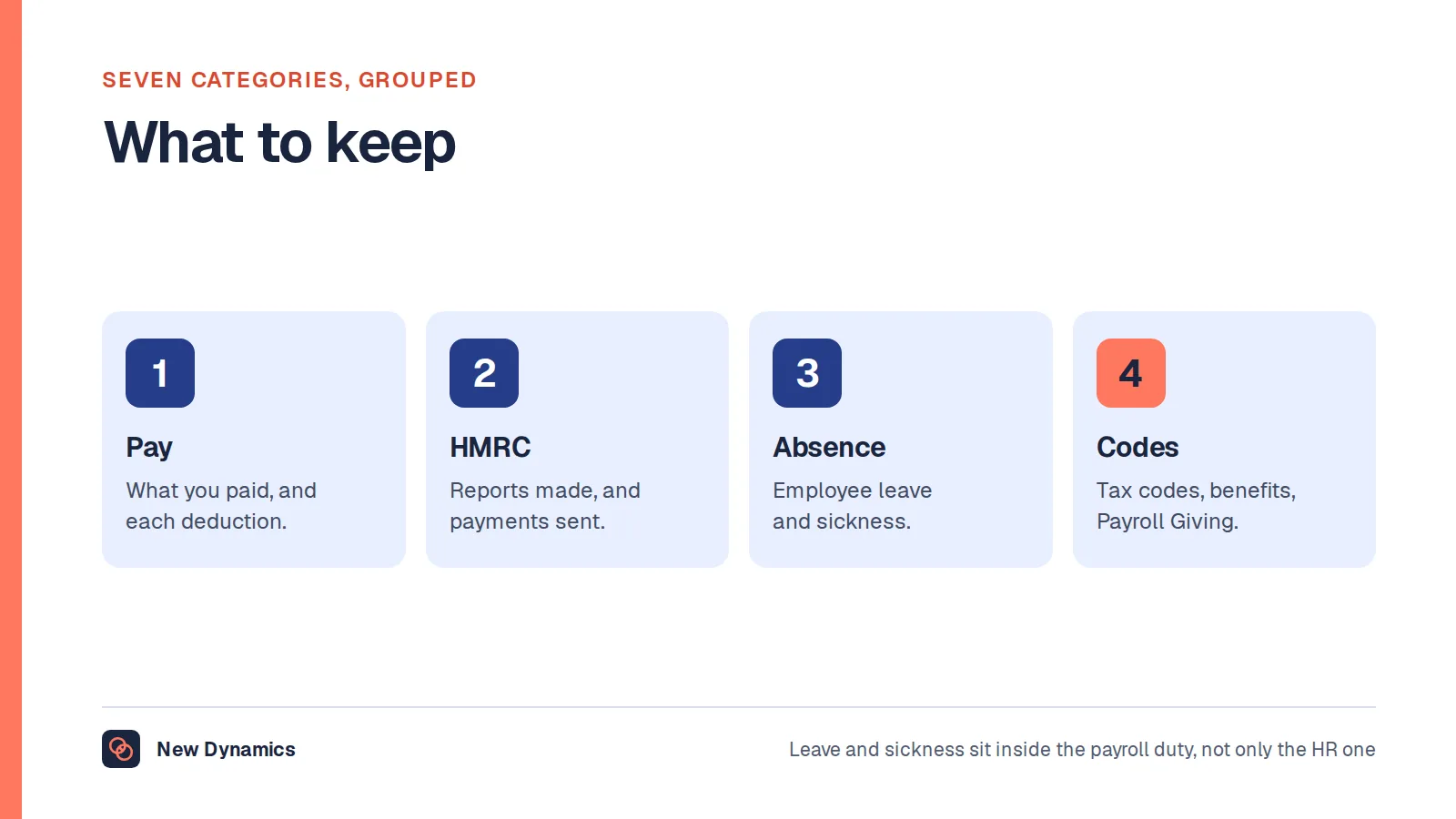
Most of the series exists for banks, brokers, insurers and government agencies. The forms an employer handles are Form W-2, Form 1099-NEC and occasionally Form 1099-MISC.
Form 1099: the definition, and what it is for
Jurisdiction: United States. Form 1099 is the series of information returns used to report payments other than employee wages. A payer tells the IRS what it paid, to whom, and under which category, and sends the recipient a matching statement. A 1099 exists so that income which was not run through a payroll still appears somewhere. The IRS does not need one for wages, because wages arrive on a W-2 with tax already withheld. It needs one for the designer, the consultant and the landlord who were paid gross.
So "how does a 1099 work" has a four part answer, and the sequence matters more than the paperwork.
- Collect the taxpayer identification number before you pay. That means a Form W-9 at the point of engagement, not in January. Missing and incorrect TINs are two of the penalty triggers below.
- Track the payments by category through the year. Fees for services, rent and prizes are different boxes.
- Furnish the recipient statement by the statement deadline, so the payee can file their own return.
- File with the IRS. Electronically for almost everybody, on paper with a Form 1096 for the small minority who still qualify.
Nothing in that list calculates anybody's tax, and an employer that treats the 1099 as a tax calculation tends to miss step one, the only step hard to fix later.
The 1099 variants an employer actually meets
Jurisdiction: United States. Two forms cover almost all of it, separated so the one with the earliest deadline could stand alone.
Form 1099-NEC, Nonemployee Compensation. The IRS About Form 1099-NEC page puts it in six words: "Use Form 1099-NEC to report nonemployee compensation." The Instructions for Forms 1099-MISC and 1099-NEC, in the revision dated December 2026, set out the test: "If the following four conditions are met, you must generally report a payment as NEC. You made the payment to someone who is not your employee. You made the payment for services in the course of your trade or business (including government agencies and nonprofit organizations). You made the payment to an individual, partnership, estate, or, in some cases, a corporation. You made payments to the payee of at least $2,000 during the year."
That last figure is recent, and it is the number to quote with its year attached. The same instructions record the change: "For tax years beginning after 2025, the minimum threshold amount for reporting certain payments required to be reported on certain information returns ... increased to $2,000 and may be adjusted for inflation beginning in calendar year 2027." If you learned this as the $600 rule, that was the position for tax years up to and including 2025. For a later year, check the current instructions rather than carrying $2,000 forward.
The examples the instructions give for box 1a are recognisably the people an HR team engages: "Professional service fees, such as fees to attorneys (including corporations), accountants" and similar providers.
Form 1099-MISC, Miscellaneous Information. Everything else, and the thresholds are not all the same number. File for "At least $10 in royalties", "At least $600 in gross proceeds paid to an attorney (box 10)", and "At least $2,000 in: Rents (box 1); Prizes and awards, including certain non-government grants (box 3); Other income payments (box 3)", along with medical and health care payments. One warning worth repeating: "do not report on Form 1099-MISC any wages reportable on Form W-2."
Form 1096: what it is, and what it is not
Jurisdiction: United States. Form 1096 is the cover sheet. Its full title is "Annual Summary and Transmittal of U.S. Information Returns", and the IRS About Form 1096 page, current revision 2026, gives its single purpose in one line: "Use Form 1096 to transmit paper Forms 1097, 1098, 1099, 3921, 3922, 5498, and W-2G to the Internal Revenue Service." The next line is what most searches are really looking for: "Do not use this form to transmit electronically."
So a 1096 is not a return, it is a transmittal, the paperwork equivalent of a delivery note. It carries no payee detail, only who the filer is, which type of form is in the envelope, how many there are and the total amount reported.
The General Instructions set out how it is used: "if you file paper forms, you must send a Form 1096 with each type of form as the transmittal document. You must group the forms by form number and submit each group with a separate Form 1096. For example, if you file Forms 1098, 1099-A, and 1099-MISC, complete one Form 1096 to transmit Forms 1098, another for Forms 1099-A, and a third for Forms 1099-MISC."
One 1096 per form type, then. Not one per filing, and not one per payee. For corrections, "use a separate Form 1096 for each type of return you are correcting", and you "do not need to correct a previously filed Form 1096".
Why most employers will never file a Form 1096

Jurisdiction: United States. Form 1096 has not been abolished. It has been made irrelevant to most filers by the electronic filing threshold.
The General Instructions record where the change came from: "T.D. 9972, published February 23, 2023, lowered the e-file threshold to 10 (calculated by aggregating all information returns), effective for information returns required to be filed on or after January 1, 2024." The rule itself appears under "Who must e-file": "If you are required to file 10 or more information returns during the year, you must e-file. The 10-or-more requirement does not apply separately to each type of form."
Aggregation is the part that catches employers out. Ten is not ten 1099-NECs; it is ten information returns of any kind added together, and W-2s count. A business with eight employees and three contractors is over the line although neither group reaches ten. The IRS page for ordering paper returns leads with the same point: "You must file electronically if you have 10 or more returns in the aggregate."
Because a 1096 exists only to transmit paper, and because almost every employer is now above the threshold, almost every employer has stopped needing one. The IRS takes these returns free through its own portal, IRIS, described as "an online portal that allows taxpayers to electronically file (e-file) information returns after December 31, 2022, for 2022 and later tax years." Forms W-2 go to the Social Security Administration rather than the IRS.
The waiver route is narrow: "submit Form 8508 at least 45 days before the due date of the returns for which you are requesting a waiver. You cannot apply for a waiver for more than 1 tax year at a time." Filing on paper when you should have e-filed is itself penalised. In the 2025 General Instructions, "the maximum penalty is $340 per return", and "the penalty for a failure to file electronically applies only to the number of returns that exceeds 10."
Ordering official forms, and why a printout cannot be filed
Jurisdiction: United States. If you are genuinely under the threshold and filing on paper, you cannot download the form and print it.
The reason is mechanical: "Because the IRS processes paper forms by machine (optical character recognition equipment), you cannot file Form 1096 or Copy A of Forms 1097, 1098, 1099, 3921, 3922, or 5498 that you print from the IRS website. However, you can use Copy B from those sources to provide recipient statements."
Read that second sentence carefully, because it rescues half the use case. The downloaded PDF is still useful for Copy B, the recipient's statement. It is Copy A, the one the machine reads, and the 1096 on top of it, that have to be official scannable stock: "Copy A is read by machine and must be typed clearly using no corrections in the data entry fields."
How to order. The General Instructions say: "You can order information returns and instructions online at IRS.gov/OrderForms, or you can mail an order to the address in part T." The ordering page, last reviewed on 30 October 2026, confirms that "You can order limited quantities of most information returns and employer returns on paper", with limits of "Information return: 10" and "Employer return: 20", and states that for "Tax year 2025 products: You should receive your order within 15 business days." Order early, because that is not a small share of January.
One exception, and it is a short list. A handful of low-volume forms can be printed and filed: "Forms 1097-BTC, 1098-C, 1098-MA, 1099-CAP, 1099-H, 1099-LTC, 1099-Q, 1099-QA, 1099-SA, 3922, 5498-ESA, 5498-QA, and 5498-SA can be filled out online and Copy A can be printed and filed with the IRS using Form 1096." Neither 1099-NEC nor 1099-MISC is on it, so for the two forms an employer is most likely to file, the printout rule bites.
The deadlines, and what missing them costs
Jurisdiction: United States. Two dates do most of the work, and they differ between the two forms.
Form 1099-NEC. "Section 6071(c) requires you to file Form 1099-NEC on or before January 31, using either paper or electronic filing procedures." Recipient statements run on the same clock: "You are required to furnish the payee statements and file with the IRS by January 31." There is no paper-versus-electronic split, which is the point of having separated this form out.
Form 1099-MISC. Here the channel changes the date: "You are required to furnish the payee statements by January 31 and file with the IRS by February 28 (March 31, if filing electronically)."
Weekends move the date. If a due date "falls on a Saturday, Sunday, or legal holiday", it moves to the next business day. That is why the 2025 General Instructions tell filers to "File Form 1099-NEC by February 2, 2026" rather than 31 January.
The penalty scales with how late you are. Section 6721 of the Internal Revenue Code covers failure to file correct information returns by the due date. The 2025 General Instructions set the top tier at "$340 per information return if you file after August 1 or you do not file required information returns; maximum penalty $4,098,500 per year ($1,366,000 for small businesses)", with lower figures of $60 and $130 per return for corrections made within 30 days and by 1 August.
Lateness is not the only trigger. You may be penalised if you "Include incorrect information on a return", "File on paper when you were required to e-file", "Report an incorrect TIN", or "Fail to report a TIN". There is a reasonable cause exception: "The penalty will not apply to any failure that you can show was due to reasonable cause and not to willful neglect." Two of those triggers are TIN problems, which is the argument for collecting the W-9 at engagement. Our post on payroll records covers how long to hold the underlying detail.
1099 versus W-2, and why "1099 employee" is a contradiction

Jurisdiction: United States. The phrase "1099 employee" appears constantly in job adverts and recruiter emails, and it cannot be right. The two words describe incompatible things.
Form W-2 is for employees. The IRS About Form W-2 page, current revision 2026, titles it the "Wage and Tax Statement" and states that "Every employer engaged in a trade or business who pays remuneration ... for services performed by an employee must file Form W-2 for each employee." Employment means withholding. The IRS page on worker classification puts the duty plainly: "Generally, you must withhold and deposit income taxes, Social Security taxes and Medicare taxes from the wages paid to an employee. Additionally, you must also pay the matching employer portion of Social Security and Medicare taxes as well as pay unemployment tax."
Form 1099-NEC is for people who are not employees. The same page completes the contrast: "Generally, you do not have to withhold or pay any taxes on payments to independent contractors."
The two forms are not two ways of paying the same person. They are the reporting consequence of two different legal relationships, so "1099 employee" names somebody treated as a contractor for tax while managed as an employee in fact. A problem, not a category.
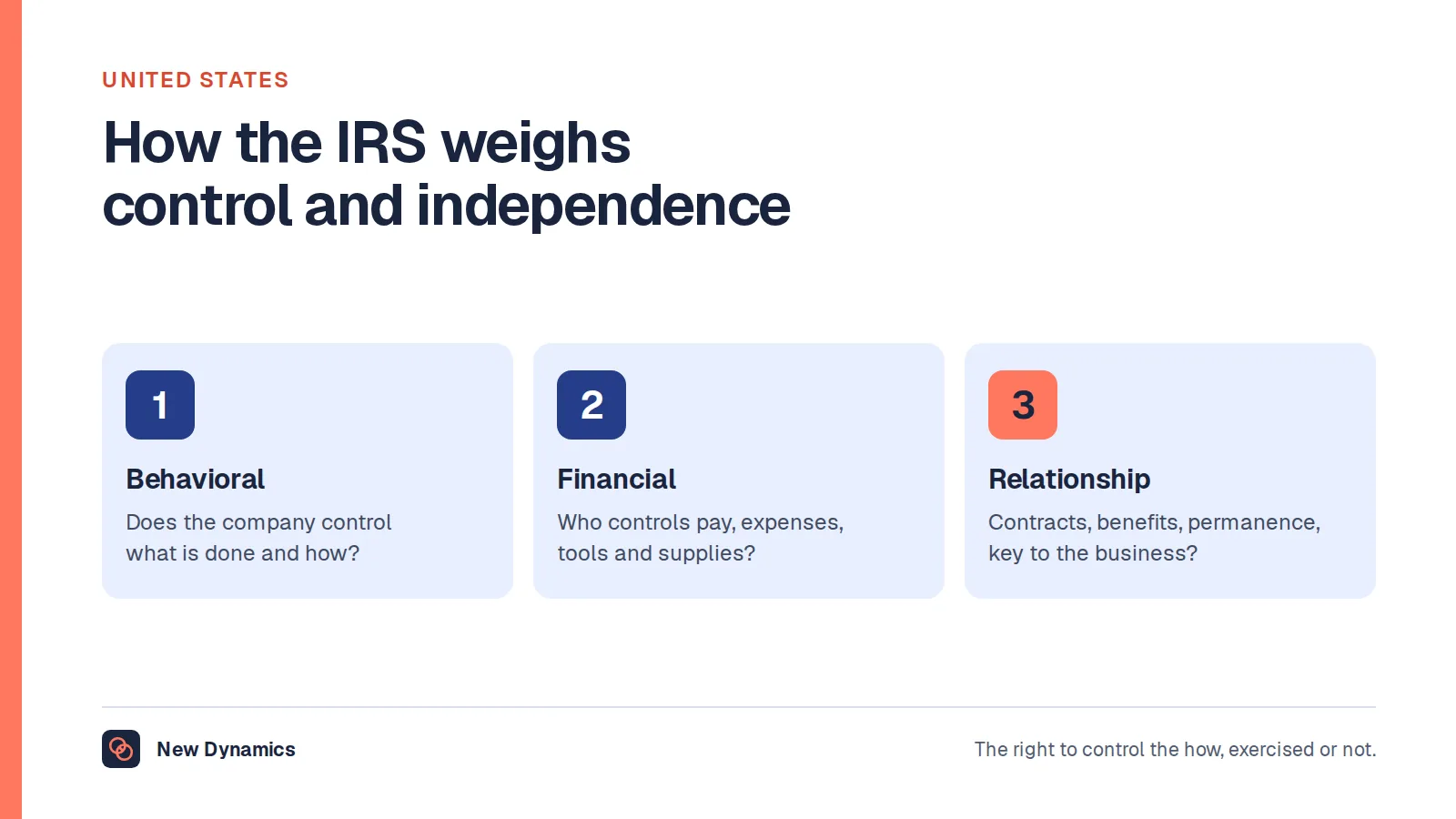
The useful question is therefore not which form to use but which relationship this is. The IRS answers with the common law rules, in three categories:
- Behavioural control. "Does the company control or have the right to control what the worker does and how the worker does his or her job?"
- Financial control. "Are the business aspects of the worker's job controlled by the payer? (these include things like how worker is paid, whether expenses are reimbursed, who provides tools/supplies, etc.)"
- Type of relationship. "Are there written contracts or employee type benefits ...? Will the relationship continue and is the work performed a key aspect of the business?"
The IRS is careful that this is not a scoring exercise: "There is no 'magic' or set number of factors that 'makes' the worker an employee or an independent contractor and no one factor stands alone in making this determination. ... Finally, document each of the factors used in coming up with the determination."
Remote work does not change the analysis: "An individual working remotely ... is your employee under the common-law rules, if you can control what will be done and how it will be done." If the facts are genuinely unclear there is a formal route, Form SS-8, which "may be filed by either the business or the worker", with the caution that "it may take at least six months to receive a determination on your filing." Six months does not help with next week's start date, which is the argument for deciding at engagement. Our post on the independent contractor meaning works through the test from the worker's side.
Misclassification, and why it lands on the business
Jurisdiction: United States. The label matters because the consequence of getting it wrong does not fall on the person who was mislabelled.
The IRS states it directly: "If you classify an employee as an independent contractor and you have no reasonable basis for doing so, then you may be held liable for employment taxes for that worker (the relief provisions, discussed below, will not apply)."
There is a relief provision, and its conditions reward consistency. "To get this relief, you must file all required federal information returns on a basis consistent with your treatment of the worker. You (or your predecessor) must not have treated any worker holding a substantially similar position as an employee for any periods beginning after 1977."
Note what the first condition means. Relief depends partly on having filed the 1099s, so a business that decided somebody was a contractor and then did not report the payments has removed its own protection. Note also what relief does not do: "Relief does not determine a worker to be an independent contractor."
The worker has a route of their own: "Workers who believe they have been improperly classified as independent contractors by an employer can use Form 8919", so the decision can be reopened from the other side without the business being asked first.
Classification is therefore a documented judgement made before the first payment, not a label applied afterwards by whoever raises the purchase order.
What the UK has instead: no 1099, and nothing like a 1096
Jurisdiction: United Kingdom. The honest answer first: there is no UK 1099, and no UK 1096. The reason is structural. The American system reports payments after the fact and leaves the recipient to settle the tax. The UK system reports pay as it happens and collects tax at source, so there is far less for an annual return to do.
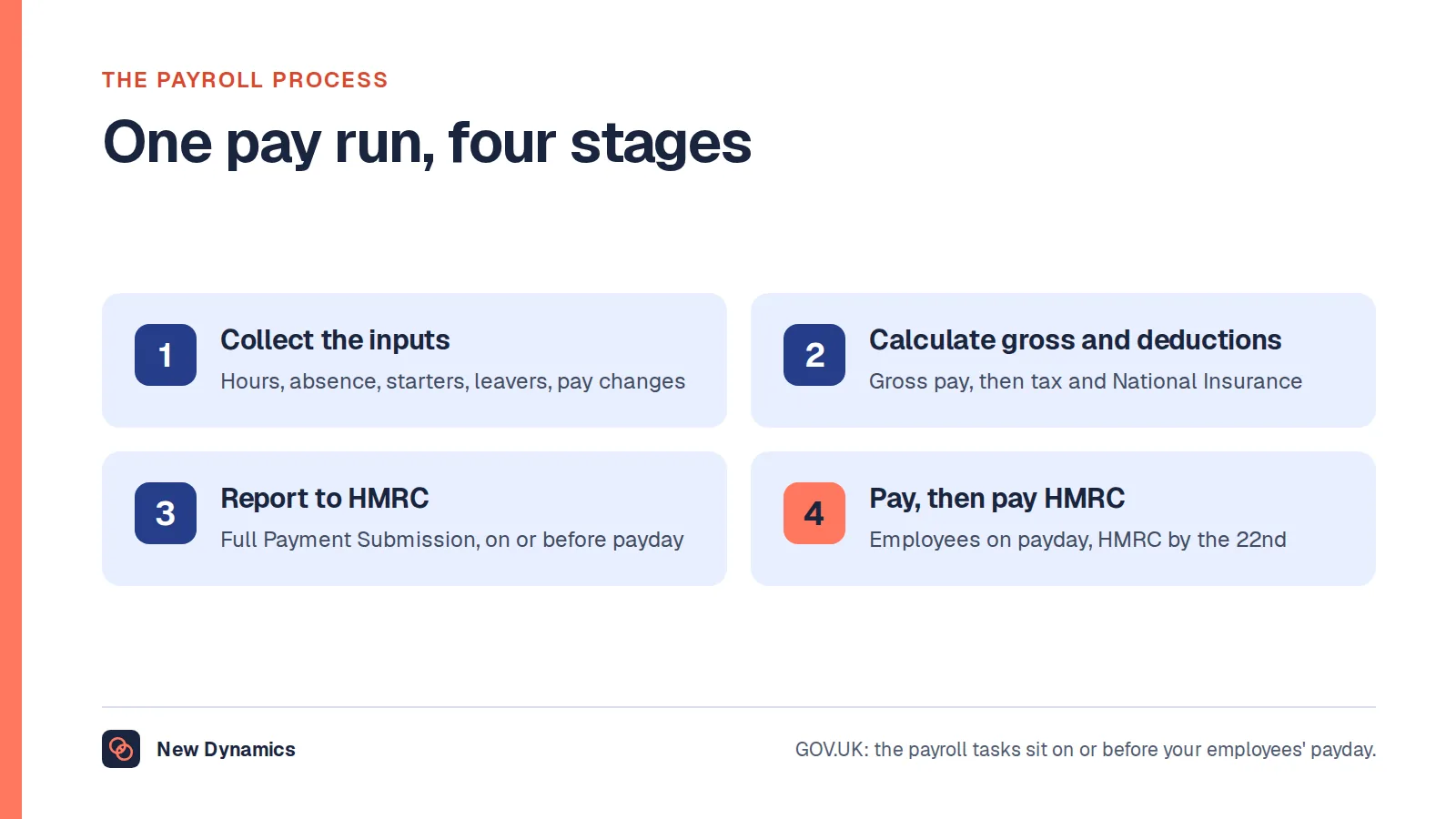
Real Time Information through PAYE is the core of it. GOV.UK's guidance on running payroll says that on or before every payday an employer must "Record their pay", "Calculate deductions from their pay, like tax and National Insurance", "Produce payslips for each employee", and "Report their pay and deductions to HMRC in a Full Payment Submission (FPS)." That happens every pay run, not once a year, which is why there is no British equivalent of the January 1099 scramble. Our post on the payroll process covers the run itself.
The P60, the P45 and the P11D are the statements an employee receives, and they are the nearest thing in spirit to a recipient copy of an American information return. GOV.UK's guide to your P45, P60 and P11D explains who gets what: a "P45 form if you stop working for them", a "P60 form if you're working for them at the end of the tax year", and a "P11D form if you get company benefits", which covers value received in a form other than salary. It adds that "Your employer also gives this information to HMRC." The difference from a 1099 is that HMRC already has the detail from the FPS, so the P60 confirms the year rather than disclosing it. GOV.UK's guidance on payroll annual reporting and tasks sets the deadlines against a tax year that "ends on 5 April": a P60 to employees by "31 May", and expenses and benefits reported by "6 July".
For contractors the UK has two mechanisms where the United States has one form.
The off-payroll working rules, commonly called IR35, deal with people who provide services through their own company. HMRC's guidance on understanding off-payroll working, last updated 26 February 2026, states the purpose: "The off-payroll working rules make sure that a worker (sometimes known as a contractor) pays broadly the same Income Tax and National Insurance as an employee would. The rules apply if the worker ... would have been an employee if they were providing their services directly to that client." Responsibility usually sits with the hirer: "In most cases, the client will be responsible for determining the employment status of the worker", although "if a worker provides services to a small client outside the public sector, the worker's intermediary is responsible for deciding the worker's employment status". Where the rules apply, the client "should produce a status determination statement (SDS) including the reasons for their determination".
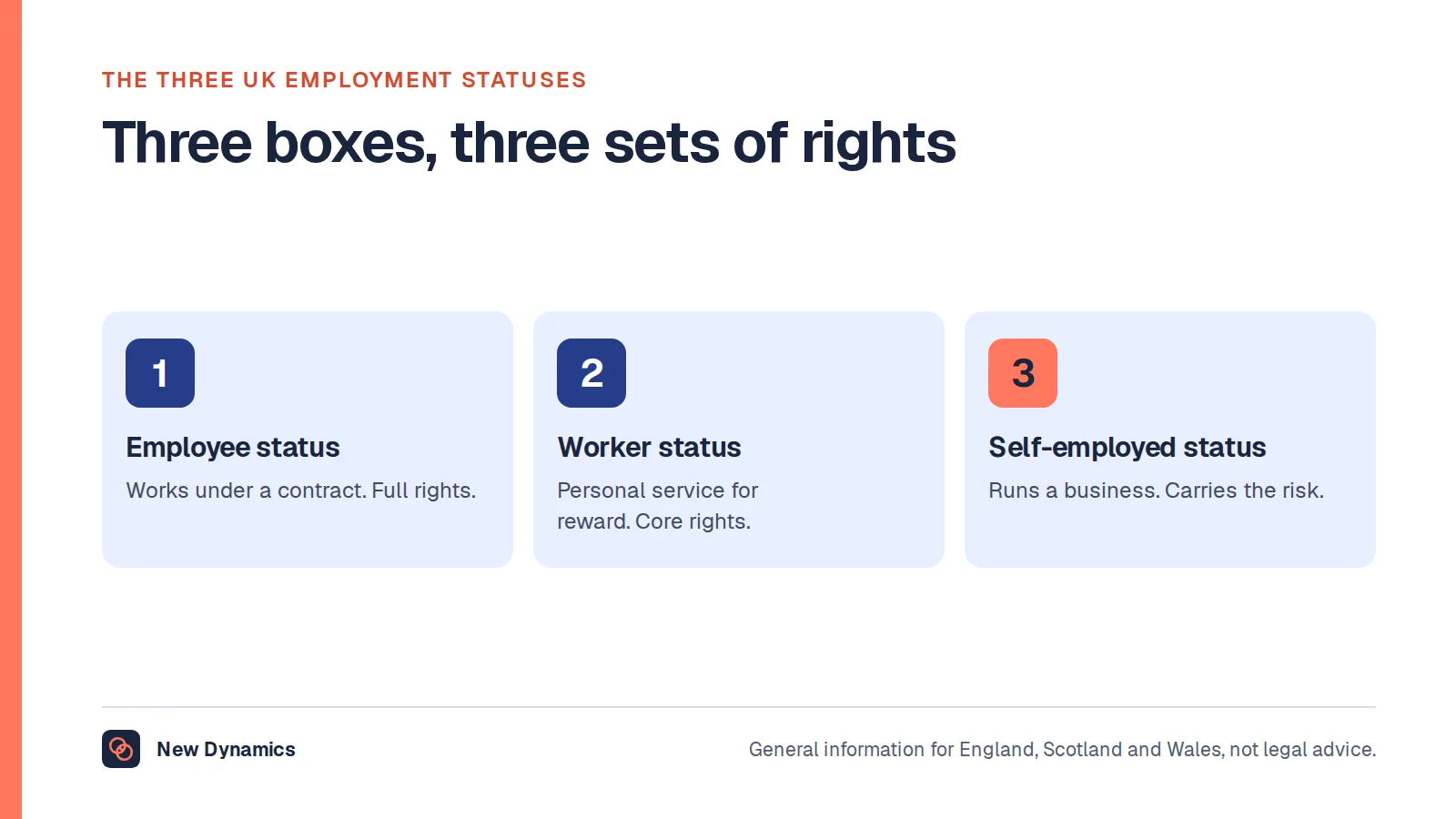
That statement is the sharpest difference from the American position: the IRS asks you to document the factors for your own protection, while HMRC requires reasons given to the worker. Our post on employment status covers the three UK statuses and the tests behind them.
The Construction Industry Scheme works almost in reverse of a 1099. GOV.UK's page on the Construction Industry Scheme explains: "Under the Construction Industry Scheme (CIS), contractors deduct money from a subcontractor's payments and pass it to HM Revenue and Customs (HMRC). The deductions count as advance payments towards the subcontractor's tax and National Insurance." Where an American payer reports a gross payment and withholds nothing, a UK construction contractor deducts at source and reports monthly. "Contractors must register for the scheme. Subcontractors do not have to register, but deductions are taken from their payments at a higher rate if they're not registered." Registration catches more than builders: it is required if "your business does not do construction work but you have spent more than £3 million on construction in the 12 months since you made your first payment".
So the mapping is roughly this. The 1099-NEC has no single counterpart: a self-employed supplier invoices and self-assesses with no employer return at all; a personal service company falls under off-payroll working; construction falls under CIS. The W-2 maps loosely onto the P60, and the 1096 maps onto nothing at all. None of this is legal or tax advice, and the UK rules reward checking the current GOV.UK page first.
Frequently asked questions
What is a 1096 form used for?
Form 1096 is the United States transmittal cover sheet for paper information returns. Its full title is "Annual Summary and Transmittal of U.S. Information Returns", and the IRS states its purpose as: "Use Form 1096 to transmit paper Forms 1097, 1098, 1099, 3921, 3922, 5498, and W-2G to the Internal Revenue Service." It carries no payee detail, only the filer, the form type, the count and the total reported, and the same page adds: "Do not use this form to transmit electronically." You need one only on paper, and then one per form type. Anyone filing ten or more information returns in the aggregate must file electronically, so most employers never use it.
How do you order 1096 forms from the IRS?
Order them rather than printing them. The IRS instructions say you can order information returns and instructions online at IRS.gov/OrderForms, "or you can mail an order to the address in part T." Quantity limits are "Information return: 10" and "Employer return: 20", and for "Tax year 2025 products: You should receive your order within 15 business days."
Why can a downloaded Form 1096 not be filed?
Because the machine cannot read it. The IRS explains: "Because the IRS processes paper forms by machine (optical character recognition equipment), you cannot file Form 1096 or Copy A of Forms 1097, 1098, 1099, 3921, 3922, or 5498 that you print from the IRS website." The PDF is still useful for the recipient's copy, since "you can use Copy B from those sources to provide recipient statements."
What is a 1099 employee?
Nothing. The phrase is a contradiction, because the United States tax system treats employees and contractors as different relationships with different forms. An employee's pay goes on Form W-2 and the employer must "withhold and deposit income taxes, Social Security taxes and Medicare taxes from the wages paid to an employee". A contractor's pay goes on Form 1099-NEC, and "generally, you do not have to withhold or pay any taxes on payments to independent contractors."
What is the difference between a 1099 and a W-2?
The relationship, not the paperwork. Form W-2 is the "Wage and Tax Statement", filed by "Every employer engaged in a trade or business who pays remuneration ... for services performed by an employee", and it reports wages with tax already withheld. Form 1099-NEC reports nonemployee compensation paid gross. The IRS decides which applies using the common law rules on behavioural control, financial control and the type of relationship, warning that "no one factor stands alone in making this determination."
Does the UK have a 1099 or a 1096?
No. UK employers report pay to HMRC on every payday through Real Time Information, using a Full Payment Submission, so there is no annual information return to post. Employees receive a P60 at the end of the tax year, a P45 when they leave and a P11D for benefits. Contractors fall under the off-payroll working rules or, in construction, the Construction Industry Scheme, where the contractor deducts at source rather than reporting a gross payment.
Your next step: fix the count, then the calendar
- Count every information return you expect to file this year, of every type, including W-2s. Ten or more in the aggregate settles the e-filing question, which usually settles the 1096 question too.
- Check that you hold a taxpayer identification number for every payee before the next payment, not in January. Two of the IRS penalty triggers are TIN problems.
- Put the two dates in the calendar with an owner. Form 1099-NEC by 31 January to recipients and to the IRS; Form 1099-MISC to recipients by 31 January and to the IRS by 28 February on paper or 31 March electronically, allowing for weekends.
- Re-read your contractor list against the three control categories, and write down the facts you relied on. Relief from employment tax liability depends partly on having filed consistently with that answer.
- If you operate in both countries, keep the two systems separate in writing. A UK manager reading an American filing calendar is where most of this confusion starts.
For a way of setting pay and engagement terms that you can explain to the person affected, read and download our compensation policy guide. The guide is free to read, and the PDF uses our short download form.
Want every annual filing task to have an owner, a due date and a visible status rather than a reminder in somebody's inbox? Book a New Dynamics demo and bring your current calendar. You can also email contact@new-dynamics.com.