TL;DR
- An IT function has five layers: support, infrastructure and operations, build, security, and leadership. Each has its own occupational description, O*NET's user support specialists “provide technical assistance to computer users”, its systems administrators “analyze network and server resource consumption and control user access”, its software developers analyse “user needs and software requirements to determine feasibility of design within time and cost constraints”, and its information systems managers evaluate “the organization's technology use and needs”.
- Most IT adverts describe technologies and omit the job. Six things separate a good IT job description from a list of tools: the on-call and shift position, the privileged access the role holds, which certifications are required and who funds them, the estate the person will actually touch, the escalation path, and whether the role builds new things or keeps existing things running.
- The access question runs through every one of these roles. The NCSC's guidance puts it well: “understanding who or what needs access, and under what conditions, is just as important as knowing who needs to be kept out”, and the policy should set out “who should have access to which systems, data or functionality, why, and under what circumstances”.
Most IT adverts are a list of technologies with a job title on top. They tell a candidate what the company bought and almost nothing about the work, the hours, the access or the escalation path, which is why the wrong people apply and the right ones leave in month three.
This article sets out IT job descriptions for a whole function: the five layers, what each one owns, the roles that sit across them, the six things an IT advert must say, and a template. It is general information about the roles.
Which layer a role belongs to is the first thing a candidate wants to know, and the first thing a structure chart should show. See how New Dynamics org charts keep reporting lines and roles current in one place.
The five layers

1. Support
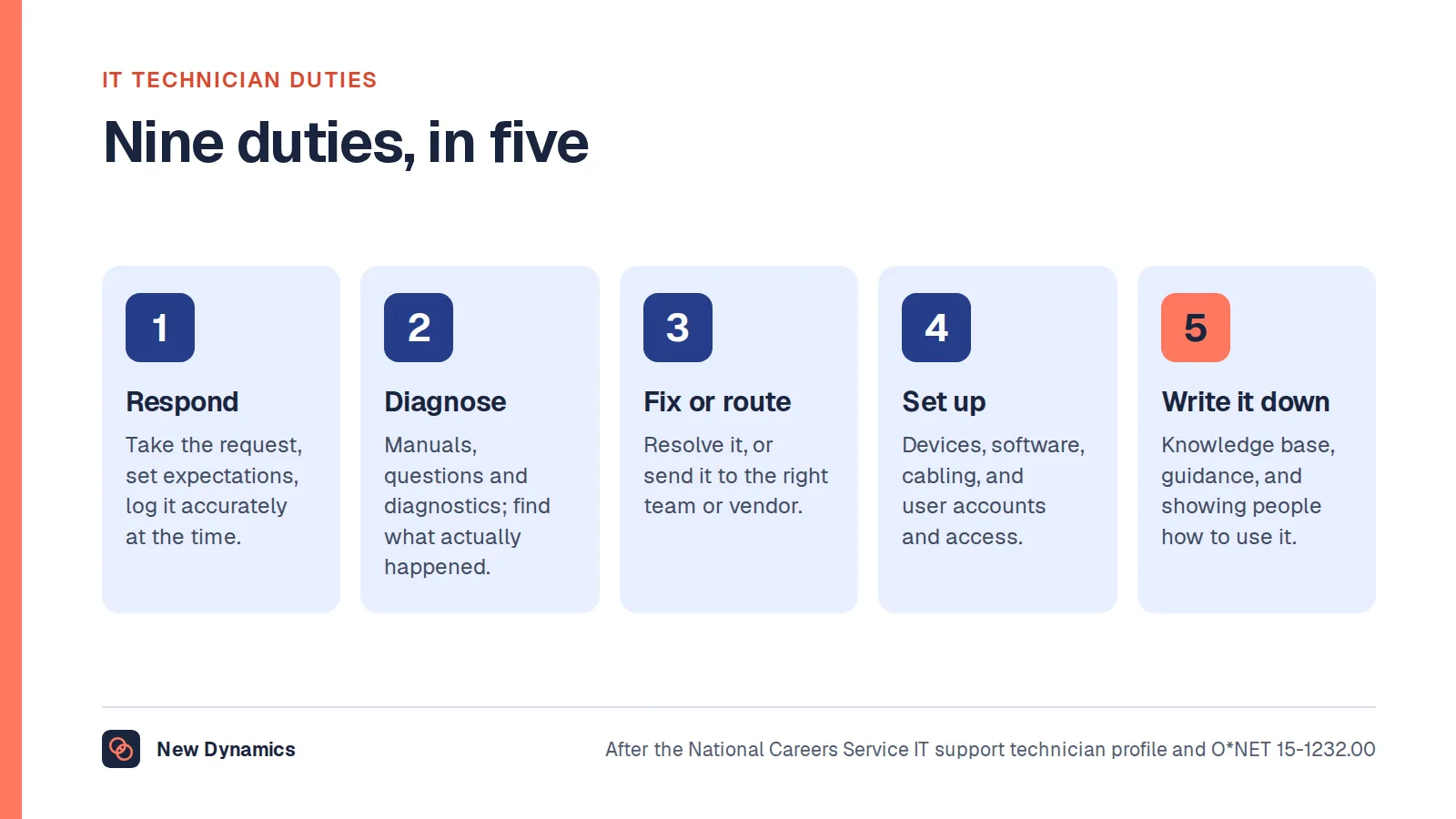
The service desk and desktop support: the people colleagues actually meet. O*NET's Computer User Support Specialists "provide technical assistance to computer users", answering questions or resolving problems "in person, via telephone, or electronically".
Typical titles: service desk analyst, IT technician, desktop support engineer, IT support apprentice. Our IT technician job description covers this layer in detail, including the three support lines.
2. Infrastructure and operations
Servers, networks, identity, storage, backup and the platforms everything else runs on. O*NET's Network and Computer Systems Administrators administer server resources and systems, "review system and application logs and verify completion of scheduled jobs, including system backups", "analyze network and server resource consumption and control user access", and "install and upgrade software and maintain software licenses".
Their tasks include planning and implementing "network security measures to protect data, software, and hardware", performing "data backups and disaster recovery operations", and maintaining "logs related to network functions, as well as maintenance and repair records". Typical titles: system administrator, network engineer, cloud or platform engineer. See our system administrator and network engineer posts.
3. Build
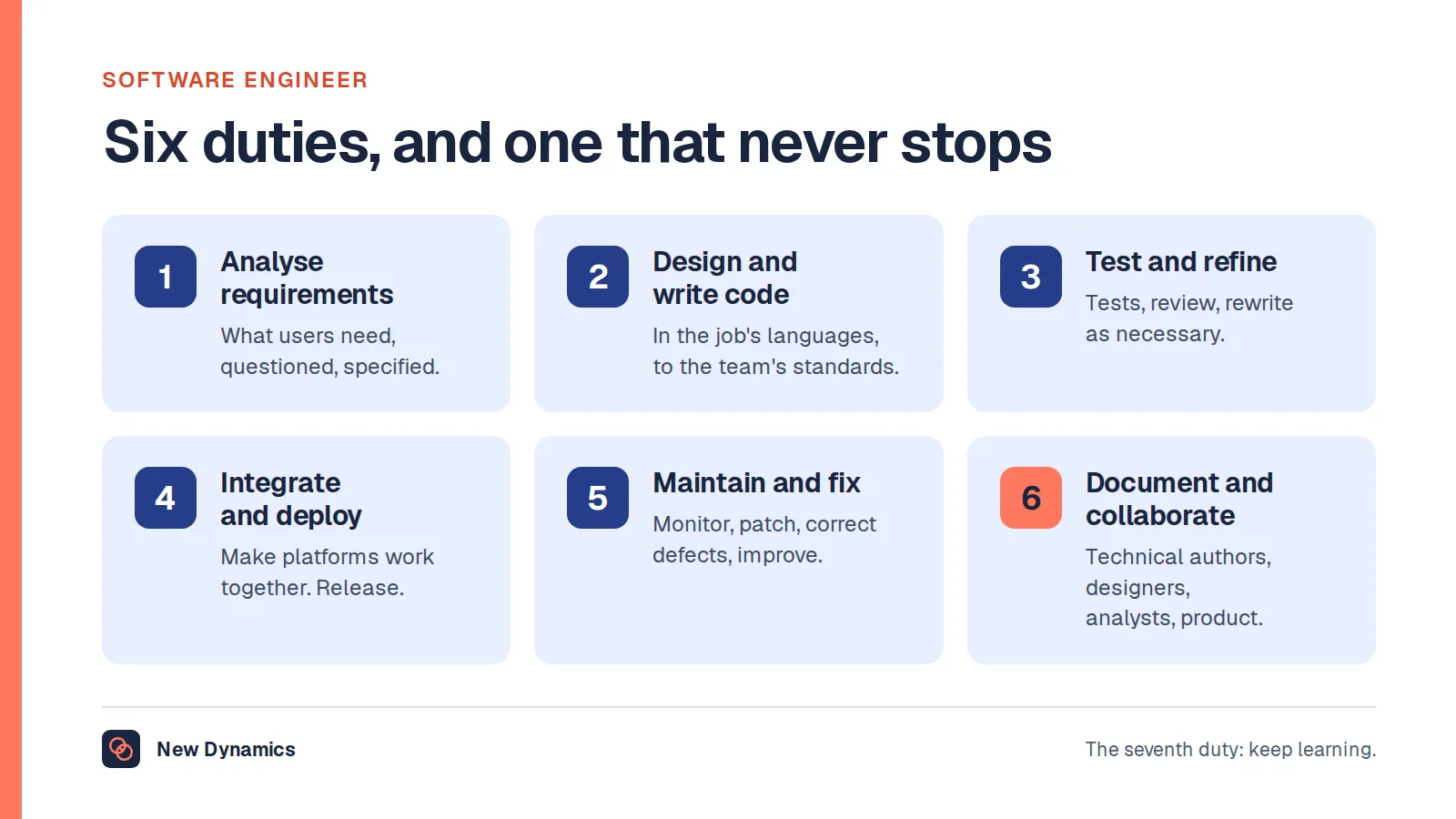
The people who make and change software. O*NET's Software Developers analyse "user needs and software requirements to determine feasibility of design within time and cost constraints", develop or direct "software system testing or validation procedures, programming, or documentation", confer with analysts and engineers "to design systems and to obtain information on project limitations and capabilities, performance requirements and interfaces", and modify existing software "to correct errors, adapt it to new hardware, or upgrade interfaces and improve performance".
Reported titles in this occupation include Application Developer, DevOps Engineer, Infrastructure Engineer and Software Architect, which is a useful reminder that "DevOps engineer" can mean a builder or an operator depending on the employer. Our software engineer job description covers the core role.
4. Security
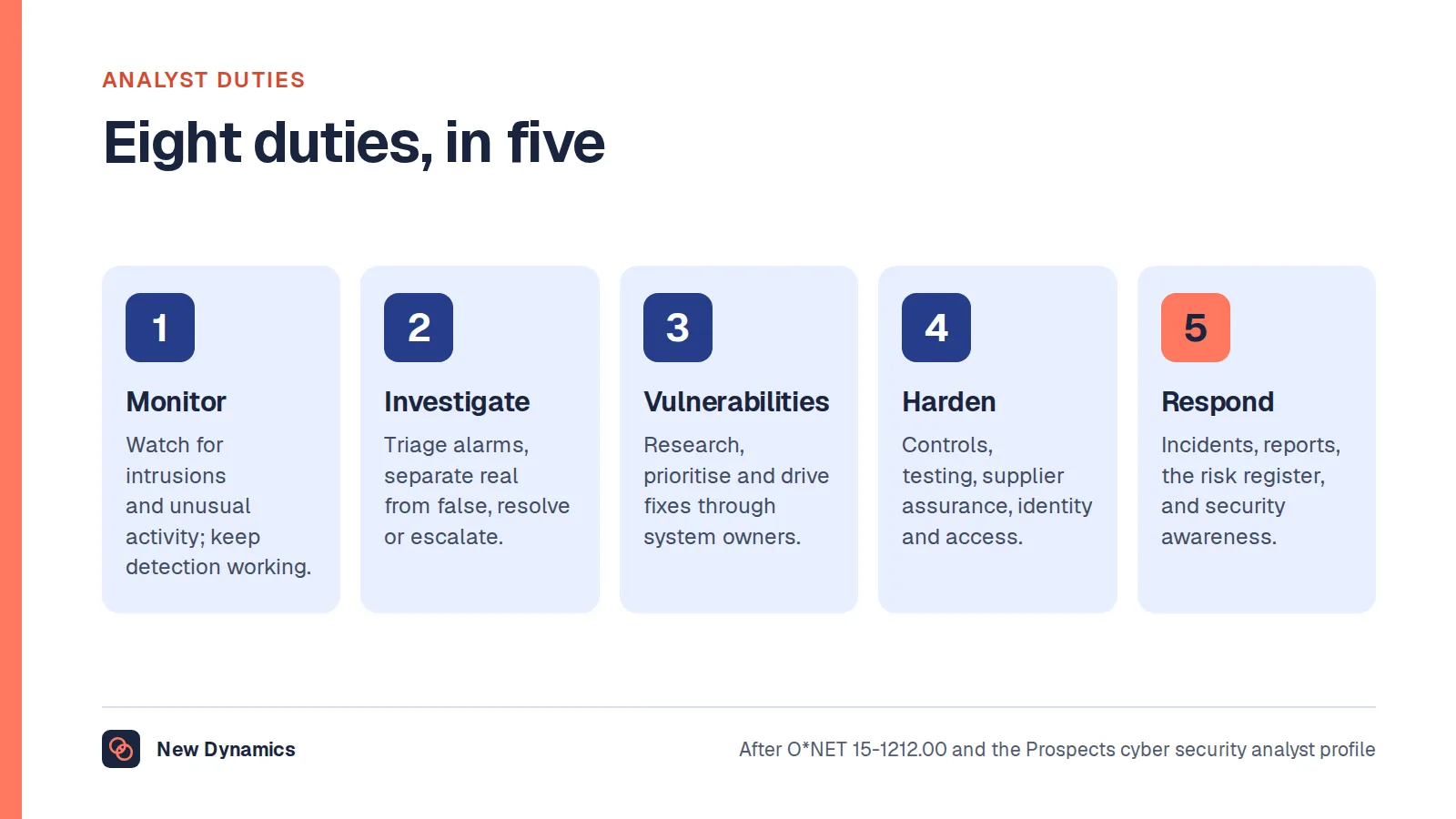
O*NET's Information Security Analysts "plan, implement, upgrade, or monitor security measures for the protection of computer networks and information" and "assess system vulnerabilities for security risks and propose and implement risk mitigation strategies". Our cyber security analyst job description maps the role against the NCSC's ten components.
5. Leadership
O*NET's Computer and Information Systems Managers "plan, direct, or coordinate activities in such fields as electronic data processing, information systems, systems analysis, and computer programming". Their tasks include evaluating "the organization's technology use and needs and recommend improvements, such as hardware and software upgrades", controlling "operational budget and expenditures", developing computer information resources "providing for data security and control, strategic computing, and disaster recovery", and recruiting, hiring, training and supervising staff.
Typical titles: IT manager, head of IT, IT director, chief information officer. Our CTO job description covers the technology leadership role in product-led organisations.
The roles that sit across the layers
- Data. Analysts, engineers and database specialists, who serve every layer and report to almost anywhere.
- Business analysis and product. The translation between what the organisation wants and what gets built.
- Project and change delivery. Our project coordinator and programme coordinator posts cover the coordination roles.
- Vendor and asset management. Licences, contracts, renewals and the estate; see our asset manager post for the four meanings of that title.
The six things an IT advert must say

- On-call and cover. Is there a rota? How often? What is paid for it? This is the single biggest omission in IT adverts and the most common reason an offer is declined late.
- Privileged access. What can this person see, and what can they change? The NCSC's identity and access management guidance frames it well: "understanding who or what needs access, and under what conditions, is just as important as knowing who needs to be kept out", and a policy should cover "who should have access to which systems, data or functionality, why, and under what circumstances".
- Certifications: which are required, which are preferred, and which are funded. The third answer is the one candidates read most carefully.
- The estate. Not a list of every technology in the building, but the systems this role actually touches, and their rough scale.
- The escalation path. Who the person escalates to, and who escalates to them.
- Build or run. Whether the role is delivering change or keeping things working. Most disappointment in IT roles comes from a build advert and a run job.
A generic IT job description template
Job title: [role], [layer]
Reports to: [role]
The estate: [systems and rough scale this role touches]
Cover: [business hours / extended / 24x7], [rota and notice], [on-call payment]
Purpose: [one sentence: what this role exists to keep working, or to change]
Responsibilities
- [Three to six duties, each starting with a verb and naming an outcome.]
- Maintain records and documentation for the systems and changes you are responsible for.
- Work within the organisation's security, access and change procedures.
- [Where applicable: participate in the on-call rota.]
Access: what this role can see and change, and what needs approval.
Escalation: who you escalate to, and who escalates to you.
Certifications: required, preferred, funded.
Levelling IT roles

Job titles in IT are unusually inconsistent between employers, so compare roles on factors rather than names:
- Scope of the estate: how much of it, and how critical.
- Autonomy: what the person changes without approval, and at what risk.
- Depth against breadth: specialist mastery or wide coverage.
- Influence on others' work: through design, standards, review or line management.
Our skills gap analysis guide covers building the capability and certification matrix that makes this comparison possible across a function.
Frequently asked questions
What are the main IT job roles?
Five layers: support, which is the service desk and desktop support; infrastructure and operations, covering servers, networks, identity and backup; build, meaning software development and engineering; security; and leadership, from IT manager to chief information officer. Data, business analysis, project delivery and vendor management sit across all of them.
What should an IT job description include?
Beyond the duties: whether there is an on-call rota and what is paid for it, what privileged access the role holds, which certifications are required, preferred and funded, the systems the role actually touches and their scale, the escalation path, and whether the job is building new things or running existing ones.
What is the difference between IT support and infrastructure roles?
Support resolves problems for users, usually by phone, chat or at the desk, and escalates what it cannot fix. Infrastructure and operations look after the platforms underneath: servers, networks, identity, storage, backups and disaster recovery, including reviewing system logs, verifying scheduled jobs and controlling user access.
Is a DevOps engineer a developer or an administrator?
It depends on the employer, which is why the advert has to say. O*NET lists DevOps Engineer and Infrastructure Engineer among the reported job titles for software developers, so the title can sit on either side of the build and run line. Ask which one the role is.
How do you compare IT roles across organisations?
Not by title. Compare the scope and criticality of the estate the person covers, what they can change without approval, whether the role is specialist or broad, and how much they influence other people's work through design, standards, review or line management.
Should an IT advert list every technology?
No. List the systems the role actually touches and their rough scale. A long technology list attracts applications from people who have used one item on it and tells a strong candidate nothing about the job.
Your next step: write the access line
- For each IT role, write one sentence saying what the person can see and what they can change.
- Put the on-call position and its payment in the advert, not in the offer.
- Mark certifications as required, preferred or funded.
- Say whether the role builds or runs, and level it on factors rather than the title.
For the capability and certification matrix behind all of this, read and download our skills gap analysis guide. The guide is free to read, and the PDF uses our short download form.
Want roles, reporting lines and objectives visible in one place across a technical function? Book a New Dynamics demo and bring your current structure chart. You can also email contact@new-dynamics.com.