TL;DR
- JAN, the Job Accommodation Network, is a free and confidential US service funded by the Department of Labor that advises employers and employees on workplace accommodations and Title I of the Americans with Disabilities Act.
- Under the ADA, a reasonable accommodation is a change to the application process, the job or the workplace, or to benefits, that lets a qualified person with a disability apply, do the essential functions or enjoy equal benefits. Employees can ask in plain English.
- In Great Britain the equivalent duty is to make reasonable adjustments, and Access to Work can help fund support. This article is general information, not legal advice, for the United States and Great Britain.
An employee mentions that the open-plan office makes it hard to concentrate since a diagnosis. A candidate asks whether the written test can be taken with extra time. A manager wants to help but is not sure what is allowed, what is required, or where to get advice. In the United States, the usual answer to that last question is JAN.
This article explains JAN accommodation guidance: what the Job Accommodation Network is, what a reasonable accommodation means under the Americans with Disabilities Act, how to handle a request step by step, and how the equivalent duty works in Great Britain. It is general information, not legal advice.
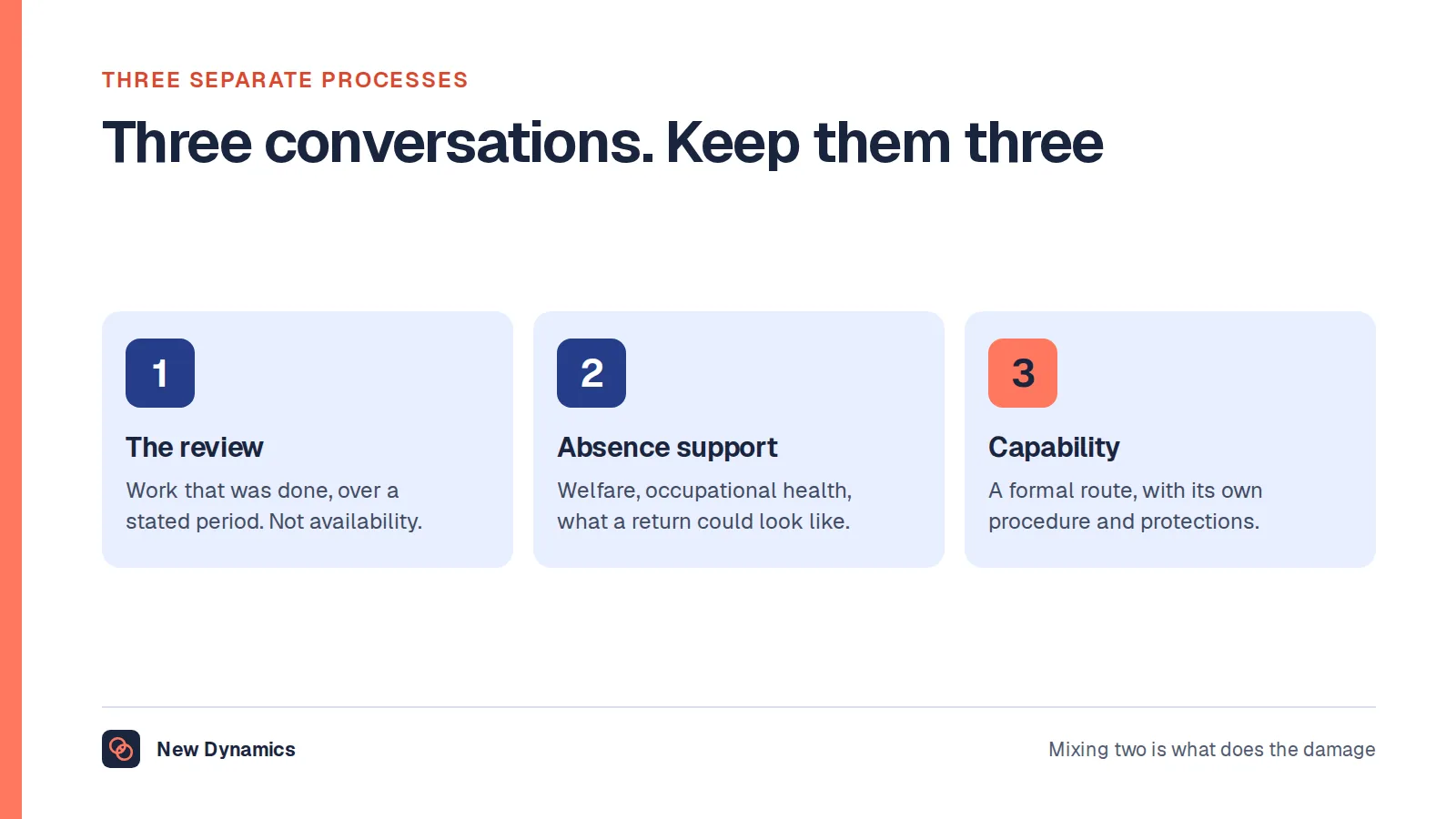
Accommodations affect how performance is judged as well as how work is done. See how New Dynamics performance reviews keep agreed adjustments and goals in the same record, so reviews take them into account.
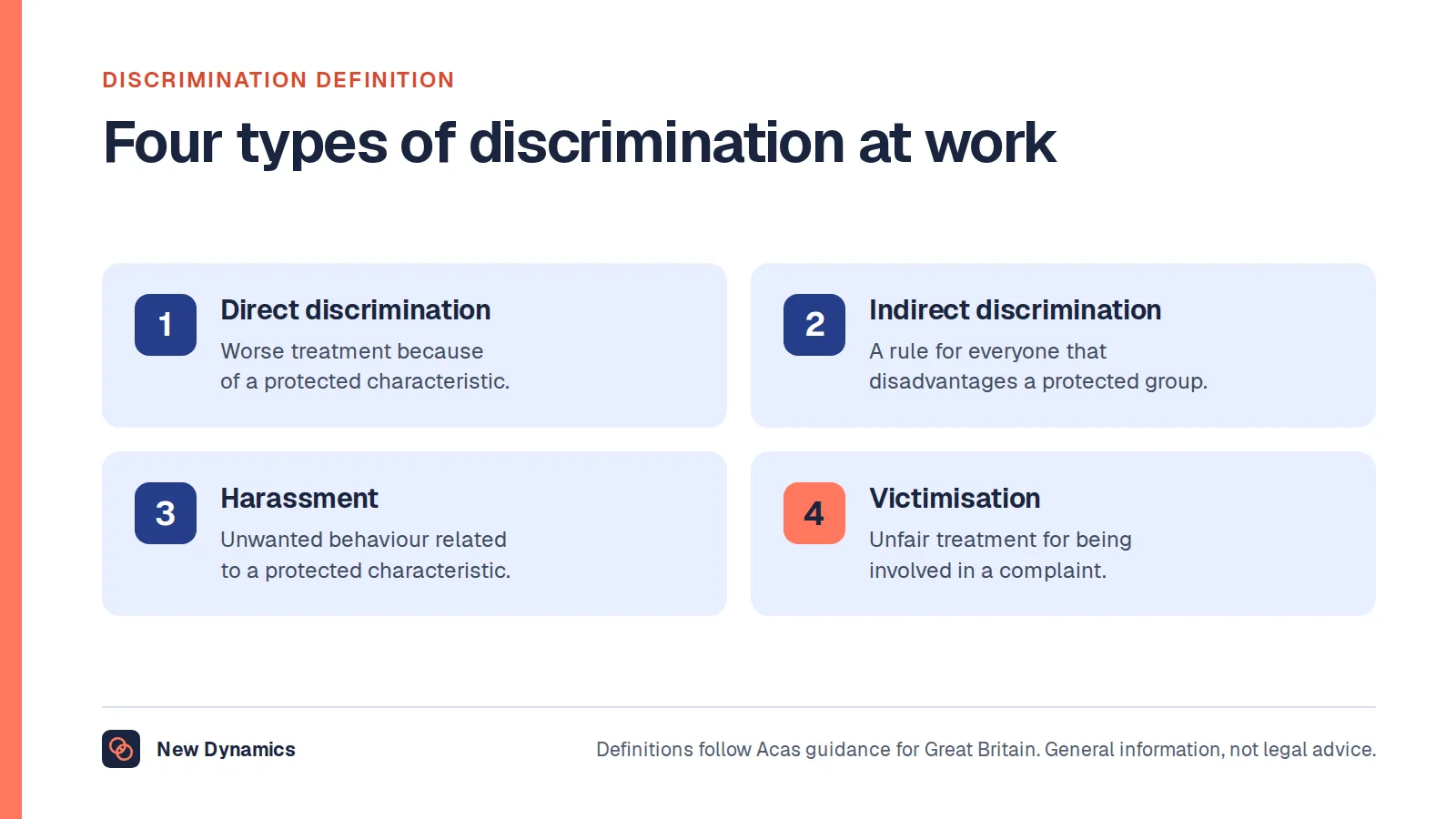
Accommodation requests often sit alongside questions about fairness more broadly; our post on the discrimination definition covers the main forms discrimination law recognises.
What is JAN?
Jurisdiction: United States.
The Job Accommodation Network describes itself in its own words: "The Job Accommodation Network (JAN) provides free, expert, and confidential guidance on workplace accommodations", along with technical assistance on Title I of the ADA, which covers employment. According to the same page, JAN is fully funded by the US Department of Labor's Office of Disability Employment Policy.
JAN offers three kinds of help:
- One-to-one consultation with specialists, for employers, employees, job seekers and advisers.
- Training, including live and recorded webcasts.
- Online resources on AskJAN.org, with step-by-step guidance and examples of accommodations for particular conditions and situations.
Because the service is confidential and free, it is a sensible first call for a manager or HR team facing an unfamiliar request, before anyone has to guess.
What is a reasonable accommodation under the ADA?

The Equal Employment Opportunity Commission's guidance on reasonable accommodation and undue hardship sets out three categories. A reasonable accommodation is a modification or adjustment:
- To the application process, so a qualified applicant with a disability can be considered for the job.
- To the work environment, or the way the job is usually done, so a qualified person with a disability can perform the essential functions of the position.
- To benefits and privileges, so an employee with a disability can enjoy the same benefits of employment as colleagues without disabilities.
Typical examples include changes to schedules, equipment or software, adjustments to how tasks are shared, a quieter workspace, extra time for tests, accessible materials and changes to policies such as breaks. What is reasonable depends on the person, the job and the employer.
How an accommodation request works

1. Recognise the request
A request does not need special wording. The EEOC is clear that "To request accommodation, an individual may use "plain English"" and does not need to mention the ADA or use the phrase "reasonable accommodation". If someone tells their manager that a medical condition is making part of the job difficult and asks for a change, treat it as a request.
2. Talk to the employee
Ask what the difficulty is and what they think would help. The person usually knows their own needs best. Keep the conversation focused on the job and the barrier, not on the diagnosis.
3. Identify options
Look at a range of possible changes and their likely effect. This is where JAN is most useful: its specialists and examples can suggest accommodations that others have used for similar situations.
4. Decide, record and review
Agree what will change, record it, and set a date to check that it is working. Needs change over time, and an accommodation that worked last year may need adjusting.
Accommodations and performance management
Accommodations and performance reviews are closely linked, and it is easy to get this wrong:
- Set goals that reflect the accommodation. If someone works reduced hours as an accommodation, their objectives should be set for those hours.
- Judge performance with the accommodation in place. A review that ignores an agreed change is not a fair review.
- Check the accommodation before a performance process. If performance has dropped, ask first whether the accommodation is still working.
- Keep medical details out of the review record. Note the agreed changes, not the diagnosis.
Our post on reviewing an employee on long-term sick leave covers a related situation.
The UK equivalent: reasonable adjustments
Jurisdiction: Great Britain.
In Great Britain, the equivalent duty is the duty to make reasonable adjustments under the Equality Act 2010. Government guidance states: "Employers must make reasonable adjustments to make sure workers with disabilities, or physical or mental health conditions, are not substantially disadvantaged when doing their jobs".
The UK also has a funding scheme. Access to Work "can help you get or stay in work if you have a physical or mental health condition or disability", and can contribute to support such as equipment or a support worker. JAN's examples are still useful in the UK as ideas, but the legal framework and the funding routes are different.
This section describes the general position in Great Britain and is not legal advice. Northern Ireland has its own legislation.
Common mistakes
- Waiting for the right words. A request in plain language is still a request.
- Asking for more medical detail than needed. Focus on the barrier and what would help.
- Deciding without the employee. The person is usually the best source of practical ideas.
- Agreeing a change and never checking it. Set a review date.
- Running a performance process that ignores the accommodation. Check it first.
Frequently asked questions
What is JAN accommodation?
JAN accommodation refers to guidance from the Job Accommodation Network, a free and confidential US service funded by the Department of Labor. It advises employers, employees and job seekers on workplace accommodations for people with disabilities and on Title I of the Americans with Disabilities Act.
Is the Job Accommodation Network free?
Yes. JAN describes its guidance as free, expert and confidential. It is fully funded by the US Department of Labor's Office of Disability Employment Policy.
What counts as a reasonable accommodation?
Under the ADA, a change to the application process, to the job or work environment, or to benefits and privileges that lets a qualified person with a disability apply, perform the essential functions of the job or enjoy equal benefits. What is reasonable depends on the person, the job and the employer.
Does an employee have to use the words reasonable accommodation?
No. The EEOC says a person may ask in plain English and does not need to mention the ADA or use the phrase reasonable accommodation. A clear request for a change because of a medical condition is enough.
Is there a UK equivalent of JAN accommodation?
The UK equivalent duty is the duty to make reasonable adjustments under the Equality Act 2010, and the Access to Work scheme can help fund support. JAN's examples can still give useful ideas, but the law and funding routes differ.
Your next step: be ready before the next request
- Make sure managers know that a request in plain language counts, and who to tell.
- Bookmark JAN for US staff and the GOV.UK pages for staff in Great Britain.
- Agree a simple record for accommodations or adjustments that keeps medical detail out of performance files.
- Check that review templates prompt managers to take agreed changes into account.
For a fuller approach to fairness across the employee lifecycle, read and download our diversity and inclusion guide. The guide is free to read, and the PDF uses our short download form.
Want reviews that take agreed adjustments into account? Book a New Dynamics demo and see how goals and reviews are recorded. You can also email contact@new-dynamics.com.