TL;DR
- Systemic discrimination is disadvantage to a group produced by an organisation's or a society's rules, processes, norms and habits, rather than by one person's decision. It can exist without anyone intending it.
- The idea maps onto legal concepts: in Great Britain, indirect discrimination under the Equality Act 2010; in the United States, disparate impact and pattern-or-practice claims. The Stephen Lawrence Inquiry's definition of institutional racism describes the same mechanism.
- At work it hides in recruitment channels, selection criteria, pay structures, promotion routes, flexibility and the handling of complaints. It is found with data, not with intentions, and fixed by changing the process.
An organisation can have no bigots on the payroll and still pay women less, promote fewer people from ethnic minorities and lose disabled staff faster than anyone else. When that happens, the cause is not a person. It is the system: the rules, habits and defaults that decide who hears about jobs, who meets the criteria and who gets the benefit of the doubt.
This article explains what systemic discrimination means, how it differs from individual bias and direct discrimination, the legal concepts it maps to in Great Britain and the United States, six places it hides at work and a five-step audit for finding it.
Systemic problems show up in patterns, and patterns need data. See how New Dynamics performance reviews bring goals, feedback and development into one fair discussion.
What does systemic discrimination mean?
The Cambridge Dictionary defines systemic, in its general sense, as describing a problem or change that “is a basic one, experienced by the whole of an organization or a country and not just particular parts of it”.
Systemic discrimination, then, is discrimination that is a property of the system rather than of a person: disadvantage to a group produced by the way an organisation or a society is set up, through its rules, processes, norms, defaults and accumulated habits. Three features distinguish it.
- It needs no intent. Nobody has to decide to exclude anyone. The process does it.
- It is patterned. It shows in outcomes across a group over time, not in a single incident.
- It is self-sustaining. Because it is built into how things are normally done, it continues until someone changes how things are done.
Institutional and structural discrimination are close relatives. Institutional discrimination usually refers to one organisation's practices; structural discrimination to arrangements across a whole society, such as housing, education and the labour market, which an employer inherits. Systemic is often used to cover both.
Systemic, individual and direct: the difference
| Kind | Where it sits | Example |
|---|---|---|
| Direct discrimination | A decision about a person | Rejecting a candidate because of their age |
| Individual bias, including unconscious bias | A person's judgement | An interviewer rating confident candidates as more competent |
| Systemic discrimination | The rules and processes | A promotion route that requires unbroken full-time service, which excludes most people who have taken parental leave |
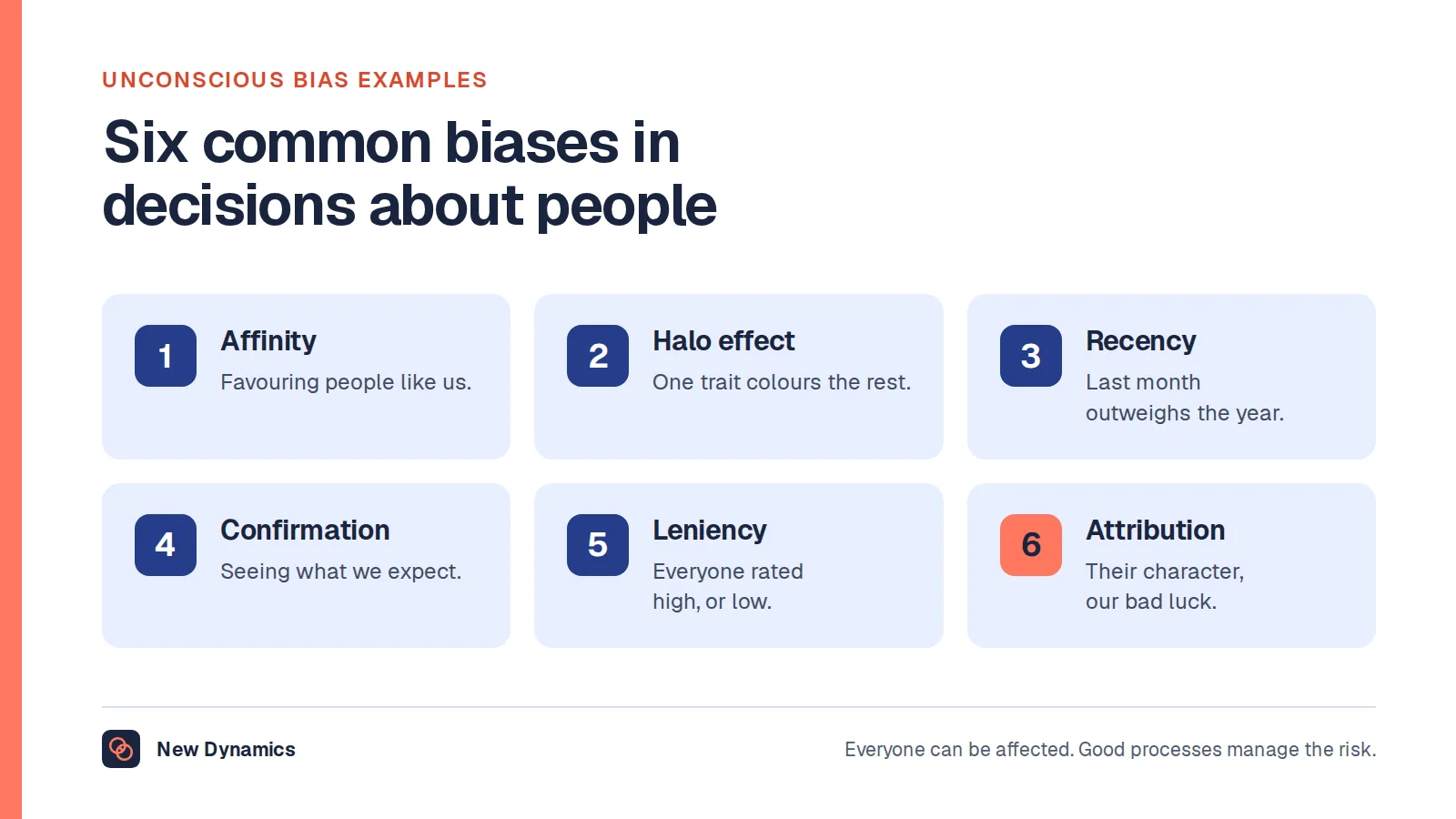
The three interact. Individual biases, repeated across hundreds of decisions, become a pattern; a process designed by biased people encodes their assumptions; and a process that produces skewed outcomes shapes the intuitions of the next generation of decision-makers. Our guide to unconscious bias examples covers the individual level, and our definition of discrimination the legal one.

The legal concepts it maps to
Systemic discrimination is not itself a legal term in most jurisdictions, but the law reaches the same mechanism under other names. What follows is general information from primary sources, not legal advice, and the law differs between countries.
Great Britain: indirect discrimination
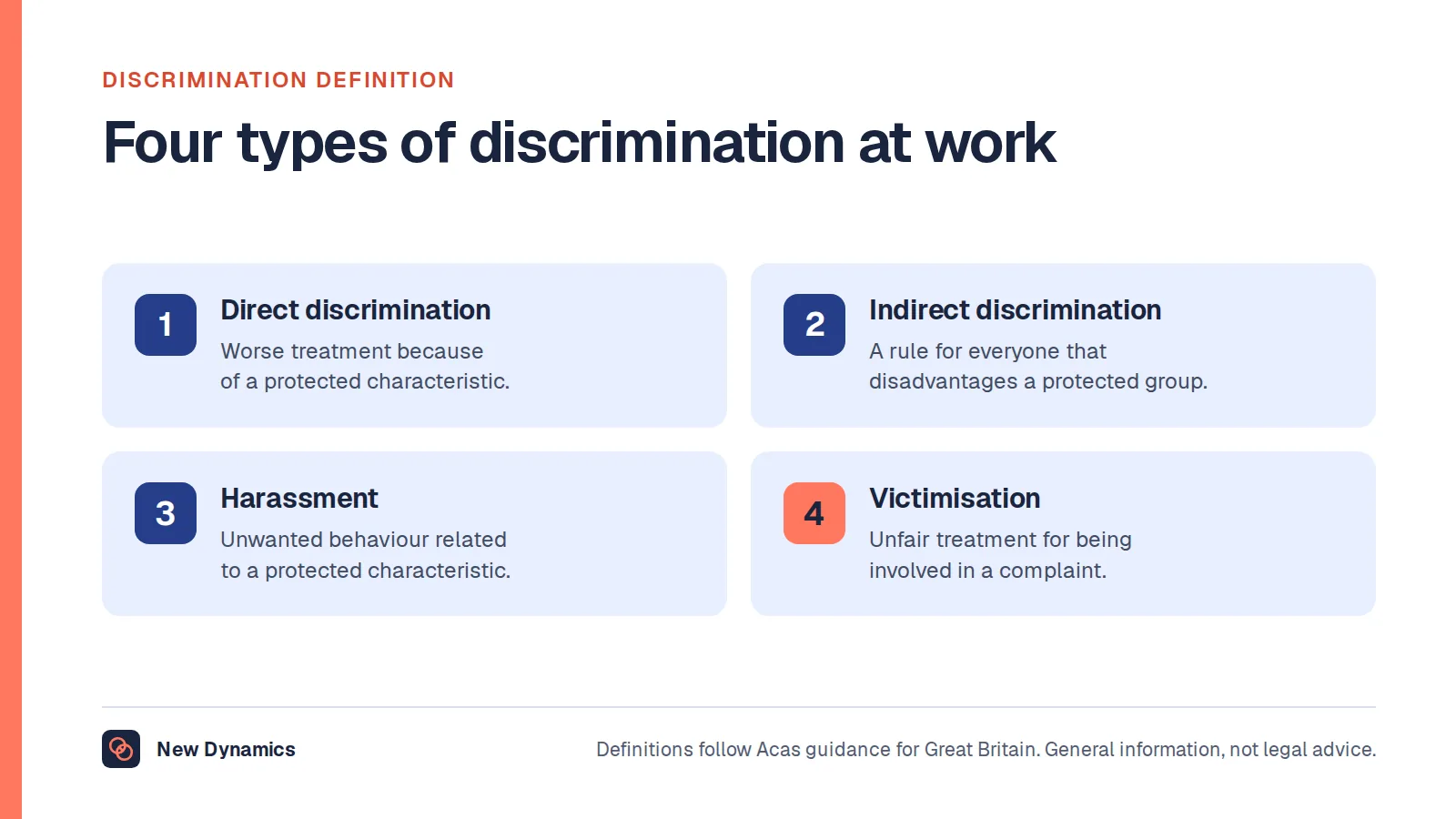
GOV.UK's guide to discrimination and your rights lists four forms under the Equality Act 2010. The one that captures systemic discrimination is indirect discrimination: “putting rules or arrangements in place that apply to everyone, but that put someone with a protected characteristic at an unfair disadvantage”. The guide adds: “It can be lawful to have specific rules or arrangements in place, as long as they can be justified.” The protected characteristics are age, gender reassignment, marriage and civil partnership, pregnancy and maternity, disability, race, religion or belief, sex and sexual orientation.
The test is the process and its effect, not anyone's motive. A neutral rule, a disproportionate effect on a protected group and no adequate justification is enough.
The Stephen Lawrence Inquiry: institutional racism
The most cited British definition of the institutional form comes from the Stephen Lawrence Inquiry report of 1999, which defined institutional racism as “The collective failure of an organisation to provide an appropriate and professional service to people because of their colour, culture, or ethnic origin.” It continued: “It can be seen or detected in processes, attitudes and behaviour which amount to discrimination through unwitting prejudice, ignorance, thoughtlessness and racist stereotyping which disadvantage minority ethnic people.” And it named the reason such failure lasts: “It persists because of the failure of the organisation openly and adequately to recognise and address its existence and causes by policy, example and leadership.”
The definition was written about policing, but every phrase applies to an employer: collective failure, processes and attitudes, unwitting prejudice, and persistence through a failure of leadership to look.
United States: disparate impact and pattern or practice
The US Equal Employment Opportunity Commission's compliance manual section on race and color discrimination separates two categories. Disparate treatment occurs when race or another protected trait is a motivating factor in how an individual is treated. “Disparate impact discrimination occurs when a neutral policy or practice has a significant negative impact on one or more protected groups”, and the policy is not job-related and consistent with business necessity, or a less discriminatory alternative exists. The manual states that a finding of disparate impact “does not depend on the existence of an unlawful motive”, and quotes the courts' description of such practices as “practices that are fair in form, but discriminatory in operation”.
The manual also describes a systemic “pattern or practice” of intentional discrimination, shown by statistical or other evidence that discrimination is “standard operating procedure – the regular rather than the unusual practice”.

Six places systemic discrimination hides at work
- Recruitment channels. Hiring mainly through employee referrals or the networks of the existing workforce reproduces its profile. Our guide to employee referral schemes covers the controls.
- Selection criteria. Requirements that are not needed for the job, such as a degree for work that does not use one, unbroken experience, a phrase such as recent graduate, or fluency beyond what the role requires, screen out groups unevenly. GOV.UK's recruitment guidance warns against phrases such as recent graduate unless they are genuine requirements.
- Pay structures. Starting pay set by negotiation or previous salary, unexplained pay bands and bonus criteria that favour the visible over the valuable all produce gaps that no single decision created.
- Promotion routes. Progression that depends on sponsorship, on presence in the office, on high-profile projects handed out informally, or on full-time continuous service.
- Flexibility and adjustments. Rigid hours, reluctance to make reasonable adjustments, and roles designed on the assumption that the holder has no caring responsibilities.
- Complaints and discipline. Grievance processes that people from some groups do not trust, and disciplinary outcomes that fall more heavily on some groups than others for the same conduct.
None of these needs a villain. Each needs someone to look.

How to find it: a five-step audit
- Collect the data. Applications, shortlists, offers, starting pay, pay by grade, promotions, performance ratings, flexible working requests and outcomes, grievances, disciplinaries and leavers, each broken down by the characteristics you monitor.
- Look for gaps at each stage. Where does a group's share fall between one stage and the next? A gap between application and shortlist points at criteria or screening; between shortlist and offer, at interviews; between grades, at promotion.
- Trace each gap to a process. Ask what rule, criterion or habit produces it. Be specific: not culture in general but, say, the requirement for five years' continuous experience.
- Test the justification. Is the rule needed for the job? Could a less exclusionary rule achieve the same aim? If not, it is the rule that has to change.
- Change the process and re-measure. Fix the rule, publish what you changed and check the numbers again next cycle. Our diversity and inclusion guide sets out the wider programme.
Training people to recognise bias is useful. It does not fix a rule. Systemic discrimination is fixed at the level where it lives.
Frequently asked questions
What is systemic discrimination?
Systemic discrimination is disadvantage to a group produced by an organisation's or a society's rules, processes, norms and habits, rather than by an individual's decision. It can exist without anyone intending it, shows up as a pattern in outcomes and persists until the process is changed.
What is the difference between systemic and institutional discrimination?
They are close. Institutional discrimination usually refers to the practices of one organisation. Systemic discrimination is often used more broadly, covering both institutions and the wider structures of society that an organisation inherits. Structural discrimination usually means the latter.
Is systemic discrimination illegal?
The phrase itself is not a legal term in most places, but the mechanism is covered. In Great Britain, indirect discrimination under the Equality Act 2010 makes a rule that disadvantages a protected group unlawful unless it can be justified. In the United States, disparate impact analysis reaches neutral practices with a significant negative effect on a protected group. This is general information, not legal advice.
What are examples of systemic discrimination at work?
Hiring through the existing workforce's networks, selection criteria the job does not need, starting pay set by previous salary, promotion that depends on full-time continuous service or informal sponsorship, rigid hours, and grievance processes that some groups do not trust.
How is systemic discrimination different from unconscious bias?
Unconscious bias sits in a person's judgement. Systemic discrimination sits in rules and processes. The two feed each other: repeated biased judgements form patterns, and biased processes shape judgements. Bias training addresses the first; changing the process addresses the second.
How do you fix systemic discrimination?
Collect outcome data by group at every stage, find the gaps, trace each gap to a specific rule or habit, test whether it is justified, change it, and measure again. Leadership matters: the Stephen Lawrence Inquiry found that institutional failure persists when an organisation does not openly recognise and address it.
Your next step: pick one process
- Choose one process where you have data: promotion is a good start.
- Break the last two years' outcomes down by the characteristics you monitor.
- Find the largest gap and name the rule or habit behind it.
- Decide whether the rule is justified; if not, change it and set a date to re-measure.
For the full programme, read and download our diversity and inclusion guide. The guide is free to read, and the PDF uses our short download form.
Want ratings, promotions and development decisions recorded so that patterns can be seen? Book a New Dynamics demo and bring your current data. You can also email contact@new-dynamics.com.