TL;DR
- A learning management system does four things: hold the content, assign and track it, record completion for compliance, and report. Most buying disappointment comes from expecting a fifth thing, which is that people will learn and apply something.
- The honest split is between compliance training, where an LMS is the right tool and the record is the point, and capability building, where a course is usually the least effective part of the answer.
- Below a hundred or so people, a shared folder, a spreadsheet of completions and real coaching often beat a system. Buy when the compliance record has to be defensible, when content is reused across many people, or when a regulator or customer asks for evidence.
Two different organisations buy a learning management system in the same week. One needs to prove that four hundred people completed fire safety and information security training this year. The other wants its managers to get better at difficult conversations.
The first will be satisfied. The second will spend a year wondering why a library of courses changed nothing.
This article explains what learning management system software actually does, how an LMS differs from the other things sold alongside it, when not to buy one, what the compliance record has to contain, and the questions to ask a provider. It names no products.
Learning sticks when it connects to goals and feedback rather than sitting in a separate system. See how New Dynamics goals and OKRs keep development objectives attached to the work people are actually doing.
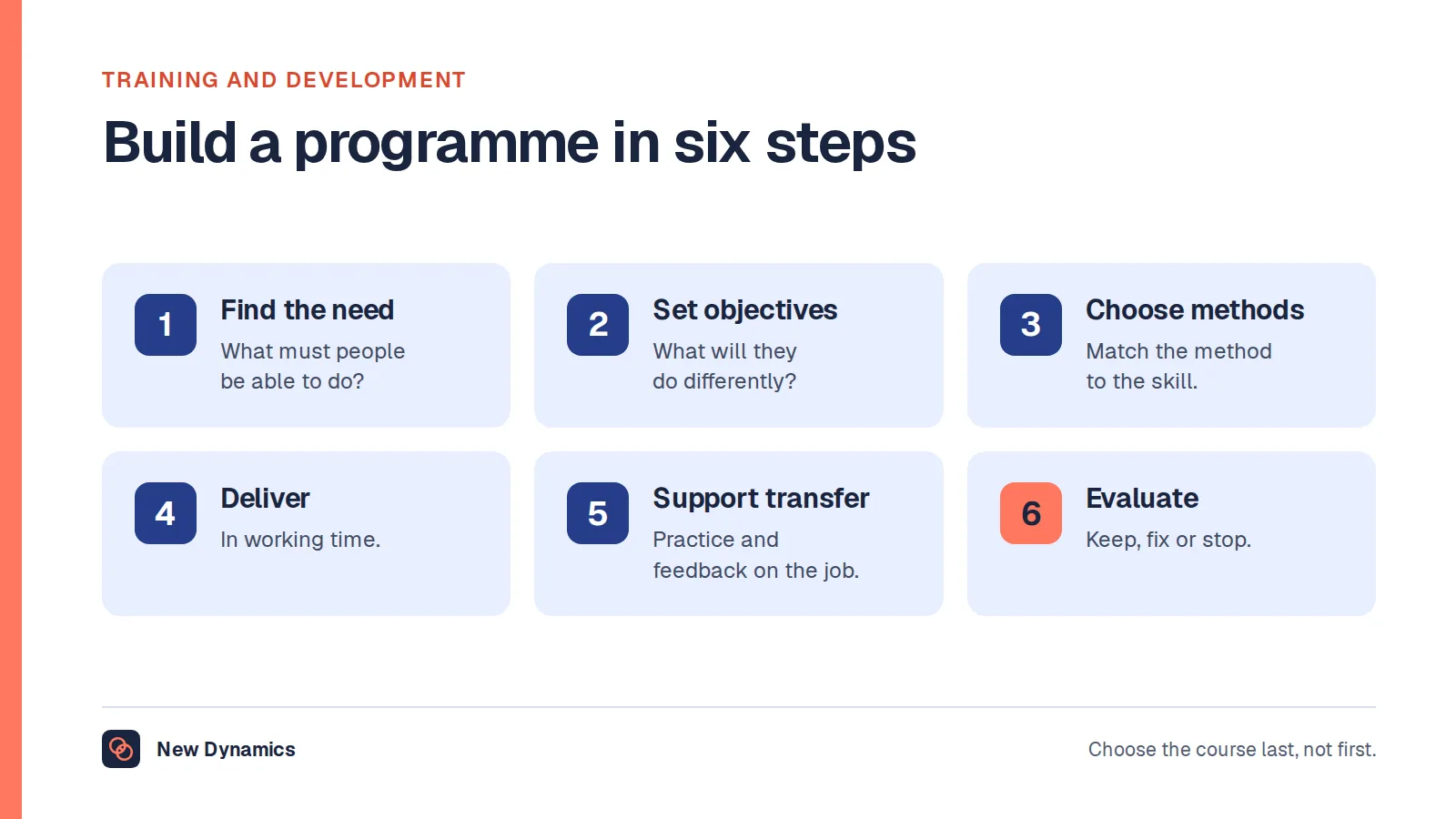
If you are designing the programme rather than buying the platform, our post on employee training and development programmes covers the structure first.
The four jobs an LMS does

- Holds content: courses, videos, documents, quizzes, whether bought in, built in-house or both.
- Assigns and tracks: who must do what, by when, with reminders and escalation.
- Records completion: the audit trail that proves a named person completed a named thing on a date.
- Reports: completion rates by team, overdue items, expiry and renewal.
Notice what is absent: whether anyone can now do the thing. No LMS measures that, and the better products are honest about it.
LMS, LXP and the rest of the labels
- Learning management system (LMS): assignment, tracking and compliance records. Built around the organisation's requirements.
- Learning experience platform (LXP): discovery and recommendation, built around the learner's interests. Good for curiosity, weak for proving who did what.
- Content libraries: subscriptions to catalogues of courses. They are content, not a system, and they are often mistaken for one.
- Authoring tools: for making your own material.
- Training management: scheduling instructor-led sessions, rooms, trainers and attendance, which many LMS products handle poorly.
Work out which of those you actually need before comparing feature grids, because a product strong in one is frequently weak in another.
When not to buy one
Three honest signals that the money is better spent elsewhere.
- Under about a hundred people with little mandatory training. A folder, a tracked spreadsheet and a calendar reminder are enough, and the implementation time is better spent on coaching.
- The problem is capability, not records. Courses are a weak instrument for behaviour change. Practice, feedback and a manager who notices beat a module, and our post on the skills matrix gives a better starting point for seeing the gaps.
- Nobody owns learning. Without an owner, an LMS becomes a library of assigned courses that people click through on the last day of the quarter.
What the compliance record has to do
Where training is a legal or contractual requirement, the record is the product, and it has to survive scrutiny.
Some of that requirement is statutory. The Health and Safety Executive states that "Health and safety training should take place during working hours and must be free for employees", and that staff "will need extra training if you get new equipment or your working practices change", which is exactly the trigger an LMS should be able to act on.
- Name, course, version, date and outcome, held as a record rather than a dashboard.
- Evidence of renewal cycles, including what expires and when.
- Proof for leavers, since the question is often asked about someone who has since left.
- Export, so the record survives a change of system.
- Retention that matches your policy, rather than keeping everything forever because storage is cheap.
On that last point, the ICO's rule for employment records is the same one that applies everywhere else: "You must not keep information for longer than you need to."
Ask any provider to produce a single-person compliance history as a file, live in the demo. It is a surprisingly effective test.
Questions for the demo

- Show me one person's complete record, exported, including an expired item.
- Show me assigning a course to a team, including someone who joins next week.
- What does it look like on a phone for someone with no desk and no work email?
- How do instructor-led sessions work, including attendance and waiting lists?
- What content do we own if we leave, and in what format?
- What does implementation need from us, in hours and in people?
- How do you handle accessibility, and can you show a module meeting it?
Red flags: completion rates presented as the main measure of success, a content catalogue used to distract from weak record keeping, and any claim that the system will change behaviour.
Measuring something more useful than completion

Completion tells you a tick happened. Four better measures, none of which needs a new product:
- Overdue compliance items, which should trend to zero and stay there.
- Time to competence for a role, measured from start date to an agreed standard.
- Manager observation after training: a short structured check four to six weeks later.
- The repeat question rate. If the same questions keep arriving, the material has not landed, whatever the completion rate says.
What usually goes wrong
- The catalogue is the strategy. Thousands of courses, no path, no owner.
- Assigning everything to everyone, which trains people to click through without reading.
- No link to the job. Learning that never appears in a one-to-one or an objective is a hobby the organisation pays for.
- Content nobody updates, so a module references a process that changed two reorganisations ago.
- Deskless workers forgotten, which is where the completion gap always shows up.
Frequently asked questions
What is a learning management system?
It is software that holds training content, assigns it to people, tracks and records completion, and reports on it. Its core strength is the record: proving that a named person completed a named course on a date, which is what compliance and audit questions need.
What is the difference between an LMS and an LXP?
An LMS is built around what the organisation requires people to do, with assignment and compliance records at its centre. A learning experience platform is built around what the learner wants to explore, with recommendation and discovery at its centre. They answer different questions, and many organisations need the first more than the second.
Does a small business need an LMS?
Often not. Below roughly a hundred people with limited mandatory training, a shared folder, a tracked spreadsheet and diarised refreshers do the job. The case for buying grows with the volume of compliance training and the need to produce defensible records.
What should an LMS compliance record include?
The person, the course and its version, the date, the outcome and the expiry or renewal date, exportable as a file and retained in line with your policy. It also has to cover people who have since left, because that is frequently who the question is about.
How do you measure whether training worked?
Not by completion. Track overdue compliance items, time to competence for a role, a short manager observation four to six weeks after the training, and whether the same questions keep being asked. Those tell you something about capability rather than about clicking.
Should training content be bought or built?
Buy for generic, regulated and widely standardised topics. Build for anything specific to your products, systems or customers, which is usually where the real capability gap sits. Most organisations need both, and the mix matters more than the catalogue size.
Your next step: separate the two problems
- Split your list of training needs into compliance records and capability building, on one page.
- For the compliance half, write down what evidence you must be able to produce, for whom, and how fast.
- For the capability half, decide what practice and feedback will accompany any course, before you buy anything.
- In every demo, ask for one person's exported record, including an expired item.
For a structure that connects learning to progression rather than to a catalogue, read and download our career development guide. The guide is free to read, and the PDF uses our short download form.
Want development objectives to live beside goals and feedback? Book a New Dynamics demo and bring your current training plan. You can also email contact@new-dynamics.com.