TL;DR
- A learning organization is one where people at every level keep improving how the work is done, share what they learn and change course when the evidence says they should.
- Peter Senge, who made the term popular in 1990, named five disciplines: systems thinking, personal mastery, mental models, shared vision and team learning.
- Training budgets do not make a learning organization. Everyday habits do: reviewing work without blame, sharing lessons across teams, making it safe to admit mistakes and giving people time to think.
Every organisation says it values learning. Fewer can show you where last year's biggest mistake was discussed openly, what changed as a result and how the lesson reached the teams that were not involved. That is the gap a learning organization tries to close.
This article explains what the term means, sets out Peter Senge's five disciplines in plain words, describes six everyday habits that build a learning organisation, and covers the barriers and the measures of progress. We use the American spelling where it is the name of the idea and British spelling elsewhere.
Learning depends on honest, regular feedback. See how New Dynamics continuous feedback makes it part of everyday work.
What is a learning organization?
A learning organization is one where people at every level keep improving how the work is done, share what they learn and change course when the evidence says they should. Learning is built into the way the organisation operates. It is not confined to the training department.
The term was made popular by Peter Senge in his 1990 book The Fifth Discipline. The encyclopaedia of informal education, infed.org, in its article on Peter Senge and the learning organization, quotes his definition. Learning organizations are:
“…organizations where people continually expand their capacity to create the results they truly desire, where new and expansive patterns of thinking are nurtured, where collective aspiration is set free, and where people are continually learning to see the whole together.”
The same article summarises the reasoning: in situations of rapid change, only organisations that are “flexible, adaptive and productive” will excel, so they need to “discover how to tap people's commitment and capacity to learn at all levels”.
David Garvin made a related point in the Harvard Business Review. Writing about why so many improvement programmes fail, he opened his 1993 article Building a Learning Organization with what he called a basic truth: “Continuous improvement requires a commitment to learning.”
A learning organisation is more than training
| Training | A learning organisation |
|---|---|
| Courses, run by a department | Habits, practised by every team |
| Individuals gain skills | The organisation changes what it does |
| Measured by attendance and completion | Measured by what is done differently afterwards |
| Happens away from the work | Happens in and around the work |
| Can be bought | Has to be built |
Training matters. It is one input. An organisation can spend heavily on courses and still repeat the same mistakes every year.
Peter Senge's five disciplines
Senge described five disciplines that, in his view, come together in a learning organization. The infed.org article lists them. The plain-language explanations below are ours.
- Systems thinking. Seeing the whole and how the parts affect each other, in place of blaming the nearest person or team. Senge treats this as the cornerstone, the “fifth discipline” that integrates the others. A sales promise that overloads the delivery team is a systems problem, not a delivery problem.
- Personal mastery. Individuals who keep learning and keep getting clearer about what matters to them. An organisation learns only through people who learn.
- Mental models. The assumptions we carry about how the world works. The discipline, in Senge's words, “starts with turning the mirror inward”: bringing those assumptions to the surface and testing them.
- Building shared vision. A picture of the future that people hold in common and care about, which gives learning a direction.
- Team learning. Senge describes it as “the process of aligning and developing the capacities of a team to create the results its members truly desire”. It starts with dialogue, in which people suspend their assumptions and think together.

A fair criticism
The infed.org article also sets Senge's work in context. It notes that he writes for practising managers and that his book is not meant as a definitive addition to the academic literature. Much of the writing in this field, it says, has been devoted to identifying templates that real organisations could try to emulate.
That is a useful caution. The five disciplines are an ideal to steer by. Few organisations would claim to have mastered them. The practical question is what your teams could do differently next month.
Six habits of a learning organisation
These are our practical suggestions. Each is small enough to start in one team.
1. Review work without blame
After a project, an incident or a lost deal, ask four questions. What did we expect? What happened? Why was there a difference? What will we do differently? Keep the review short, hold it soon and write down the answers.
2. Make it safe to say “I got that wrong”
People hide mistakes when admitting them is costly, and hidden mistakes cannot teach anyone. Google's research into what makes teams effective found psychological safety to be the most important of five dynamics. On such teams, people “feel confident that no one on the team will embarrass or punish anyone else for admitting a mistake, asking a question, or offering a new idea”.
Leaders set this tone by going first. “Here is what I got wrong last quarter” does more than any policy.
3. Share lessons across teams
Many organisations learn the same lesson several times, in different departments. Build simple routes for lessons to travel: a short written summary, a monthly session where teams present one thing they learned, and a searchable place to keep them.
4. Give people time to think
Learning needs slack. A team that runs at full capacity has no time to ask whether there is a better way. Protect a little time for reflection and improvement, and treat it as part of the work.
5. Try small experiments
When you are unsure, test the idea on a small scale before arguing about it. Agree in advance what you expect and how you will know. An experiment that disproves a belief is a success.
6. Listen to the edges
New starters, frontline staff, customers and people who are leaving all see things that insiders have stopped noticing. Ask them, and act on what you hear. See our exit interview questions and workplace engagement survey questions.

What stops organisations learning
Blame. If the first question after a failure is “who?”, people learn to hide.
Busyness. When every hour is scheduled, reflection is the first thing to go.
Silos. Lessons stay where they were learned, and other teams repeat the mistake.
Success. A good run convinces people that they have nothing left to learn. Assumptions harden into mental models that nobody tests.
Short-term targets. If only this quarter's number is rewarded, experiments and honest reviews look like a cost.
Knowledge that lives in heads. When experienced people leave, what they knew leaves with them. See our succession planning guide.
Leaders who have all the answers. If the most senior person is never seen to learn, nobody else will risk it.
The manager's part
Most learning happens, or fails to happen, inside teams. A manager can:
- ask “what did we learn?” as routinely as “did we hit the number?”;
- admit their own mistakes first;
- thank people who bring bad news early;
- give feedback that is specific enough to act on, as in our positive feedback examples and negative feedback examples;
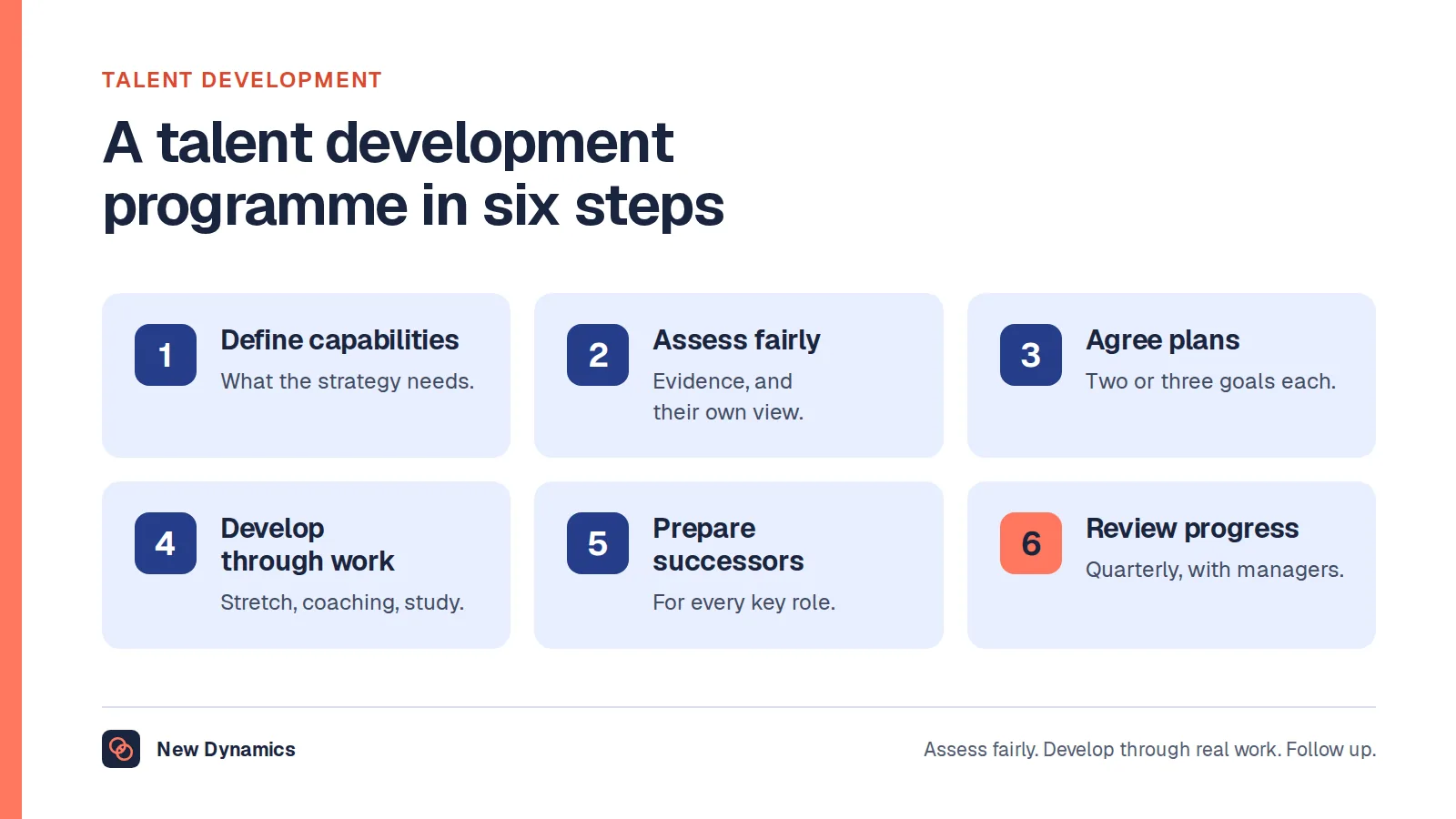
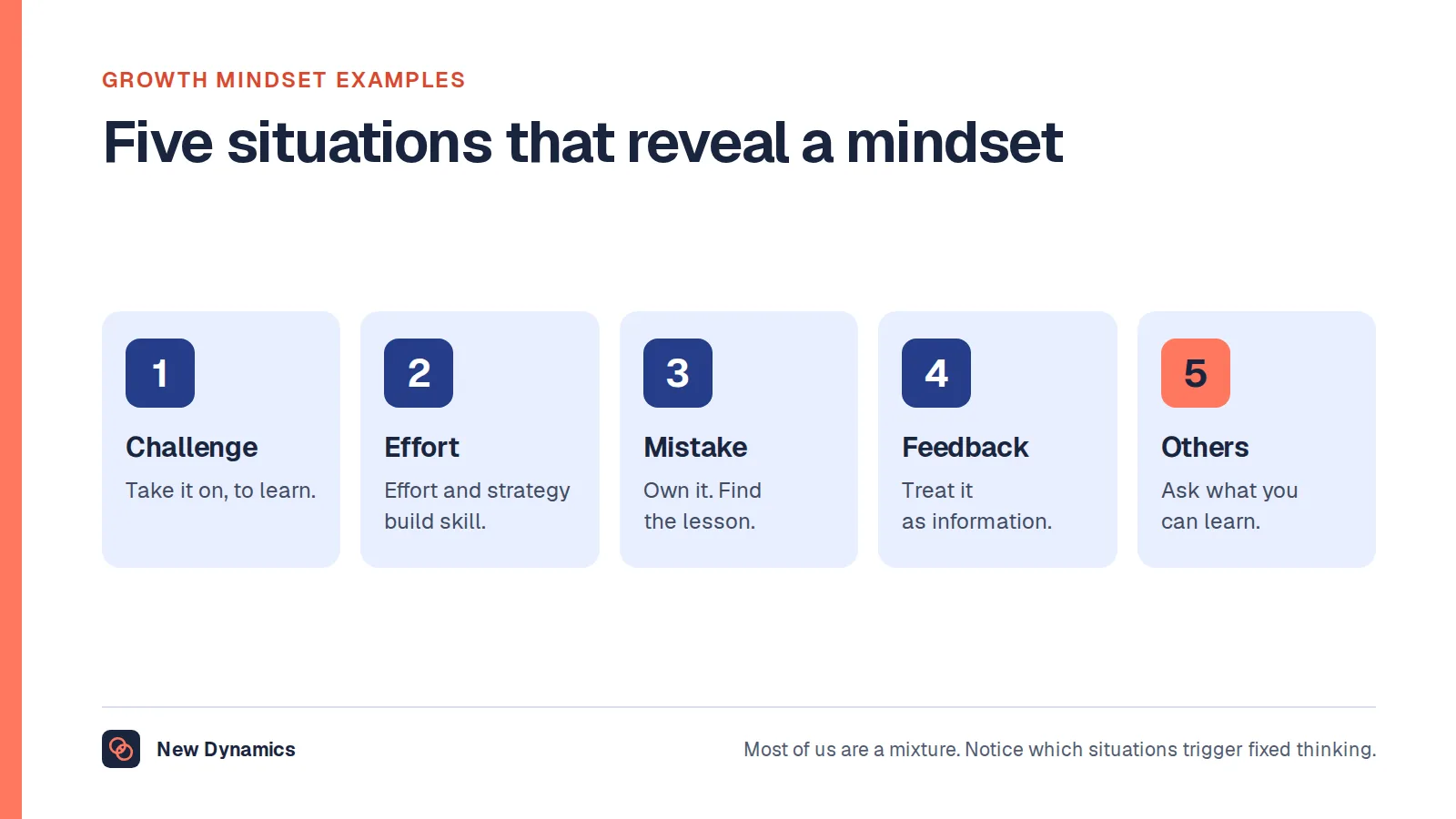
- agree a development plan with each person, and return to it in one-to-ones. Our guides to talent development and growth mindset examples go further;
- share the team's lessons with other teams, including the embarrassing ones.

How to tell whether your organisation is learning
Attendance at courses tells you little. Look for signs that behaviour is changing.
- Repeat problems fall. The same incident, complaint or error occurs less often.
- Reviews happen, and lead to change. You can point to actions taken as a result.
- Bad news travels fast. Problems reach decision makers early and undistorted.
- Ideas come from every level, and some of them are adopted.
- People move and grow. Internal moves and promotions are common, and development plans are live documents.
- Survey answers support it. Items such as “If I make a mistake on our team, it is not held against me”, which Google used in its research, score well and improve.
Choose three or four of these, record a baseline and look again in six months.
Frequently asked questions
What is a learning organization?
A learning organization is one where people at every level keep improving how work is done, share what they learn and change course when the evidence requires it. Learning is part of how the organisation operates every day. It is not limited to formal training.
Who came up with the learning organization?
Peter Senge made the term popular in his 1990 book The Fifth Discipline. He described learning organizations as places where people continually expand their capacity to create the results they truly desire, and are continually learning to see the whole together.
What are the five disciplines of a learning organization?
Senge's five disciplines are systems thinking, personal mastery, mental models, building shared vision and team learning. He treats systems thinking as the cornerstone, the fifth discipline that integrates the other four.
What is an example of a learning organisation in practice?
A team holds a short, blame-free review after every project, writes down what it will do differently and shares the summary with other teams. Leaders admit their own mistakes, small experiments are encouraged and every person has a development plan that is discussed regularly.
What is the difference between organisational learning and a learning organisation?
Organisational learning is the process: how an organisation gains, shares and uses knowledge. A learning organisation is the ideal: an organisation that does this deliberately and well. The first describes an activity, and the second describes a kind of organisation.
How do you build a learning organisation?
Start small. Review work without blame, make it safe to admit mistakes, share lessons across teams, protect time to think, run small experiments and listen to new starters, frontline staff and customers.
Your next step: hold one blame-free review
- Pick a recent project, incident or decision.
- Gather the people involved for thirty minutes.
- Ask the four questions: what did we expect, what happened, why the difference and what will we do differently?
- Share a one-page summary with one other team.
For a structured way to connect development to everyday management, read and download our career development guide. The guide is free to read, and the PDF uses our short download form.
Want feedback, goals and development plans in one place, so that learning is visible? Book a New Dynamics demo and bring your current approach. You can also email contact@new-dynamics.com.