TL;DR
- Jurisdiction: United States. There is no single document called a letter of coverage. The request usually resolves to one of four things: Form 1095-B, Form 1095-C, a dated letter from the employer or insurer, or the COBRA election notice.
- Employers no longer have to post the IRS statements out. The IRS instructions for the 2025 tax year say that "Employers no longer have to automatically send Form 1095-C to individuals" where a website notice is given, and a requested copy is timely if furnished by the later of January 31, 2026, or 30 days after the request.
- The HIPAA certificate of creditable coverage no longer exists. 29 CFR 2590.701-5 now reads that the rules for providing it "have been superseded by the prohibition on preexisting condition exclusions", an amendment that applies from December 31, 2014.
An email arrives in the HR inbox. "Can you send me a letter of coverage?" Nobody asks what it is for, somebody forwards the benefits brochure, and a fortnight later the same person is back because the Marketplace rejected what they uploaded. The problem is not the letter. Four different documents answer to that name, three different parties issue them, and only one of them does the job the employee actually has.
Jurisdiction: United States. Everything below is federal: the information reporting rules under sections 6055 and 6056 of the Internal Revenue Code, the continuation coverage rules in Part 6 of Title I of ERISA, and guidance from the IRS, the Department of Labor and the Centers for Medicare and Medicaid Services. There is no United Kingdom equivalent. This is general information about benefits paperwork, not legal, tax or insurance advice, and your own plan documents govern your case.
A request like this fails when it is answered rather than routed. See how New Dynamics workflows give a recurring request a named owner, a due date and a visible status, so it is classified before anyone writes a letter.
There is no document called a letter of coverage

No federal agency publishes a form of that name. The phrase describes whatever paper will satisfy whoever is asking, and in practice it collapses into four things.
- Form 1095-B, the IRS statement of minimum essential coverage, issued by an insurer or a small self-insured employer.
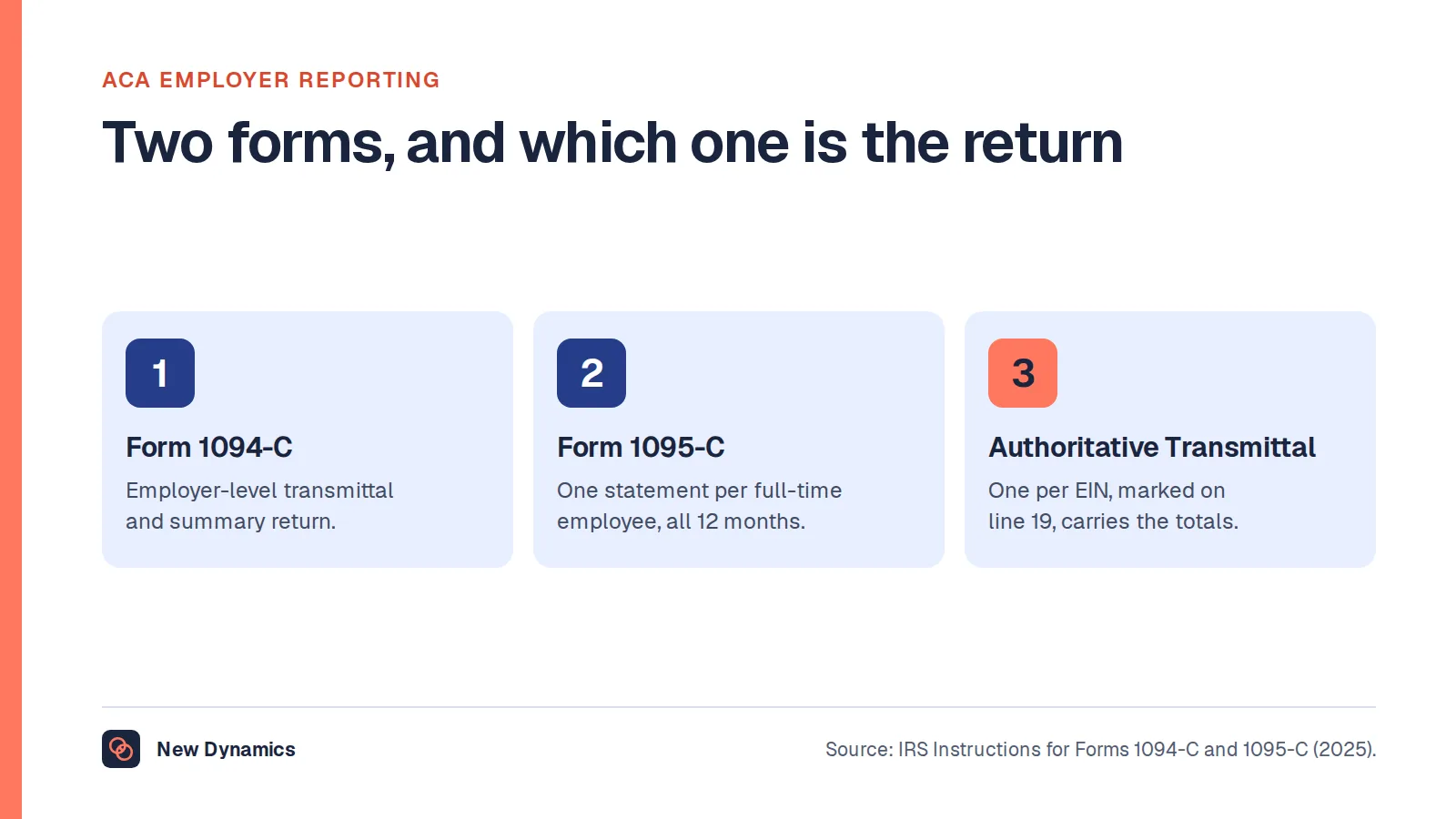
- Form 1095-C, the IRS statement of an employer's offer of coverage, issued by an applicable large employer.
- A dated letter from the employer or insurer, used as proof for a new plan, a Marketplace special enrolment, a visa application or a lender.
- The COBRA election notice, which is evidence that coverage is ending rather than continuing.
One question separates them: who asked, and what are they deciding? A tax preparer wants a 1095. The Marketplace wants a dated letter showing loss. A consulate or a lender wants letterhead with names and dates.
The IRS statements: Form 1095-B and Form 1095-C
The IRS page About Form 1095-B, reviewed on 27 June 2026, puts it in one line: "Form 1095-B is used to report certain information to the IRS and to taxpayers about individuals who are covered by minimum essential coverage and therefore are not liable for the individual shared responsibility payment."
Employees often ask the wrong party for it. The Instructions for Forms 1094-B and 1095-B (2025), reviewed on 30 April 2026, say "Small employers that aren't subject to the employer shared responsibility provisions sponsoring self-insured group health plans will use Forms 1094-B and 1095-B to report information about covered individuals". Where the plan is fully insured, the carrier reports, not the employer. The same instructions set the furnishing deadline for coverage in 2025: filers "must furnish a copy by March 2, 2026, to the person identified as the 'responsible individual' on the form", which on a family policy means the subscriber rather than the dependant who is asking.
Form 1095-C is the employer's own statement, and our post on Forms 1094-C and 1095-C covers the filing side. The point that matters here is the change most HR teams have not absorbed. The Instructions for Forms 1094-C and 1095-C (2025), also reviewed on 30 April 2026, state it plainly: "Employers no longer have to automatically send Form 1095-C to individuals. The requirement for furnishing the statement is met if the employer responsible for providing the statements provides clear, conspicuous, and accessible notice on its website that an individual may request a copy of their statement and the copy is timely furnished." The 1095-B instructions carry the identical sentence for that form.
So the form may never arrive in the post, by design. Where an employer has taken that route, a requested copy is timely if it reaches the individual "no later than the later of January 31, 2026, or 30 days after the date of the request". The instructions also describe the website notice, including a heading in capital letters reading "IMPORTANT HEALTH COVERAGE TAX DOCUMENTS", with an email address, a mailing address and a telephone number.
One wrinkle is worth knowing, because the same document says two things. The sentence above sits under "What's New", and the instructions point to Notice 2025-15 for further guidance. Further down, under Statements Furnished to Individuals, the older rule is restated narrowly: an employer may use the alternative manner "to non-full-time employees and nonemployees who are enrolled in the self-insured health coverage". The broad statement is the current one, and the narrow paragraph describes the pre-existing regulation it replaced. If you are deciding policy rather than reading history, work from the What's New text and the notice it cites.
That is worth checking this week. If your provider switched to request-only furnishing and nobody put the notice on your benefits site, you have a disclosure gap and a January inbox full of people who think their form was lost.
The letter an insurer or employer actually writes

When the request is not about tax, it is about proving a date. The clearest official statement of what the letter must contain is HealthCare.gov's page on documents proving loss of health coverage, published by the Centers for Medicare and Medicaid Services. The test is short: "These documents must include your name and the date of coverage loss."
The employer version is spelled out. The page accepts "A letter from an employer, on official letterhead or stationery", confirming one of three things about the employee, spouse or dependant: "That your employer dropped or will drop your coverage or benefits", "That your employer stopped or will stop contributing to your cost of coverage", or "That your employer changed or will change coverage or benefits, and your coverage will no longer be considered qualifying health coverage".
Note what is absent: a general statement that somebody is covered. A letter confirming current enrolment with no end date gets rejected for a special enrolment period, because the Marketplace is confirming the loss, not the coverage.
For a visa application or a lender, no federal rule sets a format. Write what the Marketplace list requires anyway: full legal name, plan and carrier, start and end dates, anyone else covered, and a named signatory. If you cannot state an end date, say so rather than implying one.
The COBRA election notice proves the opposite thing
The fourth document gets mistaken for proof of coverage because it arrives when coverage is being discussed. It does the reverse. The election notice under 29 CFR 2590.606-4 exists to tell a qualified beneficiary that cover is about to stop.
Paragraph (b)(4) requires it to identify the qualifying event and the qualified beneficiaries "and the date on which coverage under the plan will terminate (or has terminated) unless continuation coverage is elected". That is why it works as evidence of loss, and why HealthCare.gov accepts "A letter about COBRA coverage". The same regulation sets the timing: on receipt of a notice of qualifying event the administrator must furnish the election notice "not later than 14 days after receipt of the notice of qualifying event". Our post on the qualifying life event covers the surrounding windows.
One limit is written into the notice itself. Paragraph (b)(4)(xiv) requires "A statement that the notice does not fully describe continuation coverage or other rights under the plan". It is not a plan summary and should not be sent as one.
The HIPAA certificate of creditable coverage no longer exists
Older material still tells leavers to ask for a "certificate of creditable coverage". Under HIPAA, plans issued one so that a new plan could offset a preexisting condition exclusion. The Affordable Care Act prohibited those exclusions, and the certificate went with them.
This is not an inference. The final rule at 79 FR 10296, published on 24 February 2014, describes its own purpose as removing superseded provisions, "including elimination of the requirement to issue certificates of creditable coverage". The regulation reads the same way today: 29 CFR 2590.701-5 now says, in full, that "The rules for providing certificates of creditable coverage and demonstrating creditable coverage have been superseded by the prohibition on preexisting condition exclusions", applying "beginning December 31, 2014".
No plan has had to issue one for over a decade. When an employee asks, find out what it is for. Almost always it is loss of coverage, which the letter above covers.
The creditable coverage letter that does still exist
The vocabulary survives elsewhere, and there employers have a live duty. The CMS page on creditable coverage, last modified on 10 September 2024, says the Medicare Modernization Act requires entities whose policies include prescription drug coverage "to notify Medicare eligible policyholders whether their prescription drug coverage is creditable coverage, which means that the coverage is expected to pay on average as much as the standard Medicare prescription drug coverage".
The duty is annual and dated: "to provide a written disclosure notice to all Medicare eligible individuals annually who are covered under its prescription drug plan, prior to October 15th each year", reaching active employees, dependants, retirees, disabled individuals and COBRA beneficiaries. The stake for the employee is permanent, because CMS states the Act "imposes a late enrollment penalty on individuals who do not maintain creditable coverage for a period of 63 days or longer following their initial enrollment period for the Medicare prescription drug benefit". A request for a creditable coverage letter from somebody near 65 is therefore a different request, and belongs with whoever owns your Part D disclosure.
The employer side: what you issue, and what you can be made to issue

The employer issues Form 1095-C if it is an applicable large employer, Forms 1094-B and 1095-B if it is a smaller employer with a self-insured plan, the COBRA election notice where it administers the plan itself, the Part D creditable coverage notice, and any letter confirming dates of enrolment or loss.
The insurer issues Form 1095-B for fully insured coverage, and its own certificate or evidence of coverage booklet, which describes benefits rather than proving a period of enrolment. An insurer termination letter is accepted by the Marketplace on the same terms as an employer one.
An employee can compel very little of this, with one exception. ERISA section 104(b)(4), 29 U.S.C. 1024(b)(4), provides that "The administrator shall, upon written request of any participant or beneficiary, furnish a copy of the latest updated summary, plan description, and the latest annual report". Our post on the summary plan description sets out what that summary contains. That clock has teeth: ERISA section 502(c)(1), 29 U.S.C. 1132(c)(1), makes an administrator who does not comply "within 30 days after such request" potentially "personally liable to such participant or beneficiary in the amount of up to $100 a day", and 29 CFR 2575.502c-1 raised that "from $100 a day to $110 a day" for violations after 29 July 1997.
A free-text letter of coverage is on none of those lists, so you are not obliged to write one. Most employers do, which is the argument for a template rather than a fresh drafting exercise each time. The wider numbers worth tracking across HR sit in our HR statistics hub.
Frequently asked questions
What is a letter of coverage for health insurance?
It is not a defined document. In the United States the phrase usually means one of four things: Form 1095-B, Form 1095-C, a dated letter from an employer or insurer proving enrolment or its loss, or the COBRA election notice. Which one you need depends on who is asking.
Is a certificate of coverage the same as a letter of coverage?
Usually not. An insurer's certificate of coverage is the booklet describing a group policy's benefits. The HIPAA certificate of creditable coverage is a separate and now defunct document: 29 CFR 2590.701-5 says the rules for providing it "have been superseded by the prohibition on preexisting condition exclusions", applying from 31 December 2014.
Will my employer post my Form 1095-C automatically?
Not necessarily. The IRS instructions for the 2025 tax year say employers no longer have to send it automatically if they post a clear, conspicuous website notice that a copy may be requested. A requested copy must then be furnished by the later of 31 January 2026 or 30 days after the request.
What should a proof of health insurance letter contain?
HealthCare.gov requires a loss of coverage document to "include your name and the date of coverage loss", and accepts a letter from an employer on official letterhead. Include the full legal name, plan and carrier, start and end dates, anyone else covered, and a named signatory.
Does HR have to write me a letter of coverage?
No federal rule requires a free-text letter. ERISA section 104(b)(4) does require the plan administrator to furnish plan documents on written request, and section 502(c)(1) exposes an administrator who misses the 30 day window to liability of up to $110 a day under 29 CFR 2575.502c-1.
Your next step: classify the request before you answer it
- Reply with a question, not an attachment. Who needs this, and by when? An accountant means a 1095. A new plan or the Marketplace means a dated letter showing the end of cover.
- Check your 1095 furnishing method. If your provider moved to request-only, confirm the website notice exists, carries the capitalised heading the IRS instructions describe, and lists an email address, a mailing address and a telephone number.
- Build one letter template with the Marketplace fields already in it: name, plan, carrier, start date, end date, dependants, signatory.
- Find out who owns your Part D creditable coverage notice, and whether it went out before 15 October.
- Stop promising HIPAA certificates. Replace the phrase wherever it survives in your offboarding pack.
Which documents HR issues, and which come from the insurer, is worth settling in writing. Our compensation policy guide covers how to document benefits decisions.
Want these requests to arrive with an owner and a deadline attached instead of circulating as email? Book a New Dynamics demo and bring your current offboarding checklist. You can also email contact@new-dynamics.com.