TL;DR
- Sort every benefit into one of three tiers: the statutory floor you cannot opt out of, the benefits you must report to HMRC and pay tax and National Insurance on, and the narrow set that is genuinely exempt.
- The exempt tier is smaller than most employers expect. The trivial benefits exemption needs all of its conditions to hold at once, and salary sacrifice carries a minimum wage floor and a contract variation every time somebody opts in or out.
- Part-time benefits are a legal question, not a design choice. A part-time worker is protected from less favourable treatment than a comparable full-timer, so the answer is usually to scale a benefit in proportion to hours rather than withhold it.
A benefits list is easy to write and expensive to discover. Somebody proposes private medical cover, somebody else proposes a gym subsidy, and the list goes to the board with a single annual price next to each line. Then payroll asks which of them are reportable, who is eligible, and what happens to the person on fifteen hours a week, and the plan slows down.
The useful way to think about employee benefits is not by category. It is by treatment. Every item you are considering sits in one of three tiers: things you must provide because the law says so, things you may provide but must report and pay tax on, and things that are exempt. That one sorting exercise tells you more about the real cost of a package than any list of perks.
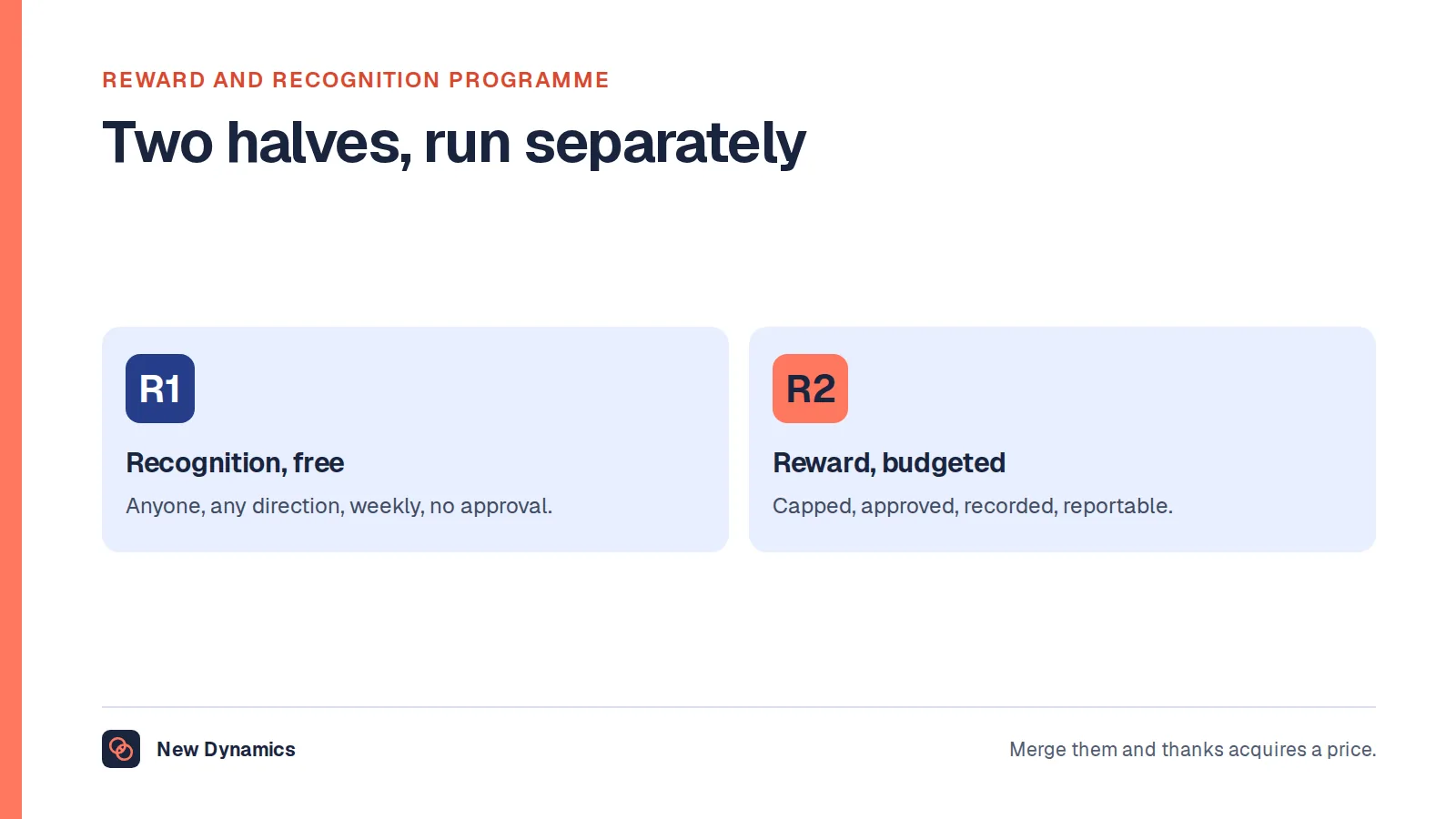
Recognition is the one part of a package that costs nothing to give and still changes how people describe the job. See how New Dynamics recognition keeps it visible and even-handed.
Everything below describes the United Kingdom. Northern Ireland employment law differs in places, and rates change. This is general information rather than tax or legal advice, so confirm each item with your accountant or adviser and against the current guidance before you promise anything.
Three tiers, not one long list

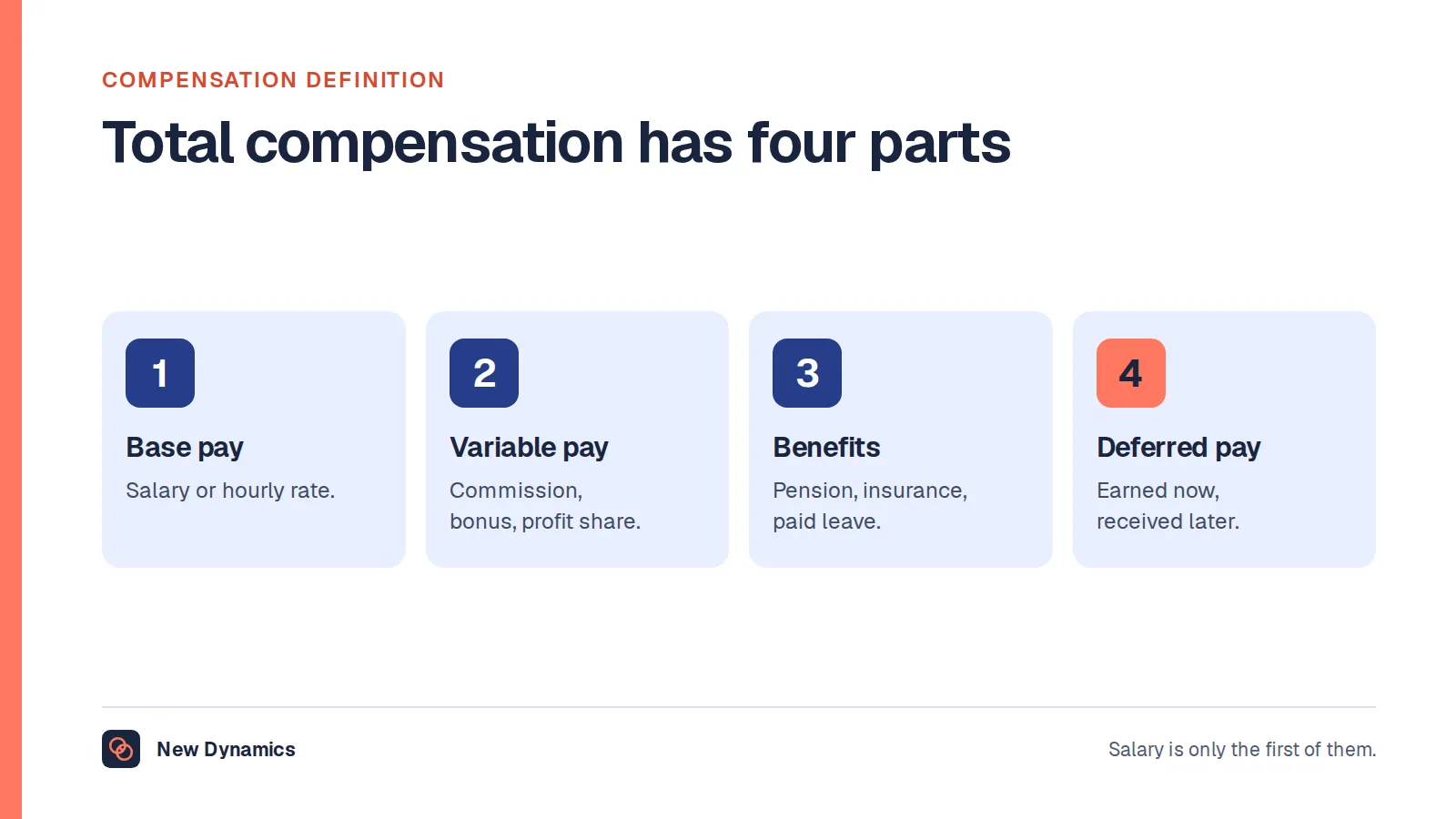
The vocabulary around this subject is unhelpfully loose. Voluntary benefits usually means the part of the package the employer chooses to offer rather than the part the law requires, and sometimes it means specifically the items an individual employee opts into and often part-funds, such as a cycle scheme or a discounted dental plan. Indirect compensation is the same territory described from the finance side: everything of value a person receives for working that is not their cash salary, including pension contributions, paid leave, insurances and benefits in kind.
Both terms are fine. Neither tells you what anything costs you. The tiers do.
Tier one: the statutory floor
This tier is not really a benefits decision at all. These are obligations, and no amount of package design makes them optional.
Workplace pension and automatic enrolment
Government guidance for employers is blunt about the trigger: "Employers have to provide a workplace pension scheme for eligible staff as soon as their first member of staff starts working for them". You must enrol and make an employer's contribution for all staff who "are aged between 22 and the State Pension age", "earn at least £10,000 a year" and "normally work in the UK".
A pension is therefore the single largest item in most packages and the one least often described as a benefit, because it arrives automatically rather than as an offer.
Holiday
Almost every worker is legally entitled to "5.6 weeks' paid holiday a year". The guidance also settles a question that causes arguments every December: "Bank or public holidays do not have to be given as paid leave", although an employer can choose to count them inside the statutory entitlement.
Extra leave above 5.6 weeks is a genuine benefit, and one of the few that costs nothing in tax and very little in administration.
Statutory sick pay
Statutory Sick Pay is paid by the employer, and gov.uk states that a worker can get "up to £123.25 per week Statutory Sick Pay (SSP) if you're too ill to work", and that "It's paid by your employer for up to 28 weeks". On company schemes the position is equally clear: "You cannot get less than the statutory amount. You can get more if your company has a sick pay scheme (or 'occupational scheme')".
Occupational sick pay is one of the most valued benefits there is, and it never appears on a perks list.
Statutory parental pay
Statutory Maternity Pay "is paid for up to 39 weeks", made up of "90% of your average weekly earnings (before tax) for the first 6 weeks" and then "£194.32 or 90% of your average weekly earnings (whichever is lower) for the next 33 weeks". Paternity, adoption and shared parental pay have their own rules and rates. Enhanced parental pay, like enhanced sick pay, is a real and costly benefit sitting on top of a statutory floor.
Tier two: benefits you report and pay tax on
Once you move above the floor, the default is not exemption. It is reporting. HMRC's general rule for employers is that if you "provide expenses or benefits to employees or directors, you must usually: report them to HM Revenue and Customs (HMRC)" and "pay tax and National Insurance on them". The same guidance adds the sentence that makes benefits design slow: "There are different rules for what you have to report and pay depending on the type of expense or benefit that you provide."
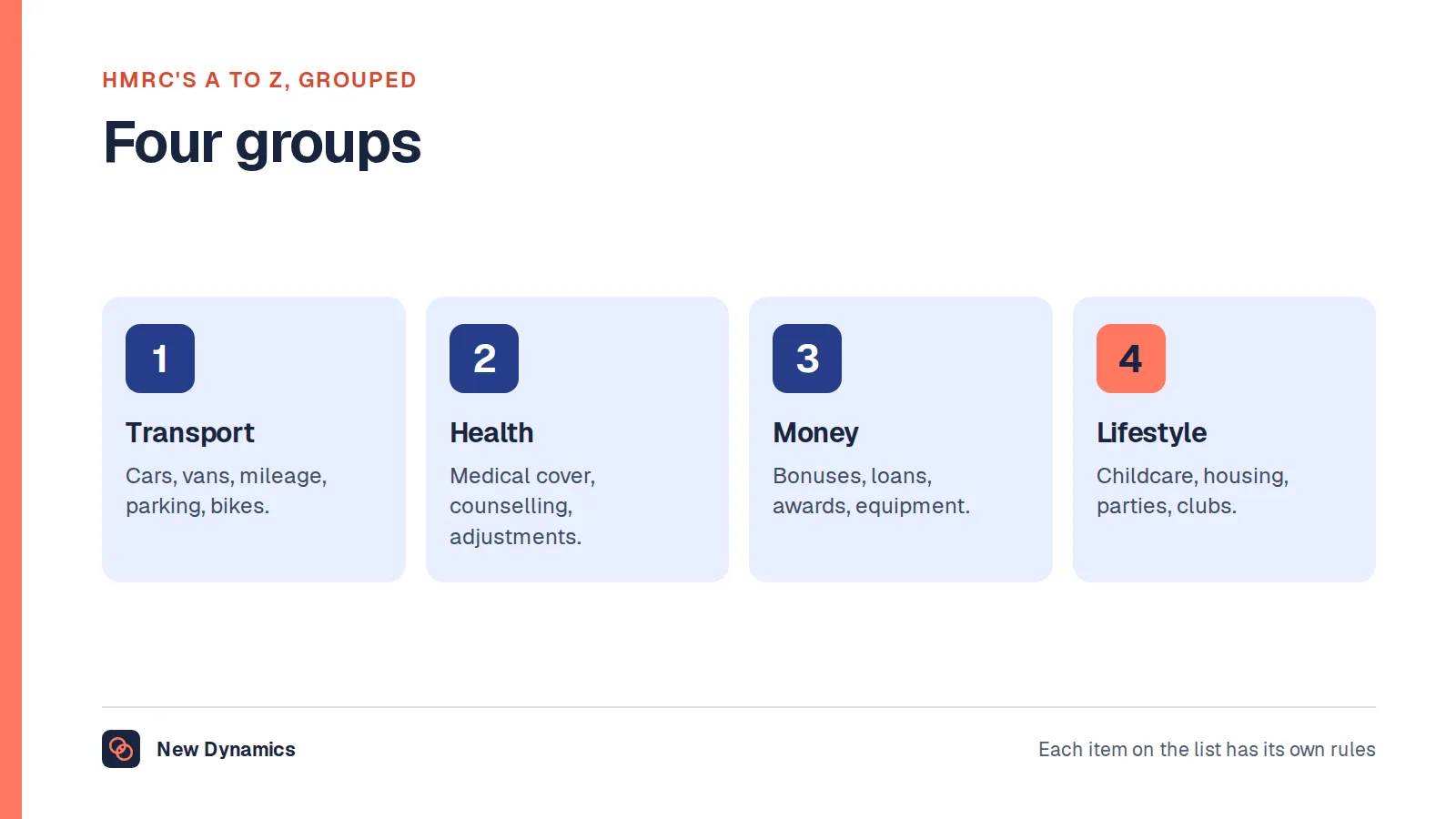
There is no single treatment to learn. There is an item-by-item list, and our post on fringe benefits walks through HMRC's own A to Z of what lands where. For planning purposes, assume tier two until you have checked, and budget for the employer National Insurance as well as the headline cost.
Salary sacrifice, and the floor underneath it
Salary sacrifice is the mechanism most benefits platforms are built around. Gov.uk defines it as "an agreement to reduce an employee's entitlement to cash pay, usually in return for a non-cash benefit". Two conditions decide whether you can run it cleanly.
First, the arrangement "must not reduce an employee's cash earnings below the National Minimum Wage (NMW) rates". That is a hard floor, and it bites hardest on exactly the people a benefits scheme is often sold as helping. Second, "If your employee wants to opt in or out of a salary sacrifice arrangement, you must alter their contract with each change". Every election is a contract variation, not a preference setting.
PAYE Settlement Agreements
For the small and awkward items, there is a purpose-built route. A PAYE Settlement Agreement "allows you to make one annual payment to cover all the tax and National Insurance due on minor, irregular or impracticable expenses or benefits for your employees", as gov.uk describes it.
If your package includes occasional vouchers, team events or one-off awards, ask payroll about a settlement agreement before launch rather than after the first P11D season. Performance awards in particular almost always belong here, which is why a reward and recognition programme needs a tax decision taken before the first award is given.
Tier three: exempt, and narrower than it looks
The main exemption employers rely on for small gifts is the trivial benefits exemption, and it only applies if every condition holds. It must have "cost you £50 or less to provide", it must be "not cash or a cash voucher", it must be "not a reward for their work or performance", and it must be "not in the terms of their contract". Directors of close companies face an additional annual cap.
Read those four together and most schemes fail at the third. A birthday gift qualifies. A gift for hitting target does not. And the moment you write a benefit into contracts, you have made it permanent and taken it out of the exemption at the same time.
Part-time workers: a legal question, not a design one
This is where benefits design most often goes wrong, because it gets treated as an eligibility choice. It is not. Gov.uk states that "Part-time workers are protected from being treated less favourably than equivalent full-time workers just because they're part time", and lists the areas covered, including "pension opportunities and benefits", "holidays", "training and career development" and "selection for promotion and transfer, or for redundancy".

The usual answer is proportion rather than exclusion. The same guidance gives the worked example: "if a full-time worker gets a £1,000 Christmas bonus, and a part-time worker works half the number of hours, they should get £500." Acas puts the comparison in the same terms, describing a comparator as "someone who works full time for the same employer and is on the same type of contract as the part-time employee or worker", and noting that part-time employees and workers are "protected from being treated less favourably than a full-time 'comparator'".
Different treatment is possible where an employer can show objective justification, but that is a reasoned case, not a convenience. Three practical consequences:
- A minimum hours threshold on a benefit needs a justification. "Only for people over 30 hours" is the kind of rule that gets challenged.
- Insured benefits need checking at the policy level, because an insurer's own eligibility terms can create the problem rather than your policy document.
- Pro rata has to be calculable. If nobody can explain how the value scales, it will be applied inconsistently, which is the same risk by another route.
Choosing benefits people actually use
With the tiers settled, the design question becomes narrow and answerable: which benefits are used, by whom, and what do they cost to run?
Three tests are worth applying to every candidate:
- Can everyone reach it? A scheme requiring a work email, a desk, a smartphone or a bank card excludes part of the workforce by accident. For a warehouse, a ward or a shop floor, this is the single biggest determinant of whether a benefit is real.
- Does it remove a cost people already carry? Travel, childcare, eyecare and dental sit above gym subsidies for most workforces, because they replace spending rather than add an option.
- Is it unconditional? A benefit that depends on manager discretion becomes a fairness problem and, if it rewards performance, loses the exemption as well.
The frontline problem
Most benefits platforms assume an office. Enrolment happens by email, elections happen on a laptop and the scheme launches with an all-staff message. On a rota, none of those assumptions holds, and uptake splits cleanly between people with a desk and people without one.
The fixes are unglamorous: a paper or kiosk route to enrol, printed summaries where the rota is posted, line managers briefed with the actual numbers, and a named person who can answer a question in a shift handover. If you only measure the total, you will never see the split.
Why usage is a weak measure
Low usage of a benefit might mean the benefit is poor, or that nobody knows about it, or that the people it was designed for cannot access it. High usage might mean it is well targeted, or that it is simply the cheapest item on a discount portal. Neither number answers the question on its own.
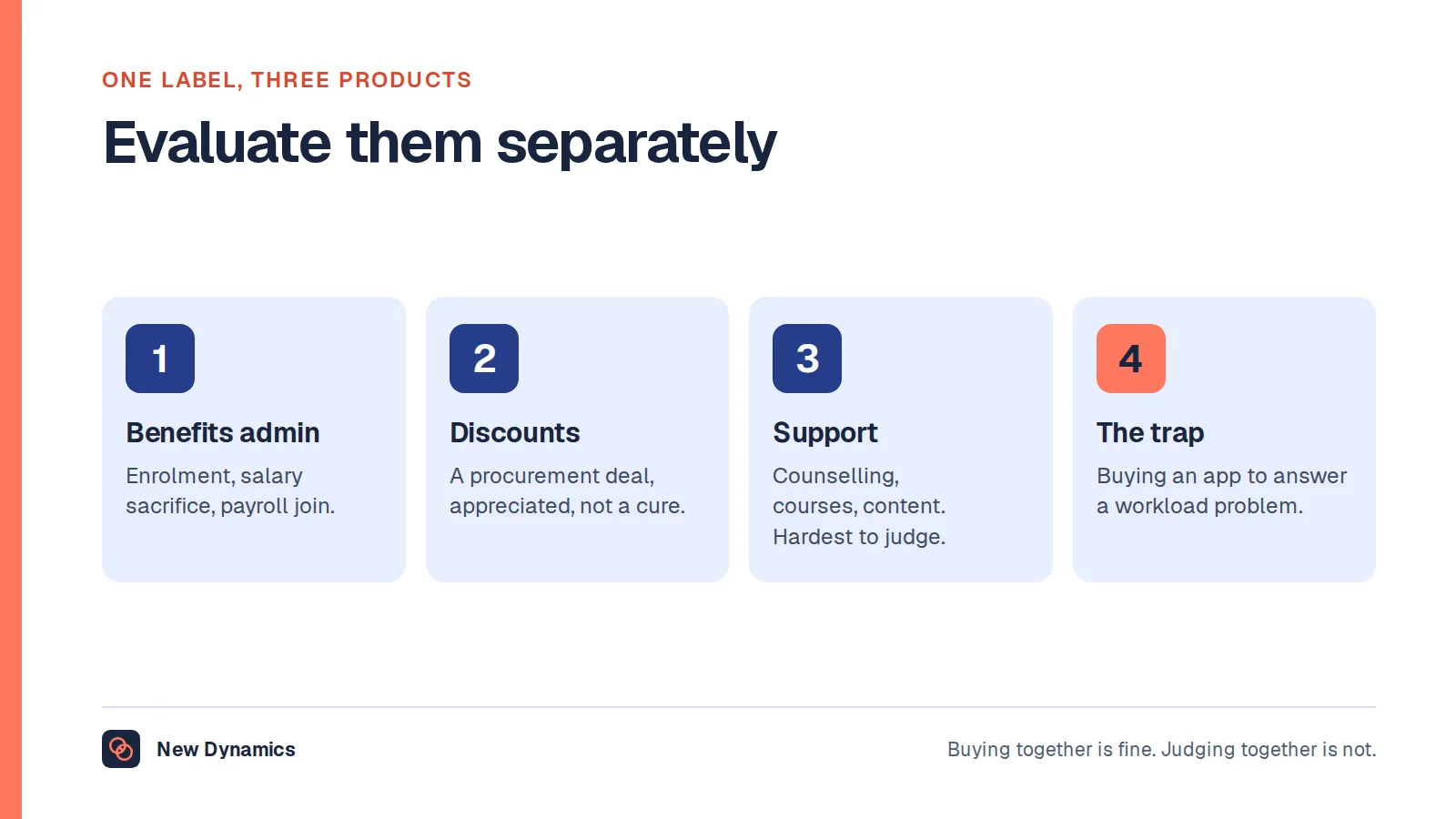
Better signals are uptake by group (and in particular, uptake among lower-paid and shift-based roles compared with salaried office roles), whether people who tried to use it could, and what the benefit was supposed to change. If you are comparing suppliers on dashboards, our note on employee wellbeing and benefits platforms sets out what to ask in a demo.
Benefits administration: the part that touches payroll

An employee benefits administrator, whether that is a job title or part of someone's week, is really a payroll integration role. The job description that matters is less about perks and more about accuracy in a monthly cycle.
Four things have to be right every period:
- Eligibility and effective dates. Who qualifies, from when, and what happens on a change of hours, a transfer or a return from leave.
- Pro rata calculation. Hours-based values worked out the same way for everyone, and auditable later.
- The minimum wage check at the point of election, not at year end, because a sacrifice that breaches the floor is a pay compliance problem created by a benefits decision.
- A tax treatment flag on every item, showing whether it is exempt, payrolled, going on a P11D or covered by a settlement agreement.
Add the contract variation requirement for each salary sacrifice opt-in and opt-out, and the administrative weight becomes clear. This is the cost that never appears in the benefits proposal.
What goes wrong
- Pricing the benefit and not the tax. Employer National Insurance and reporting work are part of the price.
- Launching into a channel half the workforce does not use, then concluding that nobody wanted it.
- Withholding a benefit from part-time staff instead of scaling it, which is the clearest legal exposure in this whole area.
- Writing a benefit into contracts to look generous, which removes both flexibility and any exemption.
- Treating a discount portal as a benefits strategy, when the thing people actually wanted was predictable hours.
- Communicating once at launch, after which awareness decays and the renewal conversation is about logins rather than outcomes.
- Letting the scheme and payroll drift apart, so corrections arrive months later in front of employees.
Frequently asked questions
What are voluntary employee benefits?
Voluntary employee benefits are the parts of a package an employer chooses to offer rather than the parts the law requires, and the term is often used more narrowly for benefits an individual opts into and may part-fund, such as a cycle scheme, dental cover or a discounted health plan. The statutory items, such as a workplace pension, paid holiday and statutory sick pay, are not voluntary at all.
What are examples of voluntary benefits?
Common examples include cycle to work schemes, dental and optical cover, private medical insurance, life assurance, critical illness cover, enhanced sick pay, enhanced parental pay, extra annual leave, eyecare vouchers, retail discount schemes and employee assistance programmes. Each has its own tax treatment, so check the item rather than the category.
What is indirect compensation?
Indirect compensation is everything of value a person receives for working that is not cash salary: employer pension contributions, paid leave, insurances, subsidised services and benefits in kind. It is a useful term for total cost conversations, because the indirect part of a package is frequently a large share of what an employee is actually paid.
Do part-time employees get benefits?
In almost all cases yes. Government guidance states that part-time workers are protected from less favourable treatment than equivalent full-time workers purely because they are part time, and that protection covers pension opportunities and benefits, holidays, training and promotion. Where a benefit has a cash value, the usual approach is to apply it in proportion to hours rather than withhold it.
What does an employee benefits administrator do?
A benefits administrator runs the scheme through the payroll cycle: maintaining eligibility and effective dates, processing elections and changes, calculating hours-based values consistently, checking that no salary sacrifice takes cash pay below the minimum wage, varying contracts where sacrifice is involved, and flagging each item as exempt, payrolled, reportable or covered by a settlement agreement.
Which employee benefits are tax free?
Fewer than most employers assume. The trivial benefits exemption is the main route for small gifts, and all of its conditions have to hold together: a cost of £50 or less, not cash or a cash voucher, not a reward for work or performance, and not written into the contract. Other specific exemptions exist item by item, so verify each one against current HMRC guidance.
Your next steps: sort your current list before you add to it
- Write down every benefit you provide today, including informal ones, and put each in tier one, two or three.
- For each tier two item, confirm the reporting route with payroll: payrolled, P11D or a settlement agreement.
- For each tier three item, test every condition of the exemption rather than the cost alone.
- Check each benefit against your part-time population and decide how the value scales.
- Check that nobody's cash pay can fall below the minimum wage through a sacrifice election.
Our compensation policy guide gives you the structure for writing the decision down so it survives a change of staff. When you want the people data behind it in one place, book a New Dynamics demo and bring your current benefits list. You can also email contact@new-dynamics.com.