TL;DR
- Decide the milestones once and apply them consistently. Marking five, ten, fifteen and twenty years with different weights is easier to run and easier to defend than deciding each case when it arrives.
- The UK exemption for long-service awards only starts at twenty years, and requires a non-cash award worth less than £50 per year of service, with no previous long-service award in the last ten years. Anything you give for five or ten years is a separate conversation with payroll.
- The questions that catch schemes out are about fairness: people who left and came back, part-time service, and what the newer colleague takes from a ceremony in a year when nothing has been said about their work.
Long service recognition tends to arrive as a surprise. Somebody notices an anniversary in a calendar, a manager improvises, and the result is either a card signed by nine people or an unexplained voucher that turns up taxed on a payslip three months later.
This article covers which milestones to mark, what to give, what the UK tax rules actually say, and the fairness questions that decide whether a scheme is liked or resented. It describes the position in the UK and Great Britain and is general information, not tax or legal advice. Ask payroll before promising anything.
Service milestones land better in organisations where appreciation is not rationed to anniversaries. See how New Dynamics recognition helps teams thank each other for specific work all year.
Decide the milestones once

Pick the anniversaries, write them down, and apply them to everybody. Improvising case by case is how one person gets a lunch and another gets a plaque for the same ten years.
A pattern that works for most organisations:
- One year. A short message from the manager, nothing more. It matters most to the person who was not sure they would stay.
- Five years. Acknowledged publicly in whatever forum the team uses, with something modest attached if you choose.
- Ten years. Marked properly: a specific message, a gesture with some thought in it, and the choice of whether they want it public.
- Fifteen years. As ten, and ask what they would value, because by now you can.
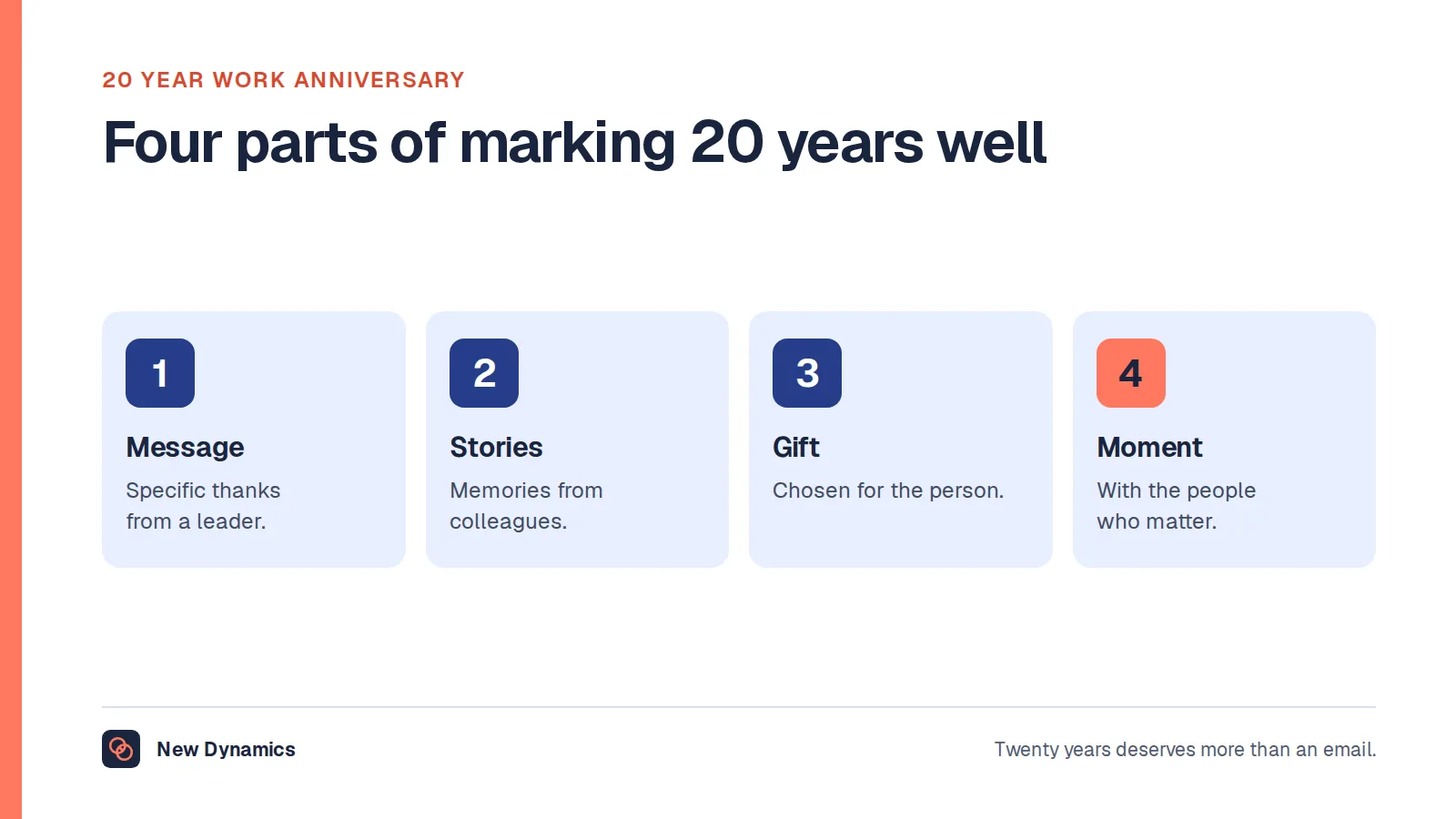
- Twenty years and beyond. The point at which the tax rules change and the gesture can be meaningful. Our post on the 20 year work anniversary covers that milestone in detail, with messages and gift ideas.
Two rules. Nothing automatic should be the only recognition somebody gets that year. And whatever you decide, say it publicly, so that people know what exists rather than comparing notes afterwards.
What people actually value
Ask, where you can. In the absence of an answer, the pattern is consistent: time is valued more than objects, choice more than a fixed gift, and a specific message more than either.
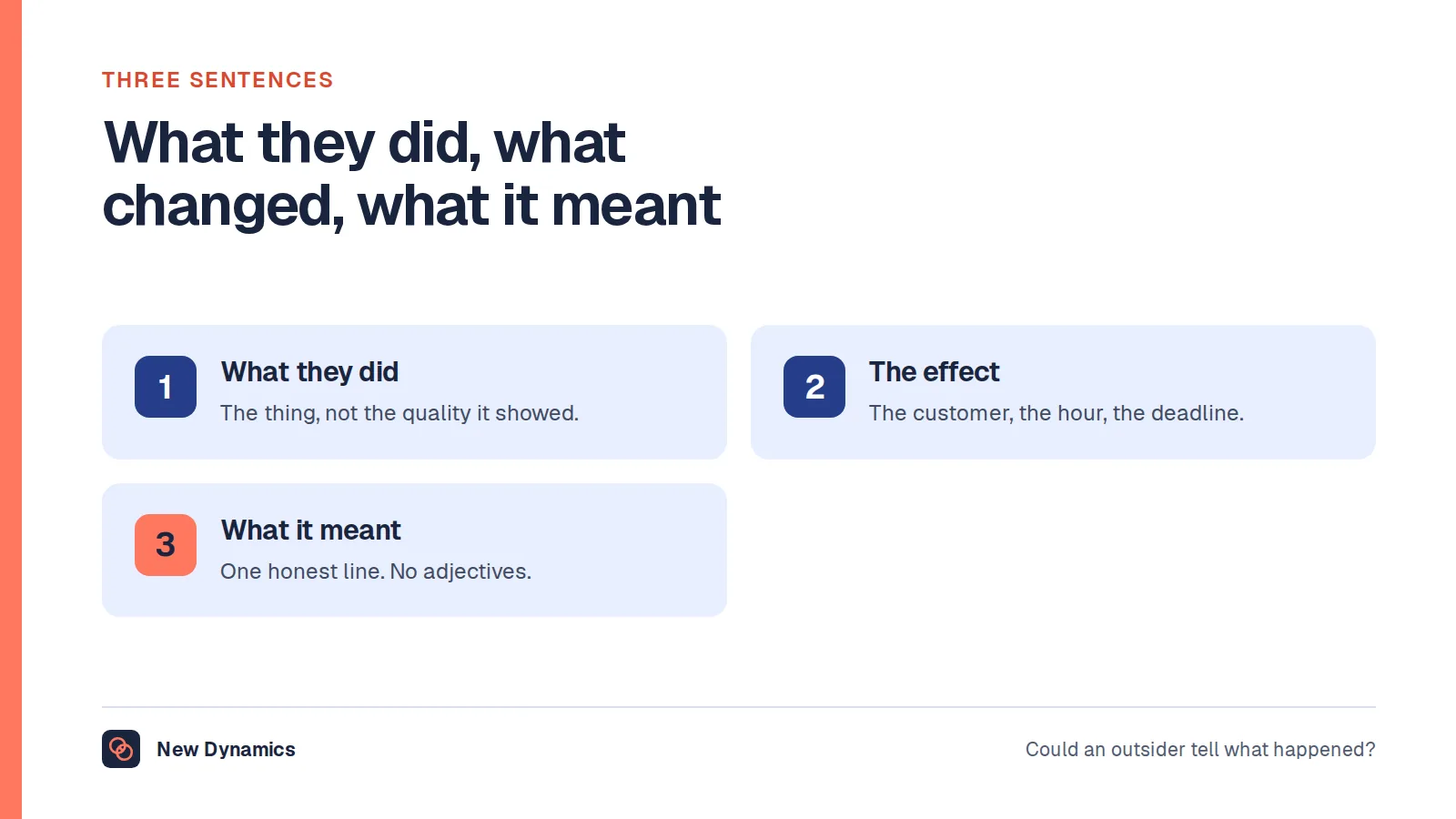
Three things worth more than most catalogues: an extra day of leave, a real choice from a range at the same value, and a short message from somebody senior that names what the person has actually done over those years. The last one costs nothing and is the part people keep.
What tends to land badly: a mug with the company logo, a certificate nobody asked for, a ceremony imposed on somebody who hates attention, and a gift of noticeably lower value than the one a colleague received last year for the same milestone.
The tax rules

This is where schemes get caught, and the detail matters.
GOV.UK says you do not have to report or pay on a non-cash long-service award if "all of the following apply: they've worked for you for at least 20 years; the award is worth less than £50 per year of service; you have not given them a long-service award in the last 10 years". Its own example: a non-cash award worth up to £1,000 for twenty years' service. Awards given as part of a salary sacrifice arrangement have to be reported.
Three consequences people miss:
- The exemption starts at twenty years. Anything given for five, ten or fifteen falls outside it. That does not mean you cannot give it, only that the treatment is different and payroll needs to know.
- Cash and cash vouchers are not covered. GOV.UK is explicit that what you report depends on whether the award is "cash, non-cash or 'readily-convertible assets', for example, shares".
- The separate trivial benefits exemption has its own conditions, including that the benefit is not cash or a cash voucher and is "not a reward for their work or performance". Whether a particular service award fits is a question for payroll rather than for a blog, and the answer depends on how your scheme is written.
The practical rule: decide what you want to give, then ask payroll how it will be treated, then tell the employee what they will actually receive. Nothing damages a scheme faster than a gift that quietly becomes a deduction.
Four fairness questions

Does part-time service count the same? It should. Acas says part-time employees and workers "should not be any worse off than a full-time comparator" for pay and leave, pension opportunities and benefits, training and career development. Ten years is ten years whether they were worked over three days a week or five.
What about people who left and came back? Decide and write it down, before the case arrives. Either continuous service counts, or total service counts, or there is a rule about breaks of more than a certain length. All three are defensible; inventing one for a particular individual is not.
What happens to everybody else that year? A ceremony for one person in a team where nobody else has been thanked for anything is a message about what the organisation values, and not the one intended. Our post on recognition messages covers the everyday version.
Is service being confused with contribution? They are different things, and pretending otherwise is the fastest way to make a scheme cynical. Somebody can have given twenty good years; somebody else can have given twenty years of adequate work. Both are worth marking as service. Neither tells you anything about this year's performance, and the message should not pretend it does.
Write it down
A long-service scheme needs half a page: the milestones, what each one is, who arranges it, how service is calculated, what happens with breaks in service, and what the person can choose. Publish it where people can find it, and tell managers that the message is their part rather than an optional extra.
Then diary it. Most of the embarrassment around service anniversaries comes from somebody noticing late, which a calendar fixes.
Frequently asked questions
Which long service milestones should you recognise?
Pick them once and apply them to everyone: a message at one year, public acknowledgement at five, something considered at ten and fifteen, and a meaningful award at twenty. Consistency matters more than generosity, because people compare, and improvisation is what produces resentment.
Are long service awards taxable in the UK?
A non-cash award is exempt only if the employee has at least twenty years' service, the award is worth less than £50 per year of service, and they have not had a long-service award in the previous ten years. Cash and cash vouchers are treated differently, and awards under salary sacrifice must be reported. Ask payroll. This is general information, not tax advice.
What can you give for five or ten years' service?
Whatever suits your organisation, but the long-service exemption does not apply below twenty years, so the tax treatment is a separate question. Many organisations use an extra day of leave, a choice from a range, or a genuinely personal gesture, and confirm the treatment with payroll before announcing it.
Does part-time service count towards long service?
It should. Acas says part-time employees and workers should not be any worse off than a full-time comparator for benefits and career development, so ten years of part-time service is ten years of service. Write the rule down so it is applied consistently.
How do you handle someone who left and came back?
Decide the rule in advance: continuous service, total service, or a rule about breaks beyond a certain length. Any of those is defensible. What is not defensible is deciding it for the first time when a particular person's anniversary arrives.
Is long service the same as good performance?
No, and conflating them makes a scheme cynical. Service recognises time and loyalty; performance is judged separately, through the review cycle. Mark the service honestly, and let the message say what the person has actually contributed rather than implying a verdict on their work.
Your next step: write the half page
- List the milestones you will mark and what each one is, then publish it.
- Ask payroll how each gift will be treated before anything is announced.
- Write the rules for part-time service and for breaks in service.
- Put every upcoming anniversary in a calendar with a reminder a fortnight ahead, so the manager has time to write something real.
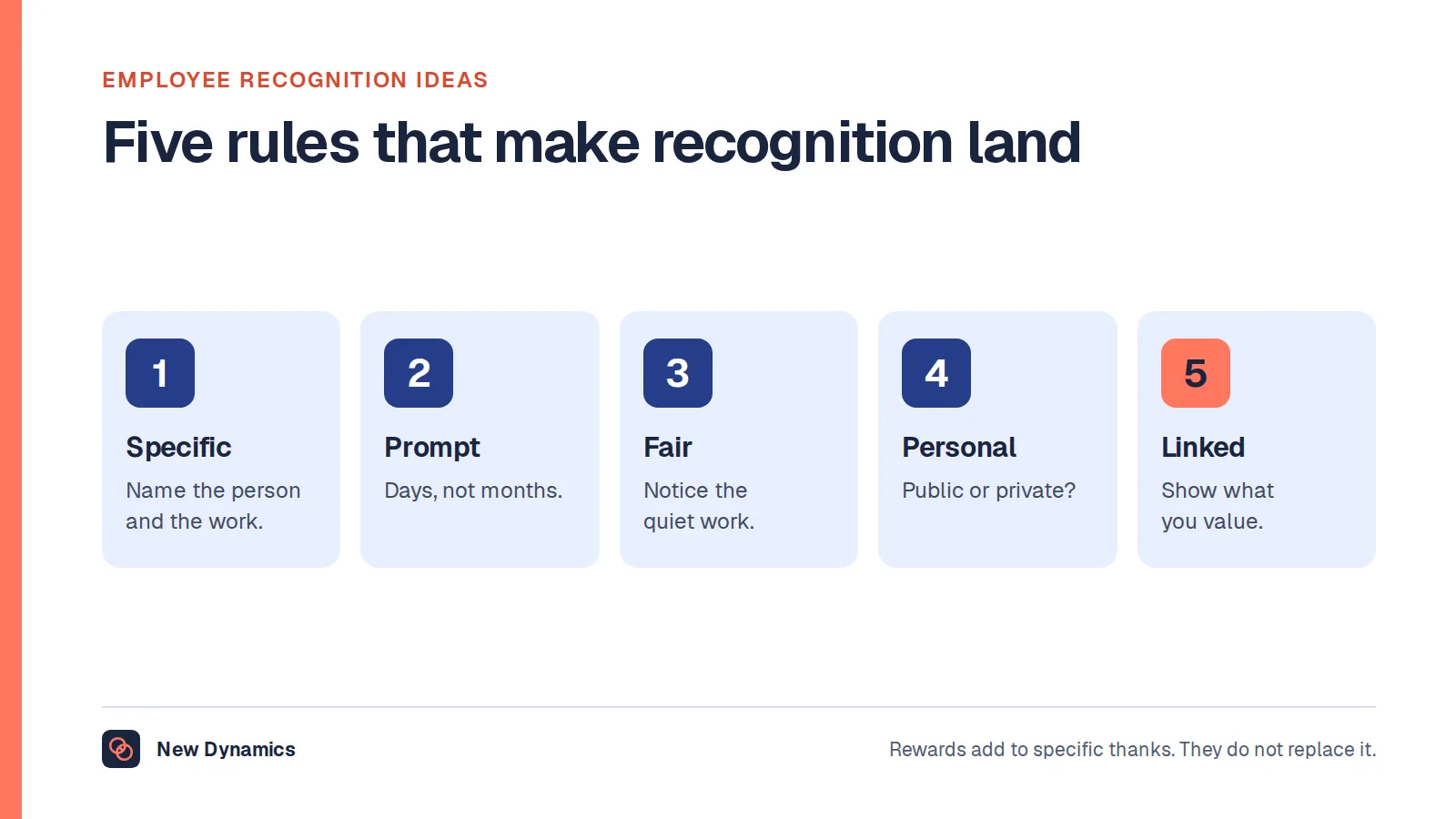
For everyday appreciation that does not wait for an anniversary, read and download our employee recognition guide. The guide is free to read, and the PDF uses our short download form.
Want anniversaries and everyday recognition in the same place? Book a New Dynamics demo and bring your current scheme. You can also email contact@new-dynamics.com.