TL;DR
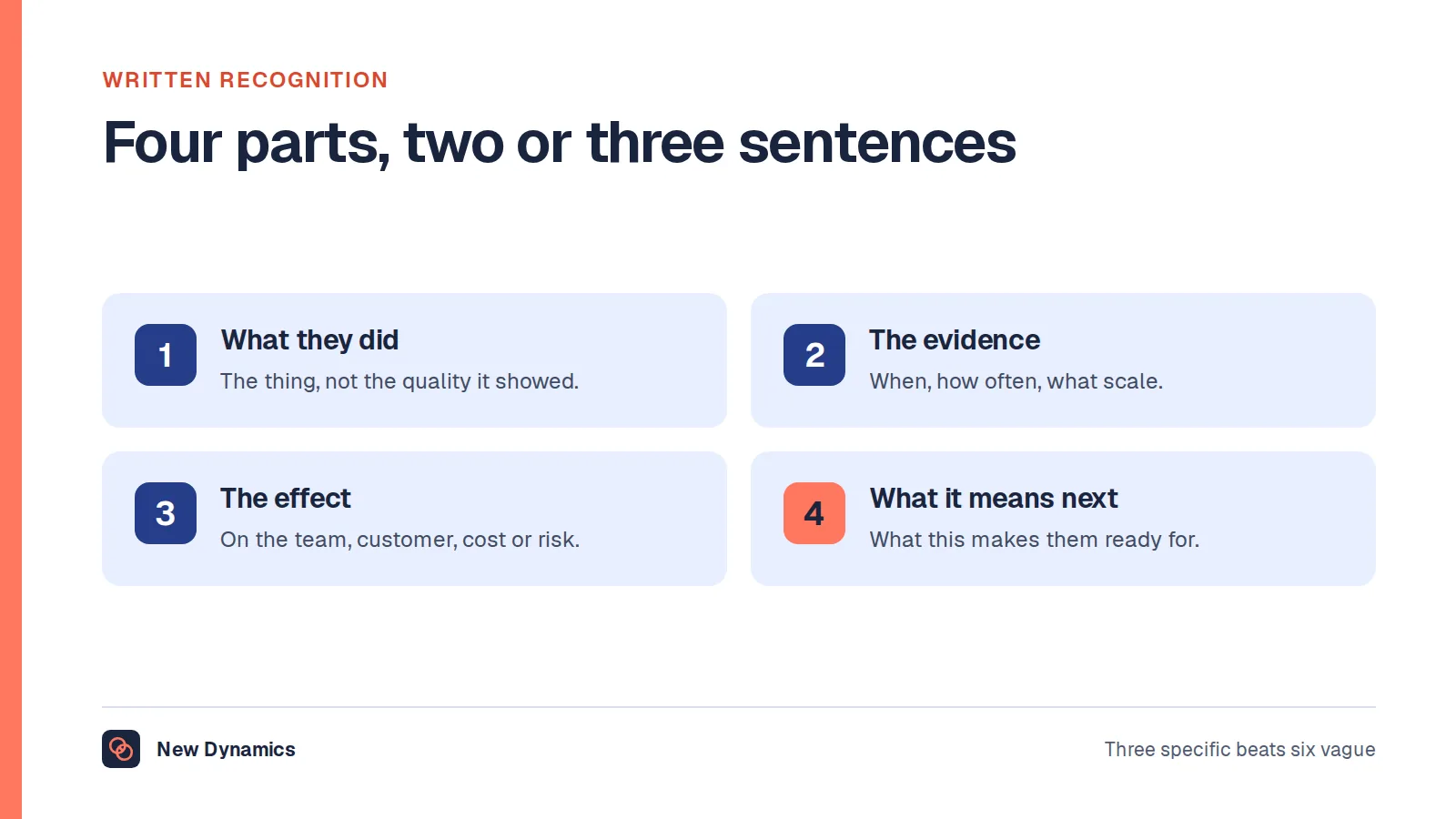
- A message that lands has three parts: what the person actually did, the effect it had, and what it meant to you or the team. Everything else is decoration, and generic praise is read as politeness rather than recognition.
- Thanking a team works the same way, with one addition: name the contributions. A message addressed to everyone, when two people did the work, is noticed by all of them for different reasons.
- Spot recognition needs five decisions before launch, including one most schemes get wrong. GOV.UK's trivial benefits exemption does not apply to anything that is a reward for work or performance, so ask payroll before promising vouchers.
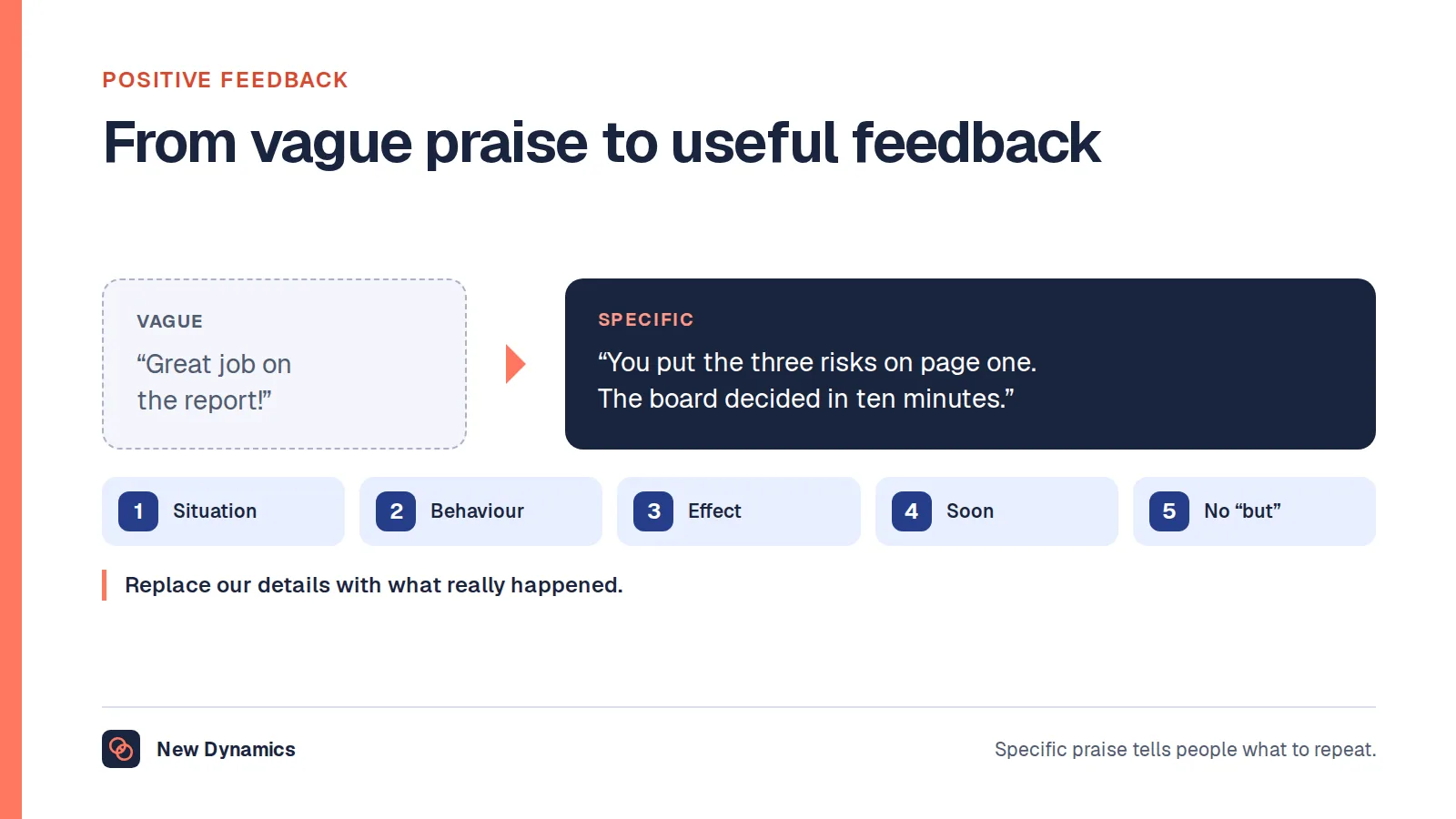
Most recognition messages say nothing. "Great job this week", "thanks for all your hard work", "amazing effort team". The sender feels generous, the receiver files it with the rest, and nothing about the next week changes.
This article covers the structure that makes a message land, wording for individuals and for teams, when to say it publicly, and how to design spot recognition so that it keeps working after the first month. It describes the position in the UK and Great Britain and is general information, not tax or legal advice.
Recognition is easier to make a habit when it is visible rather than buried in private messages. See how New Dynamics recognition helps people thank each other for specific work.
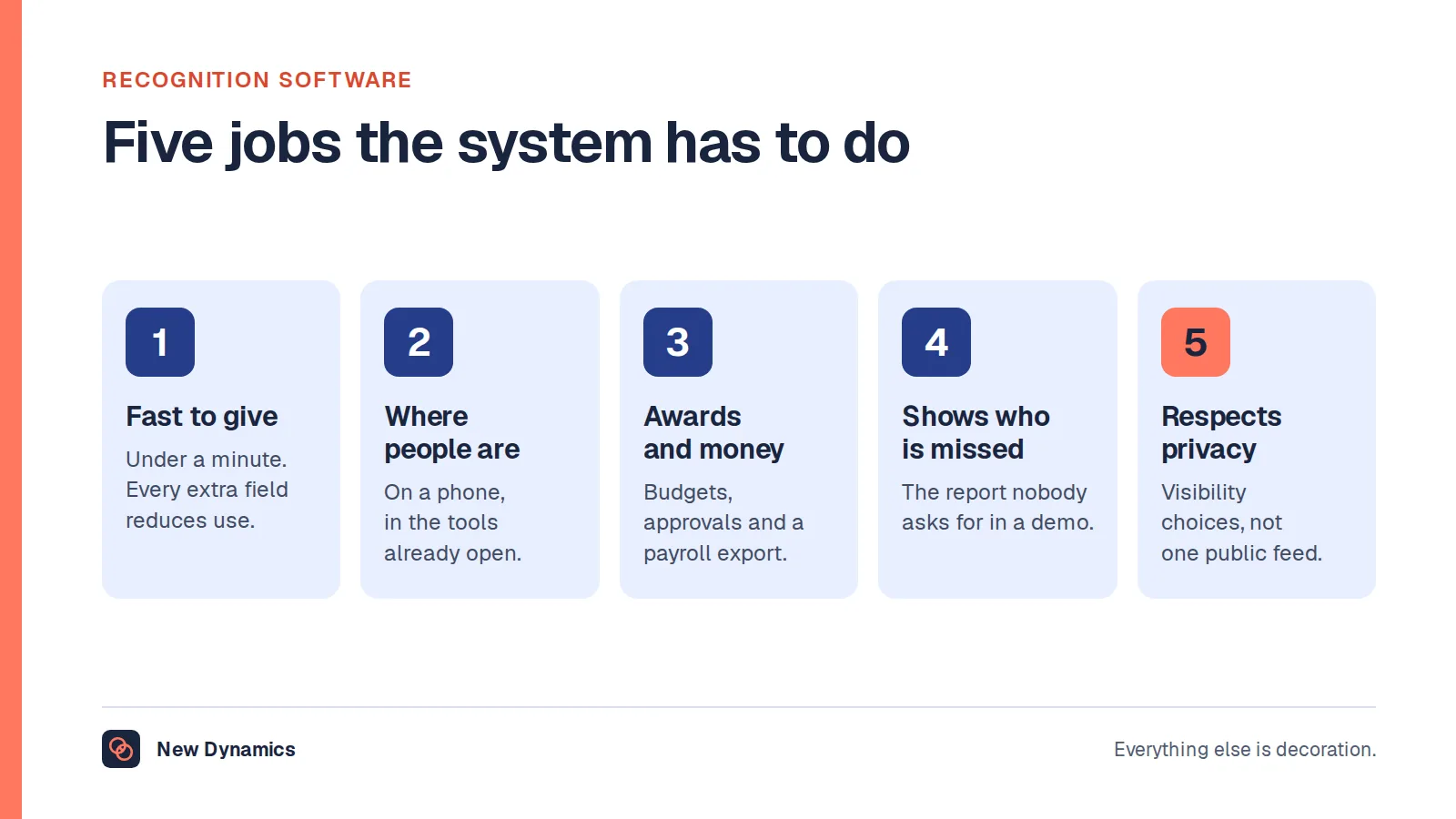
If you are weighing up a system to hold all this, our guide to choosing employee recognition software covers the five jobs it has to do and the tax question that catches most schemes.
Three parts

What they did. The specific thing, not the quality it demonstrated. "Rewrote the escalation script", not "showed great initiative".
The effect. What changed because of it: the customer who stayed, the hour saved, the release that went out on time.
What it meant. One honest line. "That made my week easier" is worth more than a paragraph of adjectives.
Three sentences is plenty. The test is whether somebody who was not involved could tell what happened from your message; if not, you have written a compliment rather than recognition. Our post on recognising good performance applies the same discipline to the written review.
Twelve messages for one person
- "You spotted the duplicate invoice before the run went out. That would have been a credit note and an apology to the customer. Thank you for reading it properly when it would have been easy not to."
- "The handover notes you wrote in March are now what we give every new starter. You did that without being asked and it has saved the team hours."
- "You stayed with that customer through three calls and got to the real problem. They renewed last week, and they mentioned you by name."
- "Thanks for saying the migration plan would not work. You were right, and saying it in that meeting was not easy."
- "You took the second region for five months while we recruited, and you flagged early what would have to drop. That is why nothing did."
- "The way you explained the pricing change to the support team meant we had no escalations that week. That has never happened before."
- "You caught the error in my figures before I sent them to the board. I would much rather hear it from you than read it in the minutes."
- "You trained three people on the reconciliation this quarter and wrote it down so it survives you being on leave. That is the opposite of job security, and it is what good looks like."
- "You rang the customer back on Friday even though it was not your account. They told me it was the first time anyone had."
- "Your question in the planning meeting changed the plan. Nobody else was willing to ask it."
- "You picked up (name)'s work for two weeks without making it a problem, and the deadline held. Thank you."
- "You have been consistently right about the data quality issue for six months, and we should have listened sooner."
Adapt the specifics. The pattern is what matters.
Eight messages to a team

Team messages fail in a particular way: a general thank-you addressed to everybody, when three people did the work and two did not. Everyone notices, for different reasons.
Two rules. Name the contributions where you know them. And if you genuinely cannot tell who did what, say that instead of pretending: "I do not know the details of who did what here, so tell me and I will say it properly."
- "The release went out on time with no rollbacks. (name) rebuilt the test data, (name) held the line on the scope, and everybody did the boring checks. Thank you."
- "Three weeks of double shifts to cover the vacancy, and the service level never dropped. I know what that cost."
- "We had the hardest quarter since I joined and nobody dropped a customer. That was not luck."
- "Thank you for the way you handled the outage on Tuesday: you kept talking to each other, and you kept the customers informed. Both are harder than they sound."
- "The new starters say this is the easiest team they have joined. That is a thing the whole team does, every week, and I notice it."
- "You delivered this with two people fewer than we planned. I have told the leadership team exactly that."
- "Everybody in this room took something off somebody else's plate last month. The handover notes prove it."
- "I asked for a plan by Friday and got one on Wednesday, with the risks already named. That is what good looks like."
Public or private
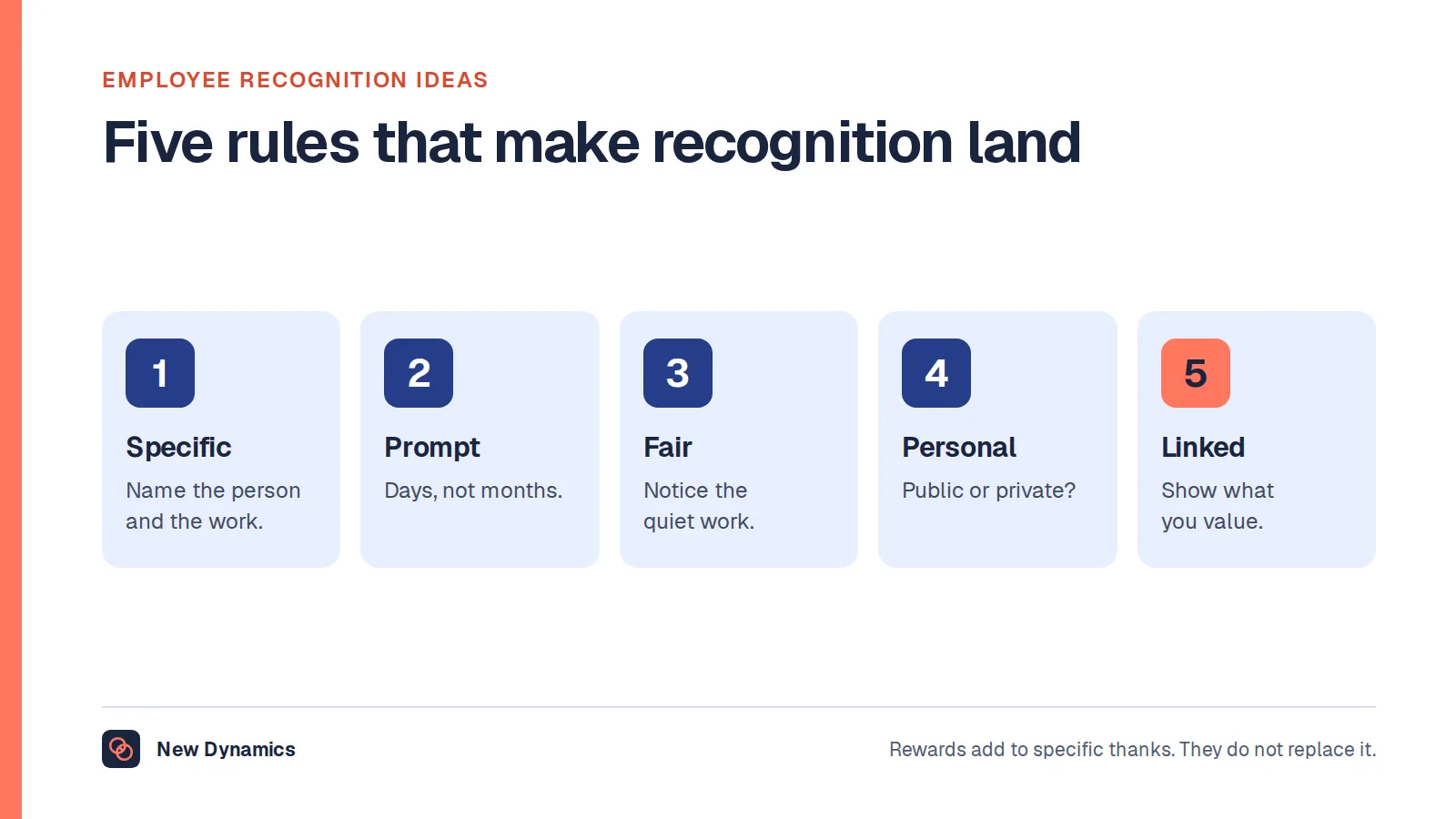
Public works for things the team should copy, for people who are comfortable with it, and for correcting invisibility: the quiet person whose work nobody sees. Private works for effort nobody else can verify, for anything that might embarrass a colleague by comparison, and for people who dislike attention.
When in doubt, ask. "Do you mind if I mention this in the team meeting?" costs nothing and is itself a form of respect.
HSE lists Support, "the encouragement, sponsorship and resources provided by the organisation, line management and colleagues", among the six areas of work design that affect health and productivity. Recognition is one of the cheapest ways to deliver it, and one of the easiest to distribute unevenly.
Spot recognition: five decisions

Spot recognition means thanking somebody at the moment the work happens, usually with something small attached. It works because of the timing, not the value. Five decisions before launch.
- Who can give it. Managers only is simpler and reaches fewer people. Peer-to-peer reaches more and needs light moderation. Both work; drifting between them does not.
- How often, and what it is for. Name the behaviour: going beyond the role, helping another team, catching something before it broke. Without that, it becomes a popularity contest with a budget.
- What it is. A message alone is legitimate recognition, which is worth saying because most schemes assume money. If something is attached, decide what, and keep it consistent.
- The tax position. GOV.UK says a benefit is exempt as a trivial benefit only if "it cost you £50 or less to provide", it is "not cash or a cash voucher", it is "not a reward for their work or performance" and it is "not in the terms of their contract". The third condition is the one that catches spot awards: a gift given precisely because somebody performed well does not meet the definition. Talk to payroll before you promise anything, and see our post on employee recognition ideas for the wider tax picture.
- How you will check fairness. Which brings us to the part most schemes skip.
Check who it reaches
Run the list once a quarter. Who received recognition, from whom, and for what. The usual pattern is that it concentrates on visible roles, confident people and whoever sits near the person giving it.
Acas notes that less favourable treatment "might include: excluding someone from opportunities or benefits" and that it "can still be discrimination even if the less favourable treatment was not intended". Recognition is a benefit, and an uneven distribution that nobody has examined is worth understanding before somebody else points it out.
What not to send
Avoid: "thanks for everything you do", which names nothing; praise for being always available, which rewards the wrong thing; recognition that arrives weeks later as an afterthought; the same message copied to six people; and anything that reads as a substitute for a pay conversation that is overdue.
Frequently asked questions
What should an employee recognition message say?
Three things: what the person actually did, the effect it had, and what it meant to you or the team. Three sentences is enough. If somebody uninvolved could not tell what happened from your message, it is a compliment rather than recognition.
How do you write a thank you message to a team?
The same way, with the contributions named where you know them. A general message addressed to everyone, when a few people did the work, is noticed by all of them. If you genuinely do not know who did what, say so and ask.
What is spot recognition?
Thanking someone at the moment the work happens, usually with something small attached. The timing is what makes it work. Decide who can give it, what behaviour it is for, what if anything comes with it, how it is taxed, and how you will check it reaches everyone.
Are spot awards taxable in the UK?
Often, yes. GOV.UK's trivial benefits exemption applies only where the benefit costs £50 or less, is not cash or a cash voucher, is not in the contract and is not a reward for work or performance. A gift given because someone performed well fails that last test. Ask payroll before promising anything. This is general information, not tax advice.
Should recognition be public or private?
Public for work others should copy and for people comfortable with attention, private for effort others cannot verify or where a comparison might embarrass somebody. Asking first costs nothing and is itself a form of respect.
How often should you recognise people?
Often enough that it is normal and specific enough that it is believed. A weekly habit of noticing one thing beats a quarterly ceremony. The thing to watch is not frequency but distribution: check each quarter who is actually receiving it.
Your next step: send three this week
- Pick three people and write the three-part message for each: what they did, the effect, what it meant.
- Ask one of them whether they would mind you saying it publicly.
- If you run a spot scheme, check the last quarter's list for who it reached.
- Before promising any gift or voucher, ask payroll how they want it handled.
For a complete approach to making appreciation specific, timely and fair, read and download our employee recognition guide. The guide is free to read, and the PDF uses our short download form.
Want recognition visible to the team instead of buried in a private message? Book a New Dynamics demo and bring your current scheme. You can also email contact@new-dynamics.com.